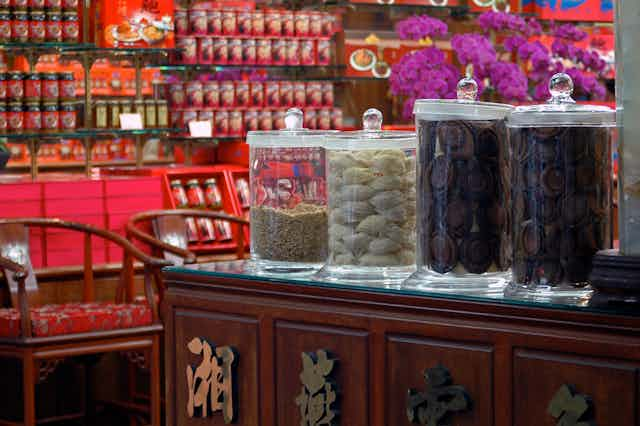
Most of traditional healing practices are based on intuitive principles of diseases involving the imbalance of elemental qualities.
For the ancient Greeks and Romans, whose systems of traditional healing were accepted in Europe until the scientific revolution, these elements were the four bodily fluids or humours. Each corresponded to the four fundamental elements of the world – earth, water, air and fire.
In traditional Chinese medicine, the elements are wood, fire, earth, metal and water; for the ancient Unani medicine in India, the four humors (akhlaat) are air, earth, fire and water; for Indian Ayurveda medicine, health is the balance of three elemental energies in the universe: air, water and fire.
None of the ideas have any scientific basis.
With the advent of modern medicine, traditional European practices were relegated to a handful of surviving herbal remedies. Similarly in China, despite recent attempts to retain traditional healing practices, modern medicine is supplanting traditional medicine.
Paradoxically, in Australia and other developed countries there’s increased interest in complementary and alternative medicines, reverting to irrational approaches to health practice, despite people from such countries benefiting most from medicine’s advances.

The resurgence of interest in traditional Chinese healing in Australia, along with other alternative medicines, is due to rising discontent with conventional medicine; a preference for natural (or gentler) alternatives to pharmaceutical drugs or surgery; desire for greater control over personal health care and the relatively low success rate of conventional medicine in treating conditions, such as chronic pain, for some individuals.
This has led to the recent contentious decision to permit traditional Chinese medicine practitioners to be registered with the new national Chinese Medicine Board of Australia from July this year. The board will be a new member of the Australian Health Practitioner Regulation Agency.
I have argued against the move, along with my colleague Associate Professor Hubertus Jersmann, in articles published today in MJA Insight and the Sydney Morning Herald.
The decision follows Victoria’s move (in 2000) to register traditional Chinese medicine practitioners, which has had a positive impact on tightening standards and dealing with complaints.
Among traditional Chinese medicine practitioners to be registered are those who provide Chinese medical diagnosis, dispense Chinese herbs and perform acupuncture. All three components of this practice have serious flaws, being based on non-existent energies (Yin and Yang), non-existent bodily structures (meridiens) and on principles of disease diagnosis based on the imbalance of five non-existent elements. It is therefore doubtful whether such practitioners are able to make correct and safe diagnoses.
Proponents of traditional medical practices often point out that extracts from animals and plants have been the source of effective remedies in modern medicine. And while pharmacology and medicinal chemistry have enabled this revolution since mid-1800s, only a handful of the extracts used in traditional healing have been proven to contain active principles beneficial for fighting disease. These include about 120 chemical substances out of the thousands of herbal remedies used in traditional medicines.

Take, for instance, qing hao su, a herb used in China for treating fever for over 2,000 years. About 40 years ago, scientific research found that it had specific anti-malarial activity and its active compound, artemesin, was isolated.
In fact, it’s fortunate that most herbal remedies have little acute toxicity. This is due to empirical experience, which over time has selected out those proven to be overtly toxic. But the more subtle, chronic toxicity of herbal remedies remains a serious concern.
Only 6% of plants species have been screened chemically and pharmacologically to identify their active principles. This process, started by modern medicine just over 150 years ago, is continuing with investigations of potential benefits of new therapies often based on a long history of empirical evidence.
This is why research on active chemical principles in herbal remedies showing some potential beneficial effect is fully supported by the Friends of Science in Medicine (FSM), of which I am a founding member.
FSM represents a growing number of medical researchers, clinicians and members of the public concerned by the “current trend which sees government-funded tertiary institutions offering courses in the health care sciences that are not underpinned by sound scientific evidence". We are worried that this gives unwarranted credibility given to their practitioners and practices, including traditional Chinese medicine.
Even though it falls within traditional Chinese medicine, acupuncture requires separate consideration because, despite being based on a flawed theory of non-existent “meridiens”, it has shown promising effectiveness in some ailments.

But it’s important to remember that despite its popularity, acupuncture has only proven beneficial in alleviating some symptoms of pain and nausea. And the mechanisms by which it appears to work are similar to the physiological processes in the nervous system underlying the placebo effects on pain. Ultimately, research on acupuncture has enabled it to become incorporated in medicine in the few conditions for which it has proven to be effective.
My view, shared by many, is that there’s only one medicine and adjectives such as traditional and “Western” are irrelevant. Rather, medicine is about efficacy and safety, proven through scientific research.
Living in a modern society requires that in matters of health, we unapologetically only accept practices that have undergone the scrutiny of science. And once that criteria is fulfilled, we can accept it as effective medical treatment and teach it in our universities.
Sadly, this is not the case for most traditional Chinese medical practices and practitioners.
Jon Wardle
NHMRC Research Scholar, School of Population Health at University of Queensland
So you acknowledge registration has had a positive impact on standards and complaints, yet you still argue against registration? Sounds more like professional politics than good public health.
Marcello Costa
Professor of Neurophysiology, Department of Physiology at Flinders University
Jon,
always ready to see the small issues but not the elephant in the room.
Our opposition remains because the small advantages of registration are outweighed by the disadvantages as pointed also in the article today in the MJA InSight. Once registered these health operators acquire a totally unwarranted credibility par with proper doctors of Medicine. There is no professional politics in pointing to this gross and gigantic discrepancy.
Jon Wardle
NHMRC Research Scholar, School of Population Health at University of Queensland
Marcello, I think it is you missing the forest for the trees. Despite your personal views high utilisation would suggest that for most Australians the issue of legitimacy is moot. The public already see these practitioners as legitimate, and in a common law nation like Australia they already enjoy the freedom of practice that you express concern about. What you are suggesting only allows them to enjoy this legitimacy without any accountability. Hardly a good outcome for patients.
Joel Mayes
Bicycle Mechanic
A reduction in complaints does not equate to efficacy in treatments which should be the main measure used to determine a treatments suitability.
But given you have published a text book which suggests homoeopathy for the treatment of Asthma[1], dermatitis[2], oestrogen withdrawal in breast cancer patients[3], opportunistic infections in HIV+ patients[4] (what the f*ck!), URTIs in infants[5], type 2 diabites[6] (again what the f*ck!) and referenced this study
http://www.thelancet.com/journals/lancet/article/PIIS0140-6736%2805%2967177-2/abstract#aff4
as with a statement that is shows 'an overall trend towards an effect for homoeopathy'[7] which is the opposite of the studies findings I don't expect you to accept that.
[1] Clinical Naturopathy page 143
[2] Clinical Naturopathy page 486
[3] Clinical Naturopathy page 414
[4] Clinical Naturopathy page 728
[5] Clinical Naturopathy page 120
[6] Clinical Naturopathy page 312
[6] Clinical Naturopathy page 558
Jon Wardle
NHMRC Research Scholar, School of Population Health at University of Queensland
Three quick points: 1) COAG's AHMAC criteria for regulation of health professions quite clearly state that regulation is based on potential patient risk, not 'suitability', efficacy or 'recognition' of a profession. Registration is not a 'prize' or 'privilege' 2) Your other points seem ad hominem and aren't really relevant here, but the study you link was not actually referenced at all - go back and check 3) Of the 4000 references in the book, yes, some were of homoeopathy if studies existed, though it was suggested they be used only in an adjuvant capacity. Never was there any suggestion of not using conventional medications
Joel Mayes
Bicycle Mechanic
Regarding the trial You are correct and I apologise the study from your book is this one.
http://www.ncbi.nlm.nih.gov/pubmed/9310601
The conclusion still states that there is no evidence for homoeopathy being efficacious any single clinical condition. which is at odds with the way homoeopathy is discussed in your book.
Jon writes
Read more"3) Of the 4000 references in the book, yes, some were of homoeopathy if studies existed, though it was suggested they be used only in an adjuvant capacity…
Marcello Costa
Professor of Neurophysiology, Department of Physiology at Flinders University
Now we begin to understand the absurdity of the defense of registering practitioners of alternative therapies.
It appears that it is acknowledged by the regulatory bodies that registration has a prime aim at ‘regulation is based on potential patient risk, not 'suitability', efficacy or 'recognition' of a profession’.
In other words it is accepted that first of all these ‘professions’ represent a danger for public health. The public may sympathize with the attempts to minimize harm that comes…
Read moreTim Scanlon
Author and Scientist
That is not a sound nor logical argument at all.
A lot of people like Michael Bay movies, doesn't make them any good. Roughly 30% of Aussies smoke, doesn't make it healthy.
The reality is that until something has been tested and found to be safe AND effective, then it has no place in society.
Sue Ieraci
Public hospital clinician
It is a logical fallacy to assume that anything that is popular must be for the common good and should be encouraged. As well as Tim's example of cigarette smoking, I would add gambling, drink-driving and dangerous speeding. A civil society has the responsibility to protect its citizens against some of their poor choices when it leads to an impact on the rest of society - whether financial or in health outcomes.
Ian Musgrave
Senior lecturer in Pharmacology at University of Adelaide
Why would you use homoeopathy as an adjuvant in asthma therapy when there is no good evidence it does anything in asthma?
http://summaries.cochrane.org/CD000353/homeopathy-for-chronic-asthma
Why would you use homoeopathy as an adjuvant for opportunistic infections when there is no good evidence it does anything?
(no evidence of any sort found)
jerry sprom
logged in via email @gmail.com
Professor Costa,
You say "My view, shared by many, is that there’s only one medicine and adjectives such as traditional and “Western” are irrelevant. Rather, medicine is about efficacy and safety, proven through scientific research"
Perhaps you could comment on this statement?
Read more"To support this, the Government’s 2009-10 Budget provided funds under the Medicare Benefits Schedule — a quality framework for reviewing services listed on the Medicare Benefits Schedule (MBS). The MBS contains 5,703…
Ian Musgrave
Senior lecturer in Pharmacology at University of Adelaide
The unpublished abstract that you reference doesn't actually say what you think it says.
The MBS covers everything from consultations to diagnostic procedures to drug and non-drug therapies, but maybe the abstracts authors were thinking of acupuncture (an MBS listed item) when they wrote the abstract.
MBS coverage:
http://www.health.gov.au/internet/mbsonline/publishing.nsf/Content/a-z
note acupuncture, which could do with some reassessment.
In this particular situation (an on going…
Read moreMarcello Costa
Professor of Neurophysiology, Department of Physiology at Flinders University
Jerry,
the principle of testing procedures in Medicine is well accepted and no one will disagree with this principle. The process to do so is the realm of all the established regulatory bodies for Medicine. They may differ from country to country but there is full agreement with the principles behind the processes.
These are fundamentally that it is possible to assess the scientific validity of explanations of any medical procedure and to test experimentally the evidence for efficacy and…
Read moreJustin Case
Gardener
Your argument is even more fallacious and lacking in logic Tim. Unless of course your so-called logic is simply that everyone else must simply do whatever you happen to say, because like hey you know everything about about everything and everyone else are just ignorant fools who understand nothing, particularly their own experience.
Are we living in Scientism based fascist state now?
So the central committee for the advancement of global scientism will now be providing prescriptive rules…
Read moreSue Ieraci
Public hospital clinician
Where are the studies of homeopathy that compare it AGAINST conventional therapy, rather than as an "adjunct"? Don't its practitioners have enough faith in its effectiveness to test it, or is there a lack of volunteers?
Bayani Bacalla Mills
logged in via Facebook
Not a logical argument? How so?
Tim exposed the flaw in Jon's argument as the logical fallacy of "The Appeal to Popularity"; you've not attempted to explain how Tim's argument was not logical, merely accused him of telling people do to what he says - something which he hasn't done at all.
Tim reasonably pointed out that we should be testing claims about a treatment before accepting them as being true.
It should also be addressed that people are inherently poor at understanding personal experience…
Read moreMarcus
logged in via Twitter
and that's where people start shouting nanny state
Sue Ieraci
Public hospital clinician
...and others would call it a civil society.
Sue Ieraci
Public hospital clinician
Jon - I am fascinated to see that the Naturopathy text that you have co-edited is organised in body systems and diagnoses in accordance with the medical model, and uses many medical references. Does naturopathy have its own model of anatomy, physiology, pathology and pharmacology, or does it follow the standard clinical sciences?
Kelly O'neill
logged in via Facebook
Wrong. You confuse two forms of legitimacy
Kelly O'neill
logged in via Facebook
Wrong again. COAG is a political forum, not a medical one.
Peter Ormonde
Peter Ormonde is a Friend of The Conversation.
Farmer
Excellent piece.
I would not be in any great rush to consign a few thousand years of herbal medicine to the wastebin of history... some of this stuff works. But the mystical explanations are mere superstition. The important thing is to evaluate and examine these claims scientifically rather than blindly accepting the nonsense explanations on offer.
I am a regular consumer of acupuncture. It works - at least for me. I have also seen it work on greyhounds and horses. I have seen serious operations…
Read moreMarcello Costa
Professor of Neurophysiology, Department of Physiology at Flinders University
Dear Peter,
pleased to hear that acupunture works for you. I assume is for some pain? As I reported, it may ameliorate some symptoms of pain, but of course not the causes.
The reports of entire very serious operations performed solely under acupunture analgesia when investigated appear to have been actually with parallel medications.
Demonstrable values should be precisely that, demonstrable. If so most welcome. As agreed research is necessary and welcome but must come before using potentially dangerous practices or replacing those already validated.
Stiofán Mac Suibhne
Contrarian / Epistemologist
There is an inter-disciplinary 'medical' form of acupuncture that does not draw on traditional knowledge for its explanations. There is evidence from trials and basic research to support acupuncture in wider range of conditions than pain. There are active research groups looking at underlying mechanism, particularly strong in Skandinavia. The British Medical Acupuncture Society is a useful source of information and they also produce a peer reviewed journal, Acupuncture in Medicine published by the…
Read moreMarcus
logged in via Twitter
most of western medicine is not concerned with treating the 'causes'. many of the causes are lifestyle related. and most alternative medicines seek to treat these, the same cannot be said for many practitioners of western medicine, but that is slowly changing.
Ian Musgrave
Senior lecturer in Pharmacology at University of Adelaide
That is simply not true, preventative medicine is a major part of so called "western" medicine. Everything from clean water supplies, to vaccination campaigns, to "life-be-in-it" to those "eat more vegetables" adds on TV are a direct part of "western" medicine.
"Lifestyle" causes are vastly over rated in disease causation. For example, high bllod pressure is often thought by many lay people to be a lifestyle disease, yet it is highly resistant to lifestyle interventions (I spent mthe eraly part of my career styding the role of stress in high blood pressure, and my coleagues worked on high salt). Exercise and good diet with fresh fruit and vegetables (not multivitamines) will reduce you chances of deveopling high blood pressure, and can reduce the need for drugs whif you develop it, Insulin dependednt diabetes is
Marcus
logged in via Twitter
True, I was referring more to GPs than policy makers, most would prefer to dispense drugs that treat symptoms rather than work with patients to help change their lifestyle and treat causes.
Ian Musgrave
Senior lecturer in Pharmacology at University of Adelaide
(stupid buttons) that should read ...and can reduce the need for drugs whif you develop it, but high blood pressure is not just people being fat and lazy,
Doctors do advise on diet and exercise (and you can't have missed the decades of exercise and healthy eating adds on TV and news papers, Heart Foundation fun runs, and the changes to school canteens all designed to encourage better lifestyles. These weren't bought about by naturopaths.
What doctors won't do is advise taking useless vitamin and mineral supplements.
Ian Musgrave
Senior lecturer in Pharmacology at University of Adelaide
GP's (as noted in the second part of my post due to stupid buttons) play an important role as well, and your characterisation of them is incorrect.
If you go to a GP with high blood pressure, most will give you guidance on diet and life style. If you go to a GP with a kid in the middle of an acute asthma attack, they are going to work on stabilizing the asthma, not giving out pointless vitamin and mineral supplements.
Marcus
logged in via Twitter
I guess some people just get better GPs than others.
Sue Ieraci
Public hospital clinician
I support Ian's view - the myth that medicine only "treats the symptoms" while alternative therapists "treat the whole person" is simply not true. In many ways, quite the opposite.
Who is at the forefront of public health campaigns about smoking, exercise, healthy eating, junk food advertising, eating a balanced diet, SIDS prevention, and so many others? The medical profession - including the AMA. And none of these campaings are about drugs - they are all about lifestyle. I have not seen similar campaigns launched by acupuncturists, CTM therapists or homeopaths. In fact, homeopathy is directed ONLY at treating symptoms (albeit with an inert substance).
I would be very surprised to find any GP who approaches an obese patient with high blood pressure or diabetes who does not promote weight loss as a first strategy. The real benefit of our medical system is that it has approaches for lifestyle and prevention AS WELL as acute crises.
Joel Mayes
Bicycle Mechanic
I saw a GP 5 times last year, and only once was I been given a prescription drug, Panadeine Forte for pain management with a kidney stone.
I even had a notifiable disease (Campylobacteriosis) and the GP's assessment of my physical condition (mid 30s, very fit & otherwise in excellent health) prompted a treatment regime of advising me on how to stay hydrated despite (amazing, earth shattering, hourly) diarrhoea, to avoid diary and meat for the duration, and advice on how to minimise the chances of infecting my partner.
This is n=1 ancedata of course but it is my experience that most GPs do not prescribe unneeded drugs or treatments, and I imagine that there would be penalties if they did (perhaps Ian or Sue know more about this?)
Marcus
logged in via Twitter
And you know what? A naturopath would have given very similar advice.
Grendelus Malleolus
Senior Nerd
They might however also add advice to take a herbal anti-parasitic formula at the time of a waxing moon along with a probiotic, a homeopathic complex spray and garlic and oregano.
http://www.naturopath.co.nz/Articles/Digestive+Problems/Campylobacter+is+a+Common+Cause+of+Food+Poisoning.html
Marcus
logged in via Twitter
Garlic does have proven anti-bacterial properties.
Sue Ieraci
Public hospital clinician
Marcus - garlic doesn have some antiseptic properties in some situations, but anything oral is fairly useless in treating an illness with vomiting and diarrhoea - it won;t be absorbed.
More to Grendel's point - how often will you see a naturopath or homeopath and not be presecribed some sort of "remedy"? It is much more likely that your GP will tell you to treat your cold with salt-water gargles and lots of fluids rather than sell you some sort of "remedy".
Joel Mayes
Bicycle Mechanic
The difference being that GP's advice comes from a strong evidence base where as the Naturopath would have been guessing.
Sure they may have guessed correctly this time, but maybe next time I get given black salve and lose half my face, or I'm told to removal *all* salt from my diet and drink an additional 6 litres of water a day and end up dead.
Grendelus Malleolus
Senior Nerd
So if the alone garlic works does this mean that buying the herbal anti-parasitic formula (at the time of a waxing moon) along with a probiotic, a homeopathic complex spray and oregano) are then a 'bogus bonus' sale for the health food store?
In any case it is insufficient to state that "Garlic does have proven anti-bacterial properties". That may be correct as a general statement but when discussing a specific pathogen you need to determine whether or not Allicin (the principle antimicrobial…
Read moreGrendelus Malleolus
Senior Nerd
My apologies Sue - I spent too long in composing my response and totally missed your succinct and pithy reply. Makes mine largely superfluous I suspect.
Joel Mayes
Bicycle Mechanic
Antibiotic treatment of Campylobacter is considered marginal in someone of otherwise good health
http://cid.oxfordjournals.org/content/44/5/696.full
So that Naturopath's comment about antibiotics is a bit of a strawman, and the rest of there treatment a fine application of regression to the mean.
Sue Ieraci
Public hospital clinician
No worries. The more the merrier!
Peter Reefman
Project Manager
For a long time I've been a sceptic of eastern medical / health practices, but I'm currently reading Bruce Lipton's book "The Biologyy of Belief" (# ISBN 13: 9781401923129 ISBN 10: 1401923127) and am finding my scepticism challenged. I don't have the medical / scientific background to determine the accuracy of Bruce Lipton's position, and I understand that at the end of the book he refers to options for dealing with things like self-belief limitiations that are possibly not helpful, but the way he ties cell biology to multi-cellular organisation, including in us humans, makes for a compelling re-think of some of these eastern practices, EVEN if their history is muddled with some whacky notions and purported foundations.
Sue Ieraci
Public hospital clinician
Peter - one of the key things to find out is whether "the way he ties cell biology to multi-cellular organisation," is actually based on the real science, rather than just good use of jargon.
Tim Scanlon
Author and Scientist
It is always a problem when untested treatments are allowed to be dispensed. Some herbal diet supplements are actually mild poisons, as the article points out, some of the herbal remedies are actually toxic. Until such time as they have been tested for safety AND effectiveness there is little point in having them on the market.
Christopher Yates
WHO Science Tech
If Chinese medicine worked, we would use it to cure disease. There would be no debate, and we would not call it Chinese medicine. We would call it medicine.
Sue Ieraci
Public hospital clinician
It seems to me that there is a similar ethical principal that goes with teaching unproven therapies in universities. On the one hand, regulation of the therapists is an important part of protecting the public (which is the role of the regulator). On the other hand, the mantle of "regulated profession" adds a certain amount of credence to the therapist in the public eye. The same dilemma exists to some extent with chiropractic - there is an obligation to work in the public good and promote public health, and yet some chiros are publicly anti-vaccination. IF a profession is regulated, shouldn't the promotion of anti-scientific advice be sanctioned?
David Colquhoun
Professor of Pharmacology, UCL
You put it perfectly
"being based on non-existent energies (Yin and Yang), non-existent bodily structures (meridiens) and on principles of disease diagnosis based on the imbalance of five non-existent elements. "
It baffles me that several vice-chancellors bring their own institutions into disrepute by offering degrees with non-existent value in Chinese medicine.
Marcus
logged in via Twitter
Calling them "non-existent energies" is perhaps taking them a bit literally. The same thing happens when you take any ancient document literally, (the bible, any other religious texts) they become nonsense. The idea of balance and harmony is not really nonsense and pretty much sums up the concept of 'good health'. I think you need to approach these things from a different angle and remember to keep an open mind.
Grendelus Malleolus
Senior Nerd
Marcus - that approach would be perfectly acceptable if what we were discussion was merely the ancient texts, however the context is contemporary practitioners who, if speaking in terms of 'balance" should be able to describe what they are balancing and the scientifically plausible method of action by which their treatment has its effect.
Christopher Yates
WHO Science Tech
If Chinese medicine worked, we would use it to cure disease. There would be no debate, and we would not call it Chinese medicine. We would call it medicine!
Marcus
logged in via Twitter
"Only 6% of plants species have been screened chemically and pharmacologically to identify their active principles."
Doesn't that tell you that we still have a lot to learn, and that maybe we shouldn't stop using the other 94% right away? 150 years of western scientific testing is not much compared to 2,000 years of practical testing. Is it?
Ian Musgrave
Senior lecturer in Pharmacology at University of Adelaide
2,000 years of "practical" testing can get things very, very wrong. Many popular therapies used for millennia are worthless
https://theconversation.edu.au/what-cam-courses-at-universities-should-look-like-5339.
Marcus
logged in via Twitter
so can 150 years of "modern" medicine - would you like a list?
Peter Ormonde
Peter Ormonde is a Friend of The Conversation.
Farmer
As I mentioned above I've had a long-term interest in uses of native plants and Aboriginal medicines.
There was actually a systematic effort to identify and analyse the active constituents of many of them immediately after WW2 via the embryonic CSIRO when we were on the hunt for options to escape the tyranny of a very Imperial pharmaceutical industry.
From the dim recesses of my memory the lead author was called Lazak or Lasak. The book produced is rather hard to find and I have been unable to track it down on the interweb. Well worth a look in the dusty corners of the campus library. Do we still have libraries?
Menzies shut the project down at the behest of the British Government.
Ian Musgrave
Senior lecturer in Pharmacology at University of Adelaide
I can give you my own even bigger list. The important point being that modern medicine can and does re-test and reject ineffective therapies (calomel anyone?).
CAM uses things without any serious testing. The fact something has been used for thousands of years is irrelevant (crocodile dung as a contraceptive for example)
Ian Musgrave
Senior lecturer in Pharmacology at University of Adelaide
A lot of potentialy fantastic CSIRO projects got shut down in that era (CSIRO helped develop the first computer with a hard wired square root function, it was felt that cloud seeding was more important than computers, so the computer work was abandoned).
There is a lot of ongoing work on developing drugs from Australian native plants, using Aboriginal medicinal plants.
http://www.chem.mq.edu.au/~jjamie/ethnopharm.htm
https://repository.uwa.edu.au/R/-?func=dbin-jump-full&object_id=30150&local_base=GEN01-INS01
http://www.eolss.net/Sample-Chapters/C03/E6-79-73.pdf
Marcus
logged in via Twitter
unfortunately money does not grow on trees. or shrubs.
Peter Ormonde
Peter Ormonde is a Friend of The Conversation.
Farmer
Not all TCM medications are "ancient wisdom" for that matter.
It was only in the early part of the 20th century that starfish were "recognised" as having a purportedly therapeutic value in the not-so TCM. There are now few of these left on the reefs around the Philippines as a result.
Sue Ieraci
Public hospital clinician
"...so can 150 years of "modern" medicine - would you like a list?"
A valid list would include ALL effective therapies and ALL failed therapies. If youa re able to assemble such a list, Marcus, it would be very interesting to see the ratio of lives saved to lives lost - even for something like antibiotics, for example. My guess would be that antibiotics' benefits vastly outweigh the risks.
Sue Ieraci
Public hospital clinician
"Ancient wisdom" is simple wisdom for ancient times, relevant to the technology that was available. Hippocrates is recognised as one of hte great thinkers of medicine, and yet almost allof his models have been replaced as we learned more about how the body works by direct observation, experimentation and imaging.
My guess is that the ancient sages would think we were crazy to follow their theories in this day and age, when we have so much more evidence about how the body works. They all worked to improve on the theories of those who came before them. Why do we think they would advise us to remain statis, or regress, rather than striving for better knowledge.
Sue Ieraci
Public hospital clinician
Oops - I meant "simply" wisdom for acient times - not "simple"
Peter Ormonde
Peter Ormonde is a Friend of The Conversation.
Farmer
Tell that to the Afghans with their pretty poppy paddocks - or those in Tasmania for that matter... let alone the acres of cannabis grown in wardrobes around the place... quinine, valerian, St John's Wort, garlic, feverfew a few thousand others as well. Money can and does grow on trees - even in mushrooms.
I remember having a meeting with a group of bright young Indian lads running a pharmaceutical operation in Mumbai making HIV antivirals under licence. I suggested in passing that the folk medicines of India's tribal groups must be of some interest since they had been surviving in the forests for many millenia. They reacted with absolute fury. "These people have no place in the future of modern India - they are pre-agricultural!" The last word was spat out like the ultimate insult.
Silly huh?
Marcus
logged in via Twitter
Lobotomies, cigarettes, mercury, radium, heroin, LSD, ECT,?
Marcus
logged in via Twitter
I am aware that many ancient remedies have been replaced, As have many modern remedies. I just think we should be more open-minded and willing to learn from TCM rather than just dismissing all of it as outdated hippy nonsense. And yes we should be striving for better knowledge, and this should include acknowledging that our current knowledge is not the be all and end all of everything.
Ian Musgrave
Senior lecturer in Pharmacology at University of Adelaide
Cigarettes weren't a therapy. Tobacco smoking was part of some medical rites in some native American tribes though, and counts more as "traditional" medicine (and it was "western" medicine that found out that smoking was cancer causing).
Read moreMercury is a quite reasonable antibacterial and was used since the 16th century for syphilis. It has a narrow therapeutic margin due to it's toxicity, but until we developed modern antibiotics in the last 150 years, it was the best we had.
Radium was the first…
Ian Musgrave
Senior lecturer in Pharmacology at University of Adelaide
A very good article on the history of radium in medicine,incidentally showing it was the alternative therapists, not the medical profession, that abused radium.
http://www.rsc.org/images/Dronsfield_tcm18-200827.pdf
Marcus
logged in via Twitter
Cigarettes were once ‘physician’ tested, approved http://www.hemonctoday.com/article.aspx?rid=37712
Mercury still being used well into the 20th century - FDA Merbromin "untested" http://www.fda.gov/RegulatoryInformation/Legislation/FederalFoodDrugandCosmeticActFDCAct/SignificantAmendmentstotheFDCAct/FDAMA/ucm100219.htm
Radium still being used well into the 20th century http://baltimorechronicle.com/rupnose.html
It is often not until many years later that we find out about the dangers of many so called medicines. It's pretty easy to label everything that failed as *experimental* or "alternative" when in fact that may not have been the case at the time.
Marcus
logged in via Twitter
therapists/doctors/businessmen/quacks the lines can become pretty blurry pretty quickly
Ian Musgrave
Senior lecturer in Pharmacology at University of Adelaide
Merbromin (here in Australia it was Mercurochrome, as kids we often had red knees from Mercurochrome on cuts, now our kids knees are brown from iodine compounds) is not mercury (it's a mercury compound, but that makes it a very different kettle of fish). Systemic administration of mercury, vs topical application of stabilised mercuric compounds are and do very different things.
Mercurochrome has vastly less toxicity issues than mercury because of its topical application, and it is hardly a "failed…
Read morePeter Ormonde
Peter Ormonde is a Friend of The Conversation.
Farmer
Eeek. I'd managed to forget mercurochrome ... I think I was 11 when I realised that not everyone had permanently red knees and elbows. My mum used to swab in on with a mop. But I'm not sure today's kids even have knees.
A really interesting discussion.
Ian Musgrave
Senior lecturer in Pharmacology at University of Adelaide
Mine do (and elbows and have done some spectacular face plants). When one finally prise them off the computer games and shoves them outside they can become quite active.
Joel Mayes
Bicycle Mechanic
Ian writes
"Merbromin (here in Australia it was Mercurochrome, as kids we often had red knees from Mercurochrome on cuts, now our kids knees are brown from iodine compounds) is not mercury (it's a mercury compound, but that makes it a very different kettle of fish)"
I often wonder if the people who don't understand this live in fear of their glass of water floating upwards then exploding. After all it's mostly Hydrogen an extremely flammable gas.
Sue Ieraci
Public hospital clinician
But modern medicine updates its own database and methods according to current knowledge and evidence, whereas TCM static. Why would it be a good thing to ignore new evidence about how the body works?
Peter Ormonde
Peter Ormonde is a Friend of The Conversation.
Farmer
Thanks Ian,
Good to see some of us are grabbing onto this stuff before it's lost for keeps.
The third paper above is particularly interesting.
Looks like someone has resuscitated the book I referred to somewhere here ...
It's Lassak EV and McCarthy T., "Australian Medicinal Plants", New Holland Publishers 2006
Well worth a look.
Incidentally those with a naturally suspicious turn of mind might recall that one Tony Abbott went and got himself lost out on the edges of the Simpson…
Read moreGabriel Chan
logged in via Facebook
The article below purports to summarise the emergence of popularity of "Traditional" orientalism-biased health in the West. Interesting read - if true, blows the CAM movement right out of the water!
http://skeptoid.com/episodes/4259
Phillip Ebrall
Professor of Chiropractic at Central Queensland University
Colquhoun's comment "several vice-chancellors bring their own institutions into disrepute by offering degrees with non-existent value in Chinese medicine" reveals either a regrettable 19th Century British Imperialism or a stunning lack of awareness of the number of Vice Chancellors of universities in China who teach and deliver Chinese Medicine at the highest levels of known evidence.
Costa's comments suggest neurophysiologists should restrain their comments to the area of knowledge with which they are expert, ie neurophysiology, and leave comment on other disciplines to clinicians and those trained in such disciplines.
David Colquhoun
Professor of Pharmacology, UCL
I'd expect Ebrall to defend alternative medicine because that is where his income comes from. I have no such conflicting interest in the argument.
But It is really going a bit far to describe a scientific disagreement as "19th Century British Imperialism". It just shows that your are clutching at straws. In the absence of good evidence, just be abusive.
As you must surely be aware, medicine is highly politicised in China. Although advocates like to present acupuncture as thousands of years…
Read moreKelly O'neill
logged in via Facebook
Incredible. QUT and now you with the funny CAM hats on, What is it about qld? And logic? China??? Health??? Serious? LOL
Marcello Costa
Professor of Neurophysiology, Department of Physiology at Flinders University
thank you David for the clarification of the first issue raised by Ebrall.
About his second issue addressed to me (he addresses me and you by surname as in old fashion schools), I am puzzled.
He suggests that I should restrain my comments to my area of expertise. I agree with this principle wholeheartedly. My humble experience as teacher in Anatomy, Physiology, Pharmacology etc for medical and science students, should entitle me to some experience in evaluating what we teach medical and…
Read moreMark Crossland
Acupuncturist and Shiatsu Therapist
I'm not so sure that I would agree that "acupuncture has only proven beneficial in alleviating some symptoms of pain and nausea". The World Health Organisation undertook a review and analysis of reports on controlled clinical trials on Acupuncture and reported (among other things) that Acupuncture has been proved - through controlled clinical trials - to be effective in treating some 28 conditions, including allergic rhinitis, hypertension, stroke, induction of labour, depression and correction of malposition of fetus. It also concluded that therapeutic effect had been shown on a further 63 conditions, but further proof was needed. This referred to conditions such as bronchial asthma, cholecystitis and female infertility. In an article I read in the Courier Mail (15/01/2012), the FSM described Acupuncture (along with other modalities) as being "unproven". Now you are saying that it is "partly proven".... I am confused!
Sue Ieraci
Public hospital clinician
Mr Crossland - can you link to the trials of effectiveness of acupuncture that you mention?
Mark Crossland
Acupuncturist and Shiatsu Therapist
I have a pdf of the 87 page report, which I am happy to email through...
I also had a quick look on the WHO website, and I believe that this is the report that I have (although I am not 100% sure)...
http://apps.who.int/bookorders/anglais/detart1.jsp?codlan=1&codcol=93&codcch=196
Sue Ieraci
Public hospital clinician
Mark - your link takes me to an out-of-print book, but I did find these papers:
http://www.annals.org/content/138/11/898.short
Annals of Internal Medicine : A Review of the Evidence for the Effectiveness, Safety, and Cost of Acupuncture, Massage Therapy, and Spinal Manipulation for Back Pain
" Initial studies have found massage to be effective for persistent back pain. Spinal manipulation has small clinical benefits that are equivalent to those of other commonly used therapies. The effectiveness of acupuncture remains unclear. All of these treatments seem to be relatively safe. Preliminary evidence suggests that massage, but not acupuncture or spinal manipulation, may reduce the costs of care after an initial course of therapy."
and
Cochrane - acupuncture for insomnia: http://onlinelibrary.wiley.com/doi/10.1002/14651858.CD005472.pub2/abstract
"Currently there is a lack of high quality clinical evidence supporting the treatment of people with insomnia using acupuncture."