When it comes to getting rocketed, nobody has more experience at it than the Israelis. For years now everything from sophisticated military missiles to backyard drainpipe firecrackers have been raining into Israel by the ton. And whilst they’re used to dealing with incoming ordnance from Gaza, the West Bank and Southern Lebanon, Israel now has a new launch pad to consider: the Sinai.
The dramatic attack on an Egyptian police post this month heralded the appearance of Islamist militants in the Sinai, and whilst that first action was a surprising choice of target, it should be no shock that next on their hit list were the Jewish neighbours.
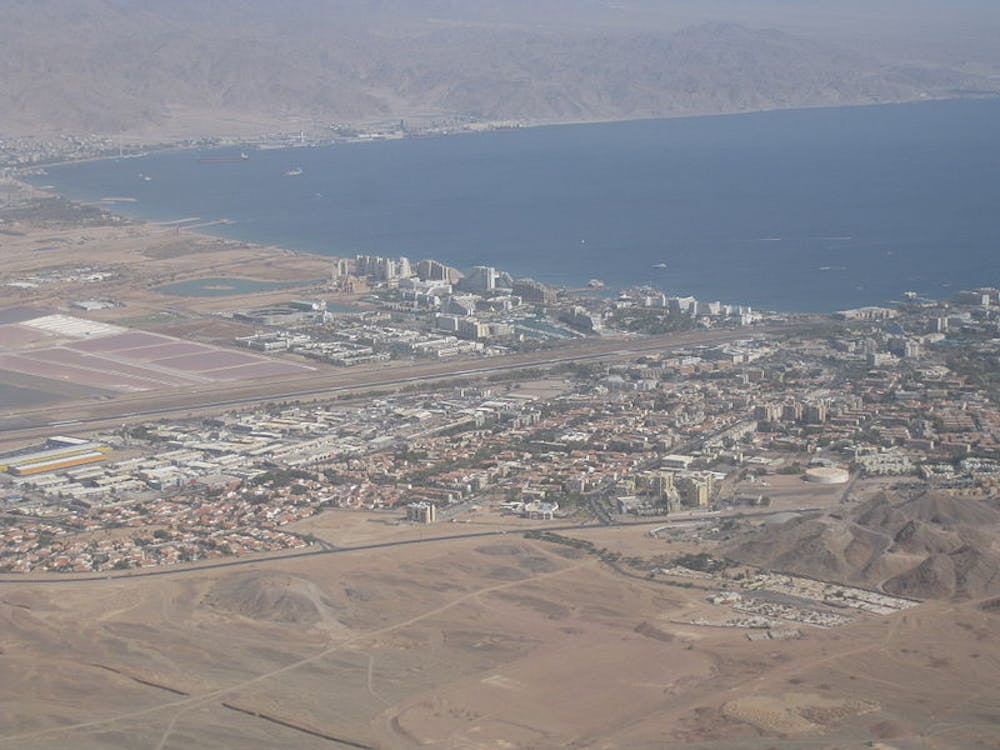
Since the start of August roughly a dozen Grad style rockets have been shot over the border at the Israeli port of Eilat. Some of the weapons over-flew the town and landed a whole other country away in the Jordanian resort of Aqaba. Ironically, the only casualties so far have been Jordanian Arabs, with one dead and four wounded when their taxi was in the wrong place at the wrong time.
It’s likely Hamas is mixed up in this Sinai business, if not as an outright perpetrator, then at least as an organiser or condoner; Egyptian Bedouins aren’t just wandering around the desert with Soviet rockets strapped to their camels, so they have to be sourcing them from somewhere.
And while the next rocket attack is no doubt being planned in the tea houses of Gaza, the Israelis are doing some anticipating of their own and putting up an Iron Dome.

This delightfully named air defence system is one of Israel’s solutions to the perennial rocketing it receives. Iron Dome uses radar and some rapid number crunching to shoot its own missiles at incoming enemy weapons and break them up before they hit their target. Part of the system’s brain also calculates where the enemy rocket is likely to land and doesn’t bother to engage if the impact area is unpopulated.
After all, at around $40,000 a shot, you don’t want to be zapping a flying drainpipe that’s destined for a patch of desert.
Specialised in quick reaction, low angle intercepts, the Iron Dome batteries have claimed 93 ‘kills’ since they came on line in 2011. The system is particularly effective against Grad rockets, exactly the type that’s now coming out of the Sinai.
Effective anti-missile defence is obviously something of a fetish for the Israelis and they have been tipping a great deal of money into it for decades. Often with the R&D and funding boosted by America, Israel is attempting to put an impenetrable roof over those parts of the country threatened by militant attacks. Iron Dome is just one component of this strategy, with other weapons systems, such as the even more coolly named “David’s Sling”, being phased in for other intercept niches.
There was even a long running program to develop a laser energy device for burning up incoming rockets, but the cost became a factor when America pulled out. Sitting there in one place and defending against a pounding is not really a part of Pentagon doctrine, and when your home turf is a long way from the action, you don’t need to so much about needing an air defence system on the roof of the local mall.
Whether the Sinai becomes a regular venue for launching attacks is yet to be seen. It’s unlikely the Egyptians will be happy to play host to such provocations, especially when their own guys are getting killed. But the more important issue is whether Israel might one day move from just catching incoming rockets to pre-emptive strikes at their source on Egyptian soil.
Rory Cahill
Editor at The Conversation
Whoever names these things for the Israelis has a real talent.
Mat Hardy
Lecturer in Middle East Studies at Deakin University
The Wiki article on Iron Dome contains the story of the name. The project director's wife thought of "Golden Dome" one weekend. They thought this was too blingy, so at the next project meeting they changed it to Iron Dome and that was that. America would have spent months, millions and massive amounts of focus groups to get the same name, or come up with an acronym like "Phased Array Tracking Radar to Intercept on Target" (PATRIOT)
Benjamin Barzel
PhD Candidate in Neuropharmacology at Baker IDI Heart & Diabetes Institute
This article is exactly the reason the conventional "numbers game" doesn't work when it comes to how many civilians are killed on either side at the end odds a skirmish.
In addition to active protection, Israel is spending millions in passive protection: major hospitals are being relocated underground and civilian bomb shelters are continuously improved.
NAJ Taylor
Research Associate, Centre for Dialogue at La Trobe University
Malta and Laos are widely-cited as "the most bombed places on earth", whether we're looking at the stats of individual states (Malta), or by population (Laos).
So I'm not sure your opener works. In fact, it reads like propaganda.
Mat Hardy
Lecturer in Middle East Studies at Deakin University
I'm not sure your readings skills work. Who said anything about bombs? The entire article is about missile interception. Perhaps in your desperation to see propaganda, you create your own fallacies.
Or we could take your comment at face value. Malta took about 3,000 Axis bombing sorties over a two year period. Israel has had circa 8,500 rocket attacks since 2001. Different tonnages, different outcomes, of course. The Laos statistic is juvenile, per capita stat fiddling. Vietnam took about three or four times as much high explosive across a similar surface area and with a much more severe casualty rate.
NAJ Taylor
Research Associate, Centre for Dialogue at La Trobe University
Um, quoting Laos is "juvenile"!? It's widely cited in the literature, as well as by reputable NGOs such as Human Rights Watch, and also the ICRC. We are talking about 250,000,000 bomblets - Vietnam was significant also, but not "the most". The point was: focusing on one weapons type is sensationalistic - it has no meaning in the realm of strategic studies.
So I don't see why you're adopting your tone in response to my comment.
Indeed, I don't think if you'd engaged with my previous work in the diaspora and in the Middle East - in research and media - you could faithfully say I harbour "desperation to see propaganda" either.
To be frank, I take some offence.
Yuri Pannikin
Director
NAJ said: "To be frank, I take some offence."
Which is neither here nor there. And neither are any of your previous points of contention.
NAJ Taylor
Research Associate, Centre for Dialogue at La Trobe University
Three people clicked the "dislike" button on Mat's initial response, which the editors seem to have taken down.
This morning, on seeing 2 strikes, I clicked it too.
I just want this to be on record.
Clive A Marks
logged in via email @attglobal.net
Matt/NAJ
Your exchange on respective munitions accountancy made me feel a little uneasy. When in Laos I took an interest in the history of the cluster bombing and its ongoing impact; not easy to ignore given the number of people with missing limbs and the ongoing impact of UXBs decades later.
As a naive bystander a couple of questions come to mind:
Isn't bomb tonnage (or even missile use) a rather poor correlate of actual suffering and impact as a stand alone metric? ie. a single cluster…
Read moreNAJ Taylor
Research Associate, Centre for Dialogue at La Trobe University
I couldn't agree more. Many methods are used to make these "most destroyed place on earth" comments, but they are often political in nature. My initial comment was intended to highlight this very fact.
As an aside: I've worked for years on the cluster munitions issue, both as an academic and somewhat of an activist. So I read your reflections on your time in Laos with some hope that more people come away from SE Asia with similar dismay, energy and hope.
Clive A Marks
logged in via email @attglobal.net
I was shocked to the core about the history and circumstances in Laos yet perhaps more deflated by how few people actually know the full extent of it then and now. Few citizens of the US and Aus have a clue about the 'secret war' and this seems to suggest that hope might need some defrosting yet.
Most US and Aus backpackers in Laos head for Van Vieng to get pissed and tube the river. Perhaps they already know that the bombing of Laos was "juvenile per capita stat fiddling".
NAJ Taylor
Research Associate, Centre for Dialogue at La Trobe University
Laos, Cambodia and Vietnam certainly have different capacities and strategies for publicising their somewhat shared histories.
Pleased to see you're spreading the word.
Yuri Pannikin
Director
You lot a being quite hysterical. This is quite reasonably an article about rocket attacks on Israel and its defense systems. It is accurate.
If you want to discuss Laos, Cambodia and Vietnam, get another article written.
If you've been reading Mat's articles over the months of the Conversation you would understand that he is no dupe for Israel and its position in the world. He's doing good journalism here and he should be recognised for it.
Mat Hardy
Lecturer in Middle East Studies at Deakin University
Just to be open about this, I did apologise to NAJ Taylor via email and he accepted that apology. Whilst I did disagree with he said, I responded in a manner that wasn’t worthy of the points raised. I did it in the heat of the moment, in a rush, and it was not a worthwhile contribution.
As regards the stats on Laos, ‘juvenile’ was a needless adjective. I guess I was frustrated at the ‘per capita’ thing as a measurement, mainly in the general the way things can be pulled this way and that depending on what ‘per’ you use. But I also felt that such comparisons were not the central point of my article.
I don't generally flip people off on discussion boards and especially not here. Sorry, everyone.
Clive A Marks
logged in via email @attglobal.net
Yuri
I'm not sure I am questioning Mat's integrity nor the article as such - you would note that it was a post script comment that caused some very reasonable concern. I commend Mat's last post and retraction. All good.
However, as I said. "I'd like to know what the impact of the missiles Israel seeks to intercept has been on the nation - relative to the impact of its (Israel's) own outgoing munitions (on others). It just seems to me that this is needed in order to get some perspective on…
Read moreYuri Pannikin
Director
Clive, that 'may' be a useful thing to do, but I'm not sure utilitarian quantitative assessments give us a useful ethical base for analysis, although I have used this measure in looking at other conflicts.
One would have to take into account qualitative elements such as aggressive intent, and self defence I would think, in order to reach some useful position. For example, presumably rocket attacks on Israel are meant to cause maximum harm, and no doubt they would if more powerful, longer-range…
Read moreChris Booker
Research scientist
I like people who apologize when they realize they're wrong. You get a +1 from me.
Clive A Marks
logged in via email @attglobal.net
Thanks Yuri. Sure, condemn all aggression, rockets and actions against UN mandates - absolutely. However I'm still left wondering about the first paragraph of the article. On Google I found that some 28 Israeli citizens have been killed and hundreds injured by these rockets (is this correct?). No small matter and horrible. However, I also saw that since the year 2000 some 5000 Palestinians (mostly civilian I suppose) have lost their lives to Israeli forces.
Aggressive intent and speculative…
Read moreLynne Newington
Lynne Newington is a Friend of The Conversation.
Researcher
Terrible to have to continue to fight for existance, dealing with countries claiming their aim is to wipe you off the face of the earth.
Fortunately, there remain those of goodwill working behind the scenes for peace.
A Ahmed
Student
With the muslim brotherhood now in charge of Egypt there is going to be alot more suffering to be reported.
- Christian Coptic.. more Coptics killed in the last 18 months than in the last 45 years.
- Muslim Moderates will have to tow the line.
- secular advocates
- minorities
- even read an article arguing the pyramids should be destroyed because of the pagan beliefs it symbolizes..
The weapons in this article are certainly going to be tested.. and nobody is going to win from the violence which will result in this arab iceage
Chris Booker
Research scientist
It's odd that for all the talk of projectile munitions being launched over borders there's no mention of the other 'metal' themed Israeli initiative - Operation Cast Lead - which led to 1,400 Palestinian civilians being killed, and included the use of illegal munitions containing phosphorous. Quite an omission I'd say.
NAJ Taylor
Research Associate, Centre for Dialogue at La Trobe University
This is precisely the point I was making below - focusing on one type of weapon (rockets) obscures the fact that historically this is far less than other sites, by a range of factors (explosive yield, weight, etc).
Additionally, Iron Dome is a political tool as much as a practical one. For Israel, it heightens the existential threat of 'outsiders', and sustains the narrative many hardline Israelis wish to adopt. For the United States, which co-funds the Dome, it's a political and symbolic gesture ('we are always protecting you'), as well as a way of testing technology that will likely have application within its own defence.
Missile defence was, after all, one of the most bitterly-debated elements of the Cold War. It still upsets the Russians even today.
Ahmad Abu-tukit
Plumber
Not every journalist piece about Israel should cover all aspects of the conflict. The author was attempting to inform readers re Israel’s missile defence system in the context of the new front opening up from across the Egyptian border.
If he wanted to deal with every bit of flying shrapnel in the region then Hamas’ ball-bearing loaded suicide bombers and tactical bombing of open fields by the IDF could be covered, to name just a few. But that will only generate sets of abuse-loaded comments from pro-Israel/Palestine entrenched readers.
Anyhow, Iron Dome and their likes should also be seen in the context of Israeli domestic politics as a psychological soothing and for the government to be seen as actively trying to control the situation.
Chris Booker
Research scientist
"Iron Dome is a political tool as much as a practical one" Agree. The article here almost seems to portray it as a 'cool hi tech toy'.
By the way, I've enjoyed your opinion pieces on Al Jazeera.
NAJ Taylor
Research Associate, Centre for Dialogue at La Trobe University
Thanks, Chris. Do you work in the field of arms control? I see you're listed as a "research scientist".
Chris Booker
Research scientist
No, not at all! Diabetes and endocrinology. I guess for me my interest stems from wider issues of human rights, not to mention the huge health and environmental threat posed by use of nuclear weapons.
NAJ Taylor
Research Associate, Centre for Dialogue at La Trobe University
Endocrinology could come into play with biological weapons. I'm sure there's medical and scientific associations like MAPW and IPPNW that'd have you contribute!
Yuri Pannikin
Director
Excellent, factual article Mat.
Moammar Mashni
Australians for Palestine
Isn't it amazing how someone who is paid to teach about the ongoing crisis in Palestine/Israel (in part) can ramble on about the threats to Israel without acknowledging any wrong-doing on the oppressor's behalf?
The question of cause and effect must surely be answered if we are to take the author even remotely serious?
As more and more records are discovered about how Israel behaved in the 1930's leading up to the Nakba of 1948, and again in the lead up to the 1967 war, it is patently clear that Israel/Zionism have been the root cause of this terrible conflict.
It is imperative that fact and fiction be correctly asserted and in this case. Mat has far more fiction than fact.
Ahmad Abu-tukit
Plumber
Mat can answer for himself if he wishes but your question is self evident.
The Israeli/Palestinian conflict is too complex to reiterate all its aspects whenever you wish to highlight ONE aspect of it. When you study a subject there is no need to continuously keep scorecards of “wrongdoings”, neither to weigh up who has more victimhood scores nor to place label of oppressors and repressors.
From your affiliation it is clear that you see the matters above as your job from the pro-Palestinian…
Read moreMoammar Mashni
Australians for Palestine
there's is certainly no need to highlight every issue, but to ignore the elephant in the room defies logic - sorry AAT.
i'm pro-Palestine because i'm pro-human rights. Israel has never once recognised the human rights of the Palestinians, be they the 20% citizens of Israel of the millions under occupation and those ethnically cleansed since the implementation of the (utterly racist) Zionist project.
one should never forget that the original Jews of Palestine, never behaved in such a grotesque manner. Jews, Christians and Muslims lived, loved and shared in prosperity prior to the Nakba - why is this never part of the 'dialogue'?
A Ahmed
Student
@Moammar
where is the real elephant here? honestly?
we all have our opinions but try this youtube link which is an arabic station interview with English subtitles.
http://www.youtube.com/watch?v=aoCLzDTlmhw
The man in the interview grew up in Palestine and His Father is a senior Hamas Leader.. He offers a very compelling perspective which i believe applies to the whole of the middle east and until this is address there will be no human rights in the middle east..
Honestly is this man right?
http://www.youtube.com/watch?v=aoCLzDTlmhw
Ahmad Abu-tukit
Plumber
Moammar
I have no intention of holding a debate on the Israeli/Palestinian issue here, especially as I see myself as pro-peace and not pro one side or the other.
For that matter I’ll just say, I cannot agree with your equation “pro-Palestine = pro-human rights”. Many horrible atrocities have been and still are committed in the name of Palestinian struggle. Siding with one side makes you stand on that side of the fence. Palestinian society uses its struggle to repress debate and human rights among its people in brutal ways that you would never equate with human rights.
I’d prefer to side with anyone from either side who’d stand for peace, for respecting the other, for adopting a non-violent approach and willing at any stage to sit and talk rather than fight over patches of dirt and old stones.
A Ahmed
Student
@Ahmad,
i totally agree.. would like to bring to your attention this link
http://www.youtube.com/watch?v=RGbzZ75mp-c
search on youtube "Son of Hamas" and find a man that is dedicated to peace for His country
Yuri Pannikin
Director
Well said those correspondents.
Lorel Thomas
National Coordinator ANBLC
All weapons of war are dreadful and sometimes statistics can be misleading. However, there is absolutely nothing misleading about the 270 million cluster bombs which rained down on Laos during the Vietnam War. Nothing is juvenile about quoting the Lao statistics. The only juvenile element of the Lao situation is that children make up a quarter to a third of the victims of the unexploded ordnance remaining from the Vietnam war. I feel that NAJ Taylor is within his rights to take offence at the cavalier way that Mat Hardy has dismissed his comments. On behalf of the people living in fear of the approximately 78-80 million unexploded cluster bombs littering the Lao country side I also take exception to the Mat comments.
NAJ Taylor
Research Associate, Centre for Dialogue at La Trobe University
Thanks, Lorel.
Michelle Fahy
Committee Member, Cluster Munition Coalition Australia
I agree entirely with Lorel Thomas. And with earlier remarks in this thread which expressed uneasiness about comparing which sort of weapon system is worse or which country has been affected most. We are talking about people's lives and limbs here - not numbers on a screen. I am dismayed that the author of this article, representing such a respected academic institution, could so flippantly dismiss the enormous tragedy that has unfolded in Laos over the last four decades. Cluster munitions are inherently indiscriminate, render large tracts of land unusable for decades, kill and maim civilians day after day, and leave a deadly legacy wherever they are used - there is nothing at "juvenile" about bringing the impact of cluster munitions in Laos to the attention of Conversation readers.