
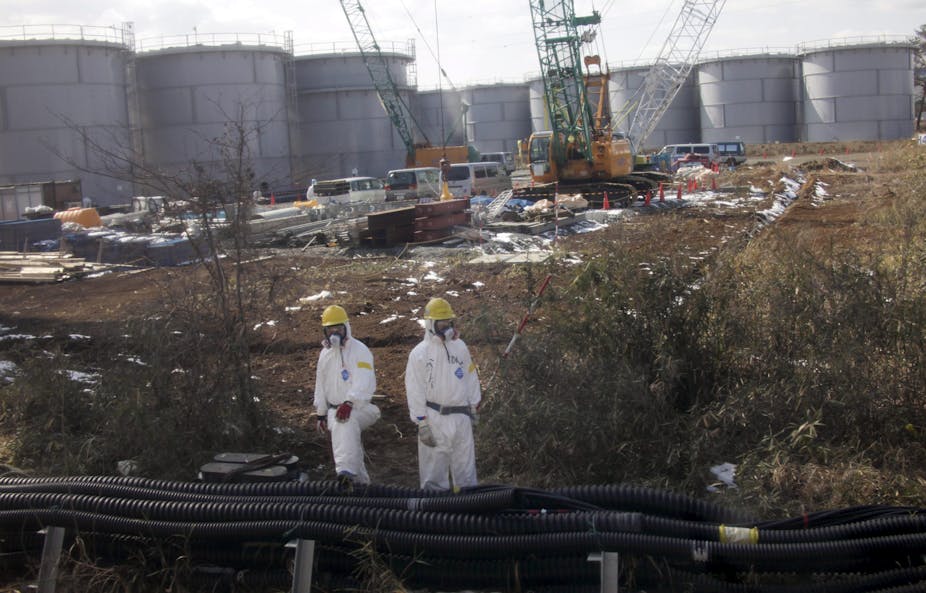
Don’t hold your breath for Fukushima’s radiation toll

A year can be a long time in politics. But for the radioactive particles released from Fukushima’s damaged nuclear reactor, a year is just a moment in their life of hundreds or thousands of years. So, what is the radiological situation at Fukushima one year after the disaster? Thankfully, despite more…

Cswtz6w5-1331271564
The true health costs of Fukushima’s radiation leaks won’t be known for decades. AAP

A year can be a long time in politics. But for the radioactive particles released from Fukushima’s damaged nuclear reactor, a year is just a moment in their life of hundreds or thousands of years.

So, what is the radiological situation at Fukushima one year after the disaster?

Thankfully, despite more than 9,000 aftershocks since the disaster – including more than 10 rating above seven on the Richter scale – there have been no major fires or explosions since March 2011 that could cause further catastrophic releases of radioactivity.

But the extensively damaged plants are still unstable and highly radioactive. This has restricted access and clean-up efforts, which will need to go on for many decades.

Though Japanese authorities declared they’d achieved a “cold shutdown” in December, an arbitrary definition was used: coolant water temperature was less than boiling, pressure inside the reactors was not raised, and the release of radioactive materials from the first layer of containment was below a specified level. But it didn’t mean the nuclear reaction inside the reactors had been stably shut down.

Investigations

A number of investigations (some of which are still ongoing) have highlighted inadequacies in the design, prevention and response measures to deal with such a disaster. There is also a high level of dysfunction, cover-up, collusion and corruption in the nuclear industry – including its regulation and oversight.

How, for example, could sea walls designed to withstand a tsunami of only 5.5 metres be acceptable on a coast battered by a 38 metre tsunami in 1896 and a 29 metre tsunami in 1933?

How could cooling pumps, back-up generators and control systems not be required to be located on high ground?

How could spent fuel ponds, filled with vast amounts of long-lived radioactivity, safely be placed right of top of reactors? And without any special containment structures?

Independent, peer-reviewed research provides strong evidence that radioactive emissions from the Fukushima plants began after the earthquake and well before the tsunami struck. This is contrary to claims by TEPCO, the power company involved, and the Japanese government that it was the tsunami and not the earthquake that irrevocably damaged the Fukushima nuclear plant.

If leaks did begin as a result of the earthquake, as the evidence strongly indicates, this has profound implications for nuclear reactors everywhere – not only those located on coasts, within reach of tsunamis.

Poor protection

Serious gaps in measures to protect the population have also become evident.

One of the important protective health measures, which should be taken for those who have been or are likely to be exposed to significant reactor fallout, is the administration of stable iodine shortly before exposure, or within 24 hours. This blocks the uptake of radioactive iodine into the body, which causes thyroid cancer.

Yet the government admitted, in its June 2011 report to the IAEA, that because of dysfunctional decision-making, iodine was not administered to anyone in Fukushima, despite supplies reportedly being available.

AAP

Exposure to radiation

We now know the computer-based system designed to guide evacuations and sheltering (known as the System for Prediction of Environmental Emergency Dose Information or SPEEDI system) correctly predicted the initial path of the heaviest Fukushima fallout. The results were delivered to the government but not acted on, resulting in the people of some towns moving right into the path of the fallout.

Detailed mapping of the population’s radiation doses (from contaminants in the air, water and food) is still not publicly available. But hundreds of thousands of people still live in areas where they will receive doses higher – in some case several tens of times higher – than the world-wide recommended levels of no more than 1 milliSievert (mSv) of additional exposure per year.

The most contaminated areas were re-categorised by the Japanese government in December 2011. Residence is not precluded in areas where inhabitants would face radiation doses between 20 and 50 mSv per year.

Astonishingly, evacuation is not recommended from areas where residents are likely to be exposed to doses of up to 20 mSv per year. Even in the “bad old days” of the Soviet Union, those anticipated to receive more than 5 mSv annually after the Chernobyl disaster were resettled as a matter of priority. And those likely to receive more than 1 mSv annually had resettlement rights.

What happens next?

On January 26, 2012 the Japanese government released a roadmap of planned environmental remediation activities, to be completed over the following two years.

But the value of such measures has likely been oversold. Plans to remove the topsoil of farmland, for instance, will erode the viability of farming. And the problem of where to store, and how to isolate, vast amounts of contaminated material remains a major challenge.

One group particularly at risk of health harm is the large and growing number of workers required to help control, shut down and clean up the damaged nuclear plants.

By early December, more than 18,000 men had participated in clean-up work in Fukushima. These largely unskilled, inadequately trained, ill-equipped and poorly monitored day labourers performed the bulk of the dirty and dangerous work. Much of the contracting of these workers is dominated by criminal “yakuza” networks.

Even before the disaster, the Fukushima Daiichi complex was staffed by 1,108 regular employees and 9,195 day labourers. On average, the contracted day labourers receive two- to three-times the radiation dose of a regular worker but are not included in utility statistics. And there is no compulsory, centralised system for tracking cumulative radiation exposure or health outcomes of these workers.

Radiation levels are not always monitored. But when they are, and a labourer is known to be near the maximal permitted dose for workers, they may be sent away. The maximum dose is normally 20 mSv per year, but this was raised to 250 mSv after the Fukushima disaster. After the workers are despatched, there’s nothing stopping them from then going to work another nuclear plant.

On top of the many other health problems that the Fukushima disaster has caused, thousands of additional cancer cases will likely be diagnosed, but these will take some years to emerge.

This means, of course, that much of the radioactive fallout from Fukushima will continue to indiscriminately harm health for many generations to come.

Articles also by This Author

Sign in to Favourite

Want to follow The Conversation?

Sign up to our free newsletter to get the day's top stories in your inbox each morning, with a special wrap on Saturday.

Spinner
Become a friend of The Conversation and donate

Join the conversation

31 Comments sorted by

  1. Tim Scanlon

    Author and Scientist

    I had to laugh when there was a claim made in another article about "being no cancer deaths and risks" associated with Fukushima. One year is not a long time for radiation.

    Some good points Timan, thanks.

    report
    1. Tim Scanlon

      Author and Scientist

      In reply to Mark Harrigan

      Mark, we're actually on the same page. I think you might have missed the "not" in my sentence. I just love claims about cancers and radiation, because cancer takes years to develop. Two of the things I learnt in the radiation safety course was dose intensity and cumulative dosage. Timan is highlighting some of the issues surrounding cumulative dosage that are not being monitored.

      But it is a good point you raise with the linked article Mark, there is a lot of media scare about what amounts to background radiation levels. Better not quote the figures for frequent flyers and their exposure.

      report
    2. Mark Harrigan

      Dr

      In reply to Tim Scanlon

      Thanks Tim - I'm not 100% sure we are on the same page though?

      The evidence suggests the overall radiation risk from Fukushima is neglible

      http://www.scientificamerican.com/article.cfm?id=japans-post-fukushima-earthquake-health-woes-beyond-radiation

      Yet most articles (including this one) blow it out of all proportion.

      In my opinion the real "disaster" is the mismanagement and then over-reaction to the Fukushima incident whilst at the same time virtually ignoring the real human tragedy from the loss of life due to the tsunami - AND the wholsesale adoption and misrepresentation of the Fukushima incident to serve the anti-science zero evidence case of the rabidly anti-nuclear brigade- which by the way is likely to make our ability to respond to the bigger problem of AGW worse, not better

      report
    3. Terry Colbert

      Terry Colbert

      In reply to Mark Harrigan

      Hello all, just wondering if moving back to Fukushima with my kids aged,8,6,5,2 and5 months, would be a good move or not?
      It is always hard to know what to do with so many conflicting reports out there. I prefer to stay on the safer side of the fence.
      I don't know if any of you live in Japan but are you aware of the abuse people from fukushima are putting up with when they travel outside the Prefecture? Mark and Peter would you set your family up in Fukushima? I'M Not trolling, I have to decide what to do soon and what mental strain and stress I would be asking my kids to deal with.
      Please find the time to comment.
      Thanks
      Terry

      report
    4. Mark Harrigan

      Dr

      In reply to Terry Colbert

      Terry - I would NOt be afraid to go near Fukushima because of any radiation risk. I would probably observe (well, legally I would have to) the immediate exclusion zone around the damaged reactor.

      Apart from that there is no risk that is any different to many other places around the world where natural levels are are higher than other places.

      In addition low radiation dosages are NOT cumulative (unlike some heavy metal exposure for example) and there is no evidence that at very low they are harmful (just a lot of ignorance).

      The social and economic conditions in the prefecture are of course another matter.

      It is shameful and ignorant and bigoted if people from the area are treated with disdain - a side effect of the luddite ignorance fear and doubt on this topic propagated by the medi and the more extreme anti-nuke elements in the environmental movement who are never ones to let facts get in the way of promoting their ill informed ideology.

      report
    5. George Crisp

      Medical Practitioner

      In reply to Mark Harrigan

      Mark and Terry are quite right the risk is VERY low. But I disagree with their comments.
      The BIER VI report 2005 makes it quite clear ( as do peak medical bodies in this field ) that current evidence suggests that a "linear no threshold" relationship exists between exposure (to ionising radiation) and damamge / ill health.
      So while low exposure really does represent low risk - it does not represent "no risk".
      There is another disingenguous argument creeping in here, and that is, treating all…

      Read more
    6. Alex Cannara

      logged in via Facebook

      In reply to George Crisp

      George, you shouldn't take your children to any place in Japan, because natural radiation levels are higher there than in most other non=volcanic, non-granitic locales. New Zealand is probably as dangerous.

      But the real error you cite is the linear dose-effect relationship. It was disproven at Hiroshima & Nagasaki, at Chernobyl, and was revealed to have come from an intentional lie decades ago...
      http://tinyurl.com/4xqwzjc (the lie about no safe rad level)

      And many confirmations exist today…

      Read more
    7. Mark Harrigan

      Dr

      In reply to George Crisp

      With due respect to George is wrong - the linear no threshold model has been completely debunked - if you research it you will find it was based on uncertainty in the first place

      http://junkscience.com/2011/12/20/lnt-model-debunked-by-berkeley-lab-researchers/

      This is well explained here

      http://decarbonisesa.com/2012/02/15/fear-of-radiation-is-frightening-guest-post/

      By the Cheif Physicist of the Adelaide radiiotherapy centre - someone who is a true expert on this topic since his knowledge…

      Read more
    8. George Crisp

      Medical Practitioner

      In reply to Alex Cannara

      If the "low dose radiation exposure" has been "debunked" then perhaps you should inform WHO, who state: "Low doses of radiation can increase the risk of longer term effects such as cancer".
      http://www.who.int/ionizing_radiation/en/

      and the United States Environmental Protection Agency which also endorses the LNT model in its 2011 report on radiogenic cancer risk: (p7) Underlying the risk models is a large body of epidemiological and radiobiological data. In general, results from both lines of…

      Read more
    9. Mark Harrigan

      Dr

      In reply to George Crisp

      George - you may find it Moncktonesque because you don't want to believe it. But the EPA and WHO themselves (in the links you provided) acknowledge there is considerable doubt.

      They also acknowledge that the model is primarlity based on extrapolation to a low does based primarily on the experiences of the very high does experiecned by Hiroshima victims and NOT on any actual experimental evidence at low doses. In other words it is accepted speculation, not verified experimentally.

      Did you…

      Read more
    10. George Crisp

      Medical Practitioner

      In reply to Mark Harrigan

      Yes, I have - the "Junkscience" post by notorious climate denier Steve Millloy refers to claims of lies bt Mueller in 1946. Well that's interesting but hardly conclusive.

      I am not sure if you have read the BIER VII phase 2 - but establishing these biological effects is the aim of this extensive study (as the acronym suggests ) and the finding is: "THe committee judged that the linear no-threshold model (LNT) provided the most reasonable description of the relation between low-dose exposure to…

      Read more
    11. Alex Cannara

      logged in via Facebook

      In reply to George Crisp

      George, there have been various studies around the world, including very long-term ones related to A-bombs and workers esposes to various radiation sources over short & long term.

      The bureaucracies won't change safety limits for very political reasons, or until embarrassed, as they already should be by how doctors & radiologists use radiation to kill cancers -- it only works because LNT is false. If LNT were true, no radiation treatments would do anything but kill & scar normal tissue, perhaps…

      Read more
    12. Mark Harrigan

      Dr

      In reply to George Crisp

      George, Alex has said it better and with more evidentiary support than I could - probably because he has far greater expertise in the area than me.

      And I do take your point about the junk science link - I don't like Milloy much either.

      But I do not think our pointing out that LNT model is specious can be called cherry picking.

      I Have read BIER. All the (reputable) authorities who main support for LNT acknowledge it is based on no evidence - just extension of high doses to a lower level…

      Read more
    13. George Crisp

      Medical Practitioner

      In reply to Alex Cannara

      "..... how doctors & radiologists use radiation to kill cancers -- it only works because LNT is false. If LNT were true, no radiation treatments would do anything but kill & scar normal tissue, perhaps kill some cancers, and breed new ones. Radiologists know all about this."

      No. I don't think you understand Radiotherapy. Allow me to explain: Radiotherapy exploits the radiosensitivity of cells. Rapidly dividing cells are more sensitive to chemotherapy and radiotherapy as cells that are in the process…

      Read more
    14. Alex Cannara

      logged in via Facebook

      In reply to George Crisp

      George, I'll certainly study the links you passed.

      But, I never said no cancers are induced in normal cells via radiotherapy. However, we both know that it takes several mutations of cellular DNA to achieve cancerous behavior, so the argument about no lower limit is clearly flawed for brief exposures. If it were true, then we'd all be born cancerous.

      Also, I didn't mention the hope that radiation treatments will do more damage to quickly-reproducing cancers cells than to normal surrounds…

      Read more
    15. Alex Cannara

      logged in via Facebook

      In reply to George Crisp

      Thanks very much for your well-stated points, Mark. I forgot that George had suggested I'd not read the Miller-McCune piece, perhaps because it's equivocal. In fact, I think it important to share pieces that aren't hard in one direction or another. Your quote from Hume is on the mark -- we must use our brains well, by examining all relevant information.

      The 2010 UN report is also equivocal, even more so than the quote George drew from it. The UN, being a political body, has many sticks pointing…

      Read more
  2. Luke Weston

    Physicist / electronic engineer

    "Though Japanese authorities declared they’d achieved a “cold shutdown” in December, an arbitrary definition was used: coolant water temperature was less than boiling, pressure inside the reactors was not raised, and the release of radioactive materials from the first layer of containment was below a specified level"

    As far as I'm aware, those pressure and temperature metrics are in fact "cold shutdown" as it is defined by all nuclear engineers.

    It appears that you are the one making up your…

    Read more
  3. Mark Harrigan

    Dr

    This article makes some valid points about poor management, poor authority approvals and implementation of the Fukushima plant.

    But it's misrepresentative. It fails to consider all the other plants in the area and what happened to them.

    http://depletedcranium.com/the-other-fukushima-nuclear-power-plant/
    The reality is Fukushima showed, if you look at the WHOLE picture, that modern reactor designs properly managed stand up well even to enormous eathquakes and tsunamis. Fukushima II Nuclear…

    Read more
  4. Alex Cannara

    logged in via Facebook

    This article is fine, except that it misses soem realities...

    1) Fallout from breached fission reactors contains fission products which can be volatilized, which are lighter, generally shorter-lived elements, like 90Strontium & 137Cesium.

    2) The statement "radioactive fallout from Fukushima will continue to indiscriminately harm health for many generations to come." is false, because the dangerous products are short lived. Longer-lived products are, by definition, less radioactive, so less…

    Read more
    1. Bruce Tabor

      Research Scientist at CSIRO

      In reply to Alex Cannara

      "The statement "radioactive fallout from Fukushima will continue to indiscriminately harm health for many generations to come." is false, because the dangerous products are short lived..."

      Plutonium isotopes (for example) are extremely dangerous (if ingested) and are certainly NOT short lived. There is evidence that significant quantites were released in the disaster and this hazard may be grossly underestimated by the Japanese government:
      http://www.nature.com/srep/2012/120308/srep00304/full/srep00304.html

      A major problem is, that given the way this disaster has unfolded, there is a huge deficit of trust towards TEPCO, the Japanese government and virtually anyone seen to have any form of vested interest in the nuclear industry.

      report
    2. Alex Cannara

      logged in via Facebook

      In reply to Bruce Tabor

      The key to living things is: are the elements emitted bio-active and incorporated into cells. Plutonium, for example has a very, very long half life, so is not very radioactive, and it has little biological activity, unless inhaled as dust. Cesium, however is biologically active and incorporated into our cellular structures, much as are potassium Iodine and Calcium. So, where there's fallout that contains biological mimics of non-radioactive isotopes, we need to be careful to avoid ingestion…

      Read more
  5. Peter Lang

    Retired geologist and engineer

    The opening paragraph is a typical anti-nuclear, scaremongering and loaded with misinformation. There is no mention that radiation levels decay (i.e. decrease) logarithmically with time. There is no mention that the cumulative health effects will be negligible over any time period, especially if put in perspective of the health effects of all other natural and man induced causes. There is no attempt to balance the benefits versus risks of health consequences. And no attempt to put the consequences…

    Read more
  6. George Crisp

    Medical Practitioner

    Thanks Tilman,
    I think you have raised some valid concerns.

    Firstly, it will be interesting to see the fallout, in terms of ill-health, unfold over coming decades. Perhaps with Japan's more transparent and modern health infrastructure and reporting we will get a better understanding of radiation exposure. ( It does mean of course that the unfortunate people of Japan will be non-consented unwitting participants in this ghastly, unplanned trial ).

    It may significantly contrast Chernobyl and…

    Read more
  7. Terry Colbert

    Terry Colbert

    Hello all, just wondering if moving back to Fukushima with my kids aged,8,6,5,2 and5 months, would be a good move or not?
    It is always hard to know what to do with so many conflicting reports out there. I prefer to stay on the safer side of the fence.
    I don't know if any of you live in Japan but are you aware of the abuse people from fukushima are putting up with when they travel outside the Prefecture? Mark and Peter would you set your family up in Fukushima? I'M Not trolling, I have to decide what to do soon and what mental strain and stress I would be asking my kids to deal with.
    Please find the time to comment.
    Thanks
    Terry

    report
    1. Bruce Tabor

      Research Scientist at CSIRO

      In reply to Terry Colbert

      No - I wouldn't take kids anywhere near the place. Provided you observe official precautions, (flawed as they may be) the dangers to adults are quite low. Children are especially vulnerable to radiation and I wouldn't take the risk.

      There is a very slight risk of a collapse of the cooling pool of reactor 4. This would lead to self-ignition of the spent mixed-oxide fuel and the vast quantities of radioactive isotopes being released into the atmosphere as gases, smoke & ash particles. It's hard to know the size of the risk or the magnitude of the consequences of such an incident as the hyperbolae are flying thick and fast:
      http://akiomatsumura.com/2012/04/682.html

      report
    2. Alex Cannara

      logged in via Facebook

      In reply to Terry Colbert

      Certainly read the report that just came out from the honest investigators...
      Honest Fukushima report...
      http://tinyurl.com/72fww8u
      www.slideshare.net/jikocho/naiic-report-hires

      After this much time, the remaining fule in the reactors has had its fission products decay so much that their self heating is about 1/10 what it was at the time of the accident.

      The report, by the way, confirms the reality that those of us who've worked with TEPCO or other Japanese companies learned -- it's not a nuclear problem, it's a Japanese govt/business/cultural problem. Even the Yakuza was involved with nuclear plant staffing. And no one at any level listened to the geologists who warned of past tsunamis just as large, nor did the govt. employ sensible land-use policy that considered all the stone tablets placed around Sendai by ancestors saying, in careful hand carvings: "Don't build here". Towns that obeyed their tablet down the road toward the sea, are fine.

      report
  8. wilma western

    logged in via email @bigpond.com

    One writer states that Iodine was not distributed to exposed communities, another states that it was.
    I guess it's a huge comfort to those who lost loved ones in the tsunami to know that probabalistic analysis dictated the height of the sea walls.
    Would the pro nuclear lot agree that placing reactors on the sea shores in earthquake-prone areas is good planning policy these days - especially in the light of the effects of king tides as well as sea level rise ?

    What seems quite obvious is that Japanese governments - national and local- failed their communities and are still failing them.

    report
  9. Alex Cannara

    logged in via Facebook

    MarkH is quite right about the realities of radiation. Here's a good exposure chart, note where Fukushima & Chernobyl fall...
    www.xkcd.com/radiation/

    Note too, that our bodies naturally contain enough 40Potassium that we radiate ourselves internally with about 4400 emissions/second (4400 Becquerels). We get that natural radioactive material from bananas, etc., and from minerals in water we drink. A granite counter top is a great source of Radon gas , which decays to Polonium in our lungs…

    Read more