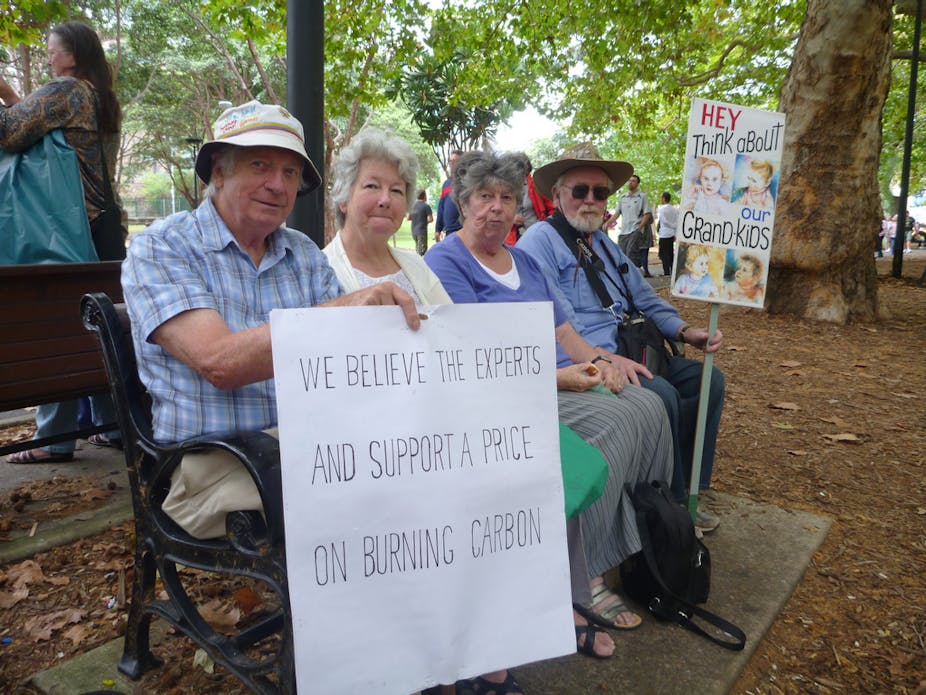
Braying climate naysayers are annoying; but so are all those well-intentioned carbon tax advocates who fail to address the core problems and make the same mistakes time and time again.
If we’re going to build the political momentum we need to price carbon in Australia, we need to think seriously about why we are doing it and who we’re talking to.
Make no mistake: the first people we have to nurse through adaptation to climate change are our brave men and women in pinstripe suits.
The current Say Yes campaign in support of a carbon tax – backed by the Australian Conservation Foundation and the Climate Institute among others – is laudable.
It’s important for the future of this country and the planet that we support a carbon price. It’s important that we support those people arguing for such a price.
But as a piece of political campaigning it is naïve, and in fact might be self-defeating.
It’s great to hear positive voices arguing for “a price on pollution, and a future powered by renewable energy”. It’s nice to hear these things over an optimistic piano riff (see video above).
It’s gratifying to hear things from like-minded people so we can all congratulate each other on how much we care about the future and the environment and so on.
But if your goal is to actually convert the unconverted on a carbon price, to turn the dismal polling numbers around, then you need to step out of your box.
Lining up spokespeople from Australia’s progressive and environmental organisations will do nothing to convince the conservative, the business-minded or the stereotypical Liberal-National Party voters. If they won’t listen to one of you, why would they listen to 30? Or 300? Or 3,000?
Indeed, campaigns like this (if it turns out to be as noisy as the Say Yes organisers might hope) might even backfire. Such campaigns may reinforce the naysayer position that there’s a noisy minority of people “not like us” who are trying to subvert the way we live and make us poorer.
To really support a carbon tax, you need to talk about climate change in ways that make sense to the millions of Australians who are not in the Conservation Foundation or Getup or Greenpeace, and you need to use arguments that resonate with them.
Framing the carbon price
Consider these questions:
1) Why do we need to price carbon throughout the world? 2) Why do we need to price carbon in Australia?
It may seem counter-intuitive, but the answers to these questions are very different. They strike at the heart of the political debate, and they go like this:
1) We need to price carbon throughout the world for the long-term security of human life and existing biodiversity on our planet. Put simply, we need to make sure the world is a place in which human civilisations – and the ecosystems supporting them – can continue.
We don’t know about you, but we’re certainly not keen to live in some crazy version of The Road, pushing a shopping trolley around in a nightmarish world of total ecosystem collapse.
2) We need to price carbon in Australia for the above, of course, but more specifically, and urgently, for economic reasons.
We need to price carbon in Australia so that business owners have a clearer picture of their operating environment. They need a clear regulatory and taxation framework to operate effectively, and more sensible businesses (BHP-Billiton, for example) have been working under the assumption for some years now that a carbon price is coming.
While the final pricing system remains up in the air, our businesses muddle on in darkness. It is odd that the Liberal party – the traditional allies of business in Australia – have abandoned the core needs of this constituency in favour of the rent-seeking and muckraking of noisy voices such as Ian Plimer, Alan Jones and Andrew Bolt.
We need to price carbon in Australia so that Australians have a legitimate seat at the table in framing the global carbon price.
Do we want to be the victims of global negotiations or sit with the agenda-setters?
Do we want to leave global carbon-pricing mechanisms to others, playing in the backyard until the grown-ups have made the decisions for us?
Do we want to keep our heads in the sand and cross our fingers hoping that things won’t hurt us, or actually step up and try and shape them?
Finally, we need to price carbon in Australia so we can begin shifting our economy towards things that will do well in a low-carbon world.
Right now, the muckrakers in politics seem to want Australia to be the last pushers of high carbon energy, like the drug dealers still trying to get people to buy their dodgy gear after the rest of the neighbourhood has been cleaned up.
Yes, coal is making us loads of money right now. But our booming, mining-fueled economy will not last forever. Would you pump your money into coal-only power companies? Would you take the bet that coal will be central to the world’s economy in 50 years time? We wouldn’t.
So why don’t we start shifting our economy, before it’s shifted for us?
Old tricks
It’s important to remember that seeking certainty about the future of the climate is a chimera.
Make no mistake, the evidence is overwhelming that we are affecting our climate dramatically and negatively. But science never offers 100% certainty. About anything.
But these critical notions of scientific skepticism and uncertainty have been reframed by naysayers to mean “don’t believe anything you don’t want to believe”, and “uncertainty means scientists don’t know anything”.
Bollocks.
We make financial decisions all the time based on the best evidence available to us, not based on certainty.
We take out mortgages and buy houses based on our best guess about whether that house will be nice to live in, and that interest rate rises won’t make payments impossible.
There can be no certain information about the market, but we look at the best available evidence and follow that.
We make medical decisions, such as whether to risk undergoing a general anaesthetic, based on weighing up the risks and benefits as we see them, and also, critically, calling on the advice of experts.
Certainty is not the goal of science; nor is it a practical basis for decision making. We do, and once more must, decide using the best information at hand. If we always waited for certainty, we would never leave the house.
Get this, and get it good
A global carbon price will come, whether we want it or not. And our economy will be affected by it. It’s really that simple.
We’ve already missed our shot at taking the lead – the UK, Europe and even New Zealand are streets ahead of us now – but does this mean we should aim for last?
Coming last in this race will damage our economy for decades.
We’d like to see campaigns telling the people who still need to hear it the real carbon story: that we need a carbon price, and we need it today.
Ironically, the only certainty in this whole mess is that doing nothing is the worst possible course not just environmentally but economically.
Do you agree or disagree with this article? Make your voice heard: leave your comments below.
Lindsay Davis
logged in via email @hotmail.com
The heading is correct. It is an unfortunate fact that the climate change proponents continue to give the same message and they do need to change it.
While I still have some degree of scepticism concerning the accuracy of their predictions (after all the for caste conditions have occurred in the past naturally) I am happy to go along with a price on carbon. The problem is not that we have to have a price on carbon but HOW it is to be added. This aspect seems to be being neglected or ignored in the current debate.
Unfortunately the proposed tax appears to be a tax compounding on everything flowing from coal fired electricity to transport to food to child care. Adding further muddle to a mess is the army of bureaucrats that will be needed to administer it and the sheer inefficiency and cost of taxing nearly everything and then handing back compensation. Oh what a feeling of rorting.
This is the problem not the fact that we need to do something.
Lindsay Davis
Brendan L G
Student
I agree with your statement on the premise of "HOW" to implement a decent carbon reduction scheme. That is the big question? Taxation is only one way to address this problem, and through the Carbon Emission Trading Scheme (CETS) is another. However, i am sure there are other smarter alternatives out there. Maybe a mixture of both??
I do believe we we have to do something urgently in addressing climate change, but i am little skeptical in how we approach the design of a system that can meet all the needs of the population, and the environment.
I would definitely say it will be a big challenge to convince everyone to agree with one system!
Tom Anderson
Chemical Engineer
One hybrid scheme is an emission trading scheme (ETS) with a floor price to provide certainty. This is being considered by the government. See:
http://www.climatechange.gov.au/government/initiatives/multi-party-committee/meetings/seventh-meeting/~/media/publications/mpccc/price-floor-paper.pdf
However, I think the key here is to act and act fast. The European ETS was not perfect, but they amend it as necessary. The key here is that while they are learning about what the best mechanism is, they have been reducing their emissions (and what's more, providing an example to the rest of the world!)
nil
logged in via Facebook
I absolutely agree with the premise of this article. As a young adult, climate change will affect my life more so than those who currently wield the decision-making power. I have, therefore, been frustrated with how the issue is being handled on both sides of the debate. Naturally, it's disappointing to witness the prominence of scepticism, hostility towards reform and even outright denial but it is equally disheartening to see the way in which advocacy groups are managing the situation. While I…
Read moreRod Lamberts
Deputy Director, Australian National Centre for Public Awareness of Science at Australian National University
Nice one, Pip - thanks! We are certainly on the same page here.
Cheers,
Rod
TREVOR RIDGWAY
MR ( I am retired now )
Pip , I enjoyed reading your letter & I liked the way in which you clearly enunciated your concerns.However, I failed to see the premise of the article with which you agreed.Was it that a couple of 'scientists' presented a convincing economic strategy (which surely would have been better expressed by an economist like Ross Garnaut.....who spends most of his time polluting rivers in New Guinea or ,confusingly , espousing scientific theory ! ) OR that the (perceived) 'eco-nuts' are making a hash of…
Read moreTroy Barry
Postgraduate student
Those who believe there will be a meaningful global agreement on pricing carbon emissions are the people with their heads in the sand. Pragmatically, the Australian government should accept that it has no capacity to have any impact on climate change and should instead be investing in adjusting to the effects, wherever such investment is justifiable.
Harry McNally
logged in via email @decisions-and-designs.com.au
Consider an alternative pragmatism Tony. Global agreement on a carbon price is irrelevant if consumers decide that they can reduce their footprint by shopping for "low-carbon" products. I can see an opportunity for on-line stores already. http://www.lowcarboncatchoftheday.com/ "Searching right along the manufacturing supply chain to certify all our products are low carbon so that you can be assured you are doing your part to reduce global emissions".
Smart companies would adapt. They may shift to corn starch derived plastics to replace steel or aluminium. Countries may process their coal or oil reserves directly to plastics in the short term. Low carbon can be treated as a threat or an opportunity; I see it as an opportunity for countries and companies who adapt to the climate of the market.
Troy Barry
Postgraduate student
Of course, there are already very many entrepreneurs (and large companies) pragmatically taking advantage of consumer and government desires for low carbon products and services, without the need for a carbon tax. A carbon tax isn't necessary to develop renewable energy, corn starch plastics or efficient diesel engines - they are already available and improving. The tax will subsidise the purchasing power of Australians who prefer low carbon products at the expense of those who don't. If that…
Read moreTom Anderson
Chemical Engineer
Troy, I hope you're wrong about the chances of a global agreement, because "adjusting to the effects" of climate change is not an easy task. Think sea level rise, reduced crop yields, and growth in the frequency and severity of adverse weather events.
Also, being pragmatic, have you considered the possible effects on our economy if trading partners who have committed to ghg reductions enforce trade embargoes against countries who fail to act? These countries include China, Japan and all countries who are members of the European Union.
I am cautiously confident of a global agreement including all the large major players. If anyone would like to see a list of the current commitments made by countries to the Copenhagen Accord, they can find them at:
http://www.usclimatenetwork.org/policy/copenhagen-accord-commitments
As an aside, I'm interested if anyone has read this article and changed their stance on a carbon tax as a result. Anyone?
Troy Barry
Postgraduate student
Currently there is no reason to believe that any countries will enforce trade embargoes based on emmissions - that's an even further bridge than believing that countries with significant emmissions will commit to reducing them. Russia, Japan and Canada have declared they won't commit to reductions past 2012 if developing nations don't, and your link shows that China, India and Brazil have only committed to increased emmissions. Meanwhile the USA has reaffirmed that it will not participate in an…
Read moreTom Anderson
Chemical Engineer
China and India have committed to curbing their emissions growth. Given that Chinese per capita emissions are roughly one fifth of Australia's, perhaps you'd agree to commit to the same per capita emissions as China in 2020? Or perhaps you'd agree to match India's per capita emissions? Their current per capita emissions are one fifteenth Australia's!
Your only reasonable argument centres around US reducing their emissions. Several US states have committed to GHG reductions, including California (the largest emitter) who is implementing an emission trading scheme on 1/1/12.
In not taking ghg reducing measures, Australia is supporting the USA as the only serious developing country not committed to an emission reduction. Why not leave the US alone on this one?
If you'd really like to see a global commitment, why wouldn't you embrace an carbon tax
Troy Barry
Postgraduate student
As they article says: "If we’re going to build the political momentum we need to price carbon in Australia, we need to think seriously about why we are doing it..."
The article splits the reasons why we should price carbon globally - which are rational - from the reasons why we should price carbon in Australia. I don't find any of the reasons given as evidence that we should price carbon in Australia convincing. If the authors can forgive me paraphrasing:
Read moreReason 1 is business certainty. If the…
Miss Eagle
logged in via Twitter
I consider myself not a Climate Change Sceptic - but a Climate Change Group Sceptic. I believe the community climate change groups have been very active - within their communities, making words on beaches - but have been very poor communicators and they have not gathered impressive numbers except in their own eyes. I support better communications and in language and design that the "other side" can understand. I also think that there are elements of Abbott's "direct action" which can be usefully integrated so that we carry forward a sound carbon policy with every tool that we can muster including - but not restricted to - a "price" mechanism.
William Raper
Mr.
Research Scientist (retired)
Why do we not hear more about more efficient energy use? Surely this would be popular with both consumers and industry (except power generators and their suppliers)! The issue seems to be the elephant in the room, but why?
I think more green house gas reduction could be achieved more quickly this way - electricity needs would be reduced and obviate the need for more generators. Great savings for all users at very low or no cost to our economy.
Bob Bingham
Mr.
Every ton of coal burned produces two tons of CO2 and although invisible it is poisoning our atmosphere. If we were pouring visible pollution into our waterways there would be an outcry. We need to stop burning coal or the outcome in Australia and around the World is going to be catastrophic and much more expensive than the income made from selling coal. The carbon tax is only a deterant. Get used to doing without coal.