Drugs, crime and ball games: how Aussie sport got crooked

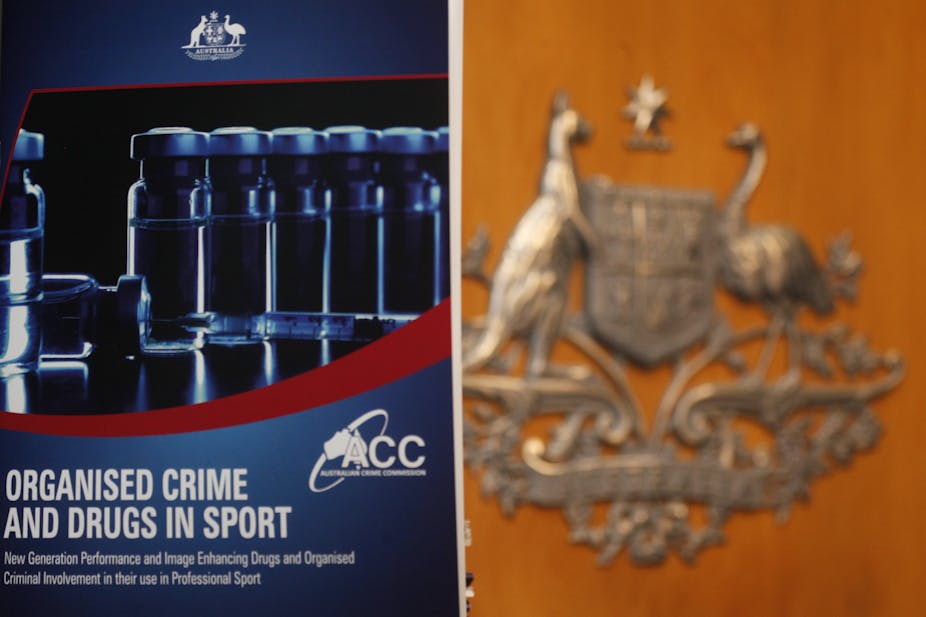
The Australian Crime Commission report, Organised Crime and Drugs in Sport, has come as a hammer blow to Australian sport. According to a review of cycling released only last month, Australia is supposed to have a reputation of being “clean” on these matters. Just weeks later, that has all been swept…

89t68rtm-1360235402
Australian sport was supposed to be clean. What went wrong? AAP/Lukas Coch

The Australian Crime Commission report, Organised Crime and Drugs in Sport, has come as a hammer blow to Australian sport. According to a review of cycling released only last month, Australia is supposed to have a reputation of being “clean” on these matters. Just weeks later, that has all been swept away.

So, how did it come to this? Like any social problem, it is the result of a whole host of things. Untangling them is to approach a Gordian Knot without even a blunt pen knife.

The management of drugs in sport in Australia and around the world is led by the anti-doping policy. Anti-doping is in essence a “legalistic prohibitionist” policy. It seeks to detect and punish to deter drug use. Attempts at alcohol prohibition throughout history have emphatically demonstrated what this kind of policy does. Underlying demand is unaffected, while legal supply disappears. This creates the opportunity for organised crime to become the supplier, with inflated prices for overcoming legalistic interdiction (policing).

Sport is big business, worth nearly $9 billion in Australia. Game day is the outcome of a lengthy and convoluted production process. What matters is the objective outcome when that day ends. If the sponsors, broadcasters and punters are happy – the managers are happy. Few resources are directed anywhere else. The Cycling Australia Review, for example, reported anti-doping was the responsibility of a part-time employee handling 40,000 competitive riders and their events. Cycling Australia saw investment in events as far more important than “the fight against doping”.

The competition between sports, such as Australian Rules and Rugby League, leads to the constant pressure to develop a competitive advantage. This is the constant nightmare of big business, preserving market share while expanding into new areas. Part of this mix is making the sport provide “more” – more excitement, more thrills, more nerve shattering moments. This is what sports consumers want; it’s what they demand. Failure to meet this demand means less money at the gates.

The production process to meet this demand rests on the athlete. In pursuit of “more”, athletes have to find ways to be higher, faster, stronger. This is compounded by pressure to return from injury as soon as possible. Athletes might just need to hang in for another season before looking for an alternative career.

Australian athletes can and do use performance enhancing substances because they have to. It is impossible to be competitive at the elite level without using some kind of substance. Athletes can lose their job if they heal too slowly. This creates a demand for performance enhancing substances that organised crime is only too happy to meet, with multi-billion dollar reward.

The government would have us believe the answer rests in ramping up anti-doping exercises to “catch” baddies – investing more in detection and making punishment more severe. Let’s be clear: making anti-doping work is going to cost a lot of money. In the current fiscal climate, that money is going to have to come from health, education, defence or welfare. This raises the question of whether “clean sport” is more important than, say, the National Disability Insurance Scheme.

Unfortunately, putting anti-doping on steroids is unlikely to do much. This approach has failed to prevent the rising market of illicit drugs in Australia – at least if Australia 21 is to be believed. The war on drugs has failed, and it seems reasonable to assume the “war on drugs in sport” is going to end the same way.

One way of resolving the problem is to move from anti-doping to drug control. Let’s look at developing ways to better understand the role of drugs in sport. A host of substances are already permitted. There are clearly some drugs that should be banned – a hockey player smacked out on ice is a danger to themselves and everyone else. But that does not apply to all substances. Unfortunately, this idea is unlikely to be palatable to those who have invested heavily in “zero tolerance” – which John Fahey, President of WADA, has repeatedly declared an unrealistic goal anyway.

Another solution is to change the nature of sport. What might professional sport look like if it emphasised the joy of the game? One reason athletes demand performance enhancing drugs is because of the inhuman expectations placed on them. Let’s change our expectations. Making seasons shorter is a simple way of giving athletes more time to recover from injuries. Looking at rotation policies might be a good way forward too. Putting athlete health and welfare on some kind of level footing with other costs of doing business might be a useful start, (though this is unlikely to be palatable to business interests).

Of course, like any social policy, the answer is to implement all these solutions at once. Australia needs to accept the reality that drugs are an inimical, yet intrinsic part of sport. We must find a better way of policing drugs in sport, and shift the focus away from business and towards human interests.

Perhaps then we can get back to sport being about the talent, grace, skill and strength of some extraordinary people.

Articles also by This Author

Sign in to Favourite

Want to follow The Conversation?

Sign up to our free newsletter to get the day's top stories in your inbox each morning, with a special wrap on Saturday.

Spinner
Become a friend of The Conversation and donate

Join the conversation

49 Comments sorted by

  1. Stephen John Ralph

    carer

    Interesting to note that now that the s**t has hit the fan, the coaches and managers etc that have been interviewed all seem incredulous that this has been going on.

    So it looks like we are going to get the Lance Armstrong denial style - it wasn't me.

    Any senior coach surely must accept blame where blame is due - the buck stops somewhere.

    report
    1. Jason Mazanov

      Senior Lecturer, School of Business, UNSW-Canberra at University of New South Wales

      In reply to Stephen John Ralph

      Stephen:

      Thanks for your comments.

      The standard approach to scandal management by the sports is rolling out - denial. I agree that the buck stops somewhere, and there are two groups who need to stand up and take responsibility.

      The first are the people who run sport in Australia - and the Australian Government is the second biggest player behind the AFL.

      The second are sports consumers. We pay for this kind of sport. If revenue increases are any guide - Australians love their drug fuelled sport. If people are unhappy with athletes using drugs, turn off the TV, return your season tickets.

      Best wishes,

      Jason

      report
    2. Delete this account as requested!

      logged in via email @iinet.net.au

      In reply to Jason Mazanov

      It would be nice to see a more nuanced response from all parties. The selective demonisation of certain chemical compounds is a strange one when looked at as objectively as possible.
      The 'illegal' drugs are chosen not on any sensible criteria e.g. long term harm to their users. Rather they seem to be a grab bag of what some unelected person or persons in an appointed office has decided is 'unfair' - a loaded term at any time.

      With increases in technology this is not ever going to go away or even be seriously enforceable. A new approach is needed.

      BTW - a bugbear of mine, No one 'consumes' sport. You can view it or participate but neither act removes sport or its ability to be watched/participated in by others. It's a term used by the copyright enforcement industry.

      Things you can consume: food, drink, air, electricity

      Things you can't consume: films, books, tv shows, software, data, knowledge

      report
  2. Geoff Henderson

    Graduate

    Great article, some great insight shown.But is it missing a couple of things?

    I guess I was expecting remarks about the role of gambling since it became a part of "sport". I was also expecting a remark about sport administration of the Codes. I find it hard to believe that any or maybe all of the administrators did not know what was happening. At best it was classic blind eye, at worst veiled approval. There seemed something comical about those televised Code CEO's standing up displaying righteous indignation and shock at the outcome of the Report. Am I wrong?

    Maybe my concerns fall outside the scope of the article, but I would still like to see them as part of the discussion.

    report
    1. Jason Mazanov

      Senior Lecturer, School of Business, UNSW-Canberra at University of New South Wales

      In reply to Geoff Henderson

      Geoff:

      Thanks for the kind words.

      I only had 700 words. My wife raised the same point you have. My expertise is in doping rather than gambling.

      What I am concerned about is that the three have been linked. That is, gambling = organised crime, organised crime = doping, therefore gambling = doping. This is spurious. Match fixing works very differently to doping.

      Best wishes,

      Jason

      report
    2. Michael Duff

      Public Servant

      In reply to Jason Mazanov

      Why would stamping out betting be any more successful than stamping out doping?

      The hundreds of thousands of people who poured through the gates at the NRL and AFL were obviously happy with what they were seeing. When they were blissfully and determinedly unaware, they enjoyed the product. Does anyone think they will be more than satisfied going back to a slower, lower impact game where the stars are spending longer on the sidelines?

      As Mark McGwire (The Simpsons, ep 2, season 11) said: "Who wants to see me hit some dingers?"

      report
  3. Stephen John Ralph

    carer

    Hi Jason

    now that you mention it, it may have been happening before our very eyes. I can recall many instances of watching footy (afl) on the teev and seeing players receiving "treatment" during the game. I believe the commentators would often mention injections in the rooms etc.

    Sadly I suppose it shouldn't surprise us, as the huge pressure on players to achieve is enormous. We always hear that a player/a team's only goal is the Grand Final. That must put a lot of pressure on teams, coaches and managers from the first bounce of the ball at the season's beginning.

    But of course that doesn't justify drug taking and unfair advantage thru unlawful means.

    report
  4. Anthony Nolan

    Ruminant

    Your key statement sums it up:

    "Game day is the outcome of a lengthy and convoluted production process."

    Which is why sport is about as interesting as watching a car being built on a production line.

    report
    1. Jason Mazanov

      Senior Lecturer, School of Business, UNSW-Canberra at University of New South Wales

      In reply to Anthony Nolan

      Anthony:

      State of Origin used to be my religion. I stopped when I found out what the sports production process was.

      From my point of view, drugs can and should be used to preserve the integrity of the athlete. What is done to athletes for our "sportainment" is unconsciounable. While the few elite performers are well treated, the graveyard of athletes who were sacrificed at the altar to give us the elite few line the Apian Way.

      Best wishes,

      Jason

      report
  5. Geoffrey Edwards

    logged in via email @gmail.com

    "Perhaps then we can get back to sport being about the talent, grace, skill and strength of some extraordinary people."

    The ideal has a long history. And an equally long history of people willing to ignore it.

    Here is Pausanias, ye olde Roman travel writer.

    "2 2. On the way from the Metroum to the stadium there is on the left, at the foot of Mount Cronius, a terrace of stone close to the mountain, and steps lead up through the terrace. At the terrace stand bronze images of Zeus.

    These…

    Read more
  6. Robin Bell

    Research Academic Public Health, at University of Newcastle

    Agree with you completely Jason.
    Recently it became clear that NRL and AFL sport culture has fundamental issues with violence generally, violence against women in particular as well as recreational drug and alcohol abuse. Now its clear that there is also a culture of curruption, cheating, use of performance enhancing drugs (many not approved for use in humans), organised crime and gambling ($billions, not just a fun bet once and a while).
    What concerns me deeply is the clear relationship between…

    Read more
    1. Jason Mazanov

      Senior Lecturer, School of Business, UNSW-Canberra at University of New South Wales

      In reply to Robin Bell

      Robin:

      Thank you for your observations.

      As a parent I am glad neither of my children show any particular sporting talent. I am also glad neither of them show any particular interest in watching sport.

      On the point of "role modelling", a paper showed that athlete role models had no effect on alcohol consumption among university students. Role modelling in that sense has little, if any effect.

      What does have an effect is the reality that drug use is normalised in Australian sport because of the emphasis we place on performance. Blaming the athlete is a misnomer. We need to be looking at the sporting institutions as well.

      Best wishes,

      Jason

      report
  7. Stephen John Ralph

    carer

    Here I go again...........good point Jason.

    here in Vic it is apparent from watching the AFL that the game has changed incredibly over the past decades, and continues to change. The AFL powers that be stating that it's "good for the game"

    The pace of AFL has increased dramatically. Instead of almost fixed positions years ago, nowadays there can be ALL the players down one end of the oval and NONE up the other. The Teev channels even put pedometers on players. This has resulted in god knows how many more injuries on a game by game basis. Just about every player has had numerous surgery reconstructions etc.

    It's a bit like a Roman coliseum spectacle - with the Apian Way littered with discarded players in the desire for blood.

    report
    1. Trevor McGrath

      Pharmacist Hobby:climatology

      In reply to Stephen John Ralph

      Hi Stephen, agreed, my point is along the same lines, but the very nature of the game, why do these players all have to look like they are about to fight for the world heavy weight title. I would have thought that the leaner and faster you are without having to carry that extra 20kg of muscle around would give you more pace, reduce impact loads and in the long run make the game more skilful. Of topic, a rule change, any kick backwards, and its play on, no stopping for the mark. Cheers

      report
  8. Joe Gartner

    Tilter

    The scope of doping in elite sport is, I guess, no surprise if you have been watching pro-cycling. That professional athletes in our codes in Australia use drugs to increase performance and improve recovery times is no surprise. What dismays me is the duplicity and feigned horror of managers, teams and possibly sponsors. I read an allegation of essondonm spending 30k on 'substances'. $30, 000 and team management did not know the scope of substance use/abuse....come on....
    The match fixing and…

    Read more
  9. Nick Stafford

    writer

    HI Jason

    thanks for this article.

    You make the valid point that nearly all professional athletes are using some sort of performance enhancing substances.

    And given that athletes are always looking for a competative edge, there is always going to be an interest in "new" substances by athletes and the people who train and prepare them.

    As one commentator notes below, we know AFL and NRL players are given drugs during games. The TV commentators will mention a "jab" having been given. These…

    Read more
    1. Jason Mazanov

      Senior Lecturer, School of Business, UNSW-Canberra at University of New South Wales

      In reply to Nick Stafford

      Nick:

      Your arguments repeat what colleagues have been saying for decades. In a sense we need "Lance" the boil and have a sensible competition. One idea I have put on the table is taking drug control away from sports managers and giving it to athletes. The moral force of athletes saying "this drug is banned because we agree is constitutes cheating" is much stronger than a faceless administrator.

      For example, cyclists might agree that supervised EPO use actually protects their health in Le Tour.

      This brings power into the equation. No doubt an excellent discussion topic for your students!

      Best wishes,

      Jason

      report
  10. Mat Hardy

    Lecturer in Middle East Studies at Deakin University

    Has anyone seen any inference that rugby union is implicated in all of this scandal?

    report
  11. Sean Lamb

    Science Denier

    Anti-doping policies are at their core about respecting athletes rights at work. Athletes have a right to pursue their profession without being obliged to pump themselves up with pharmaceuticals in order to achieve.
    Hence you establish a set of rules, people who knowingly break those rules are cheats - attempting to gain an unfair advantage against their honest competitors.
    Having good compliance regimes is important so that athletes who follow the rules can have confidence they aren't being disadvantaged.
    For many drugs there are known and real health risks to their use or overuse, for many others it is conceivable that there would be but we lack the data.

    report
    1. Jason Mazanov

      Senior Lecturer, School of Business, UNSW-Canberra at University of New South Wales

      In reply to Sean Lamb

      Sean:

      These are all part of the overarching argument. The issue is that we can change the rules if we want to. Caffeine went from being "cheating" one day to legitimate performance enhancing drug the next.

      Arguing the health angle is problematic. The first problem is that the substances we are talking about are therapeutic in origin and have well defined safety data. We know how to use them safely. Justice Woods admits that the health arguments are no longer relevant in the contemporary context. Lance Armstrong is a good example of the health implications of doping - I wish I looked that healthy!

      The other issue is that there is a difference between use, misuse and abuse. Abuse of any drug leads to health consequences, from iron supplements to anabolic steroids.

      Best wishes,

      Jason

      report
    2. Sean Lamb

      Science Denier

      In reply to Jason Mazanov

      Perhaps we are talking about a different Lance Armstrong. The Lance Armstrong that I am aware of took testosterone and hGH and got testicular cancer.

      report
    3. Sean Lamb

      Science Denier

      In reply to Michael Duff

      Mr Duff, please don't labour under the illusion you have any understanding of science. We don't know whether prolonged exposure to hGH and testosterone could promote cancer risk because it is not ethical to undertake such experiments. There is, however, an abundance of evidence that many cancer cell lines pump out high levels of hGH and this is a factor in their tumourgenicity.
      While it may be true that many of these drugs have been developed for therapeutic purposes, this therapeutic purpose…

      Read more
    4. Michael Duff

      Public Servant

      In reply to Sean Lamb

      Mr "Science Denier" Lamb, I'm not labouring under any illusions.

      The known facts are (1) that Lance Armstrong suffered from testical cancer; (2) that Lance Armstrong has admitted that he took anabolic steroids and hGH; and (3) that there may be a link between anabolic steroid and hGH usage.

      What is not know is when Lance Armstrong began taking anabolic steroids and hGH (outside what he has grudgingly admitted to), whether there is an actual link and how great the risk factor for steroid and…

      Read more
    5. Sean Lamb

      Science Denier

      In reply to Michael Duff

      Mr Duff, you are certainly laboring under the illusion that you understood what I wrote.
      Dr Mazanov seemed to suggest that Lance Armstrong's appearance of health was a significant argument in favor of relaxing restrictions on doping. I simply stated Lance Armstrong had had testicular cancer. Did I state doping caused this cancer? No. However, everything we know about the actions of testosterone and hGH make a link of one or both not implausible - certainly for tipping an incipient tumour into a maliginancy.
      At the moment I think it is possible to compete at the top level without doping, we should be encouraging this through the use of good compliance methodologies simply in the interests of the athletes and nothing else. We should be stigmatizing those who try and evade these regimes which are in place solely for the benefit of athletes for what they are - cheats. People who are trying to obtain an unfair advantage over their competitors.

      report
    6. Michael Duff

      Public Servant

      In reply to Sean Lamb

      I understand exactly what you wrote.

      You can't seem to understand that you are not in possession of a causative link between Armstrong's usage and his cancer episode.

      We now know that (at least dozens) of top level cyclists were heavily using steroids and hGH. We also know the same about sprinters, weightlifters, powerlifters, strongman, wrestlers and bodybuilding athletes.

      If you can show a higher rate of testicular cancer in people competing in those sports then you may have a point. Otherwise, I have a rock and my house doesn't get attacked by bears.

      If you think it is possible to compete at the top level without doping, then either the drugs don't work because users don't get an edge, that users are actually rare, or that there are a large cohort of people out there who are so genetically superior that they are still able to compete successfully against users.

      report
    7. Glenn McLaren

      Philosopher/Lecturer

      In reply to Jason Mazanov

      Good article Jason. I agree generally with your approach. I look at this issue in relation to the evolution of complexity. What we're seeing in elite organized sport is a lot of energy being put in by many different parties to excessively order sport for their own ends. This involves dampening or flattening natural oscillating processes in order to channel them into pre-determined outcomes. It is the excessive ordering and controlling of natural processes which produces wicked problems. Think of the wicked problem Lance Armstrong created for himself and the energy it required. As I think you suggest, the best way to address such problems is to dissipate the energy or take the heat out before the systems complexity collapses into an emergent simplicity. In other words, more efforts to tightly control adds fuel to the dysfunctional fire.

      report
    8. Jason Mazanov

      Senior Lecturer, School of Business, UNSW-Canberra at University of New South Wales

      In reply to Glenn McLaren

      Glenn:

      Thanks for the vote of confidence, and also drawing on chaos to explain what is happening here. This is a wicked problem. Definitionally this means we created it.

      By changing the focus of drug control we can get away from all the vitriole and hyperbole. But then, that's one of the key values of sport - giving us something to talk about. Taking away doping may actually diminish the overall value of sport.

      After all, as we demonstrated in a paper on Calciopoli:
      Scandal + Football = A Better Share Price.

      Best wishes,

      Jason

      report
  12. Stephen John Ralph

    carer

    Mr Hird
    definition:
    Eat, drink, or ingest (food or drink).
    Buy (goods or services).
    Synonyms
    spend - expend - waste - eat up

    In a colloquial sense we "eat, sleep and drink" sport....we EAT it up....it can consume us.....

    we can perhaps consume knowledge!

    A good start for compounds ingested by athletes might be - is it harmful to users in the short or long term.
    If no data is available why not be better safe than sorry.

    This is in part a response to illegal activities which seek to gain an unfair advantage over others, and also that some proponents are willing to risk the safety of others to gain an advantage.

    report
    1. Delete this account as requested!

      logged in via email @iinet.net.au

      In reply to Stephen John Ralph

      The etymology including buy is a new development created by industries trying to conflate purchase with consumption. Just because they've created an increasingly common use doesn't make it correct or desirable.
      I believe in the evolution of language but I also feel free to fight against the manipulation of it to the common detriment.

      I agree on the harm minimisation but disagree with the presumption of harm with no evidence. The precautionary principle is a bad basis for the creation of laws as it is inherently anti-personal freedoms. It is far too often used as an excuse for authoritarian control and prohibition.

      Indeed that is where the current situation has sprung from and with the seemingly inevitable result of prohibition acting as a gateway for crime.

      Collect the evidence first, then make the judgements. Any other way distorts the evidence and the resulting analysis.

      report
  13. Stephen John Ralph

    carer

    Mat

    Rugby Union - a mere sideline in the Australian psyche.....................

    but if it's important to you that's all that matters.

    report
  14. John Nightingale

    logged in via Facebook

    As an earlier commenter noted, cheating in major sport has been going on for thousands of years, doubtless ever since competitive sport emerged, long before written history. And it will go on forever, for all the faux surprise expressed by the bosses, who have undoubtedly known that somehow something was happening so 'don't want to know' continued, as ever.

    Taking 'stuff' to help performance isn't new, knowing what stuff actually helps might be. That applies to all high revenue sport, and always…

    Read more
  15. Stephen John Ralph

    carer

    Hi Stephen

    it seems you want to eat your cake and have it in regard to language.

    You say language needs to evolve, but then you call it detrimental when it does. Perhaps we are arguing semantics, but a common phrase is " consumed by jealousy".

    Consume does not simply mean to "eat" in terms of a digestive process, but also is used in a metaphorical connotation also these days.

    And even if coined by "industry" it is irrelevant. Every year NEW words and meanings are introduced into dictionaries that have been coined by all sorts of groups - rappers, technocrats, consumers....etc

    report
  16. Terry J Wall

    Terry J Wall is a Friend of The Conversation.

    Author, Commentator, Environmentalist at In-Sync Minerals

    For me it is black and white that betting on team sports in particular, is the conduit that allows Organized Criminals to harvest the reward from managed sports outcomes.
    Ban betting on sport in particular but especially advertising on TV will break the cycle. On arriving to live in Australia three years ago, I was shocked to see that this was legal.

    report
    1. Jim KABLE

      teacher

      In reply to Terry J Wall

      Terry

      I only ever watch commercial TV/Commercial sport if visiting - and it is that household focus. But like you - I arrived (back) in Australia a little over three years ago - and like you was shocked at the régime of gambling promoted throughout the games - more recently promoted by clean-cut young chap of famous sporting/gambling lineage! Seems quite obvious that the gambling is a prime mover-and-shaker in this sporting business - to substance use/abuse - of course!

      report
    2. Jason Mazanov

      Senior Lecturer, School of Business, UNSW-Canberra at University of New South Wales

      In reply to Terry J Wall

      Terry & Jim:

      I think it is a mistake to correlate doping with match fixing. The link of organised crime is there, just that they are in separate branches of the organisation. Unless you are talking about 'negative doping', where players are given tranquilizers to make them play worse - but apparently that's not cheating.

      Best wishes,

      Jason

      report
    3. Jim KABLE

      teacher

      In reply to Jason Mazanov

      Not quite following your critique, Jason. Nevertheless an interesting editorial in to-day's Newcastle Herald by senior opinions writer Joanne McCARTHY (she led the push to get a Royal Commission into Child Abuse) "Safe bet it's to blame": 6th par.: "People were realistic about it, or resigned, cynical, derisory, or a little saddened, but not even close to being shocked. And to a person they gave the same answer when asked why it (the ACC findings on professional sport being 'highly vulnerable to infiltration by organised crime') didn't surprise them. Betting."

      report
  17. Stephen John Ralph

    carer

    Whilst this issue is getting deserved currency, it certainly highlights how important Sport is to the Australian psyche. I'm not including every Aussie, but sport in one form or another is almost ubiquitous. And always male-dominated sports.

    It would be great if climate change, the arts (apart from the crappy movies they make these days), the breakdown of the community and family in Australian life, racism, aboriginal issues, greed and corruption and the ME generations,, etc etc.......

    I love footy and can't wait for the minor 2013 competition to start next Friday, but there comes a time when Australia as a nation needs to address issues other than drugs in sport with the fervor and universality it has reserved for this issue.

    report
  18. Tony Grant

    Student

    Instead of millions/billions being spent on the "drugs issue"....the War Against Drugs being so successful...NOT!

    To categories...with or without drugs?

    I mean how interesting is going to see the normal ordinary "events"?

    We wish for excellence and pay to see...this is consumer driven...free entreprise, not some "religious commandment" we live in a secular society, not the dark ages!

    report
  19. Gregory Lehman

    MSt Student at University of Oxford

    Sorry - the people who make the most money out of sport are not the athletes, not the punters and not the coaches, trainers and physios. The big bucks flow to the sponsors and the corporate 'heavies' that preside over the clubs and associations. It's not defence, health, education and welfare that should be paying for cleaning up the mess - its the people who reap the millions into their bank accounts every day. They drive the relentless product-oriented culture that is at the heart of the problem and they should be held responsible. NO WAY should taxpayers have to suffer cuts in basic services to clean up this jockfest!

    report
  20. Pamela H.

    logged in via email @hotmail.com

    This is what happens when we put sports players on a pedestal, and refer to them as 'heroes'. They're not heroes, they're just sports people; under way too much pressure.

    report
  21. John Kelmar

    Small Business Consultant

    I complained 20 years ago that AFL matches were rigged, and that significant cheating was happening, but was told to keep quiet and threatened with legal action.
    It is just the same at our Universities - I blew the whistle in 1995, but instead of being congratulated, I was abused, bullied, threatened, and sacked, just like others since.
    Then we have Businesses who falsely promote their products and services, but are immune from punishment due to the owner's membership of certain clubs and associations…

    Read more
  22. Stephen John Ralph

    carer

    Hi Trevor

    agree - it's a little ironic that it seems after a season of concentrating on boosting weight & muscle development, Essendon was this year moving away from that practice. I guess the coaches felt their players were not as agile as previous years....partic since the team did not finish with as good a year as was hoped for.

    that backward kick..............couldn't agree more. From my armchair I scream at the players for relying on that tactic so much these days......IF I was a coach I'd ban it.....

    report
  23. Tony Simons

    Accountant

    John Singleton said sport is a metaphor for life. We should follow the US and outlaw all betting. We should have lifetime tenure for officials ( John Coates. still around after 2000 scandals including Phil Coles reinstatement after "consulting'" for hotels and resposnsible for big losses on investing all AOC money in Reef Casino in Cairns.

    report
  24. Chris Beaumont

    Communications

    The options are:
    1. make it open slather and watch roided-up superfreaks go above and beyond what is naturally conceivable, or

    2. Punish whoever has the most to lose and is smart enough to realise it. Punish senior club executives, coaches and managers for not being vigilant enough in their own backyards. Professional athletes are getting too young and less risk-adverse to be as deterred as they should be. Responsibility lies with the executive decision makers and if they have no knowledge, then too bad - they should be doing a better job of keeping their athletic investments in line.

    report
    1. Dennis Hemphill

      Associate Professor of Sport Ethics at Victoria University

      In reply to Chris Beaumont

      Thanks Jason for your thoughtful commentary. One of the concerns now is whether the increasing moral panic about sport will provide an opportunity for anti-doping hard-liners to back even more intense policing, thereby making it more difficult to support, say, harm minimisation approaches.

      report
  25. Dennis Hemphill

    Associate Professor of Sport Ethics at Victoria University

    Thanks Jason for your thoughtful commentary. One of the concerns now is whether the increasing moral panic about sport will provide an opportunity for anti-doping hard-liners to back even more intense policing, thereby making it more difficult to support, say, harm minimisation approaches.

    report
    1. Jason Mazanov

      Senior Lecturer, School of Business, UNSW-Canberra at University of New South Wales

      In reply to Dennis Hemphill

      Dennis:

      This is a strong concern of mine as well. We can already see the coercive powers coming into place, and the consolidation of discourse around "punish the sinners". That is, in the unlikely event anti-doping is failing we must do it more so!

      Best wishes,

      Jason

      report