


On a recent long-haul flight, with very limited movie options, I watched the Angelina Jolie and Johnny Depp movie The Tourist (two thumbs firmly down).
A particular scene on a train to Venice did catch my eye. Jolie’s character boards the train and sits across from what appears to be a cigarette smoking Depp. It immediately jumped out at me as quite strange – smoking openly on public transport has long been banned and this movie is set in present day.
Depp’s character then clarifies that he is in fact smoking an electronic cigarette, “It’s ok, it’s not a real cigarette. It’s electronic. It delivers the same amount of nicotine but the smoke is water vapour.”
Which again, I found rather strange – was this a case of product placement or a scriptwriter who wanted to offer a detailed description of what Depp was smoking?
This is not the first time a celebrity has spruiked the virtues of electronic cigarettes. In 2010, American actress Katherine Heigl appeared on The Late Show with David Letterman and demonstrated how to use and explained the inner workings of her electronic cigarette.
She then went on to say that smoking an electronic cigarette was as harmless as drinking coffee and that “it’s not bad for you, so it’s a fun addiction.”
Using glamorous and famous actors to promote cigarettes dates back to golden years of Hollywood when the likes of Clark Gable, Joan Crawford, Gary Cooper, Spencer Tracy and John Wayne were all paid to smoke cigarettes.
Could the same be happening with e-cigarettes? Even if no money is formally changing hands, celebrities can have a profound influence on consumer buying habits.
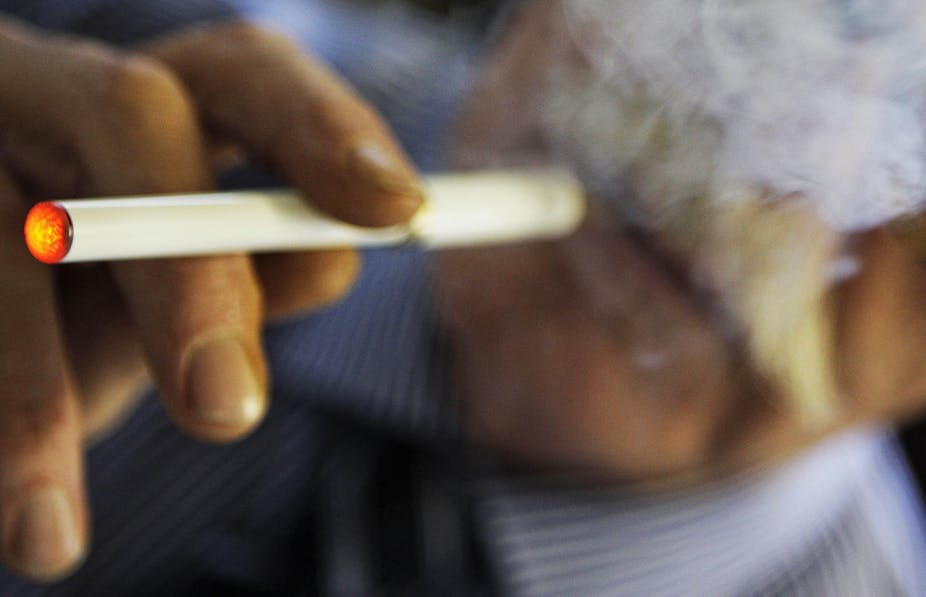
For the unfamiliar, electronic cigarettes, or e-cigarettes more commonly, are battery operated devices that vaporise cartridges of liquid nicotine.
They look very similar to traditional cigarettes except they are plastic and have a small LED light on the end – assumedly to look even more authentic.
Even the advertising campaigns for these products are reminiscent of old school cigarette ads – featuring young men and women suggestively posing with the device.
Because nicotine is a scheduled poison in Australia, e-cigarettes are banned for sale within Australian retail outlets. Scheduled poisons are tightly controlled and can’t simply be sold in any retail outlet to anyone who wants them.
Determined e-cigarettes buyers can easily go online and make a purchase from hundreds of websites and eBay sellers. But they don’t come cheap and can cost upwards of $120, plus the nicotine cartridges must be continually reordered.
In a paradoxical twist, the most harmful form of nicotine delivery, tobacco prepared and packed for smoking, is excluded from the poison schedule.
Nicotine replacement products, such as the patch, gum and inhaler, which have undergone extensive medical testing and proven to be both safe and effective in helping people quit smoking, are also allowed to be marketed and sold in Australia.
Proponents of e-cigarettes argue that they are “safer” than real cigarettes and therefore should be permitted for sale. Smokers are encouraged to swap their cigarettes for these products.
It’s true, there are few legal consumer products as harmful to health as cigarettes. But the potential risks or benefits of e-cigarettes are unknown.
E-cigarettes have not been submitted to the same rigorous safety testing as medical nicotine products and their efficacy in helping smokers quit is almost entirely anecdotal.
A search of blogs discussing e-cigarettes will nonetheless reveal zealous and enthusiastic e-cigarette users who argue that “vaping” (the slang term for the act of “smoking an e-cigarette) is the only answer to ending tobacco use.
The marketing and promotion of e-cigarettes belies the supposed intention that these products are only for addicted smokers who are unable to quit on their own. They promote nicotine addiction as a harmless and fun activity.
These products may also encourage smokers who would have otherwise have completely quit, to keep smoking.
It’s not hard to imagine a smoker substituting an e-cigarette for a few of their preferred, regular cigarettes and to keep on smoking, rationalising that they have cut down their tobacco use.
One of the most important effects of Australia’s highly effective campaign to reduce tobacco is that smoking is no longer considered a normal or socially acceptable activity.
E-cigarettes have the very real potential to derail this success and have not been proven to be a necessary or effective part of reducing tobacco use.
Substantial tax increases on tobacco products, strong legislation, like the newly announced plain packaging of tobacco products, and hard-hitting media campaigns have all been proven to bring smoking rates down in Australia.
Selling smokers unfounded promises of a miracle cure cannot be a foundation for public health policy.