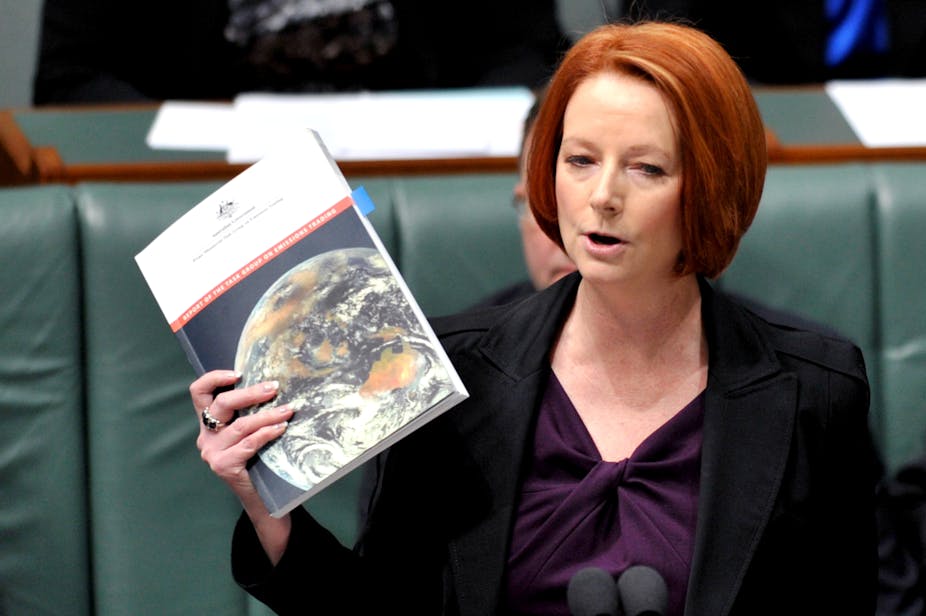
A survey of 145 economists released today found that 60% believe the Gillard government’s carbon tax is good economic policy.
The carbon tax package, announced on Sunday, penalises 500 heavy polluters for their greenhouse gas emissions and will create $24.5 billion over its first four years. It will be replaced with a market-based emissions trading scheme in 2015.
The policy has been fiercely opposed by the Coalition, which favours a suite of direct action policies instead to tackle climate change.
However, the survey of economists found that 85% of respondents who had a view on the Coalition’s plan did not think it was sound economic policy.
The survey was conducted on Monday at a meeting hosted by the Economic Society of Australia at the Australian National University (ANU).
“We asked two questions. Roughly how much are you in favour or against this carbon tax package announced by the government? And what is your reaction to the direct action plan of the Coalition?,” said the Economic Society of Australia’s president, Professor Bruce Chapman from the Crawford School of Economics and Government at ANU.
“The results were fairly clear cut. Something like 60% were in favour of the governments approach and 25% were against and 15% had no opinion.”
Professor Chapman said the results were not surprising.
“One of the basic tenets of economics is that if people are engaged in an activity which is seen to be harmful to society, then the role of government is to tax that activity to diminish that type of behaviour,” he said.
“It would be fairly surprising for a government to be engaged in penalising behaviours that were seen to have adverse conseqeuences, such as carbon emissions, and for economists not to be in favour of that. It’s a fairly mainstream way of analysing public policy.”
The survey coincided with the release of another poll of 500 members of the Economic Society of Australia on a range of policies, including the mining tax and middle-class welfare.
Around 70% of respondents to that survey said they support a national excess profits tax on miners and two-thirds of want middle-class welfare cut so that more assistance can be given to the disabled and severely disadvantaged.
“The bulk of the economists favour abolition of the Baby Bonus and the First Home Owners Grant, and are in favour of introducing the indexation of tax thresholds and for the introduction of congestion charges,“ Professor Chapman said.
“A solid majority of the male economists surveyed opposed requiring quotas of women for company boards. However, of the 94 women who responded to this question, opinion was balanced with 44% for and 44% against.”
John McLean
logged in via email @connexus.net.au
I suspect that you are not a statistician.
I'm underwhelmed that you say "85% of respondents who had a view on the Coalition’s plan" but fail to say what the base number is. Was it 20 who had a view? Was it 200?
I take it that 60% (surprisingly few!) of the total number were in favour of the government's proposed scheme, but you fail to report what the (self assessed) degree of support from each individual was. A mere 60% of people, of whom the majority gave it a borderline pass is rather different to 60% giving it 95% approval.
In fact I'm not even sure about the point of your article considering how bland it is. If it was an attempt to garner more support, which I suspect it is because there's no hint to the contrary, then it's hardly impressive and I ponder why you would take such a partisan position.
Mark Matthews
General Manager
Ah John - an article about the carbon tax, and here you are.
Lay off the whole attack troll position for a while. The headline clearly states that the majority of economists back the ALPs carbon tax - ie - >50%. Not everything is as black and white as you might like it to be and Sunanda does not have to take a side to present the information.
James Harrison
Postgraduate student at Monash University
It is telling, John, that you feel what is in fact an impartial presentation of news comes off to you as 'bland'. Have you been so drugged by charged opinion columns and hyperbole that you can't see the point of what used to distinguished from opinion?
The point is, of course, to present information. Nothing more, nothing less.
John McLean
logged in via email @connexus.net.au
I'm not an atatck troll. I simply ask for credible evidence and substantial statements. Quoting percentages is of no value whatsoever unless the base number is given.
Simple example: if The Conversation says that it's readership has gone up by 50% over the previous month and doesn't give us any idea of the original and new figures, we don't know if that was from 2000 to 3000, 200 to 300, 20 to 30 or 2 to 3. I may be odd but I do think that a context is important.
Mark Matthews
General Manager
I very much doubt "credible evidence" is what you are looking for.
I am assuming this is you: http://www.skepticalscience.com/news.php?p=2&t=61&&n=665
If I am wrong, I apologise but it is not a long bow to draw considering the position you take on any climate change/carbon tax related article in the conversation.
Perhaps what you need to be doing is finding "credible evidence" to justify your skeptical position. We would all be very happy to hear it.
Muguma Ley
logged in via email @trinitylismore.com
John seriously, I think you need to pull your head out of the ground!
And John it is attack*
james harrison i have seen retarded weasels who make better points than you.
Mark Matthews you are my hero <3
And tags on anybody else.
ily all my fans
Sunanda Creagh
Editor at The Conversation
Hi John,
The poll was of 145 economists. When asked for their view on the Coalition's direct action plan, 27% said they did not have a view. 73% did have a view. Of those that did have a view, 85% said they did not think it was sound economic policy. Hope this helps.
Bob Simpson
Project manager
Hi Sunanda,
Referring back to Professor Chapman's comments, does this mean that 85% of 145 thought it (the Coalition approach) was not good policy, simply because it did not tax the adverse behaviour of 'human induced carbon dioxide emissions'?
Chris Weir
Analyst
Professor Chapman is also reported as saying words to the effect of 'like a group cheering themselves' and 'backslapping'.
Nathan Stewart
Mr
Has anyone heard of economists opinion on what the advantage/disadvantage of a carbon tax/price will be for the Australian Economy if the US defaults on its debt repayments? Im just interested because the US debt negotiations seem to be on a knife edge, surely our economists and gov are considering what the consequences will be?