


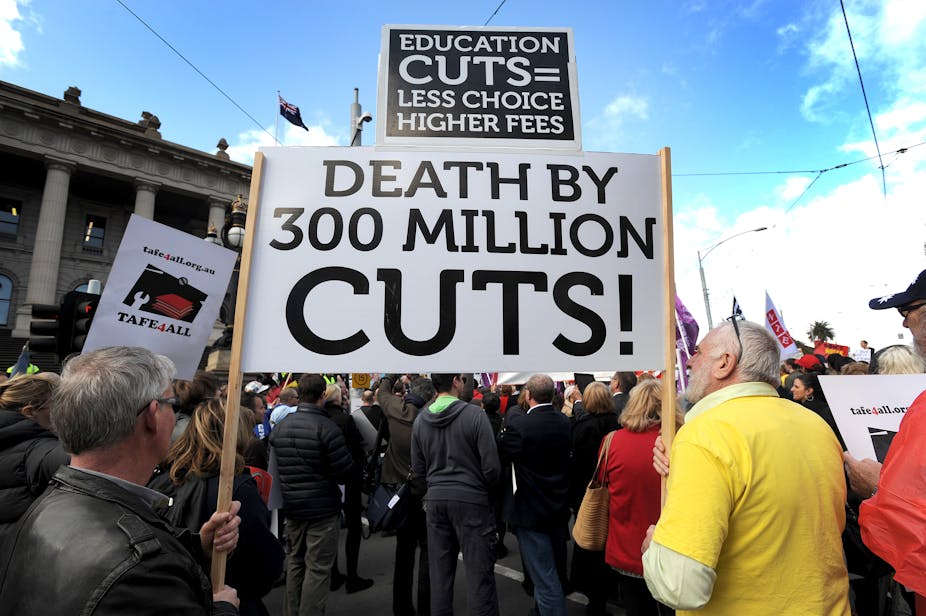
State governments are shifting responsibility for education to the Commonwealth, resulting in mixed messages about the importance of education to Australia’s future, say education experts.
Yesterday NSW became the third state to make major cuts to TAFE, as part of broader education cuts designed to save $1.7 billion over four years.
“What the state governments are doing is quite mischievous. They are passively shifting responsibility to the Commonwealth,” said John Pardy, education researcher at Monash University.
“They see the Commonwealth is, through the Gonski review and Bradley review of higher education, moving into secondary and tertiary education.
"I also suspect that they’re following a pattern that emerged under the Cameron government in the UK which was to go after education as a way to save money.”
The NSW Government will cut 1,800 jobs in the Department of Education, cap TAFE staff and teacher spending, and freeze funding to independent schools. It will also increase TAFE fees by 9.5%.
NSW Minister for Education Adrian Piccoli said the government is receiving $2.5 billion less in revenue each year since it was elected, with general expenses in the education portfolio outstripping growth in government revenue, leading to an “unsustainable” situation.
The cuts to TAFE come as the OECD reports as many as 85% of 25-64 year-old Australians who have attained vocational education were employed in 2010 – the second-highest level among OECD countries.
Australia’s education spending by government as a proportion of all spending is slightly above the OECD average. But Australia ranked 20 of 37 countries for total spending on education as a percentage of GDP – at 6%. And this result was largely attributed to the government’s $16.2 billion Building the Education revolution program.
The public share of total spending on education was also below average, put down to Australia’s relatively high university fees, high levels of full-fee paying international students, and high proportion of school students attending private schools.
“We’ve got an uncapped higher education system sitting alongside an underfunded and struggling VET sector,” said Louise Watson, associate professor at the University of Canberra’s Lifelong Learning Centre.
Professor Watson said it’s not surprising that State treasuries would take advantage of the uncapped higher education system.
“It’s a tragedy of the federal education system that responsibility is shared between the Commonwealth and the states,” she said.
“It has meant that the Commonwealth, who has the least financial responsibility for the system has been able to favour universities and private schools, whereas the huge funding burden of TAFE and school systems still remains with the states and that’s why you get these distortions in the post-compulsory school market.”
Mr Pardy said education cuts were “easy pickings” for states looking to save money.
“The way these politicians and political parties see they can get their budgets into balance is by making those who can least afford to pay pay, and that’s the tragedy.”
Peter Aubusson, head of teacher education at UTS, agreed that cutting funding out of the education system would hurt those at the bottom the most.
“When you cut government support and funding out of education it’s the people least able to cope that will be hit worst.”
Dr Aubusson said there were two agendas running at the same time, with State and Federal ministers saying they wanted to invest in education to help those people that are disadvantaged, but at the same time overseeing funding cuts.
“They’re actually engineering greater disadvantage here,” he said.
Dr Aubusson added that Australia was moving to a situation where most things seem to be determined by Treasury.
“Treasury is on a short cycle. These big social and infrastructure agendas don’t run on a one or three year cycle.”
He added that for every dollar cut out of education now, Australia would pay more for it later in terms of the costs arising from social unrest, imprisonment levels, loss of human capital, poor health outcomes and poorer economic performance.