
Explainer: The difference between a carbon tax and an ETS

The proposed carbon pricing policy in Australia is now routinely referred to as a “carbon tax” by both government and opposition. This is odd, because the proposed scheme is not actually a tax. How does an ETS work? It seems reasonably likely that Australia will, sooner or later, end up with an emissions…

Aapone-20091212000212649374-france-climate-pollution-original
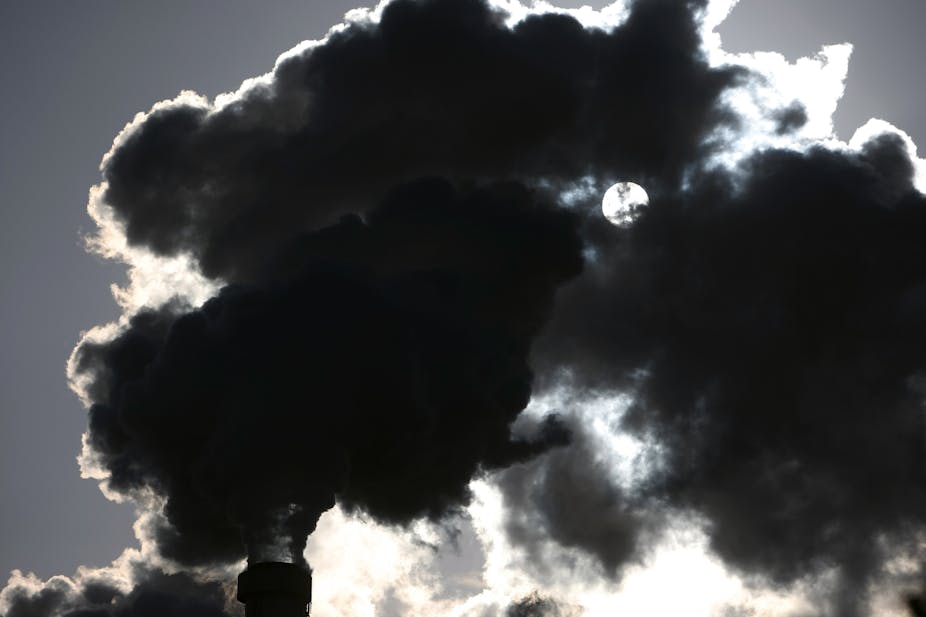
An emissions trading scheme and a carbon tax are not the same thing. AAP

The proposed carbon pricing policy in Australia is now routinely referred to as a “carbon tax” by both government and opposition.

This is odd, because the proposed scheme is not actually a tax.

How does an ETS work?

It seems reasonably likely that Australia will, sooner or later, end up with an emissions trading scheme (ETS) for CO₂.

An ETS works by setting a cap on emissions and requiring emitters to hold a permit for each tonne of CO₂ that they emit. The level of the cap determines the number of permits available.

If emitters don’t already hold a permit, they must either cut back on their emissions or buy a permit from another emitter, who must then cut back.

This means that a cost is imposed on emissions, equal to the price of buying or selling a permit.

But importantly it’s not actually the price that causes the overall cuts in emissions. The cap determines the level of emissions, and the required cuts in emissions cause the price.

That is, permits have a value because they allow you to avoid making cuts in emissions.

How does this differ from a carbon tax?

A carbon tax is sort of the opposite. A cost is added to all emissions, equal to the level of the tax, and this causes people to cut back.

There is no cap on emissions in a tax-based system. People are free to emit as much or as little as they like, but if they do emit, they must pay the tax.

Unlike an ETS, under a carbon tax it is the price that determines the level of emissions.

Where is Australia in all this?

The system the Australian government is currently proposing to move to in the medium term is a standard ETS, not a carbon tax.

But in the short term, there is a twist.

The proposal is to fix the price of permits for the first few years, presumably to reduce uncertainty during the transition period after the scheme commences.

It would still be an ETS, with a cap on emissions and permits that can be traded, but the price of permits would be fixed by the government.

There is a similarity between the fixed-price ETS approach and a carbon tax. If the fixed price is set at a high enough level, then it would be that price, rather than the cap, that determines the level of emissions.

At that high carbon price, people would actually emit less than the maximum level set by the cap. In that case, the ETS would be behaving somewhat like a tax.

But there are still important differences.

In the government’s proposed scheme, permits could still be traded among emitters and potential emitters, even in the period when there is a fixed price. That does not occur under a carbon-tax regime.

Where does the money go?

When people pay a carbon tax, the revenue goes to the government.

A fixed price ETS could be set up so that the initial revenue goes to the government (i.e. all the permits are sold by government at full price).

But it could also work effectively even if some of the permits are given away, which the government is likely to do, provided that subsequent sales were only allowed at the fixed price or the cap is enforced.

Revenue from subsequent transactions between emitters would go to the seller, not to the government.

If the fixed price is set too low, it may actually inhibit trade, resulting in inefficient emitters who have been given permits continuing to emit. That would not happen under a tax system.

Another difference between the two approaches would be in the level of transaction costs – the costs of administering the scheme and or of participating in it. Some have argued that a carbon tax is likely to have lower transaction costs, and that does seem plausible to me.

How will households be affected?

From the perspective of households, the scheme will be no different in its fixed-price phase than in its later floating-price phase, other than in the level of carbon prices (which will rise over time) and the initial absence of price volatility.

Households will not have to pay for emissions permits directly, but will do so indirectly as businesses pass on some or all of the higher costs they face.

If the government had opted for a carbon tax, the result at the household level would not have been noticeably different. Higher costs would have been passed onto them through higher prices in a similar way.

It would also have been possible to compensate low- and middle-income earners through reduced income tax or increased government payments, just as is planned under the ETS. In neither case would individuals have to put in any sort of tax return for their carbon emissions.

Can the government avoid the stigma of the word “tax”?

Despite the similarities described above, it is factually incorrect to call the proposed system a carbon tax.

I can understand why the opposition wants to call it a tax. It plays to people’s dislike of any sort of tax. But to me it seems odd that the government has adopted the same language.

Given the traction opposition Leader Tony Abbott got from his line about a “great big new tax on everything” during the last election campaign, you’d think that the government would avoid the “tax” word if they could.

And they can. Their proposed initial approach is in fact not a carbon tax, but an ETS with a fixed price.

Articles also by This Author

Sign in to Favourite

Want to follow The Conversation?

Sign up to our free newsletter to get the day's top stories in your inbox each morning, with a special wrap on Saturday.

Spinner
Help evidence based journalism become the norm and donate

Join the conversation

12 Comments sorted by

  1. David Smith

    IT Communications Professional

    The difference between an ETS and a carbon tax is, unfortunately, too nuanced for a large portion of Australians.

    report
  2. Troy Barry

    Postgraduate student

    It's possible that, in the aftermath of the financial crisis, "trading scheme" tested worse on focus groups than "tax". At least people understand what a tax is, while to the untrained ear "trade in carbon dioxide emission permits" doesn't sound very different to "trade in collateralised debt obligations".

    report
  3. Ken Xie

    Policy Officer, DCCEE

    Without having insight into the deliberations of the Multi-Party Climate Change Committee, one can surmise that the reason why the Labor Government is calling the proposed scheme a "carbon tax" is because the fixed price of the permits means the result is more akin to that of a carbon tax than an ETS.

    A slight alternative to what is proposed above is an ETS with a price floor (and/or ceiling), which would provide stability and predictability in the price of permits without having the Government take over the role of markets in setting prices.

    But all this is conjecture since the devil, as always, is in the details, and we don't yet have the details.

    report
    1. Peter Poul Bjerregaard

      Sociologist

      In reply to Ken Xie

      An often-overlooked downside of Emissions Trading Schemes (ETS) is the progression, or the lack hereof, of the amount of total emissions-quotas.

      In a situation where the ETS has a fixed level of emissions, energy-efficient companies will create an unintended disincentive for other companies not to adopt more energy-efficient technologies or improve business models as the improvement of other companies will lower the price of emissions and thus create an unintended disincentive to move towards emissions abatement.

      This concern is partly also reflected in the EU’s recent efforts to move from 20% CO2-reductions in 2020 to 30% in 2020.

      report
  4. Mel Nicholls

    logged in via Facebook

    My understanding was that when the idea was first proposed, Labor did call it a carbon price, or something similar with less negative connotations, and the opposition jumped on it as a tax, which has stuck as a label.

    Either way, good to have the differences explained.

    report
  5. Douglas Cotton

    B.Sc.(Physics), B.A.(Econ), Dip.Bus.Admin

    Whatever you call it, it's totally useless ...

    If you care to visit http://earth-climate.com you'll learn why adding extra CO2 has no further effect on temperatures. You'll also learn that the IPCC completely disregarded the component of temperature contributed by gravitational energy. And you'll learn that temperatures have not risen since 2003 despite increasing CO2 levels. So why will they increase in the next 10 years? They won't until about 2027 or 2028. Then they will increase for 30 years (as in 1970 to 2000.) It's all in the stars.

    report
    1. Andrew Kirk

      logged in via LinkedIn

      In reply to Douglas Cotton

      Why did you choose 2003 Douglas? That's an eight-year period. Not five years, not ten years. Eight. Nobody ever quotes eight year periods unless there was some specific significance of the start and end dates. You wouldn't have happened to choose 2003 because it was a local maximum in the data series on which you base your observation would it? As you have a BSc in Physics I assume you realise that if that's the case, it makes your observation devoid of any significance.

      What happens if you instead use the shortest round period most people would use - a ten year period starting in 2001?

      report
  6. Richard Lester

    Teacher

    I am not an economist, but if:

    1) the carbon price is floating under an ETS

    2) the 2020 cap is a 5% reduction on 1990 levels under both a direct action model and an ETS

    3) direct action works, ie reduces the emissions to 5% below 1990 levels

    Won't the floating market clearing carbon price fall to zero? (If the permits are not bankable)

    If this is the case, the coalition won't even need to repeal the legislation, they will simply need to deliver on their promised cut and there will be no price on carbon.

    report
    1. David Pannell

      Director, Centre for Environmental Economics and Policy at University of Western Australia

      In reply to Richard Lester

      As long as the 5%s are the same (i.e. they relate to the same base level) then yes, you are more or less right. The coalition would need to issue permits for every ton of emissions reduced, and then yes, the price would be driven to zero for as long as the "direct action" cuts match (or exceed) the reductions implied by the cap.

      Whether this is a good idea is another matter entirely. There is a strong consensus amongst economists that The Coalition's approach will be a more expensive way of achieving a similar outcome.

      report
  7. Keith

    logged in via Twitter

    I realise this is an old article, and I guess it was written before the legislation was announced, but I just want to address something.

    In the governments fixed price period of the ETS (3-5 years) there is:

    -No cap on emissions
    -No trading of permits
    -No banking of permits

    I think there is a very fine line between this "fixed price ETS" and a "carbon tax". I think it is -fair- to call the fixed price period a "tax", it functions effectively as a tax. But I think that you should always…

    Read more
    1. Troydeboy

      logged in via Twitter

      In reply to Keith

      Great call here Keith, you are spot on. Of course we are looking at these comments and the article in hindsight, by a year actually. Abbott has a bit of a dodgy stench about him due to his flip floppiness. I think we'll be in for a turbulent time, if this guy gets in.
      A double minded man is unstable in all his ways. Not sure how true this proverb is, but makes sense to me!

      report
    2. David Pannell

      Director, Centre for Environmental Economics and Policy at University of Western Australia

      In reply to Keith

      Yes, things have changed since I wrote that article. It is now clear that the system, as actually implemented, is to all intents and purposes, a carbon tax in this initial phase. So my comments above about avoiding the use of the word "tax" are no longer relevant. It is still the intention to switch to an ETS with a floating price. Another new aspect is that the ETS will be linked to the European system, so that Australia will basically be price takers.

      report