


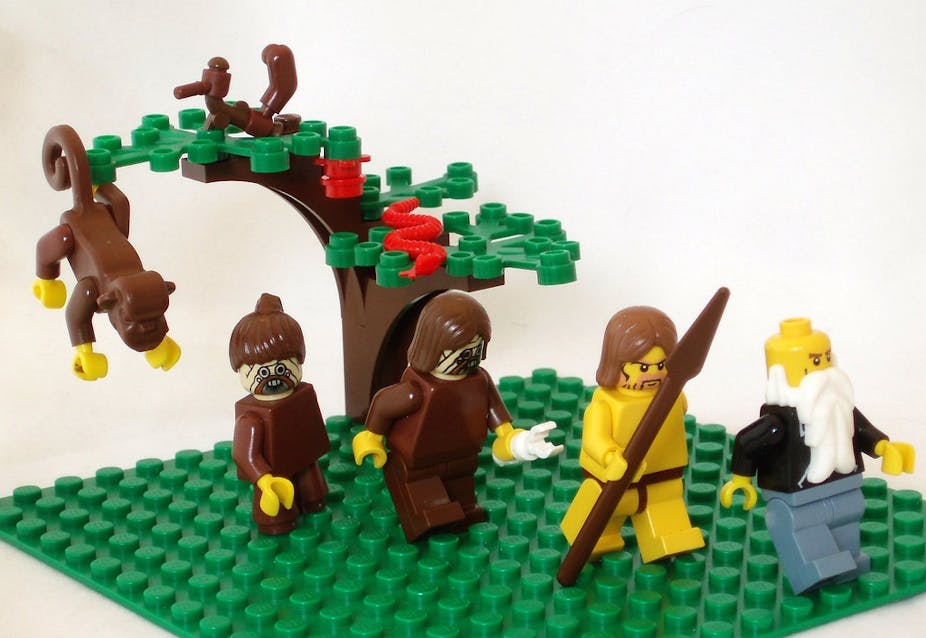
The theory of evolution encompasses the well established scientific view that organic life on our planet has changed over long periods of time and continues to change by a process known as natural selection.
Charles Darwin, the 19th century naturalist, is given credit for the theory, not because he was the first person to suggest evolution occurs, but because he proposed (in his seminal 1859 text, On the Origin of Species) a mechanism that explains the process of change.
The theory of evolution contains two parts, both of which are unnecessarily contentious. The first is the word “theory”, which means something slightly different in everyday speech than it does in science.
The second contentious word is “evolution”, because some people argue that there is insufficient evidence to support the idea that species change over time. Proponents of the latter view rely on our dual uses of the word theory to confuse the issues.
Theory
When most people use the word “theory”, they refer to a well argued bit of guesswork.
Someone might propose a theory about why a football team lost, which could lead to a spirited debate with other football fans precisely because the theories under discussion derive from mere speculations and untested assumptions.
When scientists use the word theory, they refer to a group of principles or laws developed over many years through rigorous hypothesis testing. Such theories are backed up with mathematical formulas and lines of evidence that when taken together explain a series of observations.
Gravity is a fact because it summarises a number of observations that can be made by anyone. Despite the fact there are different theories explaining gravity (Newton’s law, Einstein’s theory of relativity and more recently, quantum field theory), no-one would say gravity does not exist.
Similarly, biological evolution is supported by so much evidence from various scientific disciplines that it is a fact every bit as true as gravity. The theory of evolution, therefore, is not about whether or not evolution occurs, but how it occurs.
In the same way that our understanding of gravity has changed over time, our understanding of the process of evolution has changed over time and continues to change.
Natural selection
There are two major components to the theory. The first is the mechanism of natural selection, which was proposed independently by Charles Darwin and Alfred Russell Wallace in 1858.
In the same way artificial selection occurs when breeders choose seeds or studs that will improve their stock in the next generation, natural selection is the process of sorting living things according to how well adapted they are to their environment.
In the case of artificial selection, humans choose which traits are desirable. In the case of natural selection, traits that increase the likelihood of survival and reproduction will become more common within a population or species over time.
In the past, natural selection has been misrepresented by calling it the survival of the fittest. This statement oversimplifies the mechanism by making it sound like a tautology: the survival of those who survive.
The truth is that individuals never survive. What survives is the process for making another individual, and this resides in genes found in populations.
Natural selection has more to do with differential reproduction than survival, and what it selects are the genes that code for desirable traits or characteristics. The interaction of individuals with their environment provides a mechanism for sorting out which traits (not which individuals) will be passed on to the next generation.
Nature of inheritance
The second major component to the theory is the nature of inheritance, which follows the insights made by Gregor Mendel in 1865 and has advanced considerably since then due to our understanding of genes, DNA and the molecular processes of life.
When natural selection was first formulated by Darwin, the nature of inheritance was not understood. Our current understanding of inheritance is very sophisticated and includes the precise mechanisms for passing genes on to the next generation, how genes are modified by mutation and how they are shared among sexual species.
If we know enough about a gene and its various forms, it is possible to accurately predict the change in the frequency of those genes over time using mathematical formulae from population and evolutionary genetics theory.
This alteration of gene frequencies is subtle and does not, at first glance, seem worthy of being called evolution. But it is precisely these small changes at the genetic level that lead to large changes in the organisms that carry them.
The sorting of genes affects the fate of populations: populations drift apart and become species, and species diverge to create whole groups of plants or animals that dominate the landscape for millions of years.
The intricate details of cellular processes are responsible for the glorious and majestic diversity of life on our planet.
The theory of evolution includes large changes over vast periods of time and tiny changes made when one cell divides into two.
These processes form a continuum that is the history of life on Earth.
What element of science or technology would you like to see explained? Contact the section editor here.