
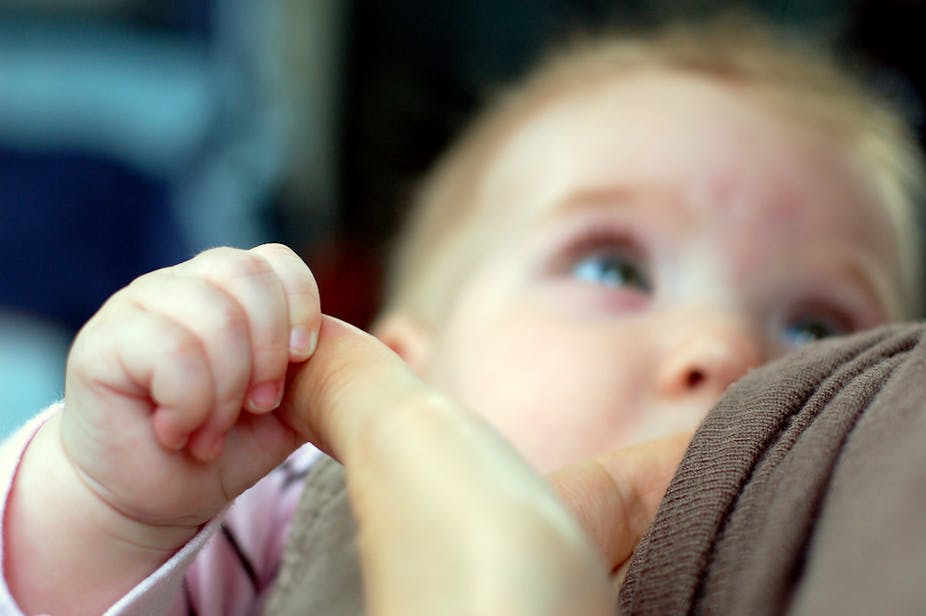
Breast milk is one of the most important components of infant care. It provides complete nutrition and helps to prevent and fight infections. And it’s also safer – in much of the world, artificial infant feed is dangerous because clean water, which is essential for mixing with the powder, may not be available.
The World Health Organization (WHO) and UNICEF recommend that infants be exclusively breastfed for six months and continue breastfeeding with the appropriate introduction of solids.
In Australia, although we have safe alternatives to breast milk and clean water to mix it with, we need to make mothers aware that breastfeeding needs to be the norm to protect their babies from infection. Babies are born with a relatively immature immune system that is supplemented with antibodies created by the mother in response to the environment that she and her baby share.
The risks of not breastfeeding include an increased incidence of respiratory and gastrointestinal infections in infancy. What’s more, people who have not been breastfed have a higher incidence of obesity, diabetes, high blood pressure and coeliac and Crohn’s disease.
Mothers who breastfeed also enhance their own health – breastfeeding has been linked to a reduced incidence of breast and ovarian cancers, diabetes and cardiovascular disease. And, breastfeeding is environmentally-friendly – it doesn’t produce any additional waste from manufacturing or packaging.
Artificial infant feeds contain some components that are similar to breast milk but it’s impossible to mimic the vast array of live cells and other components of human milk that have important beneficial qualities. Nor can formula milk reflect or imitate the changing nature of breast milk over time. The amount and type of immune factors in breast milk change as babies grow and develop, and it even has a different composition if a baby is born prematurely. Indeed, an artificial infant feed that is largely the same as human milk simply doesn’t exist.
Breast milk introduces infants to flavours in foods that are thought to influence later eating habits. Research shows young children who have been breastfed eat a wider range of foods.
Mothers need accurate and appropriate information to help guide them through any difficulty they have with breastfeeding. Many groups advocate for breastfeeding and provide resources to educate the broader community. Information for families can be found on websites of the Australian Breastfeeding Association, Raising Children Network and the Baby Friendly Hospital Initiative.
Some women begin breastfeeding when their babies are born but then stop soon afterwards for one reason or another, such as a lack of support, the need to return to work or the thought that they don’t have enough milk. Breast milk is difficult to measure and the focus on numbers in infant care with regular measures of weight gain probably doesn’t help these doubts.
It’s easy to measure volumes consumed when feeding artificially but monitoring the amount of breast milk an infant is getting is more reliant on indicators such as urine volume, stools, infant behaviour and growth. Most babies are able to grow and thrive on breast milk alone until they are six months old, with a neat system of supply and demand; the more frequently the baby feeds, the more milk the mother makes!
We need to support breastfeeding because it’s the optimal way to feed infants. We can do this by creating and maintaining ways to encourage mothers to breastfeed – but we also need to encourage them to continue breastfeeding until their child is two years of age or beyond.
Access to health-care professionals who are trained and committed to breastfeeding as well as increasing the community’s knowledge to support women who are doing so will be helpful. Breastfeeding should not be hidden away, young women who observe others successfully feeding will be more likely to choose to breastfeed themselves.
And having a strong culture of breastfeeding will mean there are lots of women around who have the wisdom of their own experience to share. Governments can help with legislation to protect and promote breastfeeding and by implementing the WHO and UNICEF global strategy for infant and young child feeding.
See more Explainer articles on The Conversation.
Sue Ieraci
Public hospital clinician
Okay - I understand that questioning the magnitude of benefit for something as basic as Mother's Milk might require either courage or lack of insight - but here we go: the health benefits for breast feeding in our wealthy society are not as great as claimed. There: I've said it.
No argument with the hazards of formula in impoverished communities - where there is no guarantee of clean water, and poverty can lead to dilution and malnutrition. Breast-feeding can be life-saving in this setting…
Read moreKate Hegarty
logged in via Facebook
Why is it we cannot talk about health interventions because it might make a population group feel like a 'failure'?
I understand the point you are making - however, I find this line of reasoning to be patronising. That guilt and fear and sense of failure comes from underlying insecurity around choices - so shouldn't parents have access to all the support and information they need, rather than the limited 'oh yes, breastfeed if possible but bottle is just as good'. Why talk about the bottle at…
Read moreSusan McCosker
Former school teacher
That idea of 'failure' must be somewhat ingrained: I just read the third last paragraph of the article and momentarily thought 'We need to encourage breastfeeding beyond two years? I've breastfed two children each for eighteen months, and that's STILL not good enough?'
I began breastfeeding and using cloth nappies on my first baby (six years ago) because I honestly didn't realise that people actually did otherwise. I've continued both activities with my second, and will with my third, because it works out a whole lot cheaper. Besides, bottle feeding seems like such a hassle!
Sue Ieraci
Public hospital clinician
Kate Hegarty asks "Why is it we cannot talk about health interventions because it might make a population group feel like a 'failure'? "
Because, in our society, the benefits to babies' health are marginal (as I've explained above). If breastfeeding made a great difference (as it does where there is no clean water), there would be a stronger case to push for it in all children.
"oh yes, breastfeed if possible but bottle is just as good'. Essentially, the bottle IS just as good. That's what…
Read moreKate Hegarty
logged in via Facebook
Certainly, in my previous message I was speaking anecdotally and narratively, from my own experiences as a mother, and from my own research before motherhood. When I wrote 'confident', I also meant women who had access to resources and coping skills -- social, economic, cultural support as well as knowledge regarding the mechanics of breastfeeding.
So yes, confidence is key - without some self belief how can anyone do anything? Women internalise the failings of their bodies at a young age and…
Read morePaul Richards
strategic foresight
Sue I - I value your opinion and understand the values your are promoting, thanks for the comment.
We all know industrialising food has had global ramifications, we have many articles here written around these issues. Looking at the overview any organisation, group or government body claiming that multinational food corporations have the formula for the foundation of human life 'right' is far fetched. We may be approaching singularity with AI, have fantastic advances in genomics, but there is vast difference in applied knowledge and the values of the worlds food corporations.
Before asking mothers to put their child's life in the hands of these entities, we would need to see a serious shift in their corporate value systems. The premiss that breast feeding mothers are not up to challenging multinational food corporations for healthy food and experience is flawed.
Food singularity with hundreds of thousands of years evolution is not that close and but just sales rhetoric.
Sue Ieraci
Public hospital clinician
Thanks, Paul. Just to clarify, I am not presenting my own opinion or values - I am presenting what the research shows.
Until I started lookingin detail at infant outcomes from feeding, I had happily accepted the "breast is best" message - who argues against mother's milk? I was personally surprised to find that the outcomes for our children don't depend much on what type of milk they are fed. That's what the population studies have found.
As I said before, breast feeding difficulties were not…
Read moreSue Ieraci
Public hospital clinician
Kate Hegarty's essay display how emotive and value-laden this issue is. But I have to keep saying: the evidence shows that, in our society, the type of milk that a baby is fed just doesn't make that much difference.
My guess is that Arthur Eidelman has never successfully breast-fed.
Paul Richards
strategic foresight
Thanks Sue for your comment, your values are appreciated.
Read more"Certainly the promotion of formula in the impoverished world is unethical "
On this issue we have a value system divergence, we both know the methods used to target women at our stage of development are very sophisticated, as it is the entire industrialised food chain. "Appropriate Nutrients" are weasel words for corporations making equal product, and a clear demonstration of detached cold corporate view.
The last decades research done…
Sue Ieraci
Public hospital clinician
Paul - you may wish to update your knowledge about infant feeding and gut flora. There is a good article on this very site:
https://theconversation.edu.au/are-people-born-by-caesarean-section-more-likely-to-be-obese-7200
"Although birth is when we first encounter microbes, the process of acquiring a stable gut microbiota takes time. As any parent knows, an infant’s poo will change dramatically in texture, smell and even colour over the first year and introducing anything new to the diet often precedes an interesting experience. A stable microbial community isn’t formed until we have a fully developed immune system and an adult diet pattern – well after age three."
Paul Richards
strategic foresight
Sue I - thanks for that, I read that the day of publication. But will return the favour
Read moreThe Application of Ecological Theory Toward an Understanding of the Human Microbiome
www.sciencemag.org/content/336/6086/1255.full 4/11
represent and reveal the fundamental types of assembly relevant to human health.
Postnatal Acquisition and Development of the Human Microbiome
"Exclusive breastfeeding selects for increased abundance of particular Bifidobacterium species whose genome sequences reflect specialized…
Sue Ieraci
Public hospital clinician
Hi, Paul. You say " industrialised formula makers have not even begun to understand or develop strategies to mimic the breast feeding cycle taking the development of microbiota and immune system before it settles into an adult diet pattern."
Perhaps your "extensive scans of published data" have missed these papers:
"Galacto-oligosaccharides Are Bifidogenic and Safe at Weaning: A Double-blind Randomized Multicenter Study" Journal of Paediatric Gastroenterology and Nutrition 2009
"Prebiotic…
Read morePaul Richards
strategic foresight
Sue I said " ..... have missed these papers" Some, not all.
Read moreGiven the many thousands generations of human evolution medicine is trying to unravel, my saying; " not even begun to understand or develop strategies to mimic the breast feeding cycle" I stand by and will explain the line of thought.
Mimicking breast milk is as limited as the broad spectrum of drugs used currently, and we both know medicine is moving down the personalised pathway for their use. Given the implications of microbiota…
Sue Ieraci
Public hospital clinician
Paul, medicine isn't trying to unravel anything - it is assisting nature in improving health outcomes and longevity. Those thousands of generations of human evolution that you mention have not produced a perfect human organism - we still get obstructed labour, tooth decay, tonsillitis, and inability to breast feed.
Historically, if women could not access a wet nurse, they might substitute goats milk, or diluted Carnation in later years. Otherwise, some babies starved.
We now have access to…
Read moreVal Kay
PhD candidate, public health
Hi Sue
Read moreI've done quite a lot of research on breast feeding some years ago. Though I'm not currently working in that area, your comment set off some alarm bells for mr because it sounds a lot like comments made by some researchers who were funded by infant formula companies. So I checked out your first link and it seems you have misunderstood what the authors are saying. They found that complete breast feeding for two months or longer, or partial breast feeding for a longer period, offered "substantial…
Sue Ieraci
Public hospital clinician
Your comments strike me as ironic, Val Kay, as that is exactly my concern about the author of this article - who appears to be making recommendations based on ideology.
Your comments about "researchers funded by infant formula" amuse me - and couldn't be further from the truth. I am no fan of multinational manufacturers, and don't approve of them pushing women in impoverished countries to use formula.
This is not my area of practice or research - but I have read a large amount of the original…
Read moreTom Hennessy
Retired
The problem with formula may lie in WHICH formula is being used.
"Infants who already had high levels of hemoglobin proteins in their blood and were fed iron-fortified formula ended up with lower scores on tests of thinking and memory than those given low-iron formula"
Sue Ieraci
Public hospital clinician
COnversely, Tom, iron-fortified formula is great for preventing iron deficiency, which can occur when iron-deficient mothers breast-feed.
Tom Hennessy
Retired
You keep bring up 'iron deficient' women when in fact , if you were current in your medical studies , very few iron deficient women even exist. You willy nilly advocate giving iron fortified formula to children WHETHER OR NOT they are iron deficient , because it has only been lately they are supplying NONiron fortified formula.
Sooo , technically , you can thank yourself and your ilk for all the asthmatic Australians wandering , gasping , aboot.
"The existing research bears out the hypothesis that iron supplementation in formulas, and even children's nutritional supplements, may be indirect risk factors for asthma in children."
"It appears that the development of vitamin E deficiency anemia occurs in infants receiving iron supplementation."
Paul Richards
strategic foresight
Evelyn V - thank you for this article. A very emotive subject, every parent has reasons justifying their decision to follow through or not on this natural process.
Read moreWith industrialisation of human foods we have lost many advantages and those given during breastfeeding count as some of the clearest lost for any human. We all know the list of benefits has grown so great it is really not possible to cover all the science effectively in an article like this.
Most women know this truth within their…
Sue Ieraci
Public hospital clinician
"Most women know this truth within their interior or intuitively, so If they do not persist and fail with breast feeding suffer the internal consequences. Always ready with lines of logic and emotional reasons why it was not possible. Down deep inside the pain of missing this crucial mothering experience lasts a life time, raising doubts when issues arise about the child's physical and probably most importantly their psychological health."
This is exactly the type of emotive nonsense that mothers have to contend with. Paul - show us the evidence that formula-fed babies "physical and psychological health" suffers.
Of course it is possible to cover the science - that's what this type of website is for.
Lisa Hodgson
Director
FWIW, I completely agree with Paul and Kate. I don't need science to tell me that the most natural process post birth is best. My simple question is why would a scientist hypothesise that baby formula is better than breast milk?
I would also add that there IS a problem in wealthy countries with formula feeding, i.e. fluoride in the water and fluoride in the formula.
Sue Ieraci
Public hospital clinician
Lisa - nobody has hypothesised that baby formula is better. They did what scientists do - they looked for a difference in outcome, and found that (a) feeding method didn't amke much difference to outcomes for babies; and (b) that there are many other more important determinants (as I listed above).
"Natural" human processes are not always better, no matter how much we might like them to be. Breasts are not perfectly functioning organs - just like the rest of the human body.
Fluoride in the water is a real bonus for both mothers' and babies' dental health.
You are free to hold whatever opinions you like, but you are not free to make up the facts.
Lisa Hodgson
Director
Sue, can the evidence say anything about the evolutionary benefits of breast feeding over a generation or two? Can you definitively say that science knows everything there is to know about breast feeding and the whole range of physical and psychological benefits it provides both mother and baby? Can you definitively say that infant formulas provide each and every one of those benefits? You place a lot of faith on the *evidence as if it is always the final word. More like a religion than science…
Read morePaul Richards
logged in via LinkedIn
Lisa H - thanks for the link posted.
"Practitioners should be aware that children are exposed to multiple sources of fluoride during the tooth development period. Reducing fluoride intake from reconstituted infant formula alone will not eliminate the risk of fluorosis development...." At the opening of the conclusion. http://jada.ada.org/content/142/1/79.full#ref-27
Awareness is raised, much appreciated.
Sue Ieraci
Public hospital clinician
Lisa - I'm not here to tell you anything definitiely - I'm directing you to what population-based research shows.
Can you definitely say that your understanding of fluoride is better than the overwhelming majority of dentists? Water fluoridation is one of the most successful public health measures - alongside vaccination.
Mother-infant health and bonding are much more complex than just about type and duration of feeding.
Lisa Hodgson
Director
Sue, you said "Fluoride in the water is a real bonus for both mothers' and babies' dental health". I provided evidence from the Journal of the American Dental Association that warns against too much F both from formula and water and the problem of fluorosis. You managed to ignore this yet as a clinician this should be something that you are aware of.
You linked to the respiratory disease study. Hardly a blanket health endorsement of infant formula. Hopefully dentists don't rely on the Cochrane Review for their knowledge of the safety effects on anything other than teeth. It is not a reassuring display of science in action.
Lisa Hodgson
Director
Hi Paul, you're very welcome. I've already had a bit to say on F on other threads here. Ditto, thanks, I've learned a lot about gut health in the past few days. What you posted added to that new awareness. You might be interested in GAPS theory? http://www.gaps.me/preview/?page_id=20
Sue Ieraci
Public hospital clinician
Yes, Lisa, TOO MUCH fluoride presents a risk for fluorosis, the optimal amount is a highly successful public health measure.
Too much potassium is life-threatening - the right amount is essential to life.
Too much magnesium makes you weak and hypotensive, the right amount is essential to muscle and myocardial function.
Too much glucose makes you pee too much and get hyperosmolar - the right amount gives your cells energy.
Do you see a pattern here?
Lisa Hodgson
Director
Do I see a pattern here? Well yes I do Sue. So how much exactly is the right amount of Fluoride? Please specify the perfect dose for infants, the perfect dose for adults, and the perfect dose for crocodiles separately.
Lisa Hodgson
Director
And please also state what the length of administration of the perfect dose of F should be to account for a life time of F doses.
Sue Ieraci
Public hospital clinician
Why ask me, Lisa - you can look all that up in the dental and public health literature.
Lisa Hodgson
Director
Nice evasion of the fact that there is utter disagreement about safe levels of F and that total F burden has hardly been examined but where it has there are concerns about correlations between high F burden and lower IQ! The fact that US recommendations for fluoridated water added to infant formula should be no more than .7ppm, and that the minimum dose in Victoria is .7ppm if the temperature is between 27C and 32C. Dose rises with cooler temperatures so Victorian bottle fed (+tap water) babies are ingesting way more F than they should be, especially in winter. Shall we talk about all of those smart countries around the world that DON'T F their water and their rates of dental caries?
Paul Richards
strategic foresight
Lisa H - thanks, it is interesting how early theories on microbiota started 1979. [GAPS theory]
With the cost of gene sequencing falling below a thousand dollars US, and projected to be hundred dollars soon we are literally at the very beginning of a new era understanding. Many CAM theory on microbiota can be tested most definitely and there are plenty of theories other than autism.
It is the literal interaction at cellular level that the knowledge will come and understanding of how human microbiota interact with the human digestive system from birth to death. We are at very beginning of this genomic research, will have soon have a definitive answer on microbiota breast to death. It takes a brave person to say human breast formula is ‘almost equal’ in comparing the genomic research era we are entering with previous methodologies and their limited evidence.
Sue Ieraci
Public hospital clinician
Paul - brave people are prepared to say that infant formula is "almost equal" to breast milk on the basis of OUTCOMES. Researchers have compared large populations of children and looked at how their health outcomes are influenced by a range of factors, including feeding.
Of course whatever new knowledge is discovered will add to our understanding of human physiology, but it won;t change the fact that the health outcomes for formula-fed and breast-fed babies, in our society, and all other things beinig equal, are not much different.
Paul Richards
strategic foresight
Sue I " ......"almost equal" to breast milk on the basis of OUTCOMES."
Projecting into our future about todays generation of formula fed children shows a great confidence.
My scan of our future sees major advances because of human microbiota and a completely different scenario unfolding about breast feedings importance. One again, thank you for your valuable insight into this area.
Tom Hennessy
Retired
"The existing research bears out the hypothesis that iron supplementation in formulas, and even children's nutritional supplements, may be indirect risk factors for asthma in children."
http://www.goodbabyfood.com/breastmillk-iron-baby-food.html
Lisa Hodgson
Director
Sue, Can you please provide some references for your claims? I'm struggling to find any "Researchers have compared large populations of children and looked at how their health outcomes are influenced by a range of factors, including feeding."
What I have found does not support your assertions. E.g. The Risks of Not Breastfeeding for Mothers and Infants. http://www.ncbi.nlm.nih.gov/pmc/articles/PMC2812877/
Sue Ieraci
Public hospital clinician
Lisa - I included several references in my original post.
The problem with the paper you linked to is that the language they use exaggerates the magnitude of the benefits. Read the actual papers in the references of that review - you will see that the reductions (in relatively mild infections) may be statistically significant, but the overall numbers are small.
I had always accepted the "breast is best" mantra myself until I started looking at the magnitude of the benefits (in our society). Yes, some benefit is there, but it is relatively modest compared with the effect of factors like smoking in the household, or going to child care.
Sue Ieraci
Public hospital clinician
Paul - breast milk replacements of various formulae (hence the name) have always existed. Formula feeding is not a 21st century phenomenon. Human health and longevity continues to improve. No need to catastrophise.
What is the basis of your "scan of the future" ? Are you an epidemiologist?
Lisa Hodgson
Director
Hi Sue,
A statistically significant result is just that. Your linked evidence concludes that “Predominant breast feeding for at least six months and partial breast feeding for up to one year may reduce the prevalence and subsequent morbidity of respiratory illness and infection in infancy.”
The longitudinal study is IMHO not worth citing. The authors state “In our study, most infants were exposed to cow’s milk formula in the maternity hospital.” Which I think as a scientist you should agree…
Read moreSue Ieraci
Public hospital clinician
*Lisa*
Your own quote supports what I was saying:
"All effects were statistically significant, but for some outcomes their mag- nitude was relatively modest.”
So, I'll repeat: "Yes, some benefit is there, but it is relatively modest compared with the effect of factors like smoking in the household, or going to child care. "
Sue Ieraci
Public hospital clinician
And to clarify: statistical significance is a numerical value that reflects the odds that two different values differ by chance. It says nothing about the magnitude of the change.
So, a value might be halved, and the difference in the values might be highly statistically significant, but it might just reduce from one two colds or gastro episodes in a year to one.
Paul Richards
strategic foresight
"breast milk replacements ................. Formula feeding is not a 21st century phenomenon" Sue I said
Read moreCertainly, we need to respect all the work done by hundreds of thousands of people over human history, evolution is a long story.
"..Human health and longevity continues to improve.." Sue I said
To quote Dr. Karl Kruszelnicki "In fact, our children may never die. ... We may be the last generation of the mortals."
"What is the basis of your "scan of the future" Sue I said
The cost of gene…
Lisa Hodgson
Director
Sue, you managed to select one of four quotes that I posted. The only one that hinted at supporting your arguments. Your blinkers are telling. May I humbly suggest that you take off your rose coloured evidence glasses or else publicly declare your interests.
Sue Ieraci
Public hospital clinician
Sure, Lisa, I'm happy to declare my interests:
I am interested in the general public, and especially new mothers, receiving balanced, realistic information about the real magnitude of the benefits of breast milk for babies short-and long-term health outcomes (in our wealthy urban society).
I'm interested in people facing this situation having realistic information about the relative magnitude of the benefits of BF vs the other confounding influences on baby health.
I'm interested in new parents being able to do their best to nurture their chikdren without being judged or made to feel like failures if they don';t, or can't, exclusively breast feed.
I'm interested in new mothers, who find that they are in severe pain or otherwise suffering but persist with BF becasue they have been bullied or feel guilty if they use formula, understanding that they dont have to suffer and that there is nothing wrong with using forumla.
Your turn, Lisa. What are your interests?
Sue Ieraci
Public hospital clinician
Paul - no need to project into the future - milennia of formula-fed babies have grown up, lived and died already.
Sue Ieraci
Public hospital clinician
Paul - I'm not sure of the significance of your final anecdote. Are you a flat-earther?
We already have generaltions of formula-fed children who have grown up, had children and grandchildren, aged and died. What do you think advances in genomics will tell us about these people?
Lisa Hodgson
Director
Sue, if you are really interested in "balanced" information then you should regard ALL of the *evidence. As you showed above you only care about the *evidence that supports your view. If you are really interested in mothers and babies then you would be providing a balanced view on the pros and cons of breast feeding which includes a statement to the effect the 'we don't really know all there is to know'. New mums might be more inclined to persist and succeed with breast feeding if they are fully aware of the potential implications, rather than being given an unsupported claim that formula is equivalent to human milk, however supportive or reassuring.
My interests are much broader than yours. I'm interested in the biopsychosocial evolution of humanity and all that that entails. I am also interested in an important means to that end - truth.
Paul Richards
logged in via Twitter
"Are you a flat-earther?" Sue I said
The old lady was a flat-earther and could only see her idea was the centre of the universe. How little we still know.
Sue I said "What do you think advances in genomics will tell us about these people?"
Good question. 'All things being equal' or using Ockham's Razor the simplest explanation is usually the best, breast feeding clearly fits this model.
Sue Ieraci
Public hospital clinician
" I'm interested in the biopsychosocial evolution of humanity and all that that entails. I am also interested in an important means to that end - truth. "
Wow - a lofty aim.
I guess I'll persist with more achievable ones.
Oh - and thank you for the advice.
Sue Ieraci
Public hospital clinician
No Paul - I was asking specifically: since we already know the health outcomes of the generations of people who have lived and died after being fed in many different ways as infants, how can genomics add to this knowledge?
William of Ockham would say that the simplest solution to a hungry baby is to feed it.
Lisa Hodgson
Director
Interest = aim? hmmm. Truth is lofty and difficult to achieve?
I came across this article this morning, it should apply to all rational thinkers including you Sue. Perhaps a couple of points will 'hit home' while you are reading;)
http://yudkowsky.net/rational/virtues
Tom Hennessy
logged in via Facebook
Quote: COnversely, Tom, iron-fortified formula is great for preventing iron deficiency, which can occur when iron-deficient mothers breast-feed
Answer: Pregnant women are iron deficient?
"Thalassemia and hemoglobinopathies rather than iron deficiency are
major causes of pregnancy-related anemia in northeast Thailand."
That study shows what is believed to be iron deficiency is in fact , not iron deficiency , it is anemia of chronic disease.
The 'anemic children' of these 'iron deficient' mothers are in fact NOT iron deficient but CONSIDERED iron deficient because YOU and your ilk use markers which are skewed and therefore diagnose children iron deficient and you give them iron and they become stupid.
"The diagnostic criteria for iron deficiency in infants should be reevaluated."
Sue Ieraci
Public hospital clinician
No, Tom, not all pregnant women are iron-deficient. But the ones with iron-deficiency are, and their breast milk is low in iron.
I claim no specific knowledge of causes of anaemia in northeast Thailand - I was speaking in generalities.
I do, however, know a bit about thalassaemia and the other haemoglobinopathies - which tend to have a familial and racial distribution, and are not caused by iron deficiency.
Tom Hennessy
logged in via Facebook
Quote: But the ones with iron-deficiency are
Answer: These , very few women , are iron deficient because why ? How could the world have survived for soooo long without the 'discovery' and intervention of iron supplements ?
Tom Hennessy
logged in via Facebook
Is this how one explains all that iron deficiency ?
"The meat diets nor the vegetarian diets fulfilled the estimated daily requirements of absorbed iron in spite of a meat intake of 180 g/d in the meat diets"
RDA set sooo high nobody can even meet the requirements.
Sue Ieraci
Public hospital clinician
Tom - what has made you sooooo obsessed about iron?
Tom Hennessy
logged in via Facebook
I'm not sure.
"In these women, the risk of delivering premature babies or newborns with low birth weight quadrupled."
Tom Hennessy
Retired
"The meat diets nor the vegetarian diets fulfilled the estimated daily requirements of absorbed iron in spite of a meat intake of 180 g/d in the meat diets"
So in theory , according to that studies' findings , most of the people in the world should be dead ? Most people in the developing world don't eat anywhere near that , and quite a few people in the developed countries don't either. So how have we survived over the centuries ?
Read moreDoes that study prove positive the RDA is a joke , as it seems…
Tom Hennessy
Retired
Age, gender, life stage group Protein DRI (grams/day)
Infants
0–6 mo 9.1
7–12 mo 13.5
Dr. Hindhede found a 150 pound man needed only ten grams of protein. So according to his work a baby would need about one gram of protein ? The RDA is ten , give or take that one gram ?
Sue Ieraci
Public hospital clinician
"hospitals and everyone associated with them maximise protein due to RDA guidelines"
Truly? Tom, have you ever eaten a hospital meal?
Peter Sommerville
logged in via Facebook
This is really a no brainier. Obviously it is better that mothers can feed their children during their early development as nature intended. But this is not always possible so other means are necessary. Time to let mothers be mothers and let them seek their own path. Technology opens opportunities for more flexible arrangements - choose your own path.
Debra Joan Smith
Account Executive
I spent a lot of my life breast feeding my kids. 7 months, 18 months, twins for a year and finally a daughter who I breast fed for a year. Yes, I was crazy enough and blessed enough to have 5 and I loved it. Even so, I still maintain - what is best for the mother is best for the baby. There is no way that a woman who hates breast feeding is better for her child many times a day and night than a happy woman is in feeding her child. I did it because the benefits in terms of nutrition are clear and I adored that mother baby flirting/bonding thing that happens so joyfully BUT those babies deserve to be loved and nurtured by a mother who has made free choices and who feels validated in those choices.