
Failure to protect seagrass may cost Australia $45b

Seagrass stores carbon 35 times faster than rainforests, preventing billions of tonnes of greenhouse gases escaping every year, but its crucial role in slowing climate change has been largely overlooked, experts said today. While rainforests lock in carbon for a century at most, seagrass does so for…

5y8nc82x-1360472942
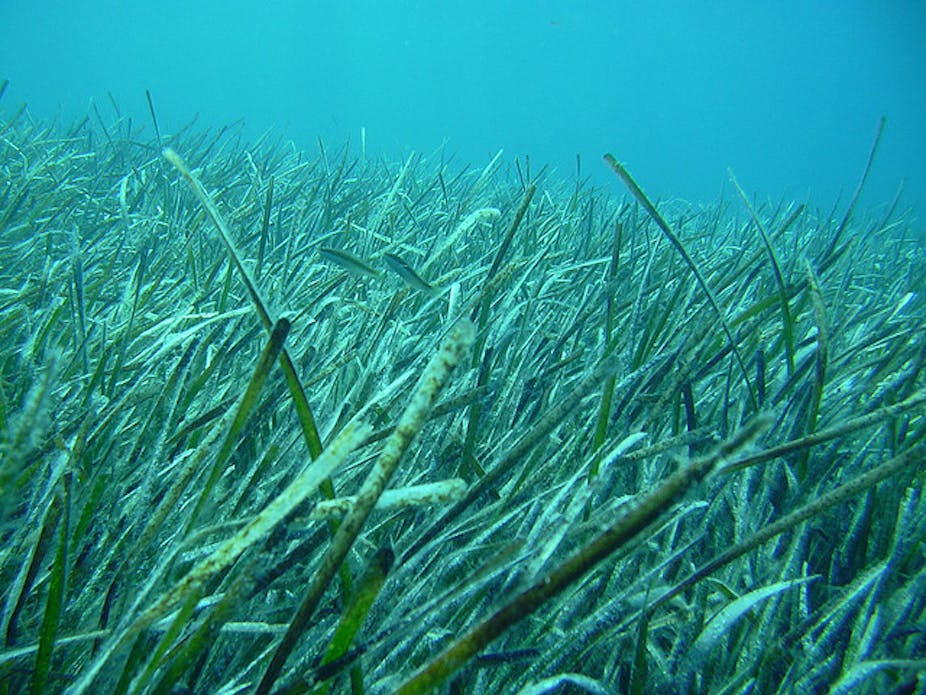
Seagrasses store carbon more efficiently than rainforests, making them a crucial part of climate change mitigation. http://www.flickr.com/photos/alessiodl

Seagrass stores carbon 35 times faster than rainforests, preventing billions of tonnes of greenhouse gases escaping every year, but its crucial role in slowing climate change has been largely overlooked, experts said today.

While rainforests lock in carbon for a century at most, seagrass does so for thousands of years. When exposed to air, the the carbon-rich sediment below the seagrass meadows begins to oxidise, releasing greenhouses gases into the atmosphere and warming the globe.

About 50% of Australia’s seagrasses have been destroyed by dredging and pollution, said seagrass expert Dr Peter Macreadie, ARC DECRA Fellow at the University of Technology, Sydney.

“The world seems to be primarily focused on reducing greenhouse gas emissions from industry, transport and food but there’s little attention being paid to carbon that is leaking out from underneath the ground, on land and in the ocean.”

Dr Macreadie, who is currently analysing carbon storage in seagrass sediment from Jervis Bay, estimated that seagrasses offset approximately 2% of Australia’s annual greenhouse gas emissions.

“It’s a huge amount that’s being offset and it’s a huge amount that’s being stored – and you can also put dollar figures on that,” said Dr Macreadie.

“If you say that carbon is worth $23 a tonne, then Australia’s seagrasses, both the plants and the carbon in the sediment, are worth about $45 billion,“ he said.

Losing the seagrass from around Australia, would be equivalent to releasing up to three times Australia’s annual greenhouse gas emissions, Dr Macreadie said.

“When someone is cutting down a forest, it’s quite noticeable, and you can chain yourself to a tree,” he said.

“But most people don’t care or notice when seagrasses are being destroyed; they are out of sight and out of mind – a tragedy of the commons.”

Despite its role in locking in greenhouse gases, seagrass is currently not on the National Greenhouse Gas Inventory, a compilation of Australia’s emissions data.

A spokesperson for the Department of Climate Change and Energy Efficiency said emissions from non-terrestrial sources are not currently included in national greenhouse accounts due to accounting rules set by the Intergovernmental Panel on Climate Change (IPCC) and the UN Framework Convention on Climate Change (UNFCC).

“Currently, there are provisions for inclusion of emissions from wetlands, however these are of the freshwater, inland type,” the spokesperson said in an email.

“The IPCC and UNFCCC periodically review the international accounting rules. The IPCC is currently drafting a wetlands supplement to the 2006 guidelines that may include coastal wetlands and seagrasses in the future.”

Professor Carlos Duarte, Director of the Oceans Institute at the University of Western Australia, said a CSIRO-funded project called the Coastal Carbon Cluster will deliver estimates on the carbon sequestration capacity of seagrasses.

“The IPCC is taking a serious look at this option,” he said.

Professor Duarte said seagrass meadows rank among the most effective carbon sinks in the biosphere.

“The key to their role relies on two key factors: their high productivity and capacity for carbon capture and their capacity to preserve carbon in their sediment for millennia,” he said.

Unlike forests, which release greenhouse gases when they burn, the carbon in the seagrass soils is protected from fire, said Professor Duarte.

“One hectare of Posidonia meadow has as much as 10 times the CO2 sequestration capacity than a pristine hectare of Amazonian forest does,” he said.

“These ecosystems also rank amongst the most threatened in the biosphere,” due to fertiliser and herbicide run-off, dredging and port development, Professor Duarte said.

Chris Riedy, Associate Professor at the Institute for Sustainable Futures, said seagrass carbon storage is an “overlooked way of reducing emissions”.

Sign in to Favourite

Want to follow The Conversation?

Sign up to our free newsletter to get the day's top stories in your inbox each morning, with a special wrap on Saturday.

Spinner
Help evidence based journalism become the norm and donate

Join the conversation

27 Comments sorted by

  1. Ben H

    logged in via email @gmail.com

    Is there much information on how seagrasses will cope with warmer, more acidic oceans?

    report
    1. Wade Macdonald

      Technician

      In reply to Ben H

      Just the same as if the oceans became cooler. Some would evolve and adapt, some would die out, some would increase there geographical spread and some would reduce.

      Ever heard of Darwin's theory of evolution?

      report
    2. Ben H

      logged in via email @gmail.com

      In reply to Wade Macdonald

      I was after something a wee bit more specific than 'evolution would occur'.

      report
    3. Ben H

      logged in via email @gmail.com

      In reply to Wade Macdonald

      I was hoping that someone with some expertise could provide a synopsis of how seagrass biology would cope in response to warmer, more acidic environments. Possibly things like changes in growth rates, photosynthesis rates, distribution, changed herbivore threats and so on.

      report
    4. Carlos Duarte

      Director, Oceans Institute at University of Western Australia

      In reply to Ben H

      Hi Ben, This is a good question. Ocean Acidification - increased CO2 in the water - leads to increased primary production (photosynthetic production of organic compounds), because seagrass are often CO2-limited. However, there is no evidence that such increased production leads to high survival or growth (same for terrestrial vegetation where the so-called fertilization effect does not lead to sustained growth, as plants end up nitrogen or phosphorus limited).

      As for warming, there is evidence that warming is already impacting severely on temperate seagrass meadows, for which maximum summer temperatures approach physiological limits. Heat waves have been linked to enhanced mortality of seagrass in the Mediterranean Sea and the Atlantic Ocean.

      Hope this helps

      report
    5. Ben H

      logged in via email @gmail.com

      In reply to Carlos Duarte

      Thanks Carlos, that's more than enough to get me started.

      report
    6. Geoffrey Harold Sherrington

      Boss

      In reply to Carlos Duarte

      Carlos Duarte,
      I can find about 2 quality papers that quantitatively claim that CO2 has changed the pH of the oceans beyond reasonable stats limits in recent decades, in actual seawater with biota present. The said papers are restricted to small study areas. The rest that I have read are arm waving and armchair analysis, particularly some of the CDIAC work which starts with a wrong definition of pH. Can you refer me please to any top papers that sound reliable to you? I apologise that the volume of literature is too large for a lone person to reasonably detect all significant observations.

      Do you infer that, although seagrass exists in the Mediterranean, there has not yet been a heat wave or stress that has wiped it out? Does this place a limit on historical temperatures over millennia? Or do you suggest that it has recovered from past heat stresses? Or are you simply guessing that the climate there is capable of generating permanent destruction?

      report
    7. Yoron Hamber

      Thinking

      In reply to Carlos Duarte

      So much more that comes to light at a daily basis, all adding to the complexity trying to foresee global warming. The Arctic have sea grasses too as I understands, what's happening with it there? And doesn't it release methane too, as it decays/rot?

      Think we are winning the battle here Carlos?

      report
  2. Wade Macdonald

    Technician

    This is a good article however I would be skeptical of the IPCC's real motives.

    Marine parks will not stop the deleterous effects of seagrass loss from ingressing pollutants etc and you do not need sanctuaries to prevent destructive dredging practices, just sound government controls.

    We already benefit as a nation/globally from our seagrasses and putting such a dollar value on it may see areas of our waters become privatised by corporates just like rainforests are on land. Many local communities in these areas have been forced from their forrests and or persecuted under draconian rules.

    These will also be used for offsetting carbon emmissions to pollute more overseas in other countries. Then we need to consider what may happen in 50 years time when such carbon fads are long forgotten and the areas contain other rich resources.

    report
  3. Dale Bloom

    Analyst

    Excellent article.

    “About 50% of Australia’s seagrasses have been destroyed by dredging and pollution”

    That is time for alarm bells to be ringing.

    It appears that by introducing such things as a carbon tax, but then allowing seagrass beds to decline, we are not actually making much forward progress.

    report
    1. Wade Macdonald

      Technician

      In reply to Michael Shand

      Correct, but the ETS will be linked. Corporates around the world are funding scientists to put a dollar value on seagrasses (as we speak) to claim carbon offsets down the track.

      The road to hell is often paved with the best intentions.

      report
  4. Sharon Hutchings

    logged in via Twitter

    For most it's "out of sight out of mind", just like the damage & suffering caused by so many other avaricious myopic human desires ie. the meat industry, petrol driven vehicles, coal fired electricity etc.

    Time for our education curriculum to include mandatory lessons, including on site tours, re all these issues so that future generations don't continue to repeat the mistakes of the past.

    report
  5. Bernie Masters

    environmental consultant at FIA Technology Pty Ltd, B K Masters and Associates

    This article highlights to me how the CSIRO is becoming less relevant to Australia. It states: "Professor Carlos Duarte, Director of the Oceans Institute at the University of Western Australia, said a CSIRO-funded project called the Coastal Carbon Cluster will deliver estimates on the carbon sequestration capacity of seagrasses." and it also claims that we have lost 50% of our seagrass meadows. Surely the priority should be to research how to regrow seagrass in damaged or degraded sites. If seagrass is as environmentally beneficial as claimed (and it certainly is an incredibly important part of our marine environment), then why is there no priority seemingly focused on regrowing it.
    Sorry, CSIRO, but you seem to have lost the plot again. Or has 'political correctness' taken over?

    report
    1. Wade Macdonald

      Technician

      In reply to Bernie Masters

      Quote...If seagrass is as environmentally beneficial as claimed (and it certainly is an incredibly important part of our marine environment), then why is there no priority seemingly focused on regrowing it.

      No money Bernie...as a rec fisher I would like to participate in such regeneration ventures through a well funded scheme but it simply doesn't exist. No one in government (in my state anyway) has the cash.

      report
    2. Wade Macdonald

      Technician

      In reply to Bernie Masters

      I know Bernie,

      Trouble with many of these regeneration programs (if they get approval) is they get destroyed/undermined by some vacant minded polluter(s) because of some decision by some vacant minded pollie(s) who see the $$$$ before the sense...so to speak.

      Would you bother trying to go through a seagrass regeneration approval process around half of OZ at the moment with all the mining, dredging and fraking going on?

      report
  6. Graham Houghton

    Archaeologist, Writer

    Whenever I read X is worth $Ybillion, or A's heritage/environmental/spiritual/recreational value is less than its commercial/industrial value, I'm taken back to something my mother told me when I was five years old. I'd just learned that a piece of china we'd inherited from a late maiden aunt was worth what seemed to me like a lot of money, so I said we should sell it and buy sweets, or toys, or something more pleasing to myself. My mother's response was, 'My grandmother would have said, "You know the price of everything and the value of nothing".' I understood the message immediately nearly 60 years ago and I've never forgotten it. It's a lesson that we, as a society, appear to have forgotten. I understand that putting a dollar value on seagrass gives it a context that is familiar to a lot of people, but it say nothing about its value. I think it's time we returned to recognising intrinsic values instead of mentally turning everything into a vast pile of lollies.

    report
    1. Wade Macdonald

      Technician

      In reply to Graham Houghton

      Quote....I think it's time we returned to recognising intrinsic values instead of mentally turning everything into a vast pile of lollies.

      Correct...but that wouldn't enable the ETS scammers to justify their right to own and control such natural resources.

      report
  7. Colin Creighton

    Chair, Climate adaptation, Marine Biodiversity and Fisheries

    Hi all
    Great to see more airplay on marine systems. In case you are not aware - Fisheries RDC has commissioned a synthesis work on this issue - The Final report is on the FRDC website its - 2011-084-DLD -Optimising and managing coastal carbon: comparative sequestration and mitigation opportunities across Australia’s landscapes and land uses
    (actual address in case you want… http://frdc.com.au/research/final-reports/Pages/2011-084-DLD.aspx)
    This report summarises the ability of Australia’s coastal…

    Read more
    1. Wade Macdonald

      Technician

      In reply to Colin Creighton

      Colin,

      I did an assignment on the acid sulphate soil build up at Gillman in Adelaide.

      The adjacent area is the important mangrove system that supports the waterways of Port Adelaide/Port Gawler. While it has improved since most of the industry disappeared, there is still a way to go for this system.

      The cause of the ASS build up was due to the bund wall created to protect the mangroves back in the 70's. Unfortunately the science was flawed and it only served to compound the problem instead of letting the natural filtration system (mangroves) do what they do best.

      This mangrove system runs intermittently right up to the top of Gulf St.Vincent another known breeding ground for many fish species.

      I trust this system is within the scope of your plans?

      Cheers

      Wade

      report
  8. Geoffrey Harold Sherrington

    Boss

    What is the moral and ethical difference between disposing of unwanted CO2 into the sea as opposed into the air?

    After 30 years the science community has failed to understand complex problems from dumping CO2 in the air.

    Some would regard the sea as being much more complex. Permission should not be given to dump CO2 into the sea because of the likelihood of unintended, untested consequences.

    The commencement of projects in climate work, before they have been understood, has drawn huge criticism. If you have not learned this from simple examples like 'hide the decline', then you are behind in your comprehension.

    Stop the work now.

    report
    1. Yoron Hamber

      Thinking

      In reply to Geoffrey Harold Sherrington

      You can't dump it, well you can try, but it's a losing battle, although very Jules Vernian in approach. Think it comes from all those comic books we read as small :) Believing in 'supermen' and 'the solution to your problem is...' Ta daa.

      We don't really want to grow up, do we?

      report