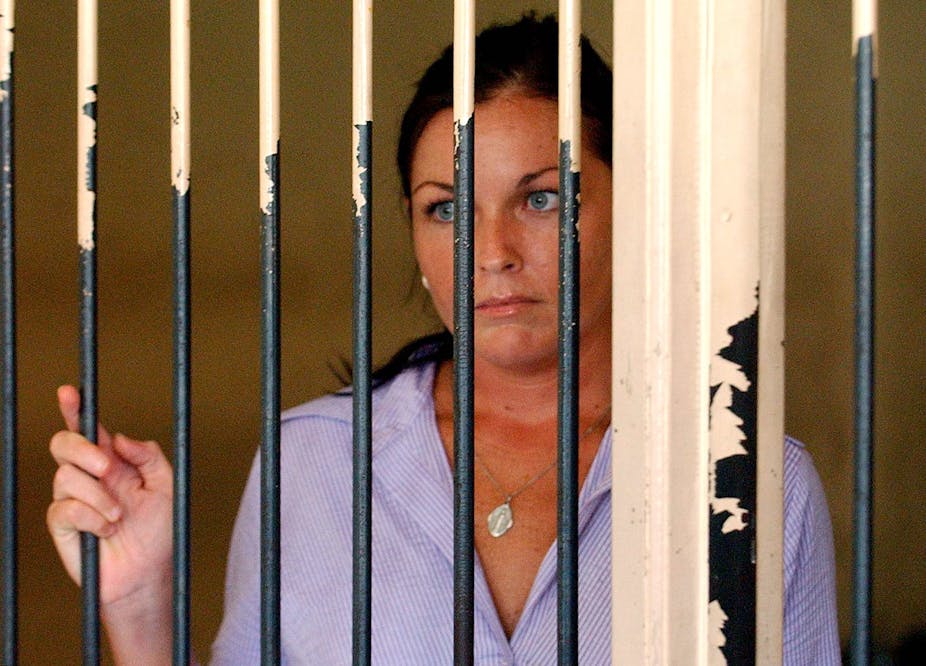
Schapelle Corby’s fate may be the centre of public attention in Australia, but not here in Indonesia where I currently live and work. The hot topic here for the past few days has been whether or not Lady Gaga will be permitted to perform at a concert in Jakarta next month.
Corby’s case simply does not have the resonance in Indonesia that it does in Australia. I suspect few Indonesians believe she is innocent; she is commonly referred to in the media as the “Marijuana Queen”.
The current interest in the case – to the extent that there has been one – is on suggestions that a deal had been done with the Australian government, linking Corby’s remission with the freeing of Indonesians currently held in Australian jails.
The Minister for Justice and Human Rights, Amir Syamsuddin, is quoted as saying he hoped Australia would reciprocate Indonesia’s actions in the Corby case, particularly in terms of Indonesian children in Australian prisons. “The Australian government has not promised anything”, he said, “but we hope there will be a positive response from the Australian government.”
Australian government denials of any such deal, made by both Foreign Minister Bob Carr and Attorney General Nicola Roxon, have also been reported, though to what extent they are believed is anyone’s guess.
Whether this presidential decision means anything for other Australians in Indonesian jails on drugs charges is unclear. If there is little public sympathy evident for Corby, there is virtually none for those convicted of more serious drug offences.
Decisions on remissions or pardons in such cases are essentially political ones. And while public opinion is clearly not the final arbiter, it is an important contributing factor.
Indonesia holds national presidential and parliamentary elections in 2014. President Susilo Bambang Yudhoyono (SBY) cannot himself stand for another term as president, having reached the constitutional limit of two terms. But he will want to try to ensure his successor will be someone sympathetic to his own aims and interests.
He will also want to try to boost the parliamentary representation of his party, Partai Demokrat).
But this will be a tough task. All the current indications are that both Yudhoyono personally and Partai Demokrat in general are in trouble with the electorate. Socially and probably politically, the electorate is becoming more conservative, led in particular by groups presenting themselves as defending traditional Islamic values against the allegedly “liberal” values promoted by SBY and his government.
In the past, Yudhoyono has shown no inclination to take on such groups, even on issues of direct significance to Indonesians, such as violence against religious minorities. He is hardly likely to take the political risk of doing so on an issue where the beneficiaries are foreigners – and drug traffickers at that.
Already he has been criticised for even considering Corby’s clemency appeal.
A senior member of parliament from the Islamist Prosperity and Justice Party (PKS), Nasir Djamil, said last month – when the possibility of a remission was being discussed – that he hoped the government would not grant a remission. Such an action, he said, would do nothing dissuade “other Australians who wanted to distribute narcotics in Indonesia”.
Further, as Hikmahanto Juwana from the University of Indonesia observed today, the president cannot afford to be seen to be weak in the eyes of the Indonesian public, given it is well-known that Australia has been exerting pressure on Jakarta on the Corby issue for quite some time.
So politically, SBY’s hands may well be tied.
But there is another important issue underlying this case, which affects the relationship between Australia and Indonesia: human rights.
In Indonesia, Australia’s reputation on human rights issues is a decidedly mixed one.
We are seen to protest loudly when our citizens are jailed in Indonesia, following due Indonesian legal process.
However as most Indonesians now know, for years Indonesian children were held in adult prisons in Australia, in clear violation of Australian law as well as Australia’s international obligations.
Were it not for the agitation of a few Australians, notably Ross Taylor and Colin Singer from Perth, these children would probably still be in jail, their causes unheard. Only after the issue began attracting media attention did the government act – and then only grudgingly.
This is in stark contrast to the government’s reactions to the holding of an Australian boy in Bali last year on a charge of possession of marijuana: both the then Foreign Minister and the Prime Minister involved themselves personally – and very publicly – in the case.
We urge the commutation of death sentences on Australians convicted of drug smuggling in Indonesia. But we call for the execution of those convicted of terrorism offences.
We cannot have it both ways. If we are not consistent in our application of human rights principles in Australia, we can hardly criticise Indonesia if it is not consistent either.
Pauline Miles
Arts Practitioner/Practicing Artist
Why should she be given this privilege. She was found guilty and she should do the time like all the other Australians are doing.
Ron Hoenig
logged in via Facebook
Why should justice for under-age Indonesian fishermen be a 'fair trade' issue between Indonesia and Australia, If the Indonesian fishermen who have participated in ferrying asylum seekers to Australia are under-age, they should not be in prison. If 'illegal' entry is later discounted in the asylum claims of asylum seekers ( as they are lsupposed to be under the Refugee Convention and later Protocol), what level of crime have these young people committed? Even if they are proved to be young men ratrher than boys, the level of criminality is limited. Perhaps it is a back door acknowledgment by both Indonesia and Australia that both our people smuggling legislation and their drug legislation are massively disproportionate
Wei Ling Chua
Freelance Journalist (night passion) at Self-Employed: Picture Framing/Wholesales
I am often troubled by western sense of human rights. There are more than 5 million drug related deaths across the world each year, with 4300 drug-related deaths each year in Queensland alone, [visit: http://outcastjournalist.com/index_files/culture_of_bigotry_hindered_australia_ability_to_intergrate.htm, look for the info and links under the subheading "Human rights and freedom is not a straight forward issues" point no 1 for detail info in this article]; and we are so-concerned about our convicted drug trafficker with her story feature on national TV and newspapers almost every 2 to 3 months over the last 8 years.
We consistently lock up aboriginal children in Adult prison with age as young as 9 year old. What kind of Australian values we are trying to lecture our migrants in this country?
Donncha Redmond
Software Developer
It's important to realise that that figure of 4300 includes alcohol and tobacco.
The National Drug & Alcohol Research Centre states that in 2007 "there were 976 deaths nationally among Australians of all ages in which drugs were determined to be the underlying cause of death and 743 among Australians aged 15 to 54 years."
Claiming 4,300 deaths in QLD alone is just scaremongering.
Wei Ling Chua
Freelance Journalist (night passion) at Self-Employed: Picture Framing/Wholesales
This is the report: http://www.brisbanetimes.com.au/news/queensland/400000-queenslanders-took-drugs-in-2008/2009/01/21/1232471385913.html, It is drugs related.
Paul Pentony
IT Professional
W Chua
Read the article again carefully. You will see it sometimes talks about "drugs" and sometimes about "illicit drugs." It is (I suspect deliberately) confusing. But it does not say that "illicit drugs" caused 4300 deaths in Queensland. If you include alcohol, tobacco and prescription drugs then the figure becomes more believable.
I recommend that you find a better source for information.
Wei Ling Chua
Freelance Journalist (night passion) at Self-Employed: Picture Framing/Wholesales
Hello Paul,
It is just your deliberate suspect. Anyhow, whether it is 4300 or 976 deaths in Queensland alone. They are still by the thousands nationwide each year. One is already too much. The problem is, it is out of control: http://www.watoday.com.au/national/war-on-drugs-labelled-a-failure-20120402-1w94j.html.
Norm stone
Project Manager
One of the problems for these "fishermen" is that their traditional and very long standing lively-hoods have been taken away by greedy Australian fishing zones. Just like the Somalian pirates many are forced into "illegal" activities when their "legal" ones are taken from them by first world profit seekers. These powerless, incredibly poor and uneducated people become pawns in Australian power games. The fact that they are held by a system they have no hope of comprehending is a bloody stain on our supposed liberal, humanitarian society.
Norm stone
Project Manager
It's interesting to see the quote "Decisions on remissions or pardons in such cases are essentially political ones." referring to the Indonesian government. Do you imagine that the incarceration of children in jails and in detention centres in Australia is purely judicial? Further to this why did the Australian government only act after publicity and even then grudgingly? Because they are trying to please all sides in all possible circumstances as usual. Public opinion is rather more than a contributing…
Read morenaomi vallins
teacher
Indeed, if guilty Schapelle should serve out her sentence but it does seem to me that the sentence meted out is disproportionate to the crime, in this the smuggling of marijuana.
Furthermore, the possibility of a death sentence (in the case of other drug smugglers) also seems to me out of kilter with liberal values. Capital punishment is no longer a country by country choice but an international matter.
Ron Chinchen
Retired (ex Probation and Parole Officer)
I'm sorry to see anyone, especially someone young with the liklihood of spending a significant proportion of their early life imprisoned. But we have laws to maintain stability in our societies and whether those laws are right or wrong in the judgement of others, we all know that they exist and what the likely penalties are for breaking them
I'm not going to get into Indonesia's or Australia's human rights issues here because I believe in this particular issue that its irrelevant. Indonesia has…
Read moreDavid Leigh
logged in via Facebook
Despite claims, by the Indonesian Government, that Schapelle Corby is guilty of smuggling drugs into Indonesia, evidence has been tendered several times, including that given by former Australian Police Commissioner, Mick Celty, that there is reasonable doubt. Whilst Indonesia is not ruled under the Westminster System, it is supposedly democratic (Partai Demokrat).
Read moreThe other point that should be taken into account is that Indonesia knows only too well of its role in people smuggling and illegal…
Marilyn Shepherd
pensioner
That is complete tosh, you don't even seem to know that giving refugees a ride is no more people smuggling than it is flying to the moon.
We are the only country in the world who jails people just because they gave refugees the final transport to a country they can be protected.
The government have been told endlessly by all legal experts that they are wrong but they continue to defy our own and international treaty obligations in the name of pandering to the ignorant bogans.
Refugees who…
Read more