
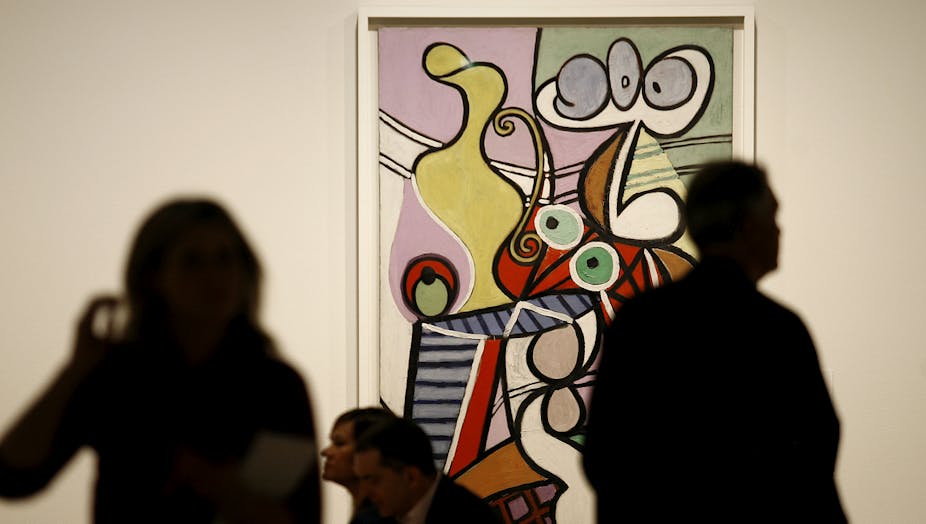
The impending closure of art history at La Trobe University has drawn sharp criticism from academics. They have pointed out that students enjoy art history: it is economical, has enduring value and demonstrably excellent outcomes.
Alas, this mystery of a discipline loved by students and scorned by deans belongs to a larger trend in universities, in which art history has either been embattled or abolished. In spite of its popularity among students, the fortunes of art history have been tenuous, sometimes clinging on obstreperously (as at La Trobe) and sometimes perishing silently (as at Monash).
Two reasons might account for the demise of art history: an indifference from outside the discipline and a small but fatal weakness from within.
Academic administrators, who lead by clichés, do not like the sound of art history. Against the vulgar rhetoric of getting ahead in a fast-paced world, realising your personal vision, extending your creative powers and pushing the future, the study of art history sounds out of date, as if dealing with quaint things from the past. Faculties like to represent their vision as aggressively forward-looking, multi-disciplinary, lateral-thinking, full of digital newness and future-shaping ideas.
If these were only platitudes, we might only sigh; but they are calculated to flatter new students with a fantasy of leap-frogging all the fuddy-duddy disciplines.
Art history has few friends. Studio art departments, keen to project a vigorous program of creative hygiene, are mostly scornful of art history. It seems too humanist in its values. For insecure studio academics, art history threatens to cloud the studio purity and seems to infect it with uncreative chronologies.
It also does not help to explain, as Art Association of Australia and New Zealand’s Anthony White admirably did in the Fairfax press, that art history is inherently interdisciplinary and that it nicely equips students for a world saturated in visual messages. Art history drove me to learn foreign languages and their literatures as well as visual languages, to come to grips with philosophy, technology, social history, popular culture, urban planning and legislation, Indigenous culture, economics and globalisation and studio practice itself.
It is hard to think of a discipline which is quite so promiscuous in examining ideas. It prepares a person to make an intervention in almost any field of criticism.
Art history is suspected of telling the wrong story. In education, the marketable myth is that we live in a new world with new challenges that require new solutions and ways of thinking. These bracing admonitions to prospective students are ingeniously pitched to sound challenging and reassuring, with the suggestion that our faculty will equip you for this turbulent new world.
Describing the world as relentlessly new is strategically disempowering for the individual, designed to present the institution as a rescue-package for your impotence and fear in the face of unprecedented change that you won’t otherwise be able to cope with.
Against this future-porn, art history suggests that wisdom arises from knowledge, imagination and analysis, but not necessarily focused on current preoccupations but deeper cultural stock. Issues of space, imagery, language, social justice and meaning have been analysed and debated for a long time and everything that we say today tends to rehearse something said before.
Ideas — like images and spaces — have genealogies; and it pays to recognise where contemporary motifs come from. But if you base your rhetoric on the line of radical creativity, that story is fundamentally unwelcome. Art history presents as the antithesis of your illusions and is resented for its enduring pertinence.
Unhappily, the discipline itself has contributed to its own demise. The problem is the name. As soon as you say “art history”, people will only think of a boutique study of pictures and sculptures, cultivated by connoisseurs.
Few appreciate that art history means the study of almost everything cultural. The term is disastrous, even concealing from view that it includes architecture and design. Various attempts have been made to change the name, terms like visual culture or theory of art and design. None of them achieved much traction and sometimes had unfortunate consequences.
The newer nomenclature encouraged anxious political discourses in reaction to older forms of art history, thus further — and incorrectly — stigmatising the existing brand-name as politically conservative.
There are other vocationally-oriented disciplines like media and communications where it might be said that their weakness became their strength. But for art history, its strength became its weakness. The immense cultural conspectus that it entails ought to have made it robust; but the very breadth — all the while expressed with a narrow title — made its image fragile.
This myth of a rarefied discipline is like a death-warrant in the contemporary environment, with its boastfulness about creativity in a new world unlike all previous ages. It produces the situation that we know today, where the surviving art historians often practice in exile or inside studio academies as if in hiding.
Christopher White
PhD candidate
This ties in with the general gutting of the Humanities Department at La Trobe and most (if not all) other universities; about the only humanities subjects that seem to survive are languages or those that have direct application - in the narrow vision of the administrative bean-counters, that is - to high-end careers in the business sector.
Subjects like gender studies, linguistics and even Indonesian are for the chop (see The AGE, June 30th), and the Philosophy department has been steadily shrinking…
Read moreJoe Gartner
Tilter
Oh please do explain to me the value of 'gender studies'.
Michael Leonard Furtado
Doctor at University of Queensland
Assuming you are authentically more quixotic than brilliantly argumentative, say, like Christopher Hitchens (though I'm content with that), you might start with Richard Hoggart's 'The Uses of Literacy', which persuasively argues that literacy is more than technical and grammarian (as some, though not all, engineers and Tyler and Taba might reductively contend) but also cultural, artistic, social, theological even, and, above all, political.
In the case of gender literacy several cultural theorists…
Read moreJoe Gartner
Tilter
Argumentum verbosium is what I think.
If this is the manner in which you would defend the value of 'gender studies' I assume that you won't be surprised if it gets the chop, as Christopher has stated?
Michael Leonard Furtado
Doctor at University of Queensland
Your comment is more Sancho Panza than in the tradition of the good Don, I fear. You asked, presumably sincerely, for an explanation. I tendered a widely recognised and richly summarised account explaining why Gender Studies won't go away. Your riposte, in Dog Latin, doesn't address the substance of my contribution, but attacks instead on style. Perchance you are beyond engaging with it, which may indeed help explain why those who would give gender studies the chop have little or no policy literacy, nor even I'm afraid, given your misrepresentation of Christopher White's above post, the capacity to truthfully comprehend (and represent!) what he has said.
Joe Gartner
Tilter
Thanks for the ad hominem attack. I always enjoy them, although I'd prefer direct abuse rather than sneering condescension.
I'm not convinced your reply had much substance, I take it from the extremely technical nature of your reply that you are an academic of some sort (humanities?). You cannot explain the value of gender studies, except in the most abstruse and recondite manner. This rather dilutes the force of your argument. In my profession if I want to communicate with those without the field I use non- technical language, which I find a more effective method of communication.
I wrote my initial post with mischievous intent... Interesting to see the supercilious and pompous response. It rather affirms my view of the extreme end of the humanities faculty... I fear that 'gender studies' is for the chop if this is as relevant as it can be made to the public.
Christopher White
PhD candidate
I'll choose to overlook your attempt at condescension for the moment. Perhaps you would care to explain why gender studies has no value, if that is in fact what you think.
Andrew Sullivan
Policy Officer
Good academic enquiry stems from questions about the world we live in. Although I have never studied it, I hope someone (one day, not here) can answer the following:
My mother recently bought my three-year-old daughter her first Lego set. Why does this Lego set have different figures to the usual Lego sets? They are longer-limbed and obviously intended to appeal to girls. Why has Lego become split down gender lines?
That's why we need gender studies.
Michael Leonard Furtado
Doctor at University of Queensland
Sounds like a useful line of enquiry, Andrew; though, your own contribution to the discourse, having never studied it, and given the presumably 'practical' constraints you anticipate in others' responses in this blog, might be enhanced by putting your very interesting questions and observations to your mother and daughter. (What do you think?)
Gender Studies is as much about critical reflection and action (or methodological enquiry), as anything else (cf. Jurgen Habermas and the Frankfurt School). Your subjects, both women and direct consumers of the product, are better placed than most to comment and would doubtless yield the information you seek, without your having to go to the trouble of approaching Lego.
Where art history transects with it is to understand how Lego itself has evolved and the many uses to which it has been put by its fascinating inventor and patent owners.
Ian Donald Lowe
Seeker of Truth
“He who controls the past controls the future. He who controls the present controls the past.”
― George Orwell, 1984
Why must we eliminate the past (and any subject related to history) from academia, when all we are and all we have become is a product of our history and our past?
“Now I will tell you the answer to my question. It is this. The Party seeks power entirely for its own sake. We are not interested in the good of others; we are interested solely in power, pure power. What pure…
Read morelavinia kay moore
child and family counsellor
Phillistine! Prostitutes! Neither the right term.So what do we call them? Maybe the only appropriate word is "barbarians".
Read moreWe, who know something of human history, know of earlier great and civilised cultures and their cultural treasures that bogan-brains have destroyed.
Productivity- so-called- without creativity makes the fiction of "Brave New World" into the new reality.
Production without memory makes the fiction of "1984" into the new reality.
What we have happening at the moment is the…
Gavin Forbes Moodie
logged in via Facebook
This piece and its supportive comments do not contribute to the preservation of art history and similar subjects. No academic administrator I know wishes to close a subject because they don't like the sound of it.
Almost all proposals to close subjects are because of modest enrolments. It isn't sufficient to assert that students enjoy art history: the main issue is how many students enrol in it.
Ian Donald Lowe
Seeker of Truth
That is quite true Gavin but modest enrolments are probably a result of a lack of value being placed upon the arts in academia (at all levels) and a focus on catering to the 'trades' (those courses that give you the skills and qualifications to suceed in finding high paid employment). Why aren't children given exposure to the arts subjects in early learning these days? Why are we told that the past is irrelevant and we must focus on "moving forward"?
I refer you to my earlier response and no, I'm not trying to save art history and similar subjects. I am just pointing to a possibility that is very real and very frightening.
(sorry, I don't have the tight focus of a specialised academic.
Gavin Forbes Moodie
logged in via Facebook
There is much dispute about the causes of low or fewer than preferred enrolments in art history, physical sciences, languages, Asian languages . . . (insert your hobby horse here). I don't think that low exposure at school can be correct because art and history are taught extensively from primary school.
Neither do I think that a simple vocational - non vocational explanation is correct. While some vocational subjects have strong enrolments others such as information technology have languished, and enrolments are strong for the creative arts which are not strongly vocational and have poor employment prospects.
Advocates for favoured subjects should contemplate the possibility that their subject is constructed in a boring way or is taught poorly.
Joanna Mendelssohn
Program Director, Art Administration, School of Art History and Art Education. Editor in Chief, Design and Art of Australia Online at University of New South Wales
This is a bit more complex than bums on seats. The La Trobe courses were well subscribed, so the attacks on art history and similar disciplines are not necessarily a cost issue, but an ideological one.
A full interrogation of the "vision" (wrong word but is the closest we have) that is currently guiding our universities and higher education sector is long overdue.
Ian Donald Lowe
Seeker of Truth
You are probably getting to closer to the truth than I was.
I never thought I would ever see the day when truth and beauty would go out of style.
Michael Leonard Furtado
Doctor at University of Queensland
Robert Nelson is one of the most, consistent, lucid and original commentators on the politics of curriculum restructure in contemporary tertiary education that I have encountered. At all times he sets aside the worrying excuse of financial cut-backs and lack of enrolments to argue the case for disciplinary integrity and the cultural and intellectual cost of what is lost. The wonder is that an Australian university, of albeit high standing, employs him in such a pivotal role. We need more people with his skills and guts to be appointed to similar positions so that it isn't just the entrepreneurs that run the show!
Gil Hardwick
Anthropologist
I can appreciate Art History and Linguistics being retained, but a separate and distinct Gender Studies? Why? Gender is studied across the board, fundamental to all Arts, Humanities, Social Sciences and Cultural Studies.
I have myself formally studied sex, gender, sexuality, the human body and coming of age, costume and social adornment in detail for over 25 years now, achieving Distinctions and High Distinctions in these fields, in Psychology, in Anthropology and in Literature, with two Honours…
Read moreel don
logged in via Twitter
in agreement with the argument and experience outlined in this article - in entirety. of course, i need to admit having studied at the national art school, and having always found art history to be the glue for all my generalist tendencies in scholarship..
Read morewell, art history is not just history either. as pointed out, it is an interdisciplinary subject, something that addresses visual culture in general. that visual culture is happening now. it uses technology - think web site design, architecture…
Laurie Benson
Curator
While I agree completely with Robert's sentiments and lamentation for the possible demise for this vital discipline, I refuse to entertain the notion that the battle is over. And Robert, you should be aware that the breadth of support for the campaign waged over La Trobe has reached far beyond academia. Just a glance at the signatures of the circulated petition ( http://www.ipetitions.com/petition/art_history_la_trobe/) shows how strongly the entire arts industry, from here and overseas has reacted to this issue. Academics, curators, gallery directors and art dealers have joined with students and members of the GP in the protest. It is also my understanding that virtually every director of Australia's State art galleries, and most if not all directors of Victorian Regional galleries have written to the VC of La Trobe, lending their weight to the campaign. I remain very hopeful that common sense will prevail in this instance.
Encho Avramov
logged in via Facebook
Hahaha.....
ART/history is dangerous ! Mediocrity/provincialism is blessing ! Politically correct/safe "art"... Ignorance/satisfaction the way of life ... HAPPY IDIOTS forever = We are the greatest nation !