
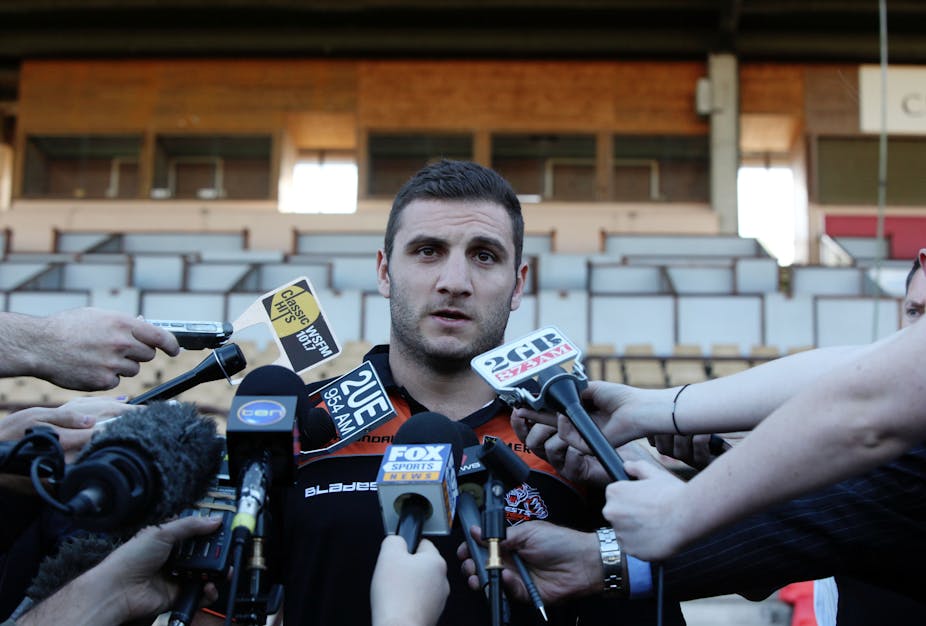
Online harassment against two prominent Australian personalities within the last fortnight has ignited fresh calls for the regulation of cyber “trolling”. The recent episodes experienced by television host Charlotte Dawson and by Wests Tigers rugby league captain Robbie Farah have brought public attention to this all-too-common online experience.
It has been unfortunate, though, that the ensuing discussion on trolling has neglected to highlight the particularly gendered nature of this abuse.
But it has emerged today that Farah, himself, may have engaged in such trollish behaviour. Last year, responding to the question of what to buy Prime Minister Julia Gillard for her birthday, Farah suggested “a noose”.

I’m certain Farah is not the only person on the internet to suggest Gillard take her own life or is in some way deserving of violence. Farah’s tweet demonstrates that being in a position of power in no way shields women from abuse online. This and other pervasive examples of misogynistic abuse directed at women online is a form of censorship and a signal to women across the internet that their views are not welcome and to watch what they say.
None of this is to say that women are the exclusive victims of trolling or that women are never themselves trolls. As the case with Farah has shown, men certainly cop a share of online harassment and, as Dawson discovered in tracing one of her trolls, women do harass women. What is too infrequently discussed, though, is the way that women are disproportionately subjected to a high level abuse that is based almost entirely on their sex.
Stop the trolls
The incidents have sparked calls from the NSW Premier Barry O’Farrell and from NSW Police Minister Michael Gallacher for a review of commonwealth telecommunications laws and closing of any loopholes that prevent legal action against online harassment. In a press conference earlier this week, Gallacher claimed the police need to be more empowered to arrest perpetrators of trolling.
He said:
We’ve got to empower police with the ability to replace their keyboards with handcuffs, grab them by the ears from mummy’s basement and take them down to the local police station and make them understand the offensive matters that they continue to raise on the internet [bear] a terrible price.
It is encouraging to see the authorities taking the issue of trolling more seriously. For too long the anonymity and interconnectivity of the internet has provided avenues for people to express their hatred and use the internet as a means for bullying and harassment. What the authorities seem to be neglecting, though, is the fact that women bear the brunt of this cyber violence. Trolls are more often males and their victims more often female.
The internet is a dangerous place for women
For most women, putting yourself out there in cyberspace means opening up to a range of online harassment, from sexual harassment, virtual rape, intimidation, cyber-stalking, and threats.
Women are routinely undermined by the posting of doctored photographs of themselves either nude or as the victims of violence, by the posting of their home address alongside suggestions that they are interested in anonymous sex, and by technological and verbal attacks on blogs and websites.
Dawn Foster, an American blogger, said of her experience of trolls:
Being a woman on the internet seemed to be enough to anger people, regardless of what you were writing.
Women’s experience of online harassment is facilitated by the internet’s virulent environment of woman-hating. A quick perusal of any news article or blog post about gender issues will show a flood of misogynist comments. Being a female and writing about feminism invariably elicits responses along the line of “shut up or I will rape you,” “you should kill yourself,” “you deserve to be raped or killed,” or “you’re too ugly to be raped.”
Trolling is a contemporary form of silencing that trivialises what women have to say and reducing the female speaker to a sexual object. It is a tactic women have experienced offline for centuries. The online form just happens to be more numerous and vitriolic.
Instead of engaging with the opinions of the female writer, commenters rely on gender stereotypes to portray the author as somehow deficient or inferior. The attacks are personal, focusing on personal attributes such as age and frequently calling the author “ugly” and “disgusting.” The women on the receiving end of the abuse are frequently encouraged to kill themselves.
The court of public opinion
There is also a stark difference in how the public has reacted to these two prominent victims of trolling.
Many in the media and public discourse blamed Dawson for “flaming” or “feeding” the trolls. She was better off, according to most, “just ignoring it”. Farah, on the other hand, has received widespread sympathy and support from the public and from public officials. NSW Premier Barry O’Farrell has publicly lent his support to Farah’s appeal while the Prime Minister’s office has made arrangements for a meeting between Farah and Prime Minister Gillard, arranged before Farah’s derogatory tweet about the PM became public.
When women complained about their treatment online using the #mencallmethings hashtag and in a series of online articles and blog posts about the harassment they experience on a daily basis, there was very little political will demonstrated to do something about trolling. Should we be asking why it took a prominent (and particularly masculine) male raising the issue to garner the political attention needed to make a change?
The interesting solution is also one rarely discussed – we currently have the means to prosecute harassment in its various forms. We do not need the prime minister or state premiers to discuss new legislation.
Queensland authorities have successfully jailed one troll, Bradley Paul Hampson from a Brisbane suburb, for “using a carriage service to menace, harass or cause offence.” The case showed the potential for using Section 474.17 of the Commonwealth Criminal Codeto punish trolling. It also highlighted the glaring absence of cases tried under this code – a clear demonstration of the persistent lack of will to criminalise this behaviour.
Part of me would like to be encouraged by the new-found interest of politicians in this old-as-the-internet phenomenon. Still, I can’t help but worry that any proposed solution that neglects the gendered dimensions of trolling will fail at stemming this tide of abuse.
Sean Lamb
Science Denier
As I said previously, Charlotte Dawson by contacting the employer of someone over a minor online spat was herself a cyber-bully.
I guess it is a sign of just how marvelous life is for the Australian upper-middle class that they can devote acres of commentary to such trivialities.
Linus Bowden
management consultant
Can we have a moratorium on pieces like this until academics catch up to what 'trolling' is? Trolling is NOT abusing narcissistic airhead celebrities online. Some would call that 'justice'.
Philip Dowling
IT teacher
Precisely.
Fancy having time to check out check out twits' comments.
Paul Firth
Student
While not right Its to be expected you live a public life your inviting people to comment on you.
What happened to the old rule "Don't feed the trolls" all this carry on in the media focusing entirely on celebrities having nasty comments posted about them is "feeding the trolls". There will always be haters, when will we grow up and learn that taking the bait is exactly the point, are we all so insecure that a few comments on your twitter feed is enough to send you crying to the police and media…
Read moreGary Murphy
Independent Thinker
Especially when your public life involves inflicting vicious put-downs on young girls on national television.
How about a public media campaign against that?
Aedan Roberts
logged in via Twitter
"Farah’s tweet demonstrates that being in a position of power in no way shields women from abuse online. This and other pervasive examples of misogynistic abuse directed at women online is a form of censorship and a signal to women across the internet that their views are not welcome and to watch what they say."
I'm really struggling to see why gender comes into this. There is nothing misogynistic whatsoever in what Farah said. The fact that it was aimed at a woman and not a man is utterly irrelevant.
Aedan Roberts
logged in via Twitter
I'm really perplexed as to why several people have labelled my comment as "unconstructive". I'd be interested to know why people think this. Is there something I missed that makes the two words "a noose" misogynistic?
Phillip Dawson
Lecturer in Learning and Teaching at Monash University
There is an unfortunate trend here of using the 'unconstructive' button as an 'I disagree' button. The thing that makes The Conversation interesting is robust debate; downvoting should be reserved for troll-posts.
Aedan Roberts
logged in via Twitter
I agree. It's a shame, because it seems to be used as an easy way for people to put down something they disagree with, without having to justify their stance.
Eamon Vale
eLearning Designer
Hi Aedan, I agree with your comment that Farrah's comment is not in and of itself misogynistic. He may not have made such a comment about a male prime minister but we don't really know. I think we need to be careful about what we label misogyny.
Meagan Tyler
Lecturer in Sociology at Victoria University
Thanks for an article highlighting the gender dimension to this. There was quite a bit of interest in this after the #mencallmethings hastag on Twitter made public the type of (frequent) sexist abuse women experience online and how this does, in fact, differ in a number of ways from the type of abuse men experience online. But this acknowledgement seems to have faded quickly and we are back to some people (mostly men in the comments here it must be said) denying that misogyny and sexism are an issue with trolling and/or abuse online.
Sexism is still an issue in traditional forms of media and communication, so it seems a bit naive to think it's miraculously not an issue in online media and communication too.
Linus Bowden
management consultant
Exploiting Charlotte Dawson's abuse of her publicity machine as an excuse to write pieces [mis]using the word "misogynistic" is classic trolling itself.
Tim Scanlon
Debunker
When you look into online user gender breakdowns then you start to see where clusters of misogyny occur. Needless to say, Reddit and Youtube have predominantly young male users and, not surprisingly, this is where you are most likely to see trolling and misogynistic statements.
But I wouldn't have said that woman are the only targets, I would have said that it is more that the language used changes. In one comment below a Julia Gillard Youtube video was the statement "Prime Minister? Of which…
Read moreEamon Vale
eLearning Designer
Hi Tim,
The difference between the comment left for Julia Gillard and that for Tony Abbot (and again in the girl vs. boy examples you give) is that the language in the insults is sexist when directed against the women but just insulting when directed against the men.
I think you are right that abuse is pretty evenly spread but I think that the fact that the 'language used changes' is a crucial difference. I don't think the insults you list are 'equally bad', sexist, racist, or homophobic language (and I think this article ignores how often racism and homophobia appears online) is the language of oppression and when we live in an unequal world they are given an unequal significance.
Eamon Vale
eLearning Designer
Sorry I said this article 'ignores how often racism and homophobia appears online' but that is obviously not the topic of the article. I think I worded that badly but what I meant was that discrimination generally is present online - it wasn't meant as criticism of the author or article.
Tim Scanlon
Debunker
Pretty much. I think that is were the misogyny really comes through.
I find it appalling that trolls are so unimaginative when it comes to slagging off women. At least they put in some effort with men. :D
Eamon Vale
eLearning Designer
I completely agree.
Phillip Dawson
Lecturer in Learning and Teaching at Monash University
I feel for anyone who is victim to abuse in the cyber world (or the real world). It is never OK. However I'm bothered by the definition of 'troll' that has proliferated in the media lately. Calling someone a troll when they are stalking or being personally abusive/agressive is very different to the original troll-as-prankster/satirist. I worry that by conflating the two we soften our attitude towards online bullying/aggression and harden our attitude towards truly artful trolling. If we want to appropriate Internet-culture terms, perhaps we could call the sorts of trolls described in this article 'griefers'? Or perhaps we could label them what they are: abusive, aggressive bullies, and leave the word 'troll' out of it.
[sorry to copy-paste from my comment on today's other Conversation trolling article but it seemed relevant]
Aedan Roberts
logged in via Twitter
This is something that really needs to be said (and heard), but I suspect it's too late and this new, inaccurate definition of 'trolling' will stick.
alfred venison
records manager (public sector)
i remember late last century when 'pirate' was used to refer to a person or persons who made a business out copying entire cd albums, including the packaging, graphics, booklet, &c., usually in quantity, and then tried to pass these off at markets as the original. then, with the advent of napster, we saw a moral outrage driven semantic bracket creep move inexorably toward the modern usage. we see this again today with a lazy media & politician driven stretching of the perfectly settled & useful term 'troll' to label something which could so obviously have been labelled more accurately 'cyber bully'. -a.v.
Linus Bowden
management consultant
Or the perfectly appropriate term, "flaming".
Daniel Kinsman
logged in via Twitter
The misogyny can even be found in the abuse towards Farah, where "He was sent an offensive message referring to his late mother" according to the smh artilce you linked. Just more proof that women are over represented as the targets for abuse by spineless cowards.
Daniel Kinsman
logged in via Twitter
Re-reading that I don't think my message was exactly clear. By "over represented" I mean "spineless cowards target women specifically, so they get more abuse". Essentially I'm agreeing with the author.
Daniel Kinsman
logged in via Twitter
Also thanks for addressing the issue of existing police powers being sufficient, if only they'd bother using them. Unnecessary new legislation seems to be the order of the day with the attempted national security power grab in works (data retention).
Mal Adapted
Primate
I'd agree with this, females in the media are often seen as purely rampant feminists. This incites a lot of bloggers to post ill-informed and petty commentary on feminism. This is not warranted. These writers should spend more time talking to female academics. That way these bloggers would be better informed about their topics.
Philip Dowling
IT teacher
I note that Sara does not provide any statistics.
I challenge her to provide any.
Philip Dowling
IT teacher
It concerns me that so much has been made of a rugby league's single tweet in these comments. It would seem that it was in fact a stupid throwaway comment in response to a question about a birthday present.
Anecdotal evidence is NOT a powerful form of argument.
It puzzles me that so many comments have been made without any reference to sites such as :-
http://www.alexa.com/siteinfo/twitter.com#
Daniel Kinsman
logged in via Twitter
haltabuse.org <a href="http://www.haltabuse.org/resources/stats/2011Statistics.pdf">2011 Cyberstalking Statistics</a>
Gender of Victim:
Female 74%
Male 26%
Meg Thornton
Dilletante
Philip, what sorts of statistics are you looking for? Better yet, what sort of statistics will you accept?
I ask that second because I'm pretty sure you won't accept my story of having been sent abusive emails by a male-named person from a series of throw-away Yahoo accounts in response to posts on a moderated newsgroup as being proof that such things happen. I also suspect you wouldn't accept things like my having been a regular at blogs like Shakespeare's Sister/Shakesville (run by a woman…
Read morePhilip Dowling
IT teacher
Meg, thanks for your comments.
Read moreBest practice would suggest that you set up a rule for unknown yahoo emails be sent to your spam folder rather than in your main email folder.
Best practice would suggest that posters to blogs have to login with acceptable email addresses. Trolls and flamers emails can then be easily blocked. It might also be useful to make sure that posts are moderated before being posted if there is a particular problem.
As for your referring me to three or four blogs that you…
Philip Dowling
IT teacher
Thank you for these.
Cyberstalking and cyberbullying and trolling are often confused. Cyberstalking as your figures indicate is simply an aspect of stalking.
Philip Dowling
IT teacher
Oh, Meg,
Going by your comment it would appear that you haven't caught up with one memorable blog.
http://www.theaustralian.com.au/national-affairs/more-offensive-than-sex-with-a-horse-larissa-behrendts-twitter-slur-against-black-leader/story-fn59niix-1226038768051
Eamon Vale
eLearning Designer
Hi Sara,
Thanks for the article. Is it accurate that woman are 'trolled' more often than men? Have there been studies on it and if there have could you refer me to a couple?
I agree with Meagan Tyler's comment that sexism is an issue in traditional forms of media (and in society generally) so of course it is rife online. Derogatory comments left on women's articles etc. are much more likely to be of a sexist nature, the same way they are likely to be of a racist nature if the articles…
Read moreTrevor S
Jack of all Trades
Maybe I have been hardened after decades online, just go back to the days of Usenet discussion groups... very rough and tumble. Anyway, I fall squarely in the camp "Sticks and Stones". Those trolling are engaging in childish behaviour and we want to engage police resources because someone calls someone a nasty name or suggestive of some orifice or other ?
I can't empathise because I can't understand how anyone can treat words from someone completely anonymous as hurtful. I would say grow up but I suspect I will be accused of trolling ? (the irony)
I suggest turning the mirror around, look inside and try and figure out why the random words of someone whom you have no idea who it is can possibly effect you ? That is, does it say more about the troll-ee than the troll-er ?
Aedan Roberts
logged in via Twitter
If there is to be a debate about misogyny, whether online or otherwise (and clearly there should be), perhaps a better place to start would be the behaviour of our politicians seeing as there seem to be few offenders worse than the man who is likely to be our next Prime Minister.
'As president, Ramjan chaired SRC meetings. She did not want to be called "Mr Chairman" but preferred "chairperson". For an entire year, Abbott called Ramjan "chairthing" whenever he addressed her at SRC meetings.'
From this article: http://www.brisbanetimes.com.au/opinion/politics/abbotts-habits-die-hard-20120912-25snx.html
It's difficult to try to change the behaviour of sections of the public when some of our leaders are setting such terrible examples.
Philip Dowling
IT teacher
Of course, both chairman and manufacturer are derived from the latin manus.
Aedan Roberts
logged in via Twitter
Interesting, although there seems to be some debate over that.
http://www.wordorigins.org/index.php/index/2006/04/
http://diemperdidi.info/blog/2011/dont-call-me-man/