
Fat of the land: how urban design can help curb obesity

OBESE NATION: It’s time to admit it – Australia is becoming an obese nation. This series looks at how this has happened and more importantly, what we can do to stop the obesity epidemic. Here Billie Giles-Corti and Carolyn Whitzman discuss ways to change our obesogenic environment through urban design…

Bv7b449y-1341206020
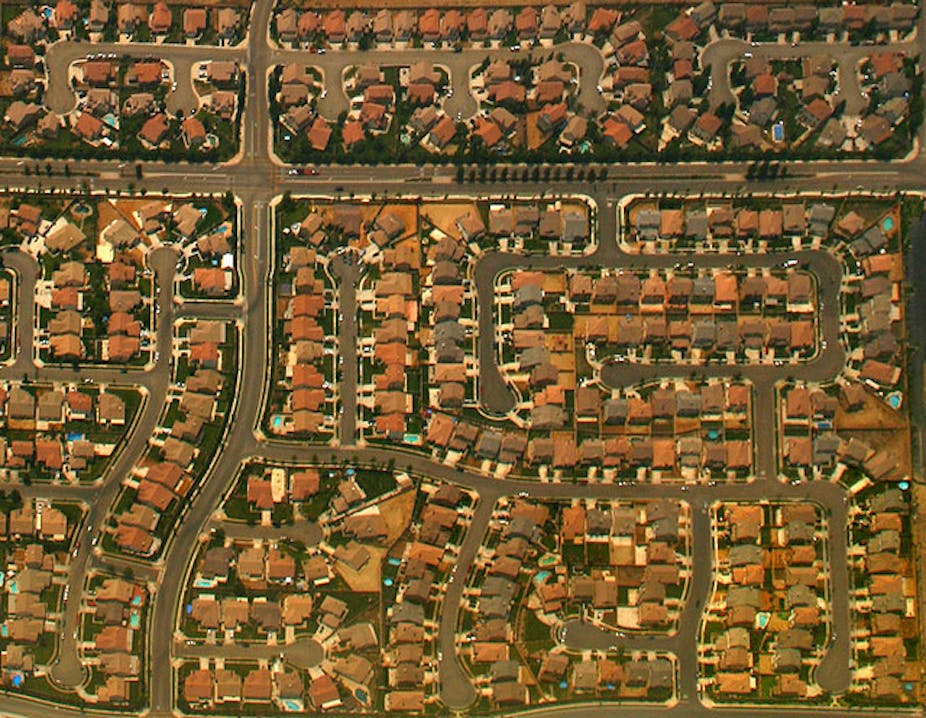
People living in the suburban sprawl walk less, drive more, and spend more time in sedentary pursuits. katie chao and ben muessig/Flickr

OBESE NATION: It’s time to admit it – Australia is becoming an obese nation. This series looks at how this has happened and more importantly, what we can do to stop the obesity epidemic.

Here Billie Giles-Corti and Carolyn Whitzman discuss ways to change our obesogenic environment through urban design while Jo Salmon looks at the role physical activity and exercise play in healthy lifestyles.


Compared with our grandparents, feeding, clothing, and entertaining ourselves has never been easier: a one-stop weekly shopping centre trip in a car, facilitated by convenient parking and light-weight maneuverable shopping trolleys that allow us to whiz around the supermarket with ease.

In fact, these days people don’t even need to leave home to do their food shopping, order takeaway food, bank or pay bills, shop for clothing or household goods, “visit” with their friends, read the newspaper or amuse themselves. Using the internet or telephone, activities that used to involve some level of activity or a short walk, can be done with “anywhere, anytime” convenience.

The internet and telephone have made life easy but it’s not all good news. teoruiz/Flickr

If we couple this lifestyle of convenience with a media environment that advertises and provides an attractive array of easily-accessed, low-cost and tasty, high-fat, high-sugar foods – it’s not surprising that obesity is such a huge problem.

Australia is one of the global leaders in the obesity epidemic, with two-thirds of Australian adults and a quarter of Australian children, overweight or obese. Alarm bells are ringing in health circles about the impact this will have on all the major preventable diseases: type 2 diabetes, cardiovascular disease and cancer. These diseases will get worse unless we can help people maintain a consistent belt size throughout their life.

Poor diet, lack of physical activity and other sedentary behaviours are the main culprits in the obesity epidemic. People choose how active they are and what they eat. But their local environments – their neighbourhood, local parks and streets, as well as their homes, workplaces and schools – provide opportunities and barriers that affect those choices.

There’s widespread agreement that we’ve created obesogenic environments that encourage both inactivity and overeating. So what can be done about it?

People are more likely to walk and cycle if they live in safe, compact, pedestrian-friendly neighbourhoods. Marionzetta/Flickr

For a start, we could improve neighbourhood design to get people out of their cars and onto the streets. People are more likely to walk and cycle if they live in safe, compact, pedestrian-friendly neighbourhoods characterised by connected street networks, access to nearby destinations such as shops and parks, mixed uses of building such as housing above shops, and high population density.

People living in the suburban sprawl walk less, drive more, and spend more time in sedentary pursuits, such as watching television or cruising on the internet, than those living in compact, pedestrian-friendly neighbourhoods. We need to plan services in new communities so that schools, shops, public transport, and parks arrive at the same time as housing – so that residents can develop good walking, cycling and public transport habits from the outset.

At the same time, we need to share the resources available in established suburbs closer to the city where there’s already good access to parks, jobs, and public transport. This means increasing the number of people who live in inner-city suburbs and giving more people access to existing shops and services.

We also need to think about quality and access to open space: parks, ovals, play grounds, and school grounds. The way open space is designed gives people cues about how it is to be used – is this open space simply for vandals and hoons, or does it say to local residents (regardless of age), “this space is open for active business, come and join in”?

The way open space is designed gives people cues about how it is to be used. Grant MacDonald

Similarly, we need to make the most of what’s called “blue space” – waterways, such as creeks, lakes, rivers and beach fronts. We know that in wealthy areas, blue spaces are opened up and invite the public to be active with walking and cycling paths, but is this true in lower-income areas?

There’s growing evidence that people who drive long distances to work are more likely to gain weight. Reducing commute times would not only be good for the environment, it would also be good for our waistlines – particularly if it involved walking or cycling to rapid public transport. This requires the right types of jobs to be available locally – what type of local business activation models could assist?

We need to give people choices so that healthy options are easy to pick – in neighbourhoods, schools and workplaces. Policies ensuring there’s plenty of fruit, water, and healthy take-away food – not just high-fat, high-salt, high-sugar alternatives – give people the opportunity to make healthier choices.

Providing access to community garden spaces encourages children and adults to develop a love of fresh food has the potential to have a positive impact on our waistlines too.

Community gardens encourage people to develop a love of fresh food. RDPixelShop/Flickr

And we need to think carefully, as a community, about how happy we are about the way unhealthy food is marketed and actively promoted so readily to children and young people. This normalises unhealthy food choices. We may need restrictions on the marketing of fast food to children in the mass media, at school and at sporting events.

These are choices to be made not only by individuals and families, but also by society. Planning and policy interventions are crucial to correct a serious market failure that is promoting unhealthy lifestyles, at the expense of the health and well-being of the nation and the future life expectancy of our children.

We have choices to make as a society. We know what we prefer – how about you?


This is part fourteen of our series Obese Nation. To read the other instalments, follow the links below:

Part one: Mapping Australia’s collective weight gain

Part two: Explainer: overweight, obese, BMI – what does it all mean?

Part three: Explainer: how does excess weight cause disease?

Part four: Recipe for disaster: creating a food supply to suit the appetite

Part five: What’s economic growth got to do with expanding waistlines?

Part six: Preventing weight gain: the dilemma of effective regulation

Part seven: Filling the regulatory gap in chronic disease prevention

Part eight: Why a fat tax is not enough to tackle the obesity problem

Part nine: Education, wealth and the place you live can affect your weight

Part ten: Innovative strat egies needed to address Indigenous obesity

Part eleven: Two books, one big issue: Why Calories Count and Weighing In

Part twelve: Putting health at the heart of sustainability policy

Part thirteen: Want to stop the obesity epidemic? Let’s get moving

Part fifteen: Industry-sponsored self-regulation: it’s just not cricket

Part sixteen: Regulation and legislation as tools in the battle against obesity

Articles also by These Authors

Sign in to Favourite

Want to follow The Conversation?

Sign up to our free newsletter to get the day's top stories in your inbox each morning, with a special wrap on Saturday.

Spinner
Donate and become a friend of The Conversation

Join the conversation

20 Comments sorted by

  1. Margo Saunders

    Public Health Policy Researcher

    What does and does not make a difference in terms of obesity and the built environment is a complex issue. Importantly, it has been the subject of recent findings from research in Canada, the UK and elsewhere that cast doubt on the sorts of simplistic relationships and, dare I say, 'urban myths', perpetuated through articles like this. Changes in food consumption have been a far greater cause of obesity than changes in physical activity, and patterns of physical activity of the sort alluded to here are also questionable, with many 'suburbs' being far more conducive to healthy outdoor pursuits than denser, 'compact' urban areas. However -- and this is a big 'however' -- it is essential to consider (as analysts such as Alan Davies in Crikey's 'The Urbanist' blog have done) research which suggests that patterns of behaviour are more a matter of who lives where rather than the form of the built environment.

    report
    1. Paul Richards

      strategic foresight

      In reply to Margo Saunders

      Margo - I appreciate your points, but the principles of who lives where is wound around many issues in the Urbanist blog.

      Industrialised food, breast feeding, child care, human gut flora, transport, lifestyle, abundance, form based building codes, new urbanism, all come together under this messy topic of obesity epidemic.

      To imply humanising cites does not cover a vast area of issues contributing to the epidemic worldwide, is naive. It is our very culture that conspires against us, and we…

      Read more
    2. Margo Saunders

      Public Health Policy Researcher

      In reply to Paul Richards

      I guess there are suburbs and there are suburbs, just as there are urban areas & urban areas. Various public health colleagues with whom I have spoken have confirmed their experience (like mine) of healthy suburban life and relatively unhealthy city life. It defies common sense and much experience that backyards and pleasant, safe, open spaces which invite walking and other outdoor activities, are somehow a problem. Life in the suburbs substantially pre-dates the obesity crisis, and I despair at…

      Read more
    3. Colin MacGillivray

      Retired architect

      In reply to Margo Saunders

      My personal experience of very high density living, Singapore, is that one still sits in a bus or train or taxi rather than one's own car. One might walk a few hundred metres more linking different vehicles than using one's own transport but the effect on obesity is surely minimal. As Margo implies to get less obese eat less.

      report
    4. Paul Richards

      strategic foresight

      In reply to Margo Saunders

      Margo S - Some of those negative high density examples you sight are relics of the 1930s architectural model. These where originally designed to replace 'form based building' modeled in Europe that operated with approximately one kilometre radius to centrally supply, food markets, home supplies, restaurants, cafes, clothing, hardware, medical and government services. A time when a 'Street' was meant for people became places for trucks and cars, no longer distinguishable from transport 'Roads…

      Read more
    5. Lorna Jarrett

      PhD candidate, science education; Physics teacher

      In reply to Paul Richards

      I didn't see many fat people in Amsterdam. I did see one elderly fat man on a recumbent - with crutches stowed on the back. Age, weight and disability against him and he was STILL cycling.

      report
  2. Paul Richards

    strategic foresight

    Good to see this issue is being highlighted again.

    "We have choices to make as a society. We know what we prefer – how about you?"

    I want humanised cites and the motor industry domination of our lifestyle brought to a halt. Hard to do when they lobby with total impunity in this country. I want form based architecture based on world best practices being applied in Europe, USA, Canada and isolated cities in Australia.

    It was announced this week that ute and SUV sales in June appears to have…

    Read more
  3. Elizabeth Blades-Hamilton

    Social Analyst

    Urban planning and obesity may be a wicked problem but we need to start somewhere. I like the tone of this article and the suggestions to get us moving. Patterns of behaviour can be a matter of who lives where but town planning and built form does also tend to dictate this. Peoples choices about where to live are restricted by their incomes, some more than others. If it wasn't for public housing in inner city Melbourne for example there would be little cultural diversity within the inner city…

    Read more
    1. Paul Richards

      strategic foresight

      In reply to Peter Fox

      Peter - I was an ex pate living in NZ when the government did this to save fuel in the late seventies and it defiantly works.

      On 30 July, 1979, the government introduced carless days, where private motorists had to choose one day of the week, on which they could not drive their motor vehicle. Heavy fines were imposed for motorists who were caught driving on their nominated carless day.

      The roads and motorways were very pleasant to drive and cycle on and this may also work. Naturally there were some exemptions, but the public had no recourse.

      report
  4. Gil Hardwick

    Anthropologist

    Correlating with all this is what somebody called, not so long ago, the right to roam.

    Studies have shown that during childhood a great-grandfather walked or rode his bike 7 miles and more to go fishing or whatever. The grandfather went 5 miles, the father to the edge of the village, and the son barely even to the end of the block.

    Children today are being driven everywhere, often in wank tanks, 4-wheel drives with bull bars front and rear, when they are far better off walking to school and…

    Read more
    1. Paul Richards

      strategic foresight

      In reply to Gil Hardwick

      Gil - Great comments, during the era pre motor industry our cites where humanised, shopping was localised and so was employment.

      If we look carefully at our history it is evident from Government Gazettes across Australia the bicycle and cycling lobbyists where the major instigators of our traffic laws.

      The right of way was given to pedestrians, cyclists, horses and carts pre 1950s in that order. The law still has this bias, but unfortunately the motor industries campaign has meant drivers…

      Read more
    2. Lorna Jarrett

      PhD candidate, science education; Physics teacher

      In reply to Gil Hardwick

      Gil,

      I've just returned from a trip to Scotland (where I grew up), taking in a few days in Amsterdam (first time there for me).

      The trip reminded me of something I miss about European cities: the ease and prevalence of public life. More compact cities mean shorter distances - more amenable to walking or cycling. They also mean less private space, so people spend their leisure time much more in public spaces. This is significant because it leads to a sense of community and builds social cohesion…

      Read more
    3. Lorna Jarrett

      PhD candidate, science education; Physics teacher

      In reply to Lorna Jarrett

      Oh, and half the "roads" in Old Edinburgh are actually staircases. Or if they ARE roads, instead of intersecting, one road often crosses over the other via a bridge. Watching American tourists in hire cars with satnav is a great local entertainment so I'm told.

      report
    4. Paul Richards

      strategic foresight

      In reply to Lorna Jarrett

      Lorna - What a picture you painted, it is sad we fell for the utopian dream based around the motor vehicle. Worse still we are still too proud to admit we did.
      I love the spirit over there this short video epitomizes how we failed to diverge when the Dutch did;

      http://youtu.be/XuBdf9jYj7o
      It is a joy to see all the females out and exercising, unlike here;
      http://youtu.be/swqaAIkGtpA

      report
    5. Lorna Jarrett

      PhD candidate, science education; Physics teacher

      In reply to Paul Richards

      Thanks Paul,

      http://youtu.be/XuBdf9jYj7o Amazing - I had no idea that the cycle infrastructure is so recent, and the explanation of how it came about is fascinating and relevant to Australia.

      I didn't see any couples cycling hand in hand in the second video though - a common sight in Amsterdam :)

      The important point is that humanising cities is no pipe dream - it's already happened in other countries and to say that Australian cities are somehow different is just a hollow, baseless excuse for avoiding change. After all, Northern Europe has vile weather and it's dark half the year - and that doesn't stop them cycling. Meanwhile Scotland is infamously full of hills and not only is cycle touring popular, cycle commuting is increasing to the extent that you can scarcely get a cheap Brompton on eBay anymore.

      report
  5. Gillian Kirby

    mature age history student

    I live on the upper north shore of sydney and despite no shops, transport or parks within 25min walk from home (and so everybody owns 2 cars) you rarely see obese people around here. I know it's probably not the norm as, you know, we're not 'real' people here as the Prime Minister pointed out. I just find that most people I know here are just interested in being healthy.

    Having said that I also hear constantly from other families that kids don't want to play much in the backyard but would prefer…

    Read more
  6. Stiofán Mac Suibhne

    Contrarian / Epistemologist

    I live in the municiplaity of Canterbury in Sydney. We are very fortunate to have the Cook's river walkway and the Wolli Creek / Bardwell valley green / blue spaces in the area. The walkway is a fantastic community resource. It allows leisure walking in a very pleasant environment and safe cycling. Attractive plantings are also a refuge for birds erc. It's well used and there is the potential to expand the network of pathways along the Alexandria Canal and a walkway along side a light rail development…

    Read more