
Future under threat: climate change and children’s health

Climate change has been widely recognised by leading public health organisations and prestigious peer reviewed journals as the the biggest global health threat of the 21st century. A recently released report, commissioned by 20 of the most vulnerable countries, highlights the size of the threat: climate…

Dfs93cfk-1349413510
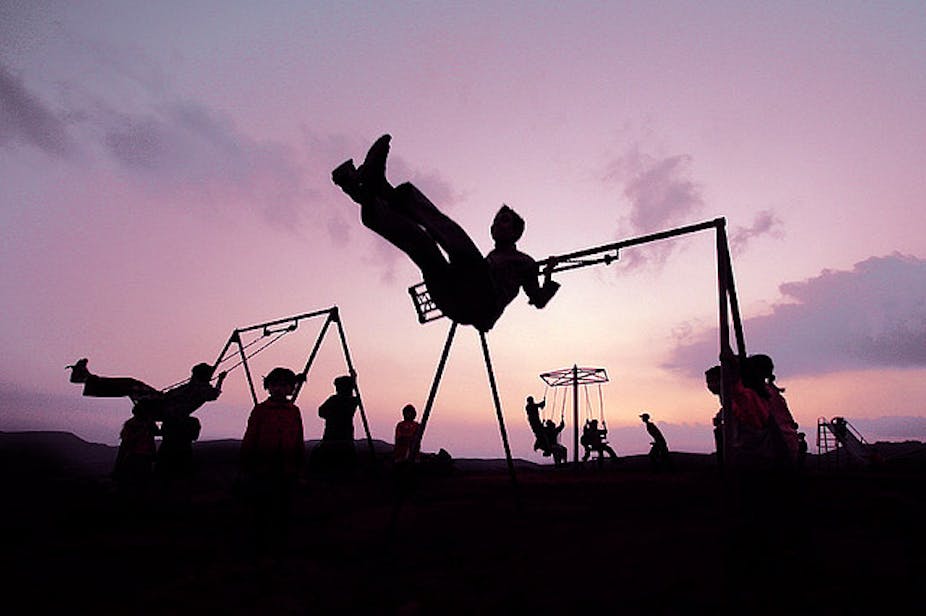
Children suffer around 90% of the disease burden from climate change. Flickr/SeemaKK

Climate change has been widely recognised by leading public health organisations and prestigious peer reviewed journals as the the biggest global health threat of the 21st century.

A recently released report, commissioned by 20 of the most vulnerable countries, highlights the size of the threat: climate change is already responsible for 400,000 deaths annually, mostly from hunger and communicable disease. And our carbon-intensive energy system causes another 4.5 million deaths annually, largely due to air pollution.

Along with the old and disadvantaged, children are particularly vulnerable to the negative effects of climate change. Children suffer around 90% of the disease burden from climate change.

What can our children expect if we continue the way we’re going?

Even if current international carbon reduction commitments are honoured, the global temperature rise is predicted to be more than double the internationally agreed target of 2°C. Humanity continues to pour record amounts of CO2 into the atmosphere. It has been argued that, if this continues, reasonable hope of avoiding dangerous climate change will have passed us by in a mere 16 years.

The impact climate change has on children born today may well be decided before they can vote on it.

Climate change will affect global agricultural productivity and food security, with 25 million additional children predicted to be malnourished by 2050. The estimate of an additional 200 million “environmental refugees” by 2050 has become the widely accepted figure. This means, if we do not intervene, millions of children will suffer the adverse mental, physical and social health impacts associated with forced migration.

The impact climate change has on children born today may well be decided before they can vote on it. Steve Slater Wildlife Encounters

The intensity and frequency of weather extremes will increase. This will result in increased child illness and death from heat waves, floods, storms, fires and droughts. The increased incidence and severity of floods, for instance, will increase child illness and death from diarrhoea and other water born diseases.

We’re likely to see more asthma, allergies, disease and other adverse health outcomes that disproportionately affect children. A recent report observed that climate change may make serious epidemics more likely in previously less-affected communities. This report also found that changing climate conditions have the potential to stimulate the emergence of new diseases and influence children’s vulnerability to disease.

Australians will not be immune to these changes.

It has been estimated that climate change will mean that Australian children will face a 30% to 100% increase across selected health risks by 2050. Indeed, if we fail to act, future generations of Australians may face a three- to 15-fold increase in these health risks by 2100.

Because their brains are still developing, children are particularly vulnerable to toxic levels of stress. Increased exposure to trauma and stress because of climate change is likely to affect children’s brain development and mental health. Children surveyed six months after the 2003 bushfires in Canberra, for example, showed much higher rates of emotional problems. Nearly half had elevated symptoms of post-traumatic stress disorder.

Research has also found that prolonged exposure to adverse weather conditions is associated with increased child and adolescent psychological distress over time. As global warming drives local and regional change to home environments, children, like many non-human animals will experience place-based distress (known as solastalgia) at the unwelcome changes.

An additional 25 million children around the world are predicted to be malnourished by 2050. United Nations Photo

We are only beginning to understand the impacts that climate change will have on children’s physical and mental health. More research at the regional and local levels is desperately needed so we can adequately understand, prepare for and adapt to the impacts of climate change.

James Hansen from NASA recently argued that:

Children cannot avoid hearing that the window of opportunity to act in time to avoid dramatic climate impacts is closing, and that their future and that of other species is at stake. While the psychological health of our children needs to be protected, denial of the truth exposes them to even greater risk.

We must listen to the fears and concerns of children and young people and include their voices in discussions about climate change.

The existence of cost effective ways to reduce climate change means there is no excuse for inaction. Climate change and the carbon-intensive energy system are currently costing 1.7% of global GDP and are expected to reach 3.5% by 2030. This is much higher than the cost of shifting to a low carbon economy.

Right now the science is telling us that we are not doing enough.

As children are innocent and non-consenting victims of climate change, adults have an ethical obligation to do everything possible to prevent further damage to their ability to thrive in the future. To do otherwise is to ignore the very thing many of us see as the most important reason for living.

Join the conversation

44 Comments sorted by

Comments on this article are now closed.

  1. Gerard Dean

    Managing Director

    You said, "As children are innocent and non-consenting victims of climate change, adults have an ethical obligation to do everything possible to prevent further damage to their ability to thrive in the future."

    Everything? Isn't that setting the bar for ethical behaviour a little too high.

    You will all agree that the science says that the biggest driver of climate change is humans burning fossil fuels.

    Then, if you say we must do "everything" to prevent further damage, does that mean that the authors of the article will no longer CHOOSE to fly overseas for holidays and academic conferences, in the full knowledge that in doing so, they are burning non renewable JetA1 fossil fuel.

    Perhaps the authors of the article can explain the ethical justification for calling adults to do 'everything' then failing to follow their own advice by choosing to fly.

    The moral of the story: Whenever you set an ethical bar for others, make sure you can jump it first.

    Gerard Dean

    report
    1. John Nicol

      logged in via email @bigpond.com

      In reply to Gerard Dean

      Well said Gerard. I really think that the so-called health hazards from climate change are in the same league as the other exaggerations associated with this phenomenon and possibly more so. As a person raised in the tropics but who has spent some time in regions as cold as -20 C one must wonder what change a few degrees will bring. Any articles on this topic have never stated the direct connection between temperature and health either for individuals nor for regional effects - they just make…

      Read more
    2. Lennert Veerman

      Senior Research Fellow, School of Population Health at University of Queensland

      In reply to Gerard Dean

      Ah yes, the 'hypocrites' 'argument'. "He who is without sin among you, let him be the first to throw a stone."

      We all emit CO2. Even IPCC panel members fly. We are all hypocrites! Nobody therefore has the right to argue for measures to limit greenhouse gas emissions. We'd better pretend this all isn't happening.

      report
    3. Michael Shand

      Michael Shand is a Friend of The Conversation.

      Software Tester

      In reply to John Nicol

      "There must be more useful things that people could do with their time than fuss on and on about these inevitable changes " - Apparently you dont have anything better to do, you dont see any irony in taking the time to comment no an article only to say that the article is unimportant and a waste of time......you dont think thats the lest bit self defeating?

      report
    4. Gerard Dean

      Managing Director

      In reply to Lennert Veerman

      Mr Veerman,

      I will repeat the JetA1 fuel argument as long as those who lecture us act on climate change choose, I stress CHOOSE to put their own pleasure in front of the need to reduce fossil fuel consumption.

      They don't have to burn JetA1 fossil fuel, but they do, and in doing so, what does it say about their high ethical stand that we should do 'EVERYTHING' to combat climate change to protect our children.

      Perhaps the rights of children to live in a safe, healthy environment, free from climate change is not as important as their regular overseas holiday?

      Remember: If you say we should reduce fossil fuel usage to combat climate change, then you CHOOSE to burn JetA1 fuel to fly overseas for a holiday - you are a hypocrite - no if's, no but's, no letouts, no excuses, no higher moral ground, no carbon credits, no shooting the messenger, no huffing - you are an ironclad, old fashioned, 100% rolled gold hypocrite.

      Thank you

      Gerard Dean

      report
    5. Lennert Veerman

      Senior Research Fellow, School of Population Health at University of Queensland

      In reply to Gerard Dean

      Mr Dean,

      I can't comment on other people's holidays - I already informed you of mine earlier - and I won't comment on the wisdom of the exact wording in this article.

      But much as I've seen you repeat this 'JetA1 fuel argument', I've never seen you argue for a tax on such fuel to punish thpse 'hypocrites'. Australia could join the proposed EU scheme (instead of lobbying against it - http://www.smh.com.au/travel/travel-news/australia-joins-attack-on-eu-airline-carbon-tax-20120817-24cec.html

      Read more
    6. Phil Dolan

      Viticulturist

      In reply to Gerard Dean

      Fixated on air travel still. Are you aware of the percentage of global emissions air travel contributes Gerard?

      report
    7. Brad Farrant

      Adjunct Research Fellow in Early Childhood Development at University of Western Australia

      In reply to Gerard Dean

      Dear Gerard,

      Yes I do believe that we should do “everything possible” to prevent further damage to our children’s ability to thrive in the future. However, I think setting this issue up as being “all or nothing” is a false dichotomy. I don’t think that you would argue that we have no responsibility to look after our children’s futures.

      If you believe in science then I think that we have a responsibility to think carefully about how we live our lives and do as much as possible to reduce our…

      Read more
    8. David Arthur

      n/a

      In reply to Gerard Dean

      Mr Dean, ever since you found out that the grade of fuel used by jet aircraft is called "Jet A1", you have bandied the phrase "Jet A1" into EVERY SINGLE CONVERSATION to which you have contributed. Matter of fact, it's about the only thing you ever contribute.

      Rest assured that technologists are labouring away on replacing fossil-based liquid fuels with biofuels, thereby making redundant your sole contribution to these discussions. Perhaps you could be of some use to the discussion if you kept the rest of us all apprised of developments in biofuel technology.

      report
    9. David Arthur

      n/a

      In reply to John Nicol

      No idea what change a few degrees might cause? Try living on the Ganges Plain.

      report
    10. Mike Hansen

      Mr

      In reply to Brad Farrant

      Gerard Dean is the hypocrite here in that he talks about ethics but fails to disclose that he is a climate science denier and a fan of Andrew Bolt.

      See his comment here "I deny that humans make a large impact on the climate..."
      https://theconversation.edu.au/an-incumbent-industry-beginning-to-squeal-9907#comment_79376

      His claim "Perhaps the rights of children to live in a safe, healthy environment, free from climate change is not as important as their regular overseas holiday?" is part of his usual faux concern trolling schtick.

      report
    11. Tim Scanlon

      Debunker

      In reply to John Nicol

      John Nicol: the arch nemesis of logical and evidence.

      I see you are back at the old doubt mongering game John. You really should stop using examples of local weather as climate, they are different after all. Your statements are akin to me spotting a basketball player and saying that the average human height is 200cm. Any decent scientist would actually see the normal distribution of measurements and then assess the changes over time, not try and look at the outliers or a single observation.

      And then you pull out the classic 'climate has always changed' meme. Amazing. All those climate scientists must missed all of the natural cycles that climate goes through and not taken that into account when they were writing up all that science. But where did you hear about these natural cycles from exactly? Oh, that would be those climate scientists who measured them all and worked out what impacts they have....

      report
    12. Phil Dolan

      Viticulturist

      In reply to Phil Dolan

      Gerard hasn't returned. Well, for his information, air travel accounts for less than 2% of global emissions. Cars about 10% and power generation about 25%. So Gerard, it would help if you turned your computer off and bought a bicycle instead of trying to stop people flying.

      report
  2. Juli Viel

    logged in via Facebook

    Thank you Brad Farrant,

    I am also concerned about climate change. I'm worried how my children and grandchild will cope. I'm worried about irreversible climate change and giving our children and grandchildren what would essentially be a doomed planet. I'm aghast that someone would think that we could all simply adapt or move. Climate change has brought a new paradigm. We need a critical mass of people concerned about our children's future in order to change OUR fossil fuel emission problem. Juli Viel, St. Louis Missouri

    report
  3. Spiro Vlachos

    AL

    As offered by a true scientist, Freeman Dyson:

    "The person who is really responsible for this overestimate of global warming is Jim Hansen. He consistently exaggerates all the dangers.”

    via:

    http://www.nytimes.com/2009/03/29/magazine/29Dyson-t.html?_r=1&sq=Freeman%20Dyson&pagewanted=all

    But, if you really believe and you want us all to pay, then I suggest you all put your money where your mouths are as Intrade are offering good odds on the global warming "sure shot":

    http://www.intrade.com/v4/markets/contract/?contractId=706208

    Bet your house on it.

    report
    1. Lennert Veerman

      Senior Research Fellow, School of Population Health at University of Queensland

      In reply to Spiro Vlachos

      Freeman Dyson probably confused Jim Hansen with Jim Henson. That's the great puppet master.

      Jim Hansen, in contrast, has warned for global warming since the early 1980s. And he was right.

      If you believe all the other climate scientists are just taking Hansen's word for it, well, that's your call. I don't find it very plausible. And besides, Dyson admitted that he doesn't know much about the 'technical facts' of global warming (http://en.wikipedia.org/wiki/Freeman_Dyson#Global_warming). I'd be cautious to take his word for this 'exaggeration'.

      report
    2. Spiro Vlachos

      AL

      In reply to Spiro Vlachos

      As you can see, these markets seem to peak in the northern summer and as in the 2012 market, fall precipitously upon realisation of actual temperatures:

      https://data.intrade.com/graphing/jsp/closingPricesForm.jsp?contractId=743901&tradeURL=https://www.intrade.com

      the same is shown here for the 2013 hottest year market:

      https://data.intrade.com/graphing/jsp/closingPricesForm.jsp?contractId=706206&tradeURL=https://www.intrade.com

      If predictions of increasing temperatures are believable, why are prices not increasing as we get closer to the realisations?

      report
    3. Spiro Vlachos

      AL

      In reply to Lennert Veerman

      So you believe that global temperatures will increase, but you will not back your beliefs? Do you also believe this to be rational?

      report
    4. Gary Murphy

      Independent Thinker

      In reply to Spiro Vlachos

      You are getting less than 2-1 odds on an event that is 37% chance of happening?

      37% is way higher than expected odds if there was no warming trend.

      report
    5. David Arthur

      n/a

      In reply to Spiro Vlachos

      Climate science for Business School Dummies.

      Observation 1. Sun irradiates earth with short-wave energy.

      Observation 2. Earth re-radiates long-wave energy.

      Observation 3. Greenhouse gases retard transmission of long-wave energy, not short-wave energy.

      Observation 4. Arctic sea ice is melting, so that summertime sunlight is being absorped in exposed ocean rather than reflected off ice.

      Observation 5. Greenland and Antarctic ice is melting, increasing the rate of sea level rise. The…

      Read more
    6. David Arthur

      n/a

      In reply to Spiro Vlachos

      Hey Spiro, one year is too short a period for certainty that a long-term trend won't be upset by a one-off trend.

      What odds is your bookie giving on the decade 2011-2020 being warmer than 2001-2010?

      report
    7. James Haughton

      Social Policy Researcher

      In reply to Spiro Vlachos

      You believe that "rationality" is better defined by bookies than by scientists?

      report
    8. Spiro Vlachos

      AL

      In reply to David Arthur

      http://www.intrade.com/v4/markets/contract/?contractId=715165

      55% percent chance at the moment. This market is a little thin. The buy sell spread is 40%. No market makers means that there is no chance of this being true.

      Average Global Temperature for 2013 to be among five warmest years on record:

      http://www.intrade.com/v4/markets/contract/?contractId=706206

      This one is has a buy-sell spread of 4%. Note that temperature data used states that the hottest five years so far are 1998, 2002, 2005, 2007, 2010. Follow your warming beliefs and put your money down. If there is a warming trend, then the fact that 2011 and 2012 have and will not be top 5 hottest years means that there is even greater certainty that 2013 will be top 5.

      report
    9. Spiro Vlachos

      AL

      In reply to James Haughton

      Risking your money on an event that you would consider certain is definitely rational.

      report
    10. Brad Farrant

      Adjunct Research Fellow in Early Childhood Development at University of Western Australia

      In reply to Spiro Vlachos

      Dear Spiro,

      I am not a climate scientist so I didn’t spend any time in the article defending the scientific consensus that is recognised by all the major scientific organisations around the world. If you believe in the benefits of science, and it’s hard not to if you’re utilising and benefitting from all it has delivered for us, then it’s not enough to for you to simply say you disagree with the scientific consensus, the onus is on you to go and do the science, do the work to prove that you’re…

      Read more
    11. Gary Murphy

      Independent Thinker

      In reply to Spiro Vlachos

      No-one considers it certain that any one particular year will be among the 5 hottest.
      Did you fail statistics?
      Have you bet your house on it not happening? Given there is only a 3% chance of a particular year being in the top 5 without a warming trend you really should go for it. After all - you know better than all those climate scientists right?

      report
    12. David Arthur

      n/a

      In reply to Spiro Vlachos

      Spiro, your interest in warming seems limited to whether or not you can win a bet at your bookmaker's over next year. To this end, you look solely at whether the previous year was among the hottest years ever.

      Such zero order empiricism serves as a start, but you could improve your odds by looking at a couple of other factors.

      1. The correlation between atmospheric CO2 and heat retention in the earth system is beyond doubt: the issue for the punter is whether or not this retained heat is…

      Read more
    13. Spiro Vlachos

      AL

      In reply to Brad Farrant

      Although, you do state that "the global temperature rise is predicted to be more than double the internationally agreed target of 2°C." With some certainty temperatures will increase, so you say. I find outstandingly dishonest that you would ask policy makers to risk our future on some loose predictions, including links to some pop-science interactive sites, when you are not prepared to use your own money to back your statements. If you want rational people to believe such predictions, put your money down. I and others will make the market for you. Otherwise, your research interests are based on some fallacy dependent on very dubious predictions. Did you fail statistics? You state "The estimate of an additional 200 million “environmental refugees” by 2050 has become the widely accepted figure." Do you know the size of a confidence interval forecast for any data generating process 38 years into the future?

      report
    14. Spiro Vlachos

      AL

      In reply to David Arthur

      Blah, blah, blah. My point is that rather than asking policymakers to waste taxpayers money on some very dubious propositions, you should use your own money if believe with certainty that predictions of climate catastrophe are true. Put your money down and stop asking policymakers to waste hard working peoples money. If the predictions are true, and Intrade is offering decent odds, then you can donate your winnings to your cause.

      By the way, there is no bookmaker. With Intrade you can buy and sell contracts. I am quite prepared to make the market for you by offering to sell some contracts.

      report
    15. Phil Dolan

      Viticulturist

      In reply to Spiro Vlachos

      The depths deniers go to in their foot stamping rage. Why would anyone gamble? It's a ridiculous argument.

      report
    16. Brad Farrant

      Adjunct Research Fellow in Early Childhood Development at University of Western Australia

      In reply to Spiro Vlachos

      Dear Spiro,

      With all due respect it is you that is prepared to risk our children’s futures by denying the scientific consensus. You seem prepared to wager their future by betting that over 95% of the world’s climate scientists are wrong and you are right. It is dishonest to call these ‘loose predictions’ - they are based on years of scientific evidence from the world’s leading scientists. Instead of advocating responsible action to protect our children’s futures you seem instead to want policy…

      Read more
    17. Spiro Vlachos

      AL

      In reply to Phil Dolan

      According to the article, there is some certainty in higher temperatures occurring. Certainty means no risk. Free money. Why would you not take it?

      report
    18. Spiro Vlachos

      AL

      In reply to Phil Dolan

      Some for me. "internationally agreed target of 2°C." Certain for the author. I cant find anywhere in the article any mention of uncertainty. In the Hansen NASA quote "denial of the truth exposes them to even greater risk.". Truth is a concept that imbues certainty.

      report
    19. David Arthur

      n/a

      In reply to Spiro Vlachos

      Spiro: "My point is that rather than asking policymakers to waste taxpayers money on some very dubious propositions, you should use your own money if believe with certainty that predictions of climate catastrophe are true."

      Spiro, your point is among the most abject misunderstandings of the issue that I have ever encountered. Not only do you demonstrate blithering ignorance of climate science, you also do not understand that the earth's climate system directly affects everyone: me, you, your bookie, the public officials who decide allocation of public funds, and the students who are being ripped off by accumulating HECS debts while in receipt of your curious notion that the common interest is insufficient reason for expenditure of public funds.

      report
    20. David Arthur

      n/a

      In reply to Spiro Vlachos

      Spiro: "blah, blah, blah".

      Thanks for that, Spiro, the most vapid and most amorl exposition of value-free neoliberalism I have yet encountered.

      report
  4. John Bloomfield

    Retired Engineer

    This recent interview on the ABC with Dr Peter Bell, who warned about nutrients in the Great Barrier Reef region 25 years ago.
    http://blogs.abc.net.au/queensland/2012/10/the-end-of-the-reef.html

    This relates the sad and sorry history of his past efforts to get the GBR problems recognised and some action implemented.
    The lethargic myopic response of our generation has allowed the reef to be decimated; it's now less than 50% of what is was in the 1980's, and in rapid (terminal?) decline…

    Read more
  5. Geoffrey Henley

    Research Associate

    Changes to climate and severe weather events have been occurring for millions or years. To suddenly blame any recent changes in climate almost entirely at the feet of man is a bit rich.

    Global temps have risen by less than 1 degree C in the last century and barely changed in the last 15 years or so. Future projections are based entirely on computer models which are themselves based on a number of unproven assumptions.

    Modest warming over last century is hardly a recipe for catastrophe. Besides, many more deaths are as the result of extreme cold than heat.

    report
    1. James Haughton

      Social Policy Researcher

      In reply to Geoffrey Henley

      A bit of a catalogue of errors and fallacies there Geoffrey.
      1) Climate change and weather events don't just "occur". They occur for reasons, to do with the conservation of energy, albedo of the earth, orbital cycles, levels of greenhouse gases, prevailing weather patterns, etcetera. The search for reasons is one aspect of science. The causality behind previous long-term changes is well understood (google "Milankovitch cycles"). We are not in the warming part of a Milankovitch cycle. We are not…

      Read more