


What if the world left it too long to take action on global climate change? Is there a way we could somehow cool the planet before an environmental crisis occurs?
Geo-engineering is a potential course of action, but it should only be used as an absolute last resort.
Simply put, geo-engineering would involve the use of advanced technology to change the Earth’s climate, thereby counteracting the effects of climate change.
While there are far more desirable options that should be tried before geo-engineering, it’s still important to research the feasibility and effects of various geo-engineering methods.
The SPICE Project
Since its inception in late 2010, the Stratospheric Particle Injection for Climate Engineering (SPICE) Project has become a catalyst for discussion about the merits of geo-engineering.
SPICE is one of only two government-funded geo-engineering research projects here in the UK. The project’s researchers – myself included – are focusing on the idea of particle injection in the upper atmosphere.
When you place reflective particles in the stratosphere – the layer of Earth’s atmosphere between ten and 50 kilometres in altitude – you cause more sunlight to be reflected away from the earth. This reduces the amount of radiation coming into the atmosphere and being trapped by the greenhouse effect.
This creates a global cooling effect, a phenomenon that occurs naturally after large volcanic eruptions, such as the 1991 eruption of Mt. Pinatubo in the Philippines.

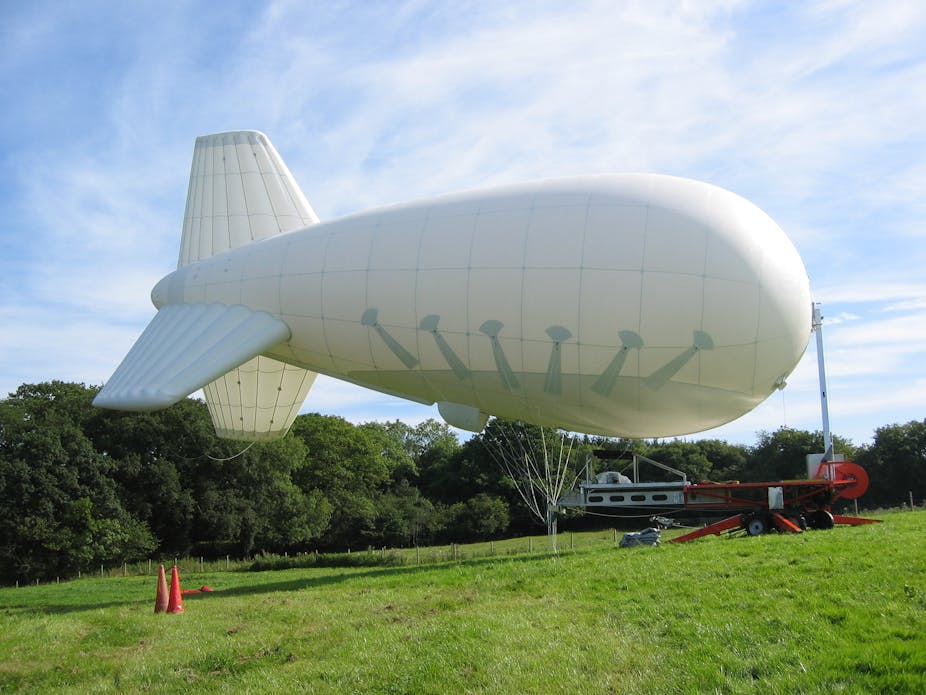
The proposed technology being investigated by SPICE involves a fibre-reinforced hose, held up by a helium balloon. Reflective droplets would be pumped up the hose, and sprayed out 20 kilometres above the earth’s surface.
Predictions show that if five to ten of these hose-balloon systems were deployed around the world, they could provide a global mean cooling effect of 2°C. That’s a significant amount of global cooling.
We aren’t doing this yet, right?
Though this might sound like the stuff of science-fiction movies, development of this technology might only be decades away. The aim of SPICE is to use computer modelling and laboratory tests to help answer the questions: “Can this be done?” and “What effects would it have?”
Of particular concern to the Cambridge University research team is how the hose will move around in the strong “jet stream” winds that travel around the globe at an altitude of roughly ten kilometres.
To investigate this, we are planning a technology test of a one-kilometre-long hydraulic hose held up by an advertising blimp.
Small amounts of water will be pumped through the hose, and cameras will record the movements of the hose in the wind. The images collected will then be used to validate computer models of hose movements, and identify engineering issues that we’d need to address if designing a system to be used at an altitude of 20 kilometres.
Another part of the SPICE project is to identify particles that are effective in scattering solar radiation while having minimal effects on stratospheric chemistry, weather systems and human health.
Research is also being done to determine the most effective locations for particle injection and the effect of radiation scattering on crops.
Even if the technology is possible, should we geo-engineer?
It’s important to note that a belief in geo-engineering research does not mean advocacy for climate modification. Apart from the scientific uncertainty surrounding this issue, there are a range of ethical, political and social considerations that need to be addressed.

Geo-engineering will not solve climate change. In particular, it does not eliminate the urgent need to reduce carbon dioxide emissions. At best, geo-engineering would only give us more time to wean ourselves off our dependence on fossil fuels.
Side-effects may well occur. Initial modelling results show shifts in rainfall patterns, localised climate changes and changes in crop yields. Ocean acidification from CO₂ present in the atmosphere would not be prevented.
Such engineering of the planet is a radical idea that prompts many important questions: Who would make the decision to deploy this technology? Under what extreme circumstances could this action be justified? Could an international agreement be reached?
These were some of the many questions raised during a public consultation exercise run as part of a parallel research project on attitudes toward geo-engineering.
This research found that very few people were unconditionally positive about the idea of geo-engineering or the proposed one kilometre test. However, most respondents were willing to accept that the test should be pursued as a research opportunity.
What’s next?
Experts and policy makers around the world are beginning to give serious attention to these issues. There are huge ethical and governance decisions to be made.
Scientific research, in the form of computer modelling and laboratory testing, will play an important role in informing this decision-making process, and in reducing the myriad uncertainties currently surrounding geo-engineering.
When the SPICE project finishes in two years’ time, we will be one step closer to knowing if geo-engineering by particle injection is feasible. Research into other methods of geo-engineering – such as cloud whitening, carbon air capture, iron fertilisation and biochar – is ongoing.
It is entirely possible that the environmental risks will be deemed too great to ever consider global climate modification.
Even as an engineer involved in the SPICE project, I sincerely hope that the need for this technology never arises. But if the need does arise, any course of action must be founded on rigorous scientific research.