
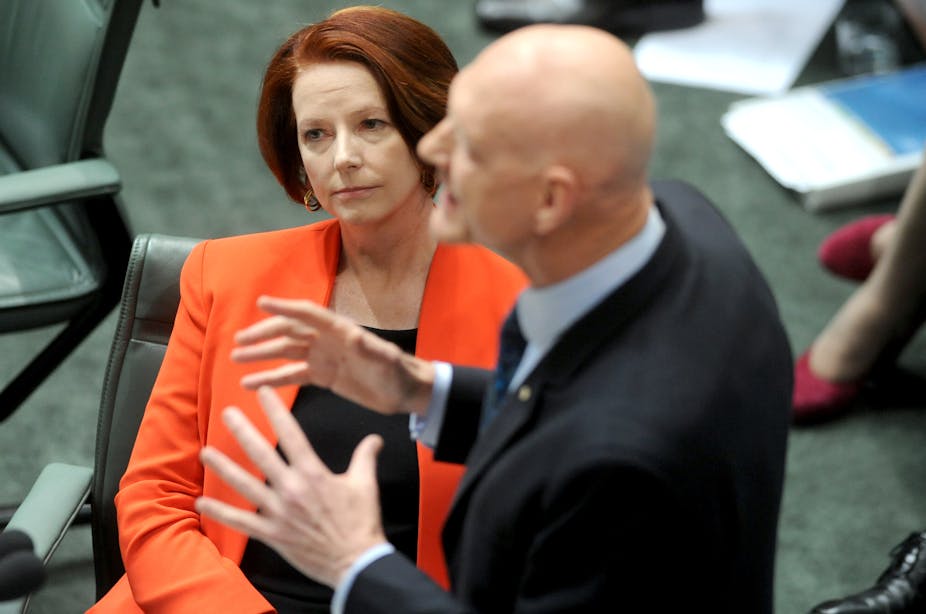
In a political echo of the unseemly bi-partisan “race to the bottom” over asylum seekers, we now have a “race to the top” with the prime minister and opposition leader vying to offer the most support to non-government schools.
Prime minister Julia Gillard earlier this week told a private school forum that “every independent school in Australia will see their funding increase” under the government’s new funding plan. “This plan will lift school standards, not school fees,” she said.
Abbott on the other hand told the forum that because 66% of Australian school students who attend public schools get 79% of government funding “there is no question of injustice to public schools here. If anything, the injustice is the other way.” Abbott reached this conclusion because the 34% of students who attend independent schools get 21% of government funding.
In a backdown away from Abbott’s comments the opposition’s education spokesperson, Christopher Pyne later said there was no injustice in regards to funding independent schools, saying the current level of funding for both independent and government schools is “appropriate.”
Pyne also stated publicly last month that there isn’t an equity issue in Australian schools and that the problem was with student outcomes. He has also declared that any government changes to the funding model of schools would be repealed under a coalition government.
Extending privileges for the privileged
This latest unedifying part of the debate comes after 10 years of public critique of the iniquitous funding formula. A system developed by the Howard government and continued under the Rudd and Gillard governments that is blind to the real needs of students, as well as schools and teachers and sees the most disadvantaged students in our community receiving the least amount of funding.
The results of this 12 year program have only extended the privileges of the already privileged.
The fact is that the fundamental pattern for the last 12 years of Australian Government funding for schools is that while most additional funding goes to non‐government schools this has never prevented private schools raising their annual fees more than 10% per annum.
Those most concerned with public education today in Australia were, until now, quietly optimistic that the unfair education funding system would be changed.
A growing chorus of parents, teachers, principals as well as those within the business community and charity groups (including Business Council of Australia’s Jennifer Westacott, Westpac’s Gail Kelly, ACOSS' Cassandra Goldie and the Smith Family’s CEO Lisa Ryan) all called on Julia Gillard to implement the reforms recommended by David Gonski in his review of school funding.
Breaking new ground
The Gonski Review sought to change an unfair system into one that was more transparent, financially sustainable and effective in promoting excellent outcomes for all students.
Gonski looked forward to an education system premised on ensuring educational outcomes that were “not the result of differences in wealth, income, power or possessions”.
When the Gonski Review was released earlier this year, it a was watershed moment in the debate on schools funding. It embraced the OECD definition of equity in education as its starting point; that every child should be able to achieve her potential regardless of social, cultural or economic background or their relationship to property, power or possession.
Gonski also gave overdue recognition to the fact that disadvantage has been “rusted on” to our education system. And he finally acknowledged our private schools whether independent or Catholic are not looking after our most vulnerable students.
Disadvantaging the disadvantaged
But there were weaknesses in the report. Gonski in fact understated the great weight of disadvantage shouldered by our public schools, the same who are least equipped and able to deal with this disadvantage: 85% of indigenous students, 78% of disabled students, 79% of low SES students attend our public schools.
While the rhetoric around social justice is espoused by both independent and especially Catholic school sectors that they are looking after the poor, in reality they are not.
Research by Professor Richard Teese demonstrates this issue clearly.
The Gonski Review does not have the depth of analysis about this disadvantage but politically it may have been impossible.
False premises … flawed data
The review’s resource based funding model starts with a false premise. Since the Karmel Report 40 years ago, we have witnessed a slow but ever-increasing movement of taxpayer’s dollars from public schools to the private sector, all apparently on the basis of Commonwealth provision for school education on the principle of “need”.
The Gonski Review has accepted as holy writ the “unique Australian tradition” that if parents decide not to send their child to the local public school, then the rest of the country is required to subsidise that choice. No other OECD country has such a tradition yet Gonski said these examples don’t count.
Statistics or lies
Abbott’s claims in this debate could be a case of lies, damn lies and statistics. Just because private schools gain 21% of the education budget and represent 34% of all school students is irrelevant.
What is relevant is the total funding per student including what parents voluntarily contribute to the private school. What has happened to the “user pays” theory of liberal philosophy?
Did it go out the door for the wealthy, and only apply to those who can least afford to pay in society?
What are the facts?
Recent pronouncements by opposition education spokesperson Christopher Pyne, are replete with false assumptions based on flawed data. The claim that Australian school education funding has increased by 44% since 2009 has been repeated so often that it is now accepted as truth.
The fact is that the fundamental pattern of Australian government funding for schools is that most additional funding goes to non‐government schools. OECD figures tell another story.
In 2001 Australia’s education expenditure was 4.9% of GDP falling to 4.4% in 2008 before rising to 5.1% in 2009 as a result of the BER capital investment in all schools. Over the same period government education expenditure as a percentage of total government expenditure in Australia fell from 14.2% to 12.9%.
Annual government expenditure on Australian government schools was $US6980 per student, compared to the OECD average of $US7262. Australia ranked 15th of the 22 OECD countries. The difference in spending on secondary students is even lower.
Finland’s government expenditure on schools was $US7178 per student. In Finland government expenditure on education was 6.1% of GDP in 2001 rising to 6.8% in 2009.
Why $5 billion (or more) is needed …
The reason for the $5 billion price tag is because the Gillard government pledged that no school would be worse of as a result of any reform to funding schedules. But in actual fact even the $5 billion is less than one half of 1 % of GDP.
OECD research explains that any increase in student outcomes has a correlative increase in productivity – so in effect this extra funding will return as additional taxes and productivity for Australia.
But despite its weakness, the recommendations of the Gonski review remain a strong step in the right direction and should be implemented in full and as soon as possible.
Gillard and Abbott need to take the recommendations on balance, look at the facts and elevate the debate around this important policy issue.
Jon Ford
Leader of the Low Back Research Group at La Trobe University
Witness the recent Gough Whitlam Oration as an example of the positive and productive bipartisan support we used to have for issues critical to national identity. And now the current state of negative bipartisan policy with refugees, foreign policy, the environment and education.
http://www.whitlam.org/the_program/2012_gough_whitlam_oration
However maybe our political parties are really only reflecting the "age of the individual"?
Jack Arnold
Director
How unexpected for Abbott & Pyne to promote middle class charity in education that was enhanced by his predecessor. Funny how Woolworths does not subsidise Coles yet governments are expected to subsidise competitors in education. So much for free enterprise.
The DOGS case allowed government funding of private schools to overcome demonstrable inequalities. Now some 50 years later, private schools continue to claim they are disadvantaged because they have to maintain their swimming pools, Olympic standard equestrian centres, rate free playing fields, multi-purpose gymnasia & purpose built theatres.
Many of these facilities were built with interest subsidies from government that were not available to state schools. Yet state schools still provide a better education.
Comment removed by moderator.
John Bloomfield
Retired Engineer
Thanks for this informative article.
Private school enterprises should receive no more than the current average cost per "like" student in the public education system.
Privately run 'business for profit' should not receive taxpayer funded subsidies.
Ken Swanson
Geologist
The cost of educating a student in the state system is $11,000 per student per year
Read moreThe cost to the taxpayer of educating a student in the private sector is $3,000 per student per year (both state & federal grants)
For every student that remains in the private sector the taxpayer saves $8,000 per student per year
If grants are removed it will result in a substantial transition of students to the state system and so increase the burden on taxpayers
Parents of private school students will just…
Michael Brown
Professional, academic, company director
Ken Swanson is correct.
David Zyngier should leave his political biases at home when he goes to work. A liitle more objective professionalism please.
David Zyngier
Senior Lecturer Faculty of Education at Monash University
I don't believe that anyone can "leave their political biases at home" seriously.
But argue the facts please. Why should a battler on $45K pay taxes that go towards subsidising middle class welfare for those that can afford "to choose"? Private Schools are fine but it is only in Australia that public money supports them - not in the USA, not in UK, not in France and not in Finland either!
Should they leave their political ideologies at home too!?
See the excellent article in today's Age by Shaun Carney http://www.theage.com.au/opinion/politics/leaders-in-epic-fail-on-education-20120821-24kjv.html
"Meanwhile, the political bubble remains intact, with the middle class being told that it has every right to hold out its hand, expecting more and more."
Michael Burke
Senior Lecturer, School of Sport and Exercise Science at Victoria University
If it costs $11,000 to educate a student publicly, then why would it cost up to $28,000 ($3,000 government subsidy + $25,000 parental contribution) to educate that same student in one of the more expensive private schools (I think that the overall debate is probably skewed by lumping all private and independent schools together). Surely these figures demonstrate that even without the government subsidy, there is still a fair bit of space available for the private schools in question to not raise…
Read moreJon Ford
Leader of the Low Back Research Group at La Trobe University
This argument is regularly trotted out to defend the middle class welfare (a fact, not a biased statement) introduced by the Howard government to win votes. I agree that there are economical barriers to reducing funding for private schools, however this doesn't mean the policy is correct. It also doesn't mean the policy cannot slowly be wound back as Gonski suggested in his report. Those who choose private schools have accepted increases in fees well over the rate of inflation (despite the Howard increase in funding) without moving their children to public schools. They would equally accept a slow reduction in funding to private schools over time without the catastrophic scenario your didactic analysis suggests. Supporting those who need it most to improve overall educational outcomes is not idealogical class envy. It is sound policy in the best interests of the country.
Ken Swanson
Geologist
David
I have given you the facts
You are not listening
It will cost the taxpayer more if we do what you say
If more students turn up in state schools due to a cancellation of grants the battler on $45k per year will get even less in an education sense because all those "rich" "middle class" sponges will be attending the school as well requiring even more taxes to be raised (political suicide for both parties)
Face it David, you do not have any answers
You are a cloistered academic on a secure government salary who envies those in the middle class you think are better off than you
Get in the real world and show some real academic rigour aimed at solving the problem you keep whining about
Ken Swanson
Geologist
Shaun Carney's article is as myopic and idealogical as yours
Read the comments from readers posted on the Age web site
Very similar to mine
Ken Swanson
Geologist
Michael
The $11,000 cost in the state system does not include the cost of capital replenishment
Remember also that the fees of the majority of private schools are not all $25k. Most are $10k to $15k on average and so the room to move is much less than what you think
Ross Lambert
Builder
Look how quick it all gets personal. In terms of rigor in 2009 recurrent government funding for state schools was $10600 per student, catholic $7700 and indi $6200. Parental contributions in indi schools average $8200. My source is Gonski . Ken what is your source? What you conveniently ignore Ken is the $1.6 billion a year that flows from the government into private school coffers in the form of capital funding (Gonski). Not to mention tax subsidies etc. The private saving the public money cannot be found in reality. Gonski offers a good way forward, proper funding of public schools and if a parent wants their little darling to have the opportunity to abuse a Steinway in year 8 music then they have to pay the full price.
Ken Swanson
Geologist
Jon
See post below
Most fees are just above or around the same as the cost of teaching a student in the state system ($10k - $15k)
A $3k grant reduction is a large % of this. There will be an influx into the state system with such a price squeeze
We need to put more money into state schools
It is economic lunacy to do that at the expense of private schools
Ken Swanson
Geologist
Cost to educate a student in state school $10.6k (I said $11k) Not including capital funding!
Cost of independent school ($6.2 + $8.2 = $15.4k)
Cost of catholic school ($7.7 + $8.2 = $15.9k)
I said fees on average ranged from $10k to $15k in private schools
Take away the government component and the students will be turning up for the free education at state schools. This will cost the taxpayer a fortune.
Did Capital Funding in 2009 include non recurring "Education Revolution" funds? You may want to check that one.
Name one private school you have personally seen a Steinway in! Name one private school where you know a Steinway has been "abused"!
These are the words of a bitter and twisted class warrior Ross.
Michael Burke
Senior Lecturer, School of Sport and Exercise Science at Victoria University
Ken,
I did state, probably in a vague way, that the debate is skewed by lumping all private school together. I would suggest that for the most expensive elite private schools, my argument remains mostly valid. I do agree that I did not include capital replenishment in the figures.
My feeling is the most expensive schools are probably the ones that benefit most from this lumping together of all private and independent schools, and will certainly benefit from sweeping statements by both sides of politics that no school would lose funding.
Michael Burke
Senior Lecturer, School of Sport and Exercise Science at Victoria University
Ken,
Isn't there a point where the private school, without the government subsidy, who makes compensatory increases to fees, loses too many students and then has to do something about either/both their increased fee structures or the cost of the programs that they offer?
I may also be a 'bitter and twisted class warrior' but there must be some expensive independent or catholic schools that could do with less government funding, and still not have to increase fees. The assurances from both sides of politics don't even allow for this possibility.
Ken Swanson
Geologist
I agree with you that the schools at the very top of the pyramid could stand the reduction in grants. But there are relatively few of them in overall terms. The savings would be small in dollar terms. The vast majority however would be devastated and they are the ones with fees $10k to $15k.
Ken Swanson
Geologist
My post above agrees with your point about the most expensive schools.
But there are few of them really.
For most, they have only a few real variables to work with:
- Increase Class sizes to 30 or 40 across all year levels
- Reduce the number of subjects on offer
- Charge more for sport & extra curricular (although most are already doing this)
- Do not replenish capital assets as often and allow facilities to run down
If you do these things parents will leave. I keep getting back to the central point. All bringing down private schools will do is increase the burden on taxpayers. Being brutal about it. While you can keep parents paying $5k to $15k in after tax dollars willingly funding their kids education (and saving the taxpayer in the process) why not do it? Why kill the goose for ideology sake!
Jon Ford
Researcher
I come back to my point raised earlier and rebutted by Ken to a point. Is there any evidence that slowly rolling back middle class welfare will have the impact Ken is suggesting? Did the GST have a massive negative impact on spending? No. Has the reduction in private health insurance subsidies resulted in mass exodus from private health schemes and ballooning public hospital waiting lists? No. Will the carbon tax (independent from other influences on electricity prices) result in mass unemployment? Unlikely. Will the mining tax result in reduced investment from mining companies in Australia? Unlikely
There is a clear common theme here. Subsidies for the middle class and business are neither required nor necessary. The money is better spent elsewhere and assertions that slow reduction of subsidies will result in economic disasters are unsubstantiated.
I'd welcome anyone out there who can provide reliable and referenced data to refute my arguments above
Dianna Arthur
Dianna Arthur is a Friend of The Conversation.
Environmentalist
" the schools at the very top of the pyramid could stand the reduction in grants. "
Reduction?
They are making a profit, like any private enterprise is supposed to do - but at the expense of tax-payers. That's my taxes and other low-income people propping up exclusive schools.
Dianna Arthur
Dianna Arthur is a Friend of The Conversation.
Environmentalist
"We need to put more money into state schools
It is economic lunacy to do that at the expense of private schools."
No it isn't. It is economic to provide the best possible education for all children - not just a wealthy elite.
Ken Swanson
Geologist
Dianna
I repeat
There are not many of these high schools though
Ken Swanson
Geologist
I meant to type "High end Schools"
Sorry
Dianna Arthur
Dianna Arthur is a Friend of The Conversation.
Environmentalist
So what?
Would rather see my hard earned tax dollars go to where they are needed most. And that does not include profit making schools - no matter how few, In fact if there are so few, then that makes bringing back some equity into education far easier.
Joseph Bernard
Director
@Dianna
"education for all children - not just a wealthy elite."
sorry but do you really believe that the majority of parents that send their children are "wealthy elite"? .. or are they families that value their children's education above their own comfort as a good percentage have to work hard to pay the fees..
i am with Ken on this one.. lets just spend the extra money on the state schools and give Parents that value education the choice of State vs Private school.
Ross Lambert
Builder
Hey Ken lighten up with the personal attacks. You hit me hard with the challenge to find a Steinway in private school. So I went the extra mile and found a $300k Stuart and Sons concert grand just down the road at Hale School. This is in addition to their 2 other grand pianos. No brand names were given, probably only Yamahas. No public reports have been issued about year 8 s abusing it but I'm prepared to concede that point because it was a joke. The capital funding figures are high for 2009 due…
Read moreDianna Arthur
Dianna Arthur is a Friend of The Conversation.
Environmentalist
Apologise all you like. There remains no excuse for run-down public schools, lack of curriculum choice, over worked teachers.
John Phillip
John Phillip is a Friend of The Conversation.
Grumpy Old Man
Michael, I've been a state school teacher for 25 yrs and I agree that the state system is lacking in resources. Do you really believe, however, that parents who pay for a private school ON TOP OF the taxes they pay that go to the state system should be penalised for the fact? Additionally, are you suggesting that some parts of the private system should have the learning opportunities they offer their students shut down or reduced simply to be on par with what the state schools offer?
Marilyn Shepherd
pensioner
Yu are right. No extra money for those students living below the breadline and working in slave labour but masses of extra money for spoilt rich brats with this sense of entitlement that started under Howard.
No extra money to allow refugees to fly here, $5 billion for concentration camps in breach of the constitutions of various countries we wish to colonise with rendered refugees.
This country has been reduced to mob rule.
John Bloomfield
Retired Engineer
Approximately 67% of student enrolments are in public schools, 33% in private schools.
Read moreThis corresponds to recurring approx. cost to government per student = $12,600 for Government, $6,600 for private schools.
On the face of it, it would cost the government an additional $6,000 per student opting out of the existing private education system infrastructure to attend a public school.
If private school enrolments were absorbed back into the existing government education system, the additional cost…
David Zyngier
Senior Lecturer Faculty of Education at Monash University
Ken,
you don't know me -I have never met you. So how can you dare to know where I come from and how I live.
I was a school teacher for many years and then principal before becoming an academic.
You write (rather offensively I might add):
"You are a cloistered academic on a secure government salary who envies those in the middle class you think are better off than you. Get in the real world and show some real academic rigour aimed at solving the problem you keep whining about"
I am…
Read moreKen Swanson
Geologist
David
Read moreIf you write articles for the Conversation you must expect comment. When you write articles about a subject as emotive as this and adopt a blatant idealogical view then you must expect more than just comment.
I have said you ignored a fundamental part of the the equation which is the cost to taxpayers of your proposition.
When I posted these facts you ignored them completely, as you have done in previous articles posted on the Conversation. The cost to the taxpayer of course seriously…
John Phillip
John Phillip is a Friend of The Conversation.
Grumpy Old Man
Jon, how can you call federal funding of private schools 'middle class welfare'? The parents who send their kids to private schools pay taxes just as the rest of us. Surely they can expect some of those tax dollars to be spent on educating their kids too. What you are actually proposing is an extension of welfare to the 'lower class'(???? - sounds insulting, doesn't it) to be funded by the 'middle class'.
John Phillip
John Phillip is a Friend of The Conversation.
Grumpy Old Man
Marilyn, you must be a sad, bitter old woman to carp on the way you do. 'Using terms like 'spoilt rich brats' and 'Concentration camps' paint you as an over emotive bigot. Try and do something productive. Oh and have a nice day - smile for a bit.
Di Pearton
logged in via Facebook
The old story of parents sending their children do the tax-payer a favour. I guess the ferrari driver is also being altruistic, not using public transport, but he doesn't yet expect government support.
Di Pearton
logged in via Facebook
Agreed! Society benefits when the public school sector is strong.
Public schools will always be teaching the most vulnerable and those from the lowest socioeconomic demographic. This sector should therefore receive the greatest government and social support if society is ever to progress.
Clearly, the elite private schools do not need government support. It is disgraceful that these schools, all of them faith-based schools, do not refuse welfare that could be better spent on lifting children out of poverty.
Elizabeth Blades-Hamilton
Social Analyst
This is such an important issue. So depressing to think they might get it wrong again. Its at the very bottom of the heap that the most spending is required otherwise we are only storing up future social problems. Apart from which the utter useless waste of talent is rerehensible.
Like many I was hopeful that Gonski had 'cracked it' and waited patiently for some progress. This is an opportunity for the PM to put her money where her mouth was as Deputy Prime Minister when she advocated support…
Read moreHelen Proctor
Lecturer, Faculty of Education and Social Work at University of Sydney
It's a good article. The Conversation is definitely the place to put a case. It's a very different thing from being "biassed"!
I'd like someone to do a piece on the value of having a viable public education system per se, whether or not one's own kids are enrolled there (whether or not one has kids at school etc). Residualisation really isn't good for anybody, is it? The other things about the current SES funding model is that it has never been universally applied. Someone will know the figure but there are huge anomalies because it was politically impossible for the then government (Coalition at the time) to reduce any nongovernment school's funding when the system was changed. Gonski ain't the revolution but at least his committee focussed on education rather than parents' entitlements.
Denis Goodwin
Retired
David Zyngier says: “Just because private schools gain 21% of the education budget and represent 34% of all school students is irrelevant.”
He may be quite sure it is front-of-mind relevant to taxpayers who fund the state school system but who also pay to send their children to non-government schools.
Politicians who ignore this fact do so at their electoral peril.
Dianna Arthur
Dianna Arthur is a Friend of The Conversation.
Environmentalist
"Politicians who ignore this fact do so at their electoral peril."
OOer - ignore the wealthy at your peril.....
Well I'm hoping there are more low-income voters than high-income voters.
Denis Goodwin
Retired
Dianna, it is also perilous to assume that you know the connections between incomes, educational preferences and voting behaviour.
Michael Leonard Furtado
Dr at University of Queensland
The results of research into reasons for school preference provide many answers and a lot of our assumptions are based on opinions rather than empirical facts.
These show up reasons to do with religious and cultural affiliation, family tradition, generational attachment and other loyalties, including sports code and extra-curricular connections, historic rivalries, location, purchasing perceived educational advantage, a sometimes unsubstantiated fear about the perceived quality of some school…
Read moreComment removed by moderator.
R. Ambrose Raven
none
Note the combination of specious and self-serving arguments for rent-seeking, with no regard for the actual situation of government schools. Private health rebates subsidise private expenditure; recall how difficult it was to bring in means-testing - the pigs were absolutely determined to keep their snouts in the trough!
By 2012-13, private schools will have received $47 billion in funding, compared with $35 billion for public schools. Yet AEU analysis of the 2012 Commonwealth Budget found…
Read moreJon Ford
Researcher
I have read most of what has been posted on this interesting discussion and learnt a fair bit about the arguments on both sides. I also contrasted this with the slightly less dignified comments on Shaun Carney's blog on The Age online
http://www.theage.com.au/opinion/politics/leaders-in-epic-fail-on-education-20120821-24kjv.html
The net result is a feeling of frustration with modern media and our politician's subservience to public opinion (when leadership is required).
And then Michael…
Read moreDenis Goodwin
Retired
Jon says, And then Michael Gawenda chimes in with a great piece on "political post modernism"
"Nothing is true and everything is true. Everything is contested and every narrative is equally valid"
Golly, that’s a worry, Jon.
If that’s “great”, can you keep a straight face while you support anything?
For instance, who could possibly get your vote?
Jon Ford
Researcher
Hi Dennis. What's "great" as I said is:
"Doesn't make me feel any better about the state of play, but at least provides a conceptual framework for understanding politician's and people's responses to issues like education!"
That's the point of my post. In the current climate it is very difficult to support any political party. And yes it is a worry!
John Bloomfield
Retired Engineer
“If you repeat a lie often enough, it becomes the truth.” - Goebels
Read moreI think our advanced industrial societies have reached a hiatus in perceived progress.
What price is moral integrity and demonstrated “leadership” when one is certain that political annihilation and impotence will be the result of democratic political contest?
As we approach (exceed?) Earths sustainability limits the desperation of politicians and global business’s to retain control in such uncertain times becomes apparent…
Ken Swanson
Geologist
Jon and John
I read your thoughtful posts. This subject alone warrants an article of two. Social media has provided a platform for everyone to have a say from right across the spectrum. To some this is democracy writ large, to others it is anarchy lead by the uninformed. I happen to think that overall it has been a positive thing. It has given a real unfiltered voice to the people, one which is not sanitized by the mainstream media journalists or politicians all of whom have their biases. It can also have the effect of moderating elitist viewpoints which so often go unchallenged as to their practicality or effect on the populace. This is important because without vigorous and sometimes bruising debate, policy which governs for the best interests of all people will never be achieved.
Jon Ford
Researcher
Thanks Ken. It is a fine line and it swings both ways. I personally don't see any justification (I've read your response to David) for personal vitriol. It is in my view the primary factor that undermines the value of social media as rationale get swamped by emotion. Carney's blog is a prime example here. Overall on this exchange (with some intervention by the moderator) the tone has been reasonable.
I agree about the "elite" not responding to arguments presented by conservatives and sitting…
Read more