



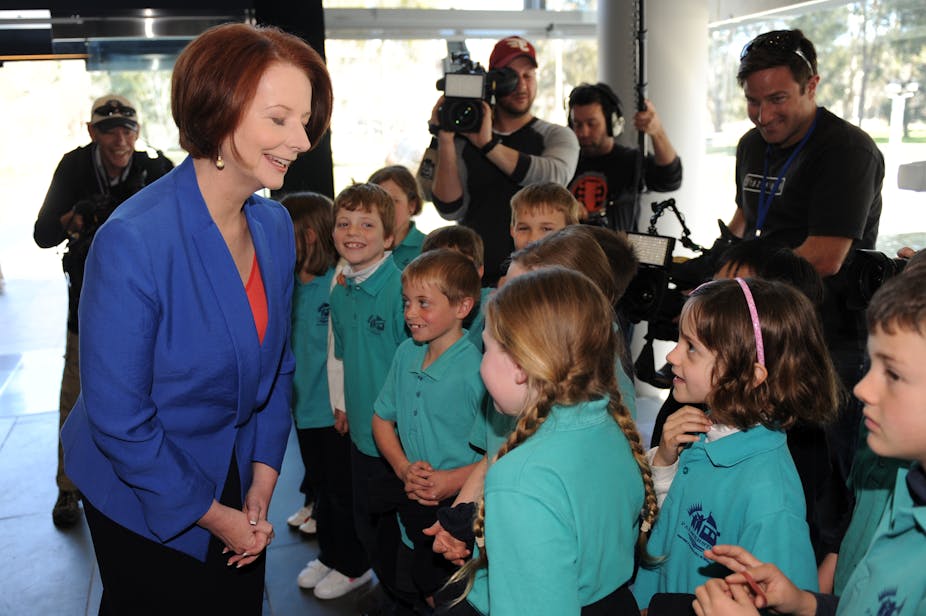
Prime Minister Julia Gillard has thrown down the gauntlet to the states and territories as she prepares to negotiate for increased school funding as part of the government’s long-awaited response to the Gonski review.
In February Sydney businessman David Gonski recommended an additional $5 billion in school funding per year. Mr Gonski also recommended that 75% of the extra money be spent on state schools, which are responsible for 66% of students.
“As a nation we should make money of this order available,” Ms Gillard told the National Press Club today, but added funding should be linked to school improvement.
“There should be no blank cheques, the money should be for better results for our students, not more jobs for bureaucrats.”
Ms Gillard said the government will now negotiate the details of school funding and the details of school improvement with the states and territories. She wants to finalise this process in time for the first meeting of the Coalition of Australian Governments next year.
“Funding should recognise that children are individuals not standardised widgets,” Ms Gillard said.
The government has set a goal to see Australian schools ranked in the top five for student performance in reading, science and mathematics by 2025. Currently Australia is ranked 7th on reading and science and 12th on mathematics.
“The average 15 year old maths student in Australia is two years behind a 15 year old in Shanghai,” Ms Gillard said, adding that four of the top five schooling systems in the world are in the Asia Pacific region.
She called on Australians to get behind a “national crusade” to ensure every child in every school gets a great education.
However the first round of funding to help reach that goal won’t commence until 2014, and there will be a six year transition period.
The government plans to legislate on the issue, introducing the Australian Education Act in 2013.
“The Australian Education Act will erect our nation’s support for a child’s education as one of the entitlements of citizenship,” Ms Gillard said.
Kevin Gould, researcher in economics of education at Central Queensland University, said today’s speech by the PM continues the saga of building hope and expectation about schooling, but delivers few details about the so-called National Plan for School Improvement.
“How does the goal of matching the world’s leading nations for schooling translate into ensuring all schools attain a high graduation rate? School funding is still up in the air.”
Earlier this year the Grattan Institute argued that only improvements in teacher training – and not increased funding – could arrest Australia’s recent slide in international numeracy and literacy rankings.
Opposition leader Tony Abbott earlier today said what’s required is better teachers, the best possible pedagogy and the right commitment to education.
“It’s not just a question of dollars,” Mr Abbott said. “There are lots of things we can do to improve our schools without just another cash splash.”
To help lift teacher quality, the government is proposing requiring more classroom experience before graduation and higher entry requirements for the teaching profession.
“Under our plan you will need to be at the top of your class to get into a university teaching course,” Ms Gillard said.
Deborah Corrigan, associate professor in Education at Monash University, said she’s disappointed with the finger pointing at teacher education.
“In so many ways we’re seen as a top quality teacher education country,” Professor Corrigan said.
She added that comparing Australia with Finland, Korea and Shanghai was not fair, given these countries were either monocultural or did not focus on the whole child.
“We need to be looking at places like Canada and New Zealand who are multicultural, who have similar contextual factors and similar goals for education and see how we rate against them.”
Professor Corrigan said while the prime minister says she is passionate about education, Australian’s don’t often get to hear good stories about teachers.
“It’s not necessarily all about the money, though that doesn’t hurt, but it is saying this is a profession that is highly valued by the community.”
The government also wants more power for principals, including over budgets and staff selection, and extra training for teachers to help them deal with bullying.
Ms Gillard said under the government’s plan every school would have a school improvement plan and would be held to account against it.
For parents, the prime minister said the My School site will deliver more information to help them see how their children are doing, including information on teacher qualifications, and how many students go on to further education or get a job when they leave school.