










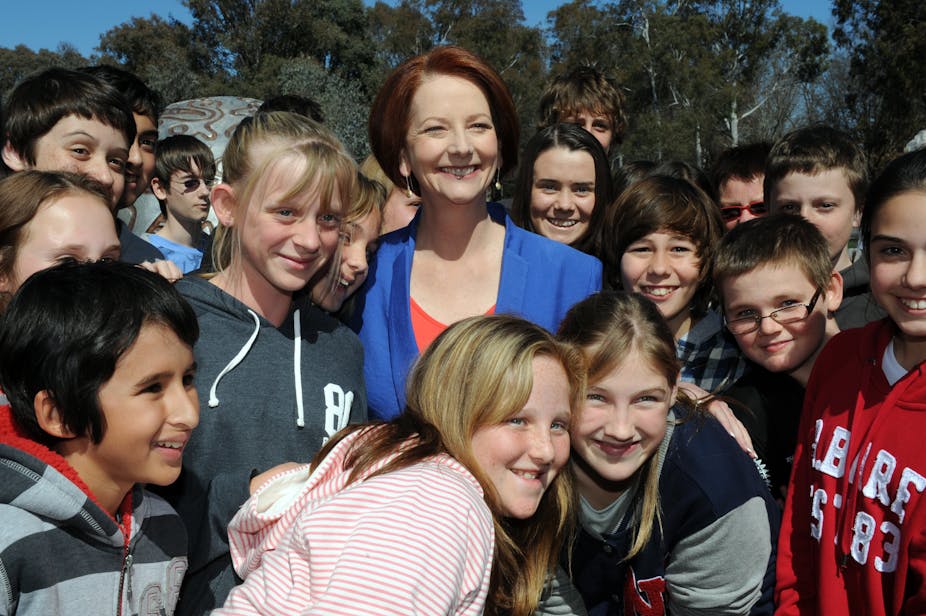
Increased funding will be tied to concrete improvements in all schools under the government’s National Plan for School Improvement, announced on Monday in response to the Gonski Review.
The government has set a goal to see Australian schools ranked in the top five for student performance in reading, science and mathematics by 2025.
In order to get there the government says it will deliver higher standards and extra training for teachers, more power for principals, a “school improvement plan” for every school, and identification of struggling schools and extra help to lift their results.
The Conversation has collected a panel of responses to the National Plan for School Improvement.
Anthony Welch, Professor of Education at University of Sydney
For once the policy stars were aligned: economics, education and equity all pointed to the need to reform school funding, along the lines proposed by David Gonski.
There is little doubt that the current funding model is broken, leaving (mostly state) schools with high proportions of disadvantaged kids lacking the resources needed to ensure they fulfil their potential. Meanwhile (mostly private) schools, with more favoured clienteles, have further favours heaped on them by generous government grants.
So, what will the new funding model deliver - IF states and commonwealth government can agree on their respective share of the funding? This is by no means a certainty, due to both differences between coalition parties at state level and the ALP federally, and the parlous state of several state budgets.
Schools with significant disadvantage could use additional resources under the Gonski formula to employ more teachers, provide more professional development, or otherwise enrich the local academic environment. This is a crucial reform, since while Australia still does relatively well in general, compared to other educational systems, the major problem is the long tail in these results. Simply put, too many children do not attain the national standards, which represents an unacceptable loss of talent, and a major break with our egalitarian ethos.
Gonski could make a real dent in that longstanding problem, if the federal government holds its nerve; and the states accept their responsibility to deliver their share of the reform agenda, including the resources needed. Already NSW has indicated that Gonski is the way to go. Will the other states sign up?
Kevin Gould, Researcher in Economics of Education at Central Queensland University
Today’s speech by the PM continues the saga of building hope and expectation about schooling, but few details about the so-called National Plan for School Improvement. How does the goal of matching the world’s leading nations for schooling translate into ensuring all schools attain a high graduation rate? School funding is still up in the air. What is the plan for the contributions of States? Is it just talk at this stage? How will private contributions be determined?
Let’s not give too much credit to the proposed funding as being “new”. The Karmel Committee recommended base dollars plus extra for disadvantage, adjusted for private capacity back in the 1970s. The difference is that the base standard then was average dollars spent in government schools – now it is average dollars spent in successful schools.
Debate cannot progress much further without a detailed plan – the PM’s “plan” at this stage is really a policy framework for coming up with a plan.
Deborah Corrigan, Associate Professor of Education at Monash University
I’m disappointed about the finger pointing at teacher education. In so many ways we’re seen as a top quality teacher education country.
If it is about a partnership between government, schools and universities then the responsibility needs to be shared by all those partners. Just blaming one partner is not actually addressing the issue.
I’ve seen 15 reviews of teacher education and the only thing that ever gets reported is the fact that teacher education isn’t working when in fact I don’t think it’s as broken as they’re making out.
They keep comparing us with Finland, Korea and Shanghai - all quite monocultural contexts. In addition our goals for education focus on the whole child and not solely academic achievement as in some Asian cultures.
We need to be looking at places like Canada and New Zealand who are multicultural, who have similar contextual factors and similar goals for education, and see how we rate against them.
Jane Caro, Lecturer, School of Humanities at University of Western Sydney
The government’s announcement is better than where we’re at. Is it an improvement? Yes. But is it a cause for celebration? No.
The Gonski formula of giving every child a base funding and loading for disadvantage was a smart way to do it. For the first time in a very long time, we’ll now be able to compare apples with apples.
But now, the big unknown is the money, no one will actually commit to any money. But if we get that money, I really hope most of it goes to public education and to the kids that need it the most. We have a starved public school system – we need to do something about that.
Unfortunately, the government in its announcement wrapped it up with a finger wag at teachers, as well as giving them more work with extra reporting. This reporting needs to be done but we need to recognise that teachers are run off their feet, particularly the teachers in our most disadvantage schools. They’re the hardest to staff, it’s hard to attract principals.
There’s this blindness on the part of government around teachers. They say the’re going to make their jobs tougher and harder – but the job is already almost impossible. It might be easy to be principal of Kings, I don’t know, but it sure as hell ain’t easy to be a principal of a disadvantaged school with concentrations of kids with huge behavioural difficulties. At the moment, they have no money to help them properly – it’s heartbreaking.
So what I would have liked to have seen in the announcement were extra teacher’s aides, extra funding support for disadvantaged schools and more pay for teachers.
The other issue of raising the entrance level requirements for teaching in universities – we know that the ATAR rating is about supply and demand. And the reason teacher’s degrees have lower ATARs is because not as many people want to do it because it doesn’t pay very well.
If they’re not going to raise the pay for teachers, and give teachers more respect in the community and improve their working conditions, then you can raise the ATAR all you like, you’re not going to get enough teachers.
The only real promises of money have gone to the private school kids, as always. I can see the political reality of what’s going on here. Labor is terrified of the churches and the lobby groups, but it’s so disappointing. I just wished there had been some commitment, some money for the most disadvantaged of the disadvantaged.
Stephen Lamb, Deputy Director of the Centre for Research on Education Systems at University of Melbourne
The response on the Gonski review outlined by the government focuses on two elements: (1) improving school performance, and (2) funding schools to achieve improved performance. It is surprising that the Federal Government focuses so heavily on school performance when it does not have direct management or funding responsibility for government schools which fall under the jurisdiction of state and territory governments.
The target of having every school see its funding from government rise every year is not consistent with the spirit of the Gonski Review. The review argues for a resource standard for schools, to be adjusted for the level of student need. It estimated a large shortfall currently exists in the amount of funding required to adequately address additional student needs associated with disadvantage. The increase in funding envisaged by Gonski would not see every school have a rise in funding, but mainly those schools serving high-need students from disadvantaged families, largely concentrated in the government school sector. Also, today’s announcement means that implementation of the key recommendation from the Gonski Review is to be delayed which increases the uncertainty for schools serving high-need students when they require additional funding more urgently.
The goal is for Australia to become one of the top 5 in maths, science and reading, and this is to be achieved largely through more rigorous selection and training of teachers, in conjunction with extra funding. Presently, in one of the top 4 Australia is compared to, there are high scores achieved in PISA on maths and science, but only one in every two students gains a senior school certificate and the system has a high level of inequality. Is that what we should aim for? What is the value of a high PISA score if you do not complete school? The goal for Australia should be to achieve a high standard of performance and at the same time level the bar so that all students can achieve at a high standard.
Quality of teachers may have a role to play in raising achievement standards, but research from across the globe points to the large impact that student background has on performance and outcomes. Research has helped identify effective teaching and learning programs that improve outcomes for students in disadvantaged settings. Applying that information should be our first priority, to raise the performance in our most disadvantaged schools in order to help level the bar of student performance.
Greg Thompson, Research Fellow in the School of Education at Murdoch University
The speech at the National Press Club by the PM Julia Gillard was a mixed bag for Australian schools. Firstly, I applaud PM Gillard and her government for their commitment to improve the equity of school funding in Australia. The announcement that the government will adopt the Gonski report’s recommendation through a student resource model based on need is both welcome and timely. Whilst exact details were not revealed, adopting a uniform funding model based on student need represents a significant change to Australian education.
That said, the absence of details about how this will work and what will be required are fairly vague. There is still a lot of information required before we can say whether or not this policy ambition will be likely to be successful. Whilst many will engage the government over where this funding will come from, I think it is also important to ask what are the educative benefits to students likely to be as a result of this intervention. Without these concrete details, we are no wiser as to what the likely impact will be.
Finally it is disappointing to see that PM Gillard continues to promote a vision of education that places so much emphasis on PISA and international rankings, questions the quality of our teachers, and proposes further policy initiatives aimed to increase the regulation and accountability of our education systems. It is a shame that we will most likely not see the improved funding model correspond with greater trust in our teachers. Too much stick, not enough carrot.
Rob Tierney, Dean at the Faculty of Education and Social Work, University of Sydney
In the Olympic tradition, Julia Gillard has gone down similar to politicians elsewhere with a statement of a goal to have Australia reach new heights in test performance –that is the top five in terms of international achievement. She has expressed a concern that places such as Shanghai, Korea and a small number of other countries have moved ahead of us.
The reality is that we are all doing better than we did in the past, but some students in some places or countries are outperforming Australia overall and our low performers are falling further behind and indeed, dragging us down in terms of ranking.
Before, discussing the merits of Gillard’s proposal, one should be careful about the credibility of such comparisons. Indeed, if one peels away at these comparisons they tend to be a flimsy rather than solid as a basis for setting national goals.
For example, comparisons with Shanghai need to be tempered. Shanghai represents a small sector of China and does not reveal the range of educational achievement across all of China, especially if rural and remote regions are included. Perhaps unpacking the growing differences in performance within the Australian is sounder and merits the emphasis that the Prime Minister is giving to such developments.
As PM Gillard confirms we have a widening gap in equity in schools and corresponding declines in performance of schools in the public schools. What is ironic is the perpetuation of policies such as national curriculum, school choice and testing regimes that have a history in other countries of widening declines in performance of students in low SE circumstances.