
“What is the value of zero?” asks the seductive commercial for the new Nissan Leaf (due to launch in Australia in April). Set against a montage of natural and man-made images of “0”, the Leaf advert asks its audience to:
“Imagine zero dependency on foreign oil, zero pollutants in our environment, zero depletion of the ozone … zero gas and 100% electric Nissan Leaf, innovation for the planet and innovation for all”.
Despite its name, is the Leaf really that great for the environment?
Electric vehicles and low-emission cars like the VW Bluemotion or the hybrid Toyota Prius are often labelled “green cars” and hailed as a technological solution to the environmental problems associated with automobiles.
Provided they run on electricity generated from renewables, electric cars do go some way toward addressing the issues of oil dependency and greenhouse gas emissions, as well as air and noise pollution from cars idling around densely populated cities. But if they run on energy generated from coal-fired power, then they merely transfer pollution from Australia’s cities to rural locations and do nothing to reduce emissions.

But even if they are run on renewables, the promise of “green cars” certainly does not address many of the more fundamental environmental, economic and social concerns associated with cars.
The green car would not reduce car use – or what Peter Newman and Jeff Kenworthy have labelled “automobile dependence”. It is likely they may even encourage more people to drive, more often. Under the misapprehension they are saving the environment, drivers will be lured into a false sense of security. “Green cars” would not reduce or address:
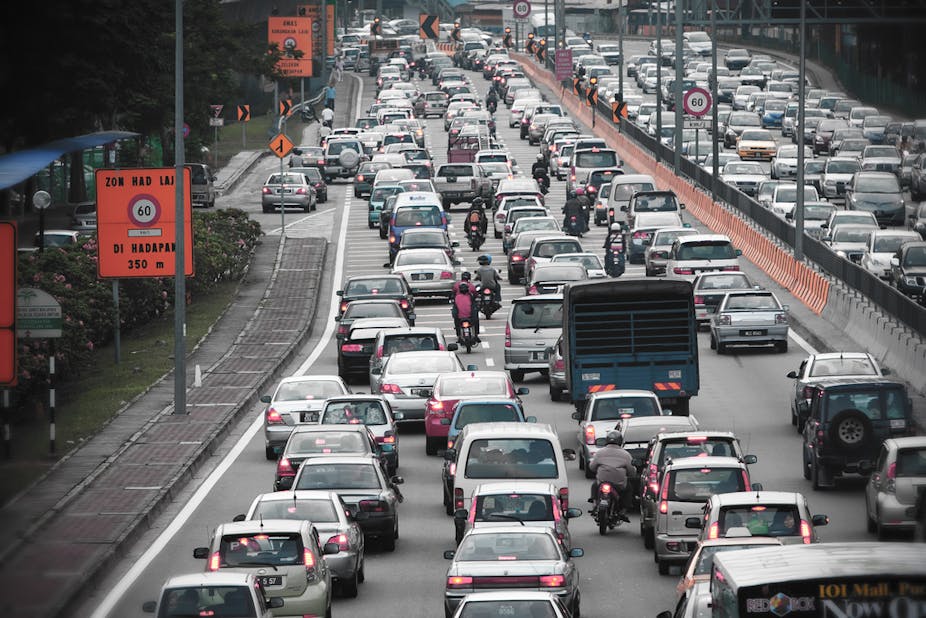
congestion. This puts a handbrake on the Australian economy, and chokes the movement of goods and people, effectively costing an estimated $9 billion in 2005
road deaths and injuries. More people have been killed on roads since 1945 than were killed in active service in WW2. Worldwide, 1.2 – 5 million people are killed annually. Australia recorded 1370 deaths and 32,500 serious accidents in 2010 In no other area of social life are such high rates of death and injury tolerated
health and social costs of car-dependence. These include inactivity and obesity and premature death from car-generated air pollution
social exclusion of non-drivers from spaces designed for automobiles. Many areas of society are set up for people with cars, and exclude those without one (the aged, people under 18, those on low incomes or with mobility impairment)
cars’ dominance of urban space. When stationary, automobiles consume valuable land space, both public (that could be used for growing food or green space in urban areas) and private for garages and parking lots. Inner-city public streets are clogged by parked cars. Automobiles also consume space in the form of roads and highways. Half of all US urban space is devoted to car use. In London it’s a quarter and in Sydney it’s about a third.
Private cars (whether “green” or not) also disenfranchise other forms of mobility such as cycling and walking. In many roads in Sydney it’s dangerous to ride because of road design and road rage. Pedestrians, for the most part, are treated at best as second-class citizens.

Even if engineers were able to produce a completely “green car” (one that doesn’t pollute at any stage of its life-cycle) it would be an ineffective technological fix. In most cities it’s the sheer number of cars on cities' roads which provides the greatest challenge to making our cities livable.
Rather than a solely technological solution focused on energy and emissions, behavioural and cultural change is necessary. This would see more emphasis on decreasing automobile dependence. In other words, we should look at the way we use cars rather than just focusing on the energy they use.
One emerging phenomenon providing a radical transformation in car use in inner-city areas around the world is car sharing, known as car clubs in the UK.
Not to be confused with ride sharing or car pooling, car sharing involves a registered community hiring cars that are parked in dedicated car bays typically around the inner city, where access to alternative forms of transport are available. Unlike traditional car rental, the vehicles in car sharing are scattered in a network through local streets, within walkable distance from local residents and businesses. Car sharing is now available in more than 1000 cities across the globe.
According to Rachel Botsman and Roo Rogers, when the US government was bailing out the “big three” car companies during the global financial crisis in 2009-2010, carsharing membership increased by 52%. By 2015, an estimated 4.4 million people in North America, and 5.5 million people in Europe, will belong to carsharing services. Perhaps shared cars – not electric vehicles – are the green car of the future.
Comments on this article are now closed.
David Arthur
n/a
Agreed, electric cars do not address our problems of urban congestion.
Imagine, if you will, a couple of dozen Nissan Leaves queued up waiting at a traffic light for the light to change to green. Now imagine the same scene, where all the vehicles are a more typical mix of GM Hummers, Rolls-Royces, Toyota Land Cruisers, Nissan Patrols. The same number of such vehicles will extend much further down the street.
Now, imagine the same scenario when the light changes to green. Include in your…
Read moreAlex Cannara
logged in via Facebook
As a long-time environmentalist, commuting across our country for school, then for years of work in an Austin-A-powered car, I cringe at uneducated 'green' remarks like: "...shared cars – not electric vehicles – are the green car of the future."
Both are. And, this article doesn't even show the intellect common to most discussions about vehicles & cities -- electric vehicles allow for something not possible with combustion vehicles -- regeneration. The reason an EV or hybrid gets better fuel performance in city than in country is simple -- electric motors become generators, depending on the the direction of the torque seen at their shafts, That benefit is about 15% of the energy put into the vehicle to get it rolling at speed.
EVs/hybrids are exactly what are needed. More car sharing, simultaneous or sequential (ZipCar), is exactly what's needed. More study by media folks is exactly what's needed.
Catherine Simpson
Senior Lecturer in Science Communication at Macquarie University
Thanks for your comments Alex. And to be perfectly honest I think to even use the term 'green car' is an oxymoron.
But back to your interesting point about electric vehicles and technology.
What EVs might lead to is what economists have called the Jevons paradox - that is, the more efficient a technology becomes the more people use it. If you just focus on the fuel technology (regeneration) then you miss all the other points regarding the sheer numbers of cars on our roads. The fuel technology that cars use is a small part of why cars are unsustainable which was the article's main impetus.
A study which incorporates all these different aspects of car use, rather than one that narrowly focuses on fuel, is what's needed.
Jonathan Maddox
Software Engineer
Jevons' paradox is real, given historical economic incentives, but the discussion is too narrow.
There is a prosperity dividend from improving the energy-consumption efficiency of energy services like transport. But this is not the only cause of prosperity!
It is possible to spend increased prosperity on more energy services and ultimately on more energy. But this is not the only way to spend it!
Moreover, we must not lose sight of the fact that it isn't *energy* use per se which is the…
Read moreAlex Cannara
logged in via Facebook
"cars are unsustainable" is an interesting assumption, Catherine. We know unchecked population growth -- total or in cities, is indeed unsustainable, but why a particular tool? A car is a tool, as is a hammer. Are hammers "unsustainable?" iPhones may be, if we care about Chinese suicides. ;]
I had a shock one day at a conference when an environmental lawyer came up to me, knowing I was a Sierra Club member, and he said "You know, the Club is too often on the wrong side of an environmental…
Read moreEclipse Now
Manager of design firm
Hi Alex,
my favourite article on cars is "My other car is a bright green city" by Alex Steffen of worldchanging fame. He's a regular TED speaker and all round systems analyst and environmental activist. Grab a coffee and check it out. This is simply one of my favourite pieces on how cars and cities interact. It will take about 20 minutes of slow and careful reading to really mine it's depths. I go back to it about once a year!
http://www.worldchanging.com/archives/007800.html
Alex Cannara
logged in via Facebook
Yes, it's good, and I see he has some good measurement data for our Bay Area. I was actually asked to help define greener building requirements for the most energy consumptive cimmunutyy in the sate -- they were embarrassed by published stats.
The problem is that we've a) ignored emissions warnings for over 100 years (even Steam Age engineers worried about burning so much coal); and b) not figured out how to match private property & development rights with livable communities.
We've many people…
Read moreCatherine Simpson
Senior Lecturer in Science Communication at Macquarie University
Hi Alex - the way WE USE cars is unsustainable. The technology of the automobile itself isn’t the problem, but rather the way it is deployed.
To use their Freund and MArtin's analogy, opening a can with a gun is a serious misapplication of the technology of the gun. Likewise hegemonic automobility – the single-occupant, owner-driver travelling short distances in privately owned vehicle around constrained city spaces – is a series misapplication of the technology of the car (whether it's electric or not!)
Alex Cannara
logged in via Facebook
Well, Catherine, what are "constrained city spaces"? Certainly in NYC, where I've lived, a car can be a problem done without. But when one is called to a hospital for a loved one not too far away, do we drive our car or do we wait long times for public transport that doesn't actually go in anything like an optimal route?
And the "Jevons paradox" (gotta love these pseud-scientific maxims) is self defeating, as to car use. It tells us nothing we don;t already know -- we must be more efficient…
Read moreShane Bryan
logged in via Facebook
Congestion is clearly a major issue. With many train crossings around Melbourne still using boom gates, you end up with cars backed up 1-2 kms and cars just sitting there, idling away, burning fuel and emitting exhaust.
Near where I live, great work has been done putting the train lines at Middleborough and Springvale Roads under the road, but many of them are still the same as they were 70 years ago. Case in point, I was stuck at Blackburn crossing this morning for 9 minutes, while I sat there…
Read moreJonathan Maddox
Software Engineer
An electric car doesn't sit there idling. Massive efficiency/pollution win, right there.
Alex Cannara
logged in via Facebook
And, remember the 15% from regenerative braking. Only hybrids/EVs can do that. It's the kind of efficiency increase that power companies spend $ billions on for "Combined-Cycle", Brayton-Cycle" turbine systems to get above ~30% from lousy, 1-pass steam efficiencies.
A problem for us today is that everyone has to study & learn more about reality, if we are to have any hope.
Robert Nelson
Associate Director Student Experience at Monash University
Catherine Simpson has written a fine article here. Even if the unsustainability of cars could be overcome---which seems as remote as Patrick Moriarty has suggested on *The conversation*---the motor car will continue to oppress communities with numerous moral and aesthetic afflictions.
Harrowing all forms of bipedality and devastating pedestrian urbanism, cars are antisocial hardware which contributes to making us miserable as a community (*The Space Wasters: the Architecture of Australian Misanthropy* http://www.planning.org.au/documents/item/3512).
Shane Bryan
logged in via Facebook
Well if someone was to make a list of things that contribute to an 'antisocial community' cars would be pretty far down the list but I can understand why they make the list.
There seems to be an increasing level of ignorance from car owners, especially in residential areas about just how to interact and live with other people in their street, and the way they park their car seems to be a sad reflection of it.
I can only comment about my local area but over the last year I've seen an increasing number of people that seem to think the following is completely fine.
a. Park opposite a T intersection.
b. Park too closely to intersections. (when combined with a. it turns the road into a rats maze).
c. Park so that they take up more space than they need.
I'm surprised that there have been no incidents of street\park rage from suburban areas with people lashing out at the ignorant and selfish parking habits of others.
Robert Nelson
Associate Director Student Experience at Monash University
Thanks Shane!
Just to clarify, I wasn’t referring to driver behaviour in describing cars as antisocial hardware. It’s the cars themselves.
In 40 years of riding a pushbike on the road, I’ve noticed a great improvement in courtesy and consideration on the part of motorists. The problem is not the drivers but the spatiality that the cars have created, which either marginalizes or obliterates the opportunities for bipedality. Inside the cars, the drivers may be sweet individuals. The problem is the spaces which have been structured around the cars. It’s the Gestalt, the whole automotive paradigm, that is antisocial.
Shane Bryan
logged in via Facebook
Yep not being a cyclist (very often) I don't see it from that perspective. No doubt that's something more people could benefit from.
I've downloaded 'Space Wasters' and will give it a read :-)
Stephen Dixon
Digital video officer
Cars kill communities. Studies have shown that that residents on busy streets have less than one quarter the number of local friends compared to those living on similar streets with little traffic. http://www.carfreeday.org.uk/traffic-community-research.aspx
Chris Harries
logged in via Facebook
Thanks for the article. A really important time to discuss this issue, because there's a huge amount of ignorance and wishful thinking out there regarding electric cars.
First we need facts on the table, rather than act on the EV promotions of 'zero-emissions'. They are anything but.
Starry eyed folk, genuinely wishing to be green, take up that tag line without analysis believing that electric vehicles, per se, are actually green. The hard cold fact is that an electric car powered by fossil…
Read moreDerek Bolton
Retired s/w engineer
Some good points in the article, but also some I would dispute.
1. "if they run on energy generated from coal-fired power, then they ... do nothing to reduce emissions."
Petrol engines are about 15% efficient, diesel 20%, electric 80% (wikipedia).
Coal to electricity is typically 30% efficient today, but state-of-the-art gets to 45%.
Even at 30%, and allowing 5% for distribution losses, electric cars net 22% for the whole path. At 45% for coal power, they get to 34%.
Further, EVs have…
Read morepaul magnus
logged in via Twitter
It is worth having a look at the life cycle footprints also.....
http://www.triplepundit.com/2011/06/full-life-cycle-assesment-electric-cars-compares-co2-impact-conventional-cars/
EVs are better but not by as much as you might think!
Alex Cannara
logged in via Facebook
"I think there is a world market for maybe five computers." -- Thomas Watson, IBM CEO in 1950s.
"There is no reason anyone would want a computer in their home." -- Ken Olson . -- DEC co-founder, 1977 (DEC id defunct inside Compaq, inside HP)
"Who the hell wants to hear actors talk?" . -- H. Warner
"The wireless music box has no imaginable commercial value. Who would pay for a message sent to nobody in particular?" -- David Sarnoff, RCA in 1920s.
--- etc., etc.
Not proof of EVs' inevitability, except the first comfortable cars that were easy to drive were EVs -- check Jay Leno's garag.
Roger Dargaville
Research Fellow, Energy Research Institute at University of Melbourne
Thanks Catherine for the article and others for interesting and insightful comments. I wanted to make another point about the electricity system requirements for charging electric vehicles: if you were to drive quite a bit, your electricity needs for the car would be similar to that of your home. So, we need to be careful how we plan on charging. If we do it at night, then it can be beneficial, making good use of the transmission lines and generators when they would otherwise be idle, or better…
Read moreChris Harries
logged in via Facebook
If electric vehicles were a truly green option, I would go out and invest in one, despite the cost and inconvenience factors that weigh against them. But in order to make that choice I would need to be convinced I was doing the planet a huge favour in doing so.
All we can digest at present is that (under ideal circumstances) electric vehicles may offer a marginally lower environmental footprint than do conventional cars.
It is this marginality that is putting buyers off. Despite very generous…
Read moreMichael Mazengarb
Masters Student (Climate Change)
I feel like this is a bit of a straw-man arguement.
You've accused producers electric cars of not achieving the promises they never made to begin with.
As you've even quoted, the advertisement for the Nissan Leaf doesn't claim to solve the issues of congestion, road tolls and the loss of land for roads and parking.
I feel that for each of the social problems that Cars cause, there are just as many benefits that they provide. People choose to drive cars because of the independence it offers. Cars are ultimately a more convienent form of transport (especially compared to buses and trains).
Personal transport has forever been an indication of social and cultural development. Australian, American and European history has experienced it and China and India are experiencing it now.
What electric cars offer is to provide this same level personal transport freedom, without the associated dependence on fossil fuels and the resulting production of pollution.
Eclipse Now
Manager of design firm
//Cars are ultimately a more convienent form of transport (especially compared to buses and trains).//
Read moreNot if everyone wants to go where you're going. Bangkok anyone? Sydney's suburban sprawl is so bad that public transport systems take a long time to get anywhere. But there are ways of building public transport systems that then encourage New Urbanism around those vital corridors. We could build transit systems to maximise New Urbanism contracting onto those systems over the coming generations…
Leo Kerr
Consultant
Good points in the article but I can't see the car being discarded any time soon - so while our transport woes are worked out it's much better for us to go electric. Despite some comments here about marginal improvements in the carbon footprint, there is a substantial gain from going electric (even if run on coal fired power). The big gain is in cleaner air in cities - for example in NSW, the department of health spends $4.7 billion annually on health problems related to air pollution (70 - 80…
Read moreChris Harries
logged in via Facebook
Sure thing, the car won't be discarded, and I don't know of anybody who is advocating such.
It's all well and good to say "electric is the way to go", but market forces prescribe what consumers end up buying. For the EV market to succeed any time soon needs more than market intervention by government. To date, generous government subsidies are not convincing the markets. We can only speculate at this point, but early signs are that consumers will place a high priority on convenience and that will…
Read moreAlex Cannara
logged in via Facebook
"Like many I think the advantages of electric vehicles are way overstated by their devotees," -- depends on whether you're a devotee of something else already, Chris.
Your msg agrees with what we all know -- EVs need time to be developed to meet typical needs and there will be various alternatives for years. The key is that if I buy a comfortable car today, it will get better mileage than my '61 Sprite. And in a few years, better still. Or then I may see an EV to buy because the charging & range issues are better, or BetterPlace may have moved into Calif. sufficiently to let me own their car, while they own their battery. Or, maybe I'll just buy a 12-year-old Prius?
This isn't about having it all happening today, or next year. Why use impatience as an argument against something that's always going to be demonstrably better environmentally?
Chris Harries
logged in via Facebook
You would need to take out the word demonstrably. From the above posters that's not a conclusion most would agree upon.
James Szabadics
Technical Development and R&D Manager, Plantation Timber Industry
Another thing to consider are the emissions during the mining, smelting and refining processes for the materials used in a new car. Rare earth metals in batteries typically come out of mines in China which use large scale acid leaching. The steel and aluminium was probably from an Australian or Brasilian mine - how many kg of emissions per car when you take this into account?
If you can keep an old car going for another 20 years with a few parts rather than sending old cars to the scrapheap…
Read moreAlex Cannara
logged in via Facebook
James, you're my man! Recycling is indeed the most direct way to energy & emissions benefits. Aluminum, in particular.
Glad to see your car is no newer than out newest! It's easier for me to get parts cheaply for our '61, '79 & '86 cars than the '96!
Jonathan Maddox
Software Engineer
I think the energy consumption from shipping is a very small portion of the total when compared with extraction and processing of metal ores, particularly aluminium. Even recycling is more energy-intensive than shipping them around the world.
Alex Cannara
logged in via Facebook
Actually, Jonathan, it's the pollution that's most significant because of the lax standards for the open sea. An engineer friend actually consults with port officials around the world to control what incoming outgoing freighters must burn when in/near port.
And, recycling aluminum saves ~90% of fabrication energy.
Jonathan Maddox
Software Engineer
Yes, big marine diesel engines can burn practically anything, and in practice they burn the cheapest fuel they can get, which is the heavy residual oil left over when an oil refinery can't extract anything lighter or cleaner from crude oil. It's like filthy brown vaseline, can only be pumped through the fuel lines by heating it up, and the soot emissions are horrendous. Nevertheless, the engines are efficient (up to 50% thermal efficiency, which I find very impressive) and the ultimate contribution of shipping to the total "embodied energy" of most shipped goods is negligible.
Alex Cannara
logged in via Facebook
The 'embodied' product energy may be low, even including empty containers going back to China, but the pollution remains serious worldwide. Not to mention the effects of accidents.
Eclipse Now
Manager of design firm
Interesting point about the amount of Co2 emissions and energy involved in *manufacturing* the car (and all the mining involved) and maintaining the car environment. (Building highways and roads, etc). Let me link to "My other car is a bright green city" once again on this thread, at the risk of being called a troll, because it highlights studies that show:-
* manufacturing the car to be about a quarter of the energy that car will use in its lifetime,
* building the car environment of highways and parking lots to be about a quarter of the energy a car will use in its lifetime
* the fuel burnt by the car is only about half the energy the car will use in its lifetime
Regards for a great conversation!
http://www.worldchanging.com/archives/007800.html
Fred Pribac
logged in via email @internode.on.net
The article makes this point... "But if they run on energy generated from coal-fired power, then they merely transfer pollution from Australia’s cities to rural locations and do nothing to reduce emissions."
Is this true? I would have thought that per kilojoule emmisons from a well maintained large facility would be significantly lower (and possibly quite different) than from a multitude of poorly maintained internal combustion engines and might this even make up for additional losses in energy transfer to battery and motor.
Take for example as a parralel, the case of motor bikes versus cars. Although motor bikes can transport a person from A to B with less fuel and associated CO2 emmssions than a car the other associated pollutants can be many times greater.
And what about base load? Is it possible to charge vehicles with off peak generated energy that would otherwise be entirely lost?
Alex Cannara
logged in via Facebook
Right, Fred. It's basic thermodynamics that a large-high-temperature generation system is more efficient than a bunch of small, moderate-temperature machines. This is why everyone riding motorbikes is worse than many people sharing cars, which is worse than many more sharing busses/trains. etc.
I don't get why the author doesn't seem to get this too. The beauty of central-station power is the ability to otimize generation, minimize total emissions, while suffering only transmission looss…
Read moreJonathan Maddox
Software Engineer
No it's not true, but for different reasons than you suggest.
Modern, well-tuned internal combustion engines have surprisingly good thermal efficiencies, quite comparable to that of power stations. The newest large marine diesels (turbocharged two-strokes burning filthy bunker oil) achieve an astonishing 50% efficiency. A good vehicle engine can achieve ~30% conversion from embodied fuel energy to torque when running at an optimum constant speed.
This is not really any worse than a power…
Read moreAlex Cannara
logged in via Facebook
Basically agree Jonathan, but your pessimism about actual power delivered at the road would mean our 1-litre AH Sprite couldn't climb the hill up the street at 25mph, and it does. Same for EV drive.
Drive trains do lose about 10% of input power under heavy load, but it only takes about 25kW to move a modest sedan at 60km/Hr on a level highway.
Also, the power plants here may be unusually efficient compared to Down Under, but we do get around 50% out of their gas (most fuel in Calif), so EVs with regeneration indeed make lots of sense, in comparison to even the latest 40mpg Toyota.
Jonathan Maddox
Software Engineer
I wasn't pessimistic about *power* but about *efficiency* :)
A car is near its maximum power output when it's pushing up a hill, and if you choose the right gear the engine will be close to its peak efficiency. If you spend all your time surging up hills or zooming along the freeway at 80km/h you're making the most of your fuel. It's idling and braking in stop/start traffic (throwing away at every stop all the energy you threw into getting the car started since last time) which reduces the *average* energy efficiency achieved by the engine.
Combined-cycle gas-fired power stations can achieve better than 60% thermal efficiency. Coal-fired power stations with a single cycle cannot (and the oldest ones operate at relatively low temperatures so rarely do better than 30-35%), nor can open-cycle gas turbines.
Alex Cannara
logged in via Facebook
Coal here often operates combine cycle.
Jonathan Maddox
Software Engineer
Really? http://en.wikipedia.org/wiki/Integrated_Gasification_Combined_Cycle#Installations
Alex Cannara
logged in via Facebook
Yep. But who cares? It will have to disappear anyway.
Eclipse Now
Manager of design firm
Hi Fred, great question about charging cars with off-peak electricity! That's the HEART of the EV debate. A study shows that 84% of US cars could be charged by existing off-peak capacity at night. Check out this well produced Youtube video that illustrates the concepts.
http://www.youtube.com/user/greenman3610#p/a/2EF0E2B9498E328E/0/pSdnycHfLnQ
Chris Harries
logged in via Facebook
And all of these technical efficiency arguments show what?
That the article's original premise holds true – the squeaky clean-green image of electric vehicles does not hold water. The relative advantage of them is very questionable. Technical experts don't agree amongst themselves.
Yet society will go down the electric vehicle road, no matter what, because we have become hooked on individual mobility. And vehicle makers want to keep producing cars when the oil wells runs dry. So there's much…
Read moreJonathan Maddox
Software Engineer
Yes, feeling good is a plus. Proving that we can live modern lives without petroleum is a big plus. Driving on wind power -- priceless ;)
Chris Harries
logged in via Facebook
Yes, Jonathan, nice thought to be driving on wind power. I used to think along those lines and then did the calculations on the numbers of wind generators to feed say 15 million EVs. It comes to an awful lot. Both the manufacture of the EVs and all the wind generators and all associated infrastructure have significant energy and materials inputs, electricity being one of those – but also plastics, steel, aluminium, glass... and so forth.
Having done the sums I came to a mathematical conclusion that to supply the electricity component of all that could really only be done by embracing nuclear power in a big way. I don't believe we can massively convert our nation's vehicle fleet without doing so.
That's a snag in itself, because Australian society is very divided on that issue at present, many not seeing nuclear as being 'green'. Others would be untroubled by it.
Alex Cannara
logged in via Facebook
So you haven't actually read what's been said, eh Chris?
"...the article's original premise holds true – the squeaky clean-green image of electric vehicles does not hold water. The relative advantage of them is very questionable. Technical experts don't agree amongst themselves."
You're sounding like the tortured logic of climate deniers, mu man.
So you missed that just regenerative braking alone returns ~15% of all the energy stored in a vehicle's motion -- 1/2 m v squared?
You miss…
Read moreAlex Cannara
logged in via Facebook
Jonathan, too bad wind isn't priceless, but it is wasteful & costly -- about 700 tons of fossil-fuel-prepared material per MW of peak installed (divide by 4) capacity. Yes, those 400-ton wind towers take steel that needs about 1000-2000 tons of coal to make. Then, all wind wastes ~19% in transmission. Their controllers actually consume kWatts from the grid when idle, or when wind is too slow or too fast.
Wind is in the past, except for those who get the rest of us to subsidize them!
Remember, like the article, the goal is to determine what's actually 'green'.
Jonathan Maddox
Software Engineer
No-one has ever pretended that electricity from the wind has no cost whatsoever, or even that no fossil energy is consumed in the construction of wind machines. *All* electricity generation techniques have these costs, no exceptions.
However you are being disingenuous. The capital costs, including fossil-energy-produced steel and concrete, of wind generation are high, though not very much higher per unit of energy generated than those of nuclear power, which are in turn higher than those of coal. Existing wind power has a high energy-return-on-energy-investment (comparable to current nuclear technology and higher than many new oil wells), and the technology continues to improve. Just as there are new-generation nuclear technologies in the offing, new generation wind machines such as those from Makani Power ( http://www.makanipower.com/ ) promise more power, a higher load factor, and lower cost than existing steel-tower turbines.
Chris Harries
logged in via Facebook
Ah, Alex, the point I am making is simply to accord with the original article – to remove the inane 'zero impact' image from electric car promotion. This is a conversation that is needed at this point in history.
Don't mistakenly read this as opposition to EVs. I love technology too. As said, they will have their place in the scheme of things, it's just that they don't offer the dreamy green panacea that is touted for them.
Interesting to analyse the EV market in England, in these early days…
Read moreAlex Cannara
logged in via Facebook
Actually, no, Jonathan. The vast majority of nuclear plant investment lasts many decades. Wind machines don't, and as the Chinese are finding, when the winds change as climate changes, who's going to move the windmills?
The reality is that wind power is high maintenance, consumes vast amounts of land, threatens species, is noisy, ugly and is subsidized more than most any form of power generation, and suffers intermittancy that must be made up for and permanent transmission loss. Nukes at…
Read moreJonathan Maddox
Software Engineer
It's a fallacy to point at a bunch of outdated equipment abandoned a decade ago due to now-you-see-it-now-you-don't flip-flopping government support and call its contemporary, commercial, industrial, large-scale successors a "scam". Yes, remote intermittent energy has incidental costs including line losses and the need for firming. But you aren't pointing at profitable wind farms built since 2006 in Texas or China, you're pointing at rows of aircraft propellers on rusty radio masts from 1985 -- equipment barely evolved from a 1915 farm water pump.
A lot of older nuclear power stations have been decomissioned too, and more than one was abandoned before it was ever completed. What a scam to rip off consumers!
Contemporary wind turbines work just fine, produce power at no greater cost than modern nuclear power, and can be installed in a matter of months, not the best part of a decade.
Both technologies have a future.
Alex Cannara
logged in via Facebook
Chris, we basically agree that hype should be pointed out where ver it appears, as for wind power.
So, indeed EVs are not solving the traffic or transport problems. They will help solve emissions & power waste, and add to future grid stability. Your 2% may be right for future penetration is some places, but much higher is mandated here.
Alex Cannara
logged in via Facebook
Jonathan, I don;t care which technology has more boosters, I'm just looking at the facts. Wind is at best 1/2MW/acre in power density. solar is now much greater than that and needs no land --DG. Solar has another doubling in efficiency per sq meter, sio wind, even if Caltech;s R&D on verticals were implemented, would still fall behind solar DG, still consume vast lands and still waste power in transmission.
Those are facts. If a wind investor said yes, we are paying into a decommissioning…
Read morePaul Richards
strategic foresight
Jonathan - I agree our focus it to narrow, bias toward known dirty sources of energy is redundant.
Electric motors sourced from brown coal power or nuclear energy doesn't make them green technology. We need a cultural shift in thinking on how we balance energy used, and numbers of vehicles, light rail, heavy rail, within a redesigned transport infrastructure.
The "myth" is electric motors in vehicles will solve our fundamental problem.
The real problem we need to solve is;
"how do we humanise our environment to extend life on earth".
Thankfully the generations coming through have a grasp of the real issue. They will continue with the humanising of cites and clean energy use, regardless of what the baby boomer generation says.
Paul Richards
strategic foresight
Alex - I take it you are in the US.
Has there been much press about Low Energy Nuclear Reaction that NASA is exploring?
Is there any news on eCat Rossi has developed and partnered with US backers?
Jonathan Maddox
Software Engineer
99% of the land "consumed" by wind power is still perfectly useable for whatever it was used for before the wind turbines were built. The only thing it's not good for any more is more wind turbines, or people who are bothered by the noise or think the view is spoiled. Your other criticisms are valid but manageable -- and each one of them also applies to other energy technologies. "Crocodile tears" about just beginning to move past the 80s on nuclear technology notwithstanding.
Alex Cannara
logged in via Facebook
OMG Paul, has the Rossi marketing team reached you poor Aussies too!?
The last I heard was a rumor that Rossi had a deal to sell through Home Depot. Now, if indeed his Nickel burners actually produced nuclear reactions, he'd be in jail for federal violation of NRC regs!
As far as I can see, Rossi is a carney hawker who may have a way to warm water by burning Nickel & Hydrogen, but he's never filed a decent patent document, never allowed full, open examination of his "cells" and hasn't ever…
Read moreAlex Cannara
logged in via Facebook
Jonathan, you make it too easy. Not only is the land taken, including tree cutting in our own eastern-forest wind 'farms. but roads are built at good cost & great damage to the environment. And, transmission swaths are taken, towers are erected (remember all that fossil fule burden for steel, etc? And the power is more variable that even solar. Then we have the bird & bat deaths, which in the US midwest are now beginning to affect farm crops -- bugs that don't get eaten, eat. So the present…
Read morePaul Richards
strategic foresight
Alex, that's pleasing to hear, at least US server filters are running relatively free.
As for Rossi filing patents, you can't blame anyone for not going down that path without billions, the system has wandered down a different direction since Albert worked patents and Edison was stealing ideas. That "Good Old Boy" Cornel Sanders never went there and neither did CocoCola, that kind of business modelling is worth serious thought.
I read enough quantum physics to leave Rossi and LENR with one…
Read morePaul Richards
strategic foresight
Alex typo - alert -
'barium' should read 'thorium'
The Liquid fluoride thorium reactor process is where generation one should have been commissioned. Russia beat the US on that one. My only concern is the terror issue, with plutonium.
Paul Richards
strategic foresight
Jonathan, add the development of the "wind lens" and bird, bat and insect strike diminish and there is a boost in efficiency. Turbine design development and improvement is occurring even if it is in Europe and Japan.
http://www.mnn.com/green-tech/research-innovations/blogs/japanese-breakthrough-will-make-wind-power-cheaper-than-nuclea
Jonathan Maddox
Software Engineer
This unscrupulous manipulation of legislatures and bureaucracies has always been part of the way business is done in many countries. There's a reason it's called "railroading". It's no different from Enron or forest clearance or shale gas drillers or cattle feedlots or mining or hydro dam construction. It's wrong and I won't defend it, but it's not relevant to the efficacy of a particular technology.
Label me "unquestioning" or however you like, these stories are those of peoples' intense frustration with a legal system which has let them down. The wind turbines are not to blame; I would suggest the problem is people who put profits before other people.
I won't defend unscrupulous turbine operators against noise complaints. There are better ways to solve disputes than to quash the complaints in bureaucracy and other places where it's perfectly appropriate to put turbines.
Alex Cannara
logged in via Facebook
Good. We agree.
Alex Cannara
logged in via Facebook
There are many people wanting to make $ or yen in many ways. Why say that the US has: "850,000 square miles of land that could yield high levels of wind energy" to sell a wind product when we;only need 25,600 sq miles of desert for solar to meet all needs?
This is the kind of naivete or fibbing that has gotten us into the triouble we're in, globally. The nuclear plan given JFK in 1962 had us replacing all fossil combustion by 2000 with <1000, 1GWe plants. There are 2 1GWe reactors per typical…
Read moreAlex Cannara
logged in via Facebook
Ok, got it. The Nobellist Glenn Seaborg discovered that it was possible to make an isotope of Uranium from Thorium and that that 233U would fission with 1/2 the next-heavier element production that 235U leaves. 235U fissions 80% of the time, so staring with 232Thorium (the only isotope) means we have 10% of 20% of the heavier isotopes being made (236U, 237U, 238U) when breeding Th to 233U. In facts, since Thorium is 7 neutron captures away from Pu, while 96% of solid fuel is 238U, which is only…
Read moreChris Harries
Environmental consultant
Well, this seems to have turned into one of those rather torrid wind-versus-nuclear debates, which one could say is a bit off the subject matter – electric cars. Except that it isn't. Because it's all about powering up these 'zero emissions' little beasties. And that's blends exactly with the article's main thesis.
I would be happy to concede that at a pinch here in lucky Australia we could provide enough renewable energy to electrify our transport fleet. At a pinch, and with a huge amount of…
Read moreEclipse Now
Manager of design firm
Hi Chris,
but if one day the world runs on GenIV nukes for all energy use, including mining, smelting, the grid and yes, even charging electric cars, where's the Co2 output?
Gen IV nukes will burn nuclear waste and could run the world for 500 years on the nuclear waste we ALREADY have sitting around in cooling ponds. We already have 300 reactor-years experience with breeder reactors and know the physics works. Prof Barry Brooks, head of the climate department at Adelaide University, explains more here.
http://bravenewclimate.com/2010/09/18/ifr-fad-7/
Chris Harries
Environmental consultant
So...Eclipse... you are saying there is a free lunch?
Like electric cars, Gen IV nuclear reactors will (when proven up) will be very seductive to the masculine mind-set. As far as technical fixes go, they are both up there with the best. So, to that extent I absolutely agree with you.
But, like so many of these energy debates, it's important not to place technological innovation on too of a high pedestal. As someone pointed out, the problems of the world don't just boil down to a simple problem…
Read moreEclipse Now
Manager of design firm
Hi Chris,
as a passionate peak oiler I agree with most of what you are saying, especially about the need for generally more sustainable societies, ecocities, and the population discussion. However, I'd just like to point out a study that said 84% of USA cars could be charged from off-peak electricity overnight: kind of doing away with the concept of off-peak electricity in the first place! It would even demand.
So the challenge is not quite as high as some expect, when considering how much unused…
Read moreEclipse Now
Manager of design firm
Hi Chris,
I guess I just plugged the GenIV thing to you in case you hadn't heard of them. Not many people know that nuclear waste could now become one 'solution' instead of a problem to store for 100,000 years!
But I agree that it is only one solution. We need many. But let's not ask GenIV nukes to do everything, hey? If they can provide abundant clean baseload power at an affordable price, and save us from our 2 biggest problems, peak oil and global warming, let's just be glad of that. Then…
Read moreChris Harries
Environmental consultant
Thanks Exclipse,
Electrification of public transport systems should be ranked several notches above electrification of private cars, in terms of policy priority.
One fundamental problem with the Utopian technology future is that the phasing out of existing infrastructure and building all the new stuff has at least a 25-year lag time. Longer for much of it. Many believe that we are going to run into real trouble well before a wholesale conversion of technology can possibly fix things up – assuming that it can.
For this reason I made a decision some 5 years ago to change focus towards the deep cultural transition that has to take place. There are no end of advocates dealing with technological innovation, I don't need to add to that noise. That said, being trained in technology I am no Luddite. I listen to all that is being said.
Alex Cannara
logged in via Facebook
Just for the record, we've blown 40 years in addressing the emissions problem: http://tinyurl.com/bueq2ev
www.economist.com/node/21541028
http://spectrum.ieee.org/energy/environment/energy-climate-all-talk-no-action
So we all owe it to these kids & our grandkids to get moving:
www.youtube.com/watch?v=TQmz6Rbpnu0 (1992)
www.youtube.com/watch?v=Ko3e6G_7GY4&feature=channel_video_title (2011)
and be wise, rather than faddish.
Eclipse Now
Manager of design firm
Thanks Chris,
sounds like we are pretty much on the same page then. However, I'm wondering how you define 'deep cultural transition'? We have 4.5 million people in Sydney. How can we meet their needs, and even some of their wants, in a sustainable manner in *as politically expedient* manner possible?
I think they masses will have to *start* to accept ecocities and trolley buses and other sustainable ideas as peak oil begins to ravage our economy. Just as wars can radically and rapidly transform cultural attitudes and the whole political economy, so too will peak oil radically challenge the status quo. If activists like ourselves can gather the top 5 policy transformations into a neat package, as I have tried to do, then maybe there's hope that the masses can latch onto these meme's and very real technological solutions.
Eclipse Now
Manager of design firm
Paul, why oh why are you placing your hopes in doubtful schemes like Rossi when we already have 300+ years of breeder reactor experience? We can burn nuclear waste. We already have. GenIV nukes are just tidying up a few new exponentially safer and more cost effective plans. That's all. Stop pretending the physics doesn't work as you were in the other thread!
Jonathan Maddox
Software Engineer
I think the urgency of peak oil means that public policy must needs be directed towards reducing private vehicle fuel consumption (or it will be once policy makers wake up to it). Expanding public transport is the only effective way to do this rapidly without completely redesigning cities -- and it will work regardless of the fuel used, because the energy consumed per passenger-km is lower by a factor of ten.
Wholesale urban renewal and electrification of the majority of private cars are both…
Read moreAlex Cannara
logged in via Facebook
Just FYI, this tool illustrates the behavior of present, :LWR spent fuel (which isn't actually spent)...
www.energyfromthorium.com/javaws/SpentFuelExplorer.jnlp
It also illustrates that upon shutdown, LWR fuel is adding isotope decay heat at the rate of about 7% of what the reactor was previously producing (e.g., 1 to 3GW thermal). This is why spent LWR fuel needs active cooling. but,, as you move the bottom slider and watch the upper left radiation value (millions of Curies per metric ton…
Read moreAlex Cannara
logged in via Facebook
The 'technological' problem we face is, in fact, one few dare speak of: population control.
Eclipse Now
Manager of design firm
Hi Chris,
as I said before, a majority of these cars can be charged with *existing* off peak electricity.
Chris Harries
Environmental consultant
My local chamber of commerce, i.e. the Big End of Town, says we need more people, to make the economy grow. We may laugh at this quaint idea, but they actually reflect a popular meme that our planet has no limits; that owning things is more important than human relationships; that any problems we have can be simply fixed by additions of new technology.... and so forth.
Every culture is built upon a narrative, a set of ideas that are accumulated and deeply implanted over decades, centuries even…
Read moreJonathan Maddox
Software Engineer
You've mentioned this a couple of times now.
Human population is not on some "exponential" growth curve, it's a logistic curve like any other population. The rate of increase is falling and the global population is projected to plateau, peak and decline in the next century. The exact timing and population level of the peak is in question, but that it will peak is not, and no-one seriously predicts that the world's population will so much as double again. The peak will most likely be somewhere…
Read moreAlex Cannara
logged in via Facebook
You're quite right about most of that Jonathan. I wasn't suggesting forced population control. The logistic describes how nature 'forces' overpopulation to limits by resource realities. That's very painful mechanism for the poor.
The reality for us is that many burgeoning countries have demographic that weight their age distributions to their young, while others, like Europe & Japan are weighted toward the old, thus stable.
The reality of approaching 9 billion is that arable land for food…
Read moreEclipse Now
Manager of design firm
Too right on development = reduced population growth or the 'demographic transition' as wikipedia calls it.
http://en.wikipedia.org/wiki/Demographic_transition
Also, the single biggest factor that reduces population growth is education and empowerment of women. So let's not offend people by talking about 'population control', let's just create campaigns for empowering and educating women in 3rd world economies. According to UN studies, it is THE factor that slows and reverses population growth…
Read moreChris Harries
logged in via Facebook
Spot on, Eclipse.
Population has become a very popular issue amongst blogists, and for good reason. But most use the word as if policy measures to bring about population stability are as easy as pie. Mass culling aside, population policy is painstakingly slow and complex. And even if successful, it doesn't resolve the 64 million dollar question put to me recently by an Oxfam manager: "When you manage to lift a nation out of poverty, how do you then prevent that population from becoming just another…
Read moreChris Harries
logged in via Facebook
That may be so whilst the electric car market is relatively small. If it scales up to become a significant component of national power demand then there will be no choice but to add power generation infrastructure.
There's only so much spinning reserve in the system and new gas generators associated with coal power plants are being installed so as to flatten out the peaks. The level of spinning reserve is stepping down as we speak. So I wouldn't overstate this opportunity.
Alex Cannara
logged in via Facebook
Actually, Chris, "spinning reserve" is already being added in large plants here, in the form of flywheels that fit in the same wells in hydro plants as their generators, and in turbine halls for thermal/nuke plants as well.
http://beaconpower.com/ (one example)
There's no reason to suspect all forms of storage won't advance as quickly as we displace fossil-fuel combustion.
Chris Harries
logged in via Facebook
On the contrary, Alex. Flywheels have the effect of enabling unused spinning reserve to be carried over to peak times, thus further ironing out the peaks and troughs. That's great for increasing efficiency of thermal plant, and reducing energy waste. All to the good.
But the idea that electric cars can power up using spinning reserve relies on that waste power being available. The more efficient power stations become, the less waste power there is. Time-of-day power pricing will further reduce the amount of available spinning reserve there is in the system.
I like the idea that electric cars can help to soak up off-peak power, but that opportunity should not be overstated. If, as someone stated, our electric car will use about as much power as our home, we are talking about a long term need to increase power generation infrastructure significantly.
And that brings us back to the wind-versus-nuclear debate that we've already had!
Alex Cannara
logged in via Facebook
You missed what I said Chris, and what the industry is doing,-- there's a differnece between power & energy, right?
So, a large flywheel at a plant is a resource of stored energy, like a filled reservoir. Nothing much is wasted by spinning it up on off peak times and making its stored energy available as needed.
This is indeed that same as for EV charge/discharge by remote grid control, except utility flywheels are a bit more efficient.
Yes, it's true that full build-out of EV home charging…
Read moreEclipse Now
Manager of design firm
Hi Chris,
I agree with everything you are saying, but won't the reality of peak oil force a rethink? Even Nature magazine recently concluded we are past peak oil.
And how do you define a 'consumer economy'? I find the term... confusing. Isn't almost *any* economy with specialisation one that will have some people that produce and some people that consume other goods and services? Instead, couldn't we be more specific and maybe work on memes about the advantages of smaller homes (and mortgages…
Read moreChris Harries
logged in via Facebook
No, I didn't miss what you said Alex,
An argument is being put that electric cars don't require the burning of more coal, because they will mostly run on surplus off-peak load. That argument is fine to a point, but we can't have our cake and eat it too. That argument relies on excess unusable power being available. Where flywheels, for example, are used to transfer off peak load to peak, the power plant may operate more efficiently and therefore more ably cater for general load as that increases.
The off-peak theory does have one benefit in that to an extent power demand can increase without adding too much to generator capacity, but any substantial increase in load has to be met by increasing the fuel input. I will agree whilst there are only a few hundred EVs around the theory is fine.
(I am happy with your conclusions on wind energy.)
Chris Harries
logged in via Facebook
Hi Explise,
There seems to be a very thin line between living without adequate means and living beyond our means. That's the conundrum that the Oxfam man put to me. Australia still sends volunteers to China, where the majority of people are poor. Yet the Chinese economy is going ballistic. Where does that transition end up? With 1,300 million wealthy people living like we do? Equity principles say that's only fair, but we know that our planet can't support it.
That said, I think you and I…
Read moreJonathan Maddox
Software Engineer
Well I for one am unhappy with Alex's "conclusions on wind energy", which goes back to your other point about fuel. As long as there are loads on the grid which can be time-shifted, such as EV charging, increased aggregate demand over the course of a day need not require extra *fuel* burning so long as the peak does not increase. These loads are ideally suited for soaking up increased generation from inexpensive but intermittent renewables. Wind and solar PV are very cheap nowadays and are only…
Read moreAlex Cannara
logged in via Facebook
Good, Chris. The point you're missing is that electric drive opens an unheard-of reality -- gaining back ~15% of kinetic energy locally, within the vehicle, from regeneration. That elimination of ~15% of recharge, means elimination of that number of kWHrs from the power plant, at whatever modest-to-low efficiency it delivers that power.
So EV/hybrid has huge benefit aside from just not burning fuel in the car. We dio have to make the grid flexibly managed, of course. And we'd better also do something before the next big solar event!
Alex Cannara
logged in via Facebook
It's always hard to argue when someone takes both sides of an argument, Jonathan!
We're "both nuts"? Really?
All forms of storage are going to find proper niches, which will change over time. Your statement about flywheels vs pumped storage is curiously backwards -- pumped storage is at best 70% efficient in-to-out, even ignoring transmission losses, which are doubled. Flywheels are >85% efficient -- even better on site in generator halls.
But, bottom line, we've plenty of room for non…
Read morePaul Richards
logged in via Twitter
"Paul, why oh why are you placing your hopes in doubtful schemes" Eclipse Now [sic]
This comment is just being antagonistic. Don't abuse me again.
My comment doesn't constitute "faith".
Saying;
"I read enough quantum physics ................ LENR with one eye on them"
Paul Richards
Is clearly to all an, open approach.
No one would understand both sides of any issue, particularly the nuclear energy debate with out it.
Please, don't project your narrow world view onto anyone…
Read moreEclipse Now
Manager of design firm
Paul,
The way you try to characterise breeder's it's as if they've all failed and demonstrated that there is no hope, ever, of fixing them. Of making them cheaper and more economical.
However, governments haven't given up on them. They're building more and more of them!
India has just about built the PFBR
http://en.wikipedia.org/wiki/Prototype_fast_breeder_reactor
India are planning on building 6 more.
//It is planned to construct six 500 MWe commercial fast breeder reactors (CFBR…
Read moreAlex Cannara
logged in via Facebook
Right Eclipse, and there's all these guys now getting going too...
www.miningaustralia.com.au/news/australian-and-czech-consortium-announce-thorium-j
http://tinyurl.com/4t5ojde
www.greenprophet.com/2012/01/saudis-china-nuclear-energy
And, remember, there's a big difference in cost between the fast-neutron & thermal-neutron systems -- the latter easily using molten salt & Thorium (fluoride/chloride), which is free as a waste from rare-earth mining.
James Szabadics
Technical Development and R&D Manager, Plantation Timber Industry
The other problem with wind power to feed EV fleets is that on a still day you cant recharge your EV. People need to keep in mind that wind projects cannot be baseload power because the wind doesn't always blow on command at peak power demand periods. Sometimes the wind blows at off peak periods causing baseload systems to have to run at sub-optimal efficency. Wind systems require the capital cost of enough standby generators of equal capacity to avoid brownouts in low wind periods and that capacity and capital outlay does nothing when the wind is blowing. Wind is useful at small % (<5) of the grid.
Jonathan Maddox
Software Engineer
The Danish, Scottish, North German, Spanish and South Australian experiences show that within a well-connected region, wind is useful at very high percentages of ultimate grid capacity (ie. at peak production, wind can produce all of local demand and export power to neighbouring grids abroad). Yes backup generators exist (in the case of Denmark they are hydro plants in Norway), but with sound demand management they do not need to be "of equal capacity". Using hydroelectric capacity in an on-demand…
Read moreJonathan Maddox
Software Engineer
Belated apologies for calling you nuts. That was insane of me.
Pumped hydro storage can achieve almost 80% RTE in practice which is excellent. I mentioned it mostly because of the article earlier this month here on The Conversation :
https://theconversation.edu.au/solar-will-force-coal-and-nuclear-out-of-the-energy-business-2557
whose author believes that numerous *small* dam sites are available, in Australia at least, adequate to provide days' worth of electric demand. I have my misgivings…
Read morePaul Richards
strategic foresight
Jonathan - the level of overview understanding in your comment is refreshing.
One very interesting issue has come out of the Fukushima nuclear accidents. The requirement that all but three reactors be shut down to meet the standards breached by the disaster. Japan has subsequently run industry, cites, business and households with reduced capacity and have discovered they have functioned well. That is with three nuclear reactors out of fifty seven that were considered essential for base-load requirements…
Read moreAlex Cannara
logged in via Facebook
Paul, having worked with & for large Japanese companies, and havi8ng a Japanese cousin, I'll just say their culture has been very gadget-oriented & power consumptive over the decades following WWII occupation. They must export, because they must import, so it's a difficult social & business environment. It's also fragmented, in cultural & business ways. For example:
Read morehttp://www.itworld.com/business/140626/legacy-1800s-leaves-tokyo-facing-blackouts
http://spectrum.ieee.org/energy/the-smarter-grid…
Alex Cannara
logged in via Facebook
Unfortunately, small dams here at least are both environmentally damaging (migratory fish...) and insurance expenses, so we remove many per year. Large storage dams are at best 75% efficient -- in to our -- and lose twice in transmission, netting maybe 60%. Plus, they can't follow fast grid changes, as from wind's typical behavior -- reversing turbine flows too quickly destroys them,
So, apart from the environmental damage from the dam, and the shoreline fill/drop extremes, pumped storage isn't a future possibility.
Alex Cannara
logged in via Facebook
The Danes must have 300MW of nuke/fossil ready to go or be turned off any time their daily wind forecast is off by 1ft/sec. Cost?
The Scots, well, they're not too happy either...
http://tinyurl.com/bl9vlc7
And us po' folks...
www.windtaskforce.org/profiles/blogs/allan-farago-big-wind-s-inconvenient-truth
Wind is indeed great for the subsidized!
Eclipse Now
Manager of design firm
Interesting Paul, pushing the same 'doco' full of the same tired old allegations? Tell me, is that where you got the phrase 'radiation is bad to all life on the planet'? What a wonderfully *defined* statement. Not a bit of agit-prop there! No pal, the reality is nukies like myself haven't bothered to watch your particular doco because we've seen them all before: hysterical, hyperventilating hypochondriacs raving about the end of the world while *purposely avoiding* the fact that GenIV reactors…
Read moreEclipse Now
Manager of design firm
Oh, and lastly Paul, regarding your 'documentary'. (Agit prop piece). There's no 'change of mindset' necessary to watch it, but a change of language. It's in subtitles. Some people don't feel like sitting through subtitles after a hard day at work, especially if they're being asked to revisit cliché objections to out-of-date nuclear technologies. If they had information against today's AP1000, well, that might be something. But, by and by, the reactors they are attacking are usually one's even I would say *should* be shut down!! Some countries are running old reactors? This is news?
Eclipse Now
Manager of design firm
John Maddox, "baseload" is not inflexible, it's flexible in the sense that it's *reliable*. Flexible electricity is there when you need it. It bends to your will. You'd have us turn our energy system back to front. We'd bend to it's will. Can we run the dishwasher *and* air-conditioner *and* charge the car at night? "I don't know honey, I'll have to ask the wind..."
If you think there's an affordable way to back up a wind and solar grid, then show us the peer-reviewed papers that spell it out…
Read moreEclipse Now
Manager of design firm
Jonothan Maddox,
we don't need day's worth of electricity storage, we need *months*! We need to store the extra sunlight we get in summer for winter. But now that's summer's gone all La Nina on us, at least here in Sydney, that's not so great a promise either, is it? But the point is that we need to store *seasonal* differences in energy production.
Availability of hydro *storage* is not the issue in Australia. Note I said storage, not hydro-power. We have hardly any rivers left to dam. But we…
Read morePaul Richards
logged in via Twitter
Alex, thanks the background information, my source is a neighbour who visits Japan yearly and Bullet is a film maker, so your technical perspective is appreciated.
Going from so many nuclear energy power plants down to just three, is remarkable all the same. I just wonder if we are as discipled and community minded.
Alex Cannara
logged in via Facebook
Paul, we are indeed disciplined enough that our nuclear power systems are very safe, despite having >20 ,of the same style of GE Mark-Is that TEPCO, NISa & the Japanese govt. successfully ruined by negligence.
Local solar, efficiency, nuclear (preferably MSR) -- all we'll ever need.
Paul Richards
logged in via Twitter
Alex I don't have your "faith" having seen how the nuclear energy industry was militarised right from the very first reactor. Why is it that only one thorium reactor has been, built and experimental? You know it doesn't produce weaponised material.
What I do have is - faith in is a great number of US civil, nuclear, and electrical engineers that have an opposing mindset to the current status quo, with intent to deliver a safe solution via thorium fuel. But pigs will fly when they get their way…
Read moreAlex Cannara
logged in via Facebook
Paul, given WWII, the knowledge that the Germans were thinking about Uranium and E = m c squared, why wouldn't nuclear energy have been militarized first by us?
The point is that the inventor of our resent reactors nad the safer later salt designs was one of those physicists who wrote Truman askiing not to drop A-bombs.
Napalm is militarized fuel oil. Gunpowder is militarized chemistry -- and Nobel made it even better!
No technology has not been weaponized. But, nuclear power plants…
Read morePaul Richards
strategic foresight
Alex - because I was talking about the construction of the first reactor, for the Trinity test. The first reactors purpose was to produce plutonium, energy production was to justify the expense to congress, spin if you like in current jargon or sales pitch in car sales talk. Nothing has changed, just the jargon and names, same old story same old motive. You are intelligent, you must have joined the dots and want a good nuclear energy program just like I do. But we are fighting the militarised nuclear energy industry, it really is a dammed shame.
Further the US military employed any body qualified on the development of the Trinity Test, and the Russians chased the US down Alices Rabbit hole. So here we are with today with over 40 000 war heads facing each other off in 2012.
A figurative "sword of Damocles" hanging over the human race, while we punce about talking about GAIA theory, seriously behaving like the "emperor has clothes".
Paul Richards
strategic foresight
Alex
I left off I never said the Japanese management weren't an issue, they are culturally still semi tribal and certainly very conservative as a SD Level.
I get the Japanese mindset problem of "face" my partner is Chinese. But to distance a global industry from Japans's disaster, is to not recognised what the industry does itself. They are collectively trying to hose Fukushima down, it has the potential to be an end game.
Alex Cannara
logged in via Facebook
Paul, what does this mean? "They are collectively trying to hose Fukushima down, it has the potential to be an end game."
In you previous comment, I wonder what you mean by "militarised nuclear energy industry" -- there's none! The only relation is that civilian reactors use mildly-enriched Uranium for fuel -- useless for weapons.
Napalm is far closer to the gasoline in your car than reactor fuel is to nuclear weapons material. I don't get the relation you're drawing between military & civilian…
Read moreEclipse Now
Manager of design firm
Hi Paul,
you know there are a variety of technical setups that could eliminate proliferation as an issue, don't you? Integral Fast Reactors like G.E.'s S-PRISM can be jigged to produce non-pure plutonium that can 'burn' but not go boom. This is entirely possible, and a world nuclear fuel agency could attach access to nuclear fuel on the proviso that regular inspections ensure reactors comply with non-proliferation designs and practices.
Also consider this: there are cheaper, faster ways to produce nuclear bomb grade plutonium. Ever hear of a graphite pile?
Paul Richards
logged in via LinkedIn
Alex "They are collectively trying to hose Fukushima down"
Maybe I am hypersensitive to it or aware but at every stage of the Fukushima incident and since TEPCO, the Japanese government, US nuclear military and US civilian consultants have been acting to deal with the Public Relations fallout. It has had a wide ranging negative impact globally, ergo; potential to be an "end game".
In other words the nuclear industry has been at risk from the loss of support by the global political centre…
Read moreAlex Cannara
logged in via Facebook
Ok, Paul, so the reality is there's no "end game" for even the nuclear power we were supposed to be done with by 2000. The resurgence of new nuke construction around the world is not only real but necessary -- late, but still necessary.
The 30-year study of Fukushima will indeed be eye opening, because, if it's honest, it will find few if any deaths attributable to the quite restricted fallout areas We'll see, but your wording above sounds like you'll attribute anything that happens to anyone…
Read morePaul Richards
logged in via LinkedIn
Alex - there is no time to elaborate tonight. But if the cognitive bias we all suffer from has meant you haven't picked up on how inappropriate the treatment of Japanese contamination has been I am sorry.
One issue alone amongst many, they have been removing contaminated waste unsafe for humans, and mixing it with concrete and building in Tokyo among many cities. The radioactive material is still harmful, just untraceable. Newly constructed buildings are reading of the safety scale and sky high, you and I would never move in knowing what we know.
Paul Richards
logged in via LinkedIn
Alex - again the Japanese government act in an almost child like way, I believe although consulting with the US Military and Civil nuclear energy industry opt for face saving at citizens expense.
Another issue following the concrete is the summer Rice Crop;
Read moreContaminated rice from the region, was piled up an burnt it. Releasing radioactive paticulants into the atmosphere, these have been taken into peoples interior to sit for the next 20 years mutating cells. So instead of ingesting cesium as…
Alex Cannara
logged in via Facebook
Just as gas lines are dangerous in the wrong, unregulated hands, the Japanese have proven land-use policy and nukes can be dangerous in the wrong hands. Land-use error killed thousands,; nuke errors may kill no one.
Everyone needs to learn about all aspects. It's interesting that the govt. is now considering mostly nationalizing TEPCO, and has an independent management group in temporary place. We'll see if their traditional politics fails again.
Alex Cannara
logged in via Facebook
Paul, radiation isn't "endless". It's the exact signal of something going away. Reactors, over the years, actually reduce environmental radiation, if the radioactive materials remain in the fuel until consumed, and only those isotopes needed for efficiency, medicine, etc. are removed. That's the whole idea behind our 1960s molten-salt reactors, now returning as Gen-IV here, and elsewhere around the world. Just like a fire, don't touch, but just like a fire, radioactive isotopes go out without…
Read moreJonathan Maddox
Software Engineer
I have (finally!) made the time to watch the entire documentary.
While it is clearly biased against the nuclear industry I wouldn't have gone so far as to call it an agit-prop piece, and I'd say the criticisms it raises are perfectly valid.
Parts of it are exceedingly disturbing : the cavalier attitude of Russian authorities in particular to the victims of those several major leaks of radioactive material less well publicised than Chernobyl. People really are dropping dead of cancer along…
Read morePaul Richards
logged in via Twitter
JM - take it you are referring to ARTE: Nightmare of Nuclear Waste - http://youtu.be/QEbjYr8rubA
Not very palatable is it? [rhetorical]
".......failure of democracy are more interesting to me than the information on radioactive material dumped by Western countries.." - JM
That is the - core - issue if you are evolved enough to take an overview, most can't.
"...expensive and dangerous and thrives only under in centralised bureaucracies without popular scrutiny." - JM
I agree totally…
Read morePaul Regis
Business Analyst
Interesting points but one of biggest problems overlooked - peak load.
I worked for a power generator, it causes some big headaches. Imagine lots of people arrive home from work at 6pm and plug in their EVs. There will be a huge spike on the grid. As electricity not easily stored, we have to build power stations and infrastructure just to serve the peak load.
We cannot turn these power stations on/off easily. Hydro has a 30 second run-up time, but not much of it about. Coal takes 6 hours to…
Read moreChris Harries
logged in via Facebook
Good point, Paul. There has been an argument that powering up EVs can take place at night and thus help to even out fluctuating load on the grids, but, as with air conditioners, the real situation is that EVs are likely to place a inconvenient spike on the grid just at the wrong time.
The problem of recharging will be further exacerbated by drivers misjudging how far their EV can go on a charge, resulting in frequent occasions where cars end up crawling along busy highways as their batteries run down, or even worse, stop altogether in dangerous situations.
To overcome this problem a fleet of breakdown trucks is being designed and planned for Japanese cities. That too will become a real logistic problem. Of course, all technologies come with problems, so these are not knockout blows. Again, we just need to go into this technology with wide open eyes, it's not good enough just to project a 'feel good' image and hide the hard truths behind a smokescreen.
Jonathan Maddox
Software Engineer
Hmm. I think you have it exactly backwards. An electric car has a big fat battery, and storage attached to the grid is great for load levelling and peak shaving. Charging big batteries is exactly the sort of thing you can have network operators choose to do exactly when it suits them. They'll pay to time-shift the charging load and they'll pay even more for the ability to partly draw down the battery at peak load times.
http://www.google.com.au/search?q=v2g
Chris Harries
logged in via Facebook
In theory, yes. In practice, people will mostly charge up their EV when they need to, not when the price suits them.
To some extent time-of-day pricing can help to prevent additional spikes on the grid, but your happy EV owner is not always going to sit there with a flat battery waiting for the price to come down before they charge up again.
Jonathan Maddox
Software Engineer
Under current eastern-Australian-state network rules, yes indeed. But current network rules lead to massive unnecessary expenditure, where smarter investment can provide the same services at a fraction of the cost ( see http://www.theglobalmail.org/feature/the-hidden-cost-of-infinite-energy-part-1/19/ for example ).
Change the rules, make the problem disappear, save money, profit. We're not talking just about time-of-use pricing but explicit arrangements to have non-essential loads severable…
Read moreRoger Dargaville
Research Fellow, Energy Research Institute at University of Melbourne
Paul - see my earlier comment - indeed if EVs all arrive home and start charging at the same time we have a big problem. But with some intelligent design, the cars could be programmed to draw current through the night allowing coal/gas to run at optimal efficiency. Or, even wait for the wind to blow and use that increase in supply to charge.
Roger Dargaville
Research Fellow, Energy Research Institute at University of Melbourne
Oops - just read the earlier replies to Paul's post and my comment is already redundant... - where's the delete button?
Alex Cannara
logged in via Facebook
It would pay, for anyone not an engineer following what grid designs are being proposed and what standards are being proposed, and what businesses are already rolling out around EVs, to Google aroun for "smart grid standards", etc.
The whole idea is that EV/hybrid batteries are both sources & sinks for energy. It's very expensive to throttle a coal/nuke, even a gas plant, so the EV battery is an excellent resource. -- allowing utilities to tell it to charge, or to draw from it, as daily demands…
Read moreAlex Cannara
logged in via Facebook
Exactly the business model for some new folks and the intent of remote batteryr-charge control in the smarter grid. The rollout of EVs & better batteries will coincide with the rollout of contracted utility control of all those levellers.
Alex Cannara
logged in via Facebook
Interesting in this day of iPads, GPS, & all manner of communications toys, tat we'd assume EVs are going to be charged vicariously. Their benefit to utilities and regulators as dispatchable load/power is not being overlooked.
You'll indeed be able to plug in your EV when arriving home (or at work), turn on its charger, and go inside to await another day (or go home). But, the charging rate won't, in general, be your choice.
In the US, EV charging for all drivers effectively doubles grid…
Read moreEclipse Now
Manager of design firm
Hi Alex,
yes, Better Place is inspiring stuff isn't it? Now imagine that instead of coal we are burning old nuclear waste in clean GenIV reactors. That means baseload supply both day and night and no 'intermittent' wind or solar to try and store for. It would allow EV's to just do what they are meant to do, charge for transport. Then plugging in all the cars when people get home from work simply becomes a matter of timing, and the cars talking to the smart-grid to know when it's their turn to charge. And, with off-peak electricity demand at night now raised with all those cars charging, we can maximise the efficiency with which we run the GenIV nukes. The best of both worlds. If we can afford to install all the equipment to allow cars to SELL BACK to the grid, then even better. Those cars with extra juice can sell some of their power back during peak demand, earning their owners some money.
Paul Richards
strategic foresight
Fundamentally the Electric Vehicle with an - inappropriate change - in culture will do nothing but - "swap deck chairs on the Titanic".
Meaning our bias toward on type of transport infrastructure will change little.
We need to change the ratio between motor vehicles, public transport, cycles, and pedestrian traffic.
One very good graphic put out by the City of Munster in Germany illustrates the heart of our cultural problem;
http://progressivetransit.wordpress.com/2012/01/25/cars-kill-cities/
Alex Cannara
logged in via Facebook
No doubt cars are not well handled in our present transport systems, Paul. But trenchant metaphors like EVs effectively: "swap deck chairs on the Titanic" miss the point that proper, efficient, convenient transport alternatives aren't common.
In the distant past, cars were rich folks' toys, and things like high parking fees and exclusion zones return them to the privileged. The car is a physical symbol of personal freedom around the world now, even if traffic is terrible.
So, as Atlanta did…
Read morePaul Richards
strategic foresight
Alex, you have clearly got very defensive.
"But the EV isn;t making things worse, it can't"
Alex Cannara.
I agree.
Neither did the "...... deck chairs on the Titanic"
Meaning if we source energy from the wrong place it won't matter, if they are electric, oil or nuclear. The energy has to be clean that runs these vehicles, literally. Otherwise we will still sink.
Back to my point, we need to change our culture. Our political centre of gravity still centres around dirty energy sources. Promoting petro-chemically driven vehicles, or even backing dirty electrical vehicles, trams, trains, trucks, cars etc.etc. just isn't good enough.
Changing the mode of transport is the "myth".
We need clean energy sources for our transport infrastructure while we continue to humanise our cites designs.
Alex Cannara
logged in via Facebook
Gotta love blog exchange manipulations -- the other fellow is "defensive", so you win something Paul? Really?
I agreed with the need to vet hyped entities. I agree the EV isn't perfect, but you brought up two incorrect points -- that peak load and the effect of EV on energy source.
The simple fact that EVs/ hybrids can regain ~15% of their kinetic energy, originally derived from combustion, is huge. Since combustion efficiency is low, anything we can do in the vehicle to prevent extra combustion…
Read morePaul Richards
strategic foresight
Alex did you understand the analogy in the context it was meant? It still isn't clear.
As for winning, you are projecting with this one.
My personal philosophy is win win and I don't have a blog, unless you count FB.
I - win - if you grasp my context you - win - if you do as well and we conduct common dialogue.
As for "kinetic energy" and "levelling", these principles apply to light and heavy rail and motor drives of private transport equally as it is part of good design infrastructure…
Read moreAlex Cannara
logged in via Facebook
Paul, no idea what you;'re drawing this our for. I explained the scientific & engineering oversights in you previous statements, that's all. You can "win" if that's important to you, but my purpose is simply to be an honest broker for science & engineering, so other folks don;''t get misled.
Paul Richards
strategic foresight
Alex, honest broker is worthy. However critical thought, does require George Monbiot's approach. Even though we disagree on IFR, he has a point.
"We have to challenge the ideas we like far more fiercely than the ideas we don't like," ~ George Monbiot ~
Alex Cannara
logged in via Facebook
;] But you left out my Uncle Vinnie (he's gone to the Big House in the sky).
James Szabadics
Technical Development and R&D Manager, Plantation Timber Industry
Kinetic energy return is nice in stop start driving but consider the full efficiency equation and electric vehicles are more efficient when they use fossil fuels and city air quality is much improved but the difference is not as much as you might think.
In the final analysis a fully electric vehicle powered by a coal power station is really only about 25% efficiency and powered by gas is about 35%. A modern diesel with fuel made from typical crude oil is about 20% efficiency - see below for…
Read moreJonathan Maddox
Software Engineer
These well-to-torque efficiency numbers are more valid than the ones I presented earlier which were fuel-to-wheels (and probably not totally accurate either). But you do not take into account the torque and fuel wasted in a conventional ICE car whilst running below optimum efficiency -- accelerating at excessively low or high revs, engine braking, and just idling -- which cut the overall well-to-wheels figure by a large fraction.
I also think the *practical* efficiency of the charge-discharge…
Read moreAlex Cannara
logged in via Facebook
James,
As Jonathan indicates, your numbers are also wrong for regeneration, which is multiplied by the (1-efficiency) loss you mark for a power plant plus transmission loss. The kinetic energy recovery in an EV is over 80% efficient. No use of a fueled engine in a vehicle lacking regenration could come close to the 35% or less you rightly mention.
To field EVs/hybrids without regeneration is to simply mean power plants burn more & emit more.
James Szabadics
Technical Development and R&D Manager, Plantation Timber Industry
Alex regeneration is a fringe benefit if you are braking a lot and on long journeys is almost negligible added efficiency. Nice to have no doubt in a crowded stop/start city but EV true efficiency is going to be less than 35% due to the inefficiencies of power generation that feeds them - i actually left out of the equation the energy invested to extract the coal or gas fuel and transport it to the power plants, so in reality EV efficency is likely to be closer to a modern diesel (20%) once you take that into account, maybe very slightly more efficient i dont have the efficiency numbers for coal power plant that include the energy needed to extract and transport coal or gas.
Alex Cannara
logged in via Facebook
James, you have it backwards -- the lower the generation efficiency, as when including coal extraction/transport, the more value regeneration in the vehicles becomes. It would even be of value to the coal haulers!
Not sure what you're missing, but if an EV/hybrid doesn't have to draw battery/fuel power just now, because it stopped or decelerated back there, it's ahead of any energy need it will have when later parked for recharge. And, that recharge reduction is multiplied by about 3 in terms of thermal efficiency/waste at the coal power plant.
Even we rest up when walking a bit downhill, to be ready for the next uphill.
James Szabadics
Technical Development and R&D Manager, Plantation Timber Industry
Alex - you cannot create energy. The power generator efficiency is the starting point and it goes downhill from there.
Alex Cannara
logged in via Facebook
Right James. But you forget we can indeed store energy, and that's exactly what the kinetic energy of a vehicle is. Regeneration thus uses it locally, at higher net efficiency than if the energy were dissipated to heat via brakes, then demanding the power plant replace that at ~30% efficiency.
Starting a vehicle up on energy stored from its previous stop greatly reduces the energy needed to be drawn from an in-vehicle combustion engine, or later, from the combustion power plant serving the owner's charger in his/her garage.
Don't you get that?
Jonathan Maddox
Software Engineer
Indeed. See the discussion and diagram here : http://www.aashe.org/wiki/climate-planning-guide/conservation-and-efficiency.php#The_Power_of_End-Use_Energy_Conservation
If losses in transmission, distribution and/or storage are high, reducing end-use energy demand by one joule saves many joules worth of fuel.
James Szabadics
Technical Development and R&D Manager, Plantation Timber Industry
Alex, i do get it. Regeneration is a nice feature and is worth having! But lets keep it in perspective - even if the vehicle is frictionless and has no aerodynamic drag and 100% efficient regenerative braking - the overall efficiency of such a vehicle cannot exceed the efficiency of the electrical power plant that made its power - if we say that the thermal efficiency of a coal plant is 33% and then take into account that we had to mine the coal and transport it to the power plant conservatively…
Read moreAlex Cannara
logged in via Facebook
JAmes, you still miss the point -- the original popwer, made at 35% eff., if returned to local use at 15%, is worth more than 15% at the original power plant. Jonathan is saying the same thing.
Otherwise, braking to waste 100% of kinetic energy, thus demandinding 100% back later at 35% power plant efficiency would be exceedingly wasteful.
Alex Cannara
logged in via Facebook
Just a lesson in reality...
http://rt.com/news/germany-reactors-cold-weather-927/comments/?d=1?
The political naivete expense, for misrepresenting a technology...
www.pointcarbon.com/aboutus/pressroom/pressreleases/1.1552105 (extra emissions)
www.reuters.com/article/2012/01/17/us-siemens-energy-idUSTRE80G10920120117
http://spectrum.ieee.org/energywise/energy/nuclear/siemens-says-germany-nuclear-phase-out-to-cost-
trillions/?utm_source=techalert&utm_medium=email&utm_campaign=011912
www.world-nuclear-news.org/NP_Eye_watering_cost_of_renewable_revolution_2301121.html?utm_so
http://rt.com/news/germany-reactors-cold-weather-927/comments/?d=1? (reality!)
www.world-nuclear-news.org/NP_Japanese_trade_figures_reveal_cost_of_nuclear_shutdown_2501121.html
Some sanity...
www.world-nuclear-news.org/NN-Atmea1_safety_features_meet_French_requirements-0702124.html
Eclipse Now
Manager of design firm
Alex, your last post with all the links is unreadable. I'd love you to spend a bit more time tidying it up by placing a sentence summarising what we'll find at the link, and why the link was important to you, and then using tinyurl.com to shorten it. Cool?
Alex Cannara
logged in via Facebook
Ok, Eclipse, the 1st is just that Germany has had to turn nukes back on because it;'s cold!
The next several, up to "some sanity" show how many $trillions it will cost Japan & Germany if they indeed di shut all nukes down.
The last link is just that the new Areva/Mitsubishi reactor design meets French standards. We just got approval for a new, 2-unit expanded nuclear station in Georgia, as well, which can be up by 2013.
We're 'only' 1GWe per day, of new, emissions-free power, behind the goal for 2000, expressed to JFK! http://tinyurl.com/6xgpkfa
;]
Eclipse Now
Manager of design firm
Thanks mate. Interesting stuff. It's not only impossible to replace current nukes fast enough, but going to be impossible to cure climate change without rapidly advancing most of our economies onto new nukes. You probably know far more about the technical specs of all this than I do, as I'm not very technical, but I listen to the experts. Like James Hansen. Have you heard this quote of his?
"Can renewable energies provide all of society’s energy needs in the foreseeable future? It is conceivable…
Read moreAlex Cannara
logged in via Facebook
Definitely read David MacKay's "Sustainable Energy -- Without the Hot Air" -- Google it and get the free download.
And, real recycling is indeed a key, once emissions are checked.
Chris Harries
logged in via Facebook
This conversation has become so multi-stranded that it is taking ages to load up in this computer so I will have to bow out from this post.
But it's been a good one. In summary:
We have a Big Problem:
Read moreWe have millions of cars chocking up our transport systems, contributing to climate change, contributing to urban pollution, causing significant death and injury trauma, and alienating people from each other as our living places are dominated by roads and traffic. Nearly every car has just one…