Greenland ice loss is accelerating

Global warming has caused nearly 200 billion tons of Greenland’s mass to disappear annually in the last decade but its icy centre actually grew, a new study has found. The melting of the Greenland ice sheet is seen as a yardstick for the rate of global warming and is one of the main causes of catastrophic…

Zpb44myh-1353355726
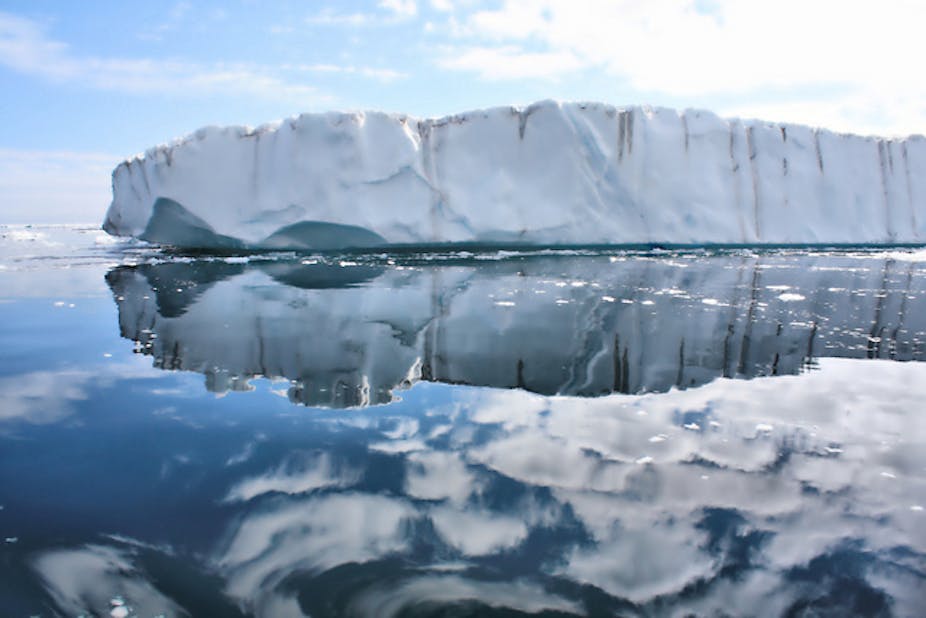
The Greenland ice sheet continues to shrink around the edges but grew in the middle, the study found. http://www.flickr.com/photos/chrissy575

Global warming has caused nearly 200 billion tons of Greenland’s mass to disappear annually in the last decade but its icy centre actually grew, a new study has found.

The melting of the Greenland ice sheet is seen as a yardstick for the rate of global warming and is one of the main causes of catastrophic sea-level rises.

A new study by Christopher Harig and Frederik J. Simons from Princeton University’s Department of Geosciences, published today in the journal PNAS, used satellite data and mathematical modelling to show that Greenland is shrinking by about 200 billion tons of mass every year.

Ice melted mostly from the eastern coast of Greenland between 2003 and 2004 but then disappeared more rapidly from the southeastern side.

Between 2007 and 2010, ice-loss picked up speed along the northwest coast and slowed in the southeast after 2008.

In Greenland’s centre, however, ice mass grew.

“Although the total mass loss trend has remained linear, actively changing areas of mass loss were concentrated on the southeastern and northwestern coasts, with ice mass in the centre of Greenland steadily increasing over the decade,” the authors wrote.

Professor Matt King from the University of Tasmania’s School of Geography and Environmental Studies said the paper highlighted the complicated patterns of melting, which move around over years and decades.

“It’s like someone flicks a switch and glaciers losing a lot of mass stop losing mass, while at the same time on the other side of Greenland the mass loss picks up,” he said.

“Their analysis yields subtle new insights into concentration of the mass loss around the edges, how that’s recently shifted from the southeast to the north, and reveals how the interior of the ice sheet continues to thicken throughout.”

Professor King noted that the study found a much lower rate of acceleration of the overall mass loss than other researchers.

“To me, the paper re-emphasises how the observations are now streets ahead of our ability to explain them – we need to relate the changes we do see with models that will help us explain why it is happening, and people are working hard at that but we need more people funded. But at the same time, we really still don’t have a firm handle on how the changes are happening in time and how much is decadal (10 year) fluctuations and how much is longer-term accelerations,” he said.

“With longer observations and advanced models we’ll be in a better position to determine how much Greenland may contribute to sea levels over the coming decades.”

Dr Andrew Glikson, an Earth and paleo-climate scientist at the Australian National University, said the study added regional and temporal information to trends already demonstrated in other research.

“The extreme rate of ice loss and its acceleration should ring alarm bells in the corridors of the world’s governments, due to its implications for rapid climate change associated with the loss of ice and sea level rise rates,” he said.

Sign in to Favourite

Want to follow The Conversation?

Sign up to our free newsletter to get the day's top stories in your inbox each morning, with a special wrap on Saturday.

Spinner
Donate and become a friend of The Conversation

Join the conversation

18 Comments sorted by

  1. Mark Harrigan

    Dr

    Anyone what to take a bet on how long it is before some "skeptic" jumps on the "but its icy centre actually grew" finding and use this to claim warming has stopped??

    report
    1. David Arthur

      n/a

      In reply to Mark Harrigan

      Neil Gibson might be interested in Matt King's work on Antarctic ice distribution, where the GRACE data was adjusted for isostatic adjustment. It's reported at the Conversation at https://theconversation.edu.au/weigh-in-reveals-antarcticas-losing-190-million-tonnes-a-day-10254

      I was surprised and pleased to see that I'd already had a similar discussion with Mr Gibson at that page; perhaps Mr Gibson can inform Anthony Watt, and together they can try to grasp the concept of "isostatic adjustment"?

      report
    2. Mark Harrigan

      Dr

      In reply to Mark Harrigan

      Anyone who bet about 5 hours takes the prize! Thanks Mr Gibson for proving the reliability of denilaists denying.

      report
    3. Matt King

      Professor, School of Geography and Environmental Studies at University of Tasmania

      In reply to Mark Harrigan

      Neil: nothing wrong with GRACE in terms of making these measurements. And the acceleration of mass loss as headlined is not even affected by glacial isostatic adjustment (since it's linear over decades to centuries). As I replied on the Antarctic post, GRACE is orbiting the Earth at a rapid rate - a bias in GRACE measurements in Greenland would also affect the Sahara the same way and suggest it is losing mass at the same rate. As it turns out the Sahara record from GRACE shows little variability and almost no trend. To some extent, the GRACE data are self-checking. To a larger extent there is no surprise here - 2 other independent measurement types show the same rate of change, and the acceleration. There's no one with actual and relevant data that is suggesting otherwise.

      report
    4. Felix MacNeill

      Environmental Manager

      In reply to Mark Harrigan

      I'm still waiting for Neil's learned response to Matt King's simple, polite, factual and complete demolition of his furphy...or is it that measurement isn't his strong point (as opposed to bluster, sarcasm and repetition).

      report
    5. David Simpson

      Investigator of all things of interest

      In reply to Mark Harrigan

      The thing I find interesting is that if a planet warms such as ours has at the moment (although not for the last 15-16years) and has also in the past, are not all the symptoms that are referred to... ice melting, sea level rises... etc... etc... exactly the same? None of these things prove or substantiate the current theory of CO2 causing dangerous warming of the planet, they are simply symptoms of a either naturally or as some say an unnaturally warming planet. So, I dont see symptoms as any evidence…

      Read more
    6. Alex Cannara

      logged in via Facebook

      In reply to Mark Harrigan

      DavidS utters the classic denier concept: " I dont see symptoms as any evidence of the possible cause. "

      Really, David? When you are doubled over from a sahrp pain in your belly, you're not going to accept doctor telling you to go to the hospital because your appendix may have burst? really, David?

      The problem your word evidence, however, is that unlike true skeptics, you don't read contrary facts. Earlier here we discussed how all the last hundreds of years of climate temp variations are accurately rendered by 4 powerful parameters -- remember, David?

      If not, go read.

      If you want to have folks respect what you write, have the integrity to read & study what others write, particularly if they have the science/engineering qualifications.

      And, let us know who pays you too.
      ;]

      report
    7. David Simpson

      Investigator of all things of interest

      In reply to Mark Harrigan

      To Alex C, you assume an awful lot about me, how rude of you, .... as for your analogy... " Really, David? When you are doubled over from a sahrp pain in your belly, you're not going to accept doctor telling you to go to the hospital because your appendix may have burst? really, David?" You mean to say a pain in the belly couldn't be caused by anything other than a burst appendix? I beg to differ and until my doctor conducts the appropriate tests and the results come back I wont be letting them…

      Read more
    8. Alex Cannara

      logged in via LinkedIn

      In reply to Mark Harrigan

      DavidS, "You mean to say a pain in the belly couldn't be caused by anything other than a burst appendix? I beg to differ and until my doctor conducts the appropriate tests and the results come back I wont be letting them cut me open unless"

      Good try at missing the point, David. The point is to do the tests, not to reject the possibility of anything the test data might expose.

      What your "skepticism" has said so far is that you don't believe tests you don't like, which is what thousands of honest scientists around the world have been doing for decades.

      So, you indeed appear to want to wait until it becomes a life & death situation, and not just for you. That's not being a "skeptic".

      But no one's trying to convince you of anything. Just don't want others to be mislead.

      report
  2. David Arthur

    n/a

    "Ice melted mostly from the eastern coast of Greenland between 2003 and 2004 but then disappeared more rapidly from the southeastern side.
    "Between 2007 and 2010, ice-loss picked up speed along the northwest coast and slowed in the southeast after 2008."

    To what extent do these regional fluctuations correlate with adjacent sea (and air) temperatures?

    "In Greenland’s centre, however, ice mass grew." How does this compare with the regional precipitation (snow fall) record in this area?

    report
    1. Matt King

      Professor, School of Geography and Environmental Studies at University of Tasmania

      In reply to David Arthur

      David: there's been a number of studies which show just how sensitive Greenland is to ocean current fluctuations - that is bringing "warm" water along the coast. Surface melting has hit some records recently as well, but nothing completely unheard of during the past century.
      http://news.nationalgeographic.com.au/news/2012/07/120725-greenland-ice-sheet-melt-satellites-nasa-space-science/

      On the precipitation - I don't have a study in mind, but increased high altitude accumulation tends to come hand in hand with warmer oceans (and hence increased evaporation).

      report
  3. Michael Gioiello

    High school music teacher/ freelance Opera singer

    And we still have idiots like Alan Jones on talk back radio trying to convince ignorant people that it is all a myth.
    Blokes like him should really be put in jail.

    report
  4. william mcinnes

    investigator into medical negligence

    The earths atmosphere is its lung, put more CO2 into it and everything becomes more acidic......including the oceans and so goes the first of the food chain. Increasing populations consume more, up goes the CO2, up goes the acid down go the trees, and so forth ......until one day down goes humanity.......

    report
  5. Alex Cannara

    logged in via LinkedIn

    We see MattK quoting NAt. Geographic, owned by Murdoch now?

    The fact of surface meting may have indeed occurred before, but the real fact is record low ice coverage of the Arctic Ocean in Summer, and the fact of Greenland;'s accelerating ice-mass loss, from ~50 cubic miles/year a few years back, to about 100 this past year.

    These are not "surface melts" of the previous centuries. Ice cores demonstrate that back by millennia.

    It's always interesting how contrived these odd, anti-climate-change comments are. None of those making such dodges around facts would dare do so when their personal lives were threatened, as when asking for medical help from doctors & pharmacists. Odd.

    report
    1. Alex Cannara

      logged in via LinkedIn

      In reply to Arthur James Egleton Robey

      As the old farm saying goes: "Spit in one hand and wish in the other, and see which gets full first."

      Of course, the real sating was less genteel about what's going into the 1st hand.
      ;]

      report