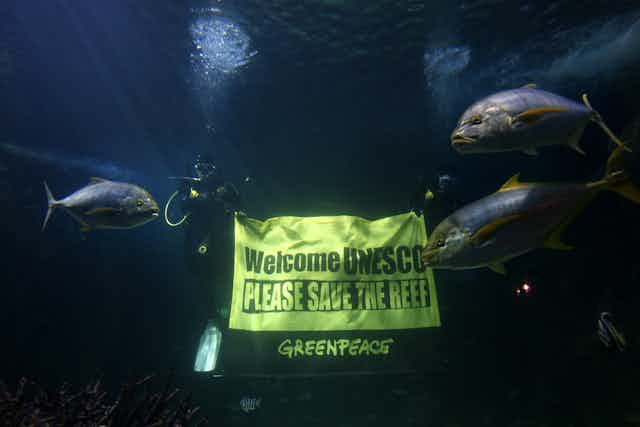

The Great Barrier Reef World Heritage Area is clearly in danger. But will UNESCO bite the bullet and officially declare it so?
UNESCO acknowledges that the property is iconic. It is the world’s largest coral reef ecosystem. Its size, beauty, composition and biodiversity remain exceptional. But alarm bells rang at UNESCO when it found out it hadn’t been told three LNG plants were being constructed or planned on Curtis Island in the World Heritage Area.
A Mission of the World Heritage Committee visited last year and encountered a Gladstone Harbour in a parlous state, with 45 coastal development proposals in the pipeline.
Moreover, key water quality programs were not in place beyond 2013; coincidentally, the Reef was suffering calamitous floods and a cataclysmic plague of crown of thorns starfish.
The Australian Government was told to respond by February 1, 2013 to a series of demands about progress in, and plans for, managing the property.
The Commonwealth’s recent response does not seem to fully appreciate the true state of the reef. The Executive Summary is little more than a self-congratulatory and political statement for the benefit of domestic readers. The greatest advance made by the Commonwealth – the increase in no-take zones in the Reef from 4% to 33% in 2004 – happened almost nine years ago. It also makes bold statements of doubtful veracity, such as, “The management and protection of the GBR continues to be an ongoing priority for the Australian and Queensland governments.” The state of the reef suggests otherwise.
The government also says, “The declaration of a Coral Sea marine reserve offers substantial additional protection for the integrity of the GBRWHA.” The protection offered by the Coral Sea Reserve is in fact minimal.

Water quality problems
According to the government’s statement, “Both the Australian and Queensland governments have committed to continuing efforts to ensure the quality of water entering the reef from adjacent catchments has no detrimental effect on the health and resilience of the GBR.” It needs to be explained why and how these “continuing efforts” have fallen short.
Almost 20 years ago a water quality target was adopted in a 25-year Strategic Plan for the Great Barrier Reef World Heritage Area. A 25-year objective (by 2020) was “to reduce human-caused inputs into the World Heritage Area of silt, nutrients, toxic pesticides, herbicides and other toxic pollutants to as close to zero as possible”. As a consequence the key agricultural industries stakeholder walked away from the plan.
While the Australian and Queensland governments did embrace the plan and the target for pollution reduction, any serious action had to wait for 14 years, when the Reef Rescue initiative commenced. By this time the situation was much worse. The legacy of this vacillation includes total catchment loads five to nine times the natural loads for total suspended solids, nitrogen and phosphorus.
Diffuse source sedimentation and chemical deposition in the lagoon of the GBR, originating from grazing and farming properties, was always going to be difficult to manage. And the intransigence of the sector must have sent signals about how difficult controlling runoff was going to be politically. Governments ended up relying on voluntary programs rather than making the polluter pay.
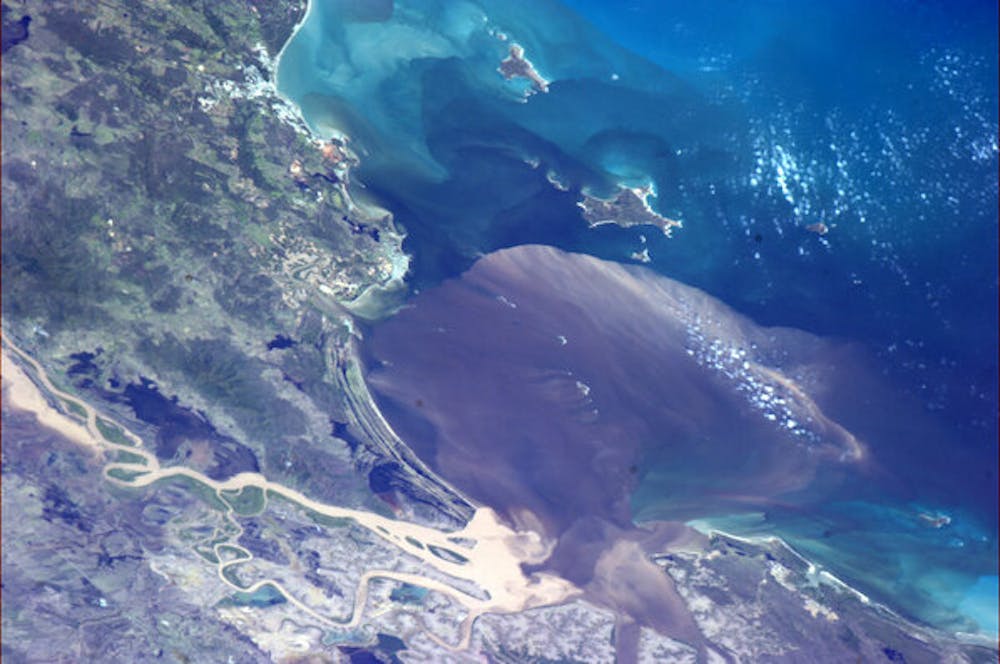
In the last three years the unprecedented series of flood events has extended the reach of sediments and chemicals out on the coral. These will have set back some weak favourable trends in pollution loads.
Lack of strategy and targets
The reef has been assailed to such a degree that it now has only 14% coral cover – half what is was 27 years ago. And it continues to be severely threatened. As such it will hardly be able to resist its biggest challenges – dealing with rising sea water temperature and associated acidification.
It is instructive to analyse further the responses of the Commonwealth to UNESCO.
The Commonwealth says “Australia is … building on the strong record of management of the property and continuing a long legacy of adaptive management and good stewardship.” This statement, unwittingly, goes to the heart of the problem.
Adaptive management of the reef does indeed have a long, but disastrous, legacy. The point is that tackling water quality and coastal development threats requires more sophisticated management than simply waiting for things to go bad before acting. These threats must be addressed by strategies that adopt the precautionary principle, with targets set and met, taking account of cumulative impacts.
But as UNESCO’s demands reveal, there has been no strategy, nor meaningful targets. (UNESCO itself had stipulated the target for ports – no new ones are to be developed.)
Moreover, cumulative impact assessments are conspicuous by their absence. (Trumpeted by the Commonwealth is a recent environmental impact assessment (EIS) done voluntarily by the proponents, that is cumulative; but its scope is confined simply to Abbot Point port developments.)
Economic benefits, but for whom?
Environmental impact statements are noted for their rich analysis of the economic benefits of development proposals. In contrast, that of economic impacts on stakeholders is often pathetic. It is not surprising that the narrowness is noted by UNESCO. It says “This assessment should consider in detail … the social and economic costs and benefits and lead to a clear indication of the net benefit of the development to the values and integrity of the property.”
In the face of this strong hint, the Commonwealth responded blandly “In deciding whether to approve an action, and what conditions to attach to an approval, under section 136 1 (b) of the EPBC Act the Australian Government environment minister must consider, amongst other things, economic and social matters.“ It did also offer that “any unavoidable residual impacts are offset in a way that promotes a net benefit overall”. However, in practice the benefits of damage offsets have been problematic and their practicality questionable, as noted by UNESCO.
Strategy development in grave doubt
One of the demands of UNESCO was that the Commonwealth “undertakes an independent review of the management arrangements for Gladstone Harbour that will result in the optimization of port development and operation in Gladstone Harbour and on Curtis Island, consistent with the highest internationally recognized standards for best practice commensurate with iconic World Heritage status”.
Queensland has management responsibility over the harbour. It thus holds all the cards but refused to deal a hand to the Commonwealth. This has set back the review by seven months.
UNESCO will have noted Queensland’s policy to ramp up coastal development along with the state’s refusal to cooperate with the Commonwealth on the harbour management review. These are both strong signs that progress will be difficult.
The reef is dying a death by pollution and a thousand cuts. Nor is the prognosis good. Governments’ responses to threats have proved inadequate and coastal development is rampant. If the strategic assessment is to resurrect and strengthen the Outstanding Universal Values of the property it will require commitment and close cooperation by governments. That these preconditions are absent is clear from the recent stand-off between Queensland and the Commonwealth over the Gladstone Harbour review.
The reef is in danger. It would not be surprising if it is officially listed as such. This would diminish Australia’s standing in the world as an environmental steward; and the negative impact on the tourism industry and the Queensland economy could be long-lasting.
David Arthur
n/a
Thanks Colin. The quote, “The management and protection of the GBR continues to be an ongoing priority for the Australian and Queensland governments is intriguing", since neither government seems interested in addressing quality of riverine runoff from Queensland.
This is an issue because the nutrients that sustain crown-of-thorns starfish larvae, and smothering algal blooms, are largely derived from these rivers.
Extending GBRMP boundaries is a feel-good exercise, designed to appeal to…
Read moreWade Macdonald
Technician
Excellent article Colin,
Most of what I have witnessed you write on this forum is bang on the money regarding such situations.
If I may elaborate here....
The government also says, “The declaration of a Coral Sea marine reserve offers substantial additional protection for the integrity of the GBRWHA.” The protection offered by the Coral Sea Reserve is in fact minimal.
Correct....It should be clarified that MPA's offer little protection full stop from the real threats to biodiversity loss…
Read moreDavid Arthur
n/a
Gday Wade, as it happens, no-take zones work to improve fish catches in areas adjacent to the no-take zones.
A new NOAA research report finds that both fish populations and commercial and recreational anglers have benefited from "no-take" protections in the Tortugas Ecological Reserve in the Florida Keys National Marine Sanctuary.
The report, "An Integrated Biogeographic Assessment of Reef Fish Populations and Fisheries in Dry Tortugas: Effects of No-take Reserves," evaluates how the 151-square…
Read moreWade Macdonald
Technician
David,
I have no problem with MPA's that respect local stakeholder imput when implemented and are based on sound science not political grandstanding/vote grabbing or partial science funded by ENGO's, such as the models seen at both state and Federal levels in this country. Australia already past the UN's guidelines on areas closed to fishing prior to the recent state and federal MPA campaigns of the last few years.
If you seek to take me on over the ins and outs of MPA's you will have to do…
Read moreColin Hunt
Honorary Fellow in Economics at University of Queensland
Wade,
Thanks for the compliment.
David Arthur
n/a
Thanks to the reference to Wally Starck.
I once heard him on ABC Counterpoint, arguing that Australian fisheries were under-utilised and overgoverned because the permitted intensity of fishing effort is far less than in Indonesia!
The Good News, Wade, is that you are welcome to go fish in Indonesian waters at any time.
Wade Macdonald
Technician
There is some truth in Starck's point. However using McCook et al as advocacy with authors recipients of PEW grants etc is worse.
Not quite is bad as the Boris Worm PEW funded report but a close second.
To close off natural reef systems and seagrass meadows that are biodiversity hotspots, then claim the sanctuary is the reason for increased biomass against adjacent sandy bottom barren wastelands is hyperbowl.
These areas already contained higher levels of biomass and spillover of fish into…
Read moreDavid Arthur
n/a
There might have been some truth in Starck's point, IF Australian fisheries weren't experiencing degradation due to polluted runoff from Australian, IF Australian fisheries aren't at risk from climate change.
Further, the point has been made in the discussion in these pages around super-trawler Margiris that Australian fisheries are often not even exploited to the full extent of Australian quotas. even relative to Australian-set quotas.
For Starck to then claim that those quotas are too restrictive…
Read moreWade Macdonald
Technician
David,
Focus on Starck if you like but it matters not to me. The only reason I linked his article in was to show that MPA's are a social science that has largely been politically driven by PEW's arrogant global legacy agenda.
Dr Ben Diggles, Prof. Ray Hilborne, E.Prof. Bob Kearney and Prof. Colin Buxton plus many more fisheries scientists are all well aware of the facts I speak of here.
Conservation and exclusion are too seperate issues and largely discriminantry when they focus only on…
Read moreWade Macdonald
Technician
Sorry link attached...
http://au.news.yahoo.com/thewest/a/-/breaking/16010732/fishing-bodies-angry-over-park-plans/
David Arthur
n/a
How would I feel about it? That's social science.
How do the fish feel about it? That's irrelevant, it's what the fish are OBSERVED to respond to no-take zones. That's fish-counting marine biology, not social science.
You'll recall earlier in this thread I clearly stated that pollution via runoff is a large problem, which governments prefer to not address. Instead, they "pick the low-hanging fruit" of establishing marine parks. We are in loud agreement, I think, that just setting up marine parks is inadequate without addressing terrestrial runoff.
Where we differ, I suggest, is that I accept that marine parks are of SOME benefit, whereas you would take issue with that. In support of your position, you would need to show that marine biology is just a social science. It appears to me that the Australian Environment Foundation seeks to thus besmirch any and all politically inconvenient reality such as marine biology.
Wade Macdonald
Technician
No David,
I take issue not with MPA's or the benefits they sometimes provide but the advocacy of MPA's based on unobstanciated, promotion of the science. This is where our conversation began.
You see, I understand the truth behind the hubris....
Read this from NOAA
http://www.sciencedaily.com/releases/2013/02/130204184627.htm
Sounds fantastic doesn't it...but what does the history of that article say?
Quote...."The report's analysis of long-term socioeconomic and scientific information…
Read moreDavid Arthur
n/a
Thanks Wade, let me get this right:
NOAA claims that establishing no-take zones has improved fish abundance OUTSIDE the no-take zones, for which they have before-after comparisons. Sounds pretty clear,and straightforward to me.
You note, on the other hand, that the report neglects the effect of changes to quota limits over the same period; to which quota limit changes do you refer?
If there were no quota limit changes, then logic tells us that the yield improvements can only be due to establishment of the Marine Reserve.
Wade Macdonald
Technician
David,
This area has undergone massive fisheries management changes along the same time frame as the implementation of the MPA. It had to, it was fished out...the only direction for stocks to go was up and the sanctuary alone would of contributed little on its own to this rise.
Management changes included, quota adjustments, trap fishing gear amendments, long line reductions, trawl reductions, roller rig trawl modifications, bag limits and a plethora of other regs for both recreational and…
Read moreDavid Arthur
n/a
Thanks for clarifying that, Wade. There are some good points.
What you're pointing out is, a fishery suddenly has X% excised through establishment of a no-take zone, and total fishing effort remains unchanged, then intensity of fishing effort is increased by a factor of 100/(100-X) in the remainder of the fishing range, is that correct?
In that case, of course it's going to be several years before fish in the no-take zone increase in size sufficiently to produce sufficiently large numbers of young for fish take over the remaining available area of fishery to be restored.
Stands to reason that, if you want overall productivity to improve, then as well as establishing permanent no-take zones, you have to give the remainder of the fishery a bit of a rest for a while. Some might think of this as social science, but I think of it as applied mathematics.
Wade Macdonald
Technician
Quote...Some might think of this as social science, but I think of it as applied mathematics.
Fair point there David. The social side is the loading of benefits to the sanctuary while ignoring other management or natural ecosystem changes, such as what scientists call 'class years'. These ocurr when favourable natural conditions align and result in unusally high catch rates for some targeted species. A good outlier in statistics if you understand bell charts is perhaps a useful analogy?
Quote…
Read moreDavid Arthur
n/a
Thanks Wade, so Gardmark et al (Density-dependent body growth reduces the potential of marine reserves to enhance yields, J Applies Ecology (2006) v43(1) 61-69) found that within sanctuaries, there is an eventual levelling-out of fish numbers and size.
No surprises there, it's called carrying capacity, it applies to all ecosystems. Doesn't disprove my point, which is that when you've all but denuded a fishery (the opposite of the near-restoration which Gardmark et al are considering), no-take…
Read moreWade Macdonald
Technician
Ha...yes, obese isn't probably the best term, how about lethargic?
Even fish slow down at old age. Some of the old snapper I have landed were not the best from a purely sportsfishing perspective despite their size.
Snapper in SA are considered broodstock between around 40-100cm after that their migratory habits change. Even though they still breed these old snapper become more demersal and tend not to migrate out to deeper waters with their younger bretheren.
Even to this day with acoustic tagging programs we still know little about their movements during the cooler months when they head out deeper.
David Arthur
n/a
Thanks Wade, perhaps larger fish lose 'sportiness' because they lose anaerobic fitness through not having to outrun predators because they have outgrown them instead? This could account for their changed behaviour.
Also, explosive acceleration varies with muscle cross-section area, whereas inertia varies with mass, and hence volume. If an 80 cm fish is identically proportioned to a 40 cm fish, it will weigh 8 times as much but its muscles will have only four times the cross-section area.
Jon Brodie
Research scientist
It should be noted however that at least something is being done about agricultural pollution albeit very late and slowly. Reef Rescue programs are having some impact on improving water quality. Whether this is enough to 'save the reef' is debatable but it's the only area where some progress has been made. Management of port development is a continuing failure as noted in this article and of course wrt managing climate change it is pointless to mention the failures. Management of micropollutants such as pharmaceuticals (from sewage), plastics, heavy metals, coal dust, PAHs, Endocrine disrupting substances, etc is non-existent. The continuing saga of Gladstone where finally a year after completion the turtle contamination study results from 2011 have been released is also 'amusing'.
Colin Hunt
Honorary Fellow in Economics at University of Queensland
Jon,
What are the sources for the data on reductions in agricultural pollution that you mention? There is a note of some improvement only in nitrogen by UNESCO. Also I should think that the recent floods have made improvements difficult to sustain.
Jeremy Tager
Extispicist
In a 2011 letter to the PM, Environment Minister Tony Burke wrote "I am advised that the cumulative impacts of development on the reef, along with the impacts of climate change, will make it increasingly difficult to make decisions that are favourable to development in and adjacent to the reef if the World Heritage and other environmental values are to be protected and conserved.” Since that bit of rhetoric he has approved every mine, rail line and port expansion adjacent to the Great Barrier Reef that has crossed his desk.
Australia is determined to be the world's largest exporter of coal and CO2 no matter the consequences. Listing of the GBR as 'in danger' won't change that unless it becomes the point at which the public realises that the interests of the coal sector matter to our leaders far more than the GBR.
Colin Hunt
Honorary Fellow in Economics at University of Queensland
Jeremy,
The more severe the jolt to the public’s perceptions of the status of the GBR, the more likely our politicians are to change their priorities. An in danger listing might do that. However, given the massive run-off problem that will take years to fix and the huge development proposals in the pipeline (coals exports set to double and LNG fivefold by 2020) even a stepped up program of reef rescue could well be too little too late.
Ilsa Mac
logged in via Facebook
Wonderful article detailing why it should be listed as in danger.. great danger! Many thanks - will share widely.