


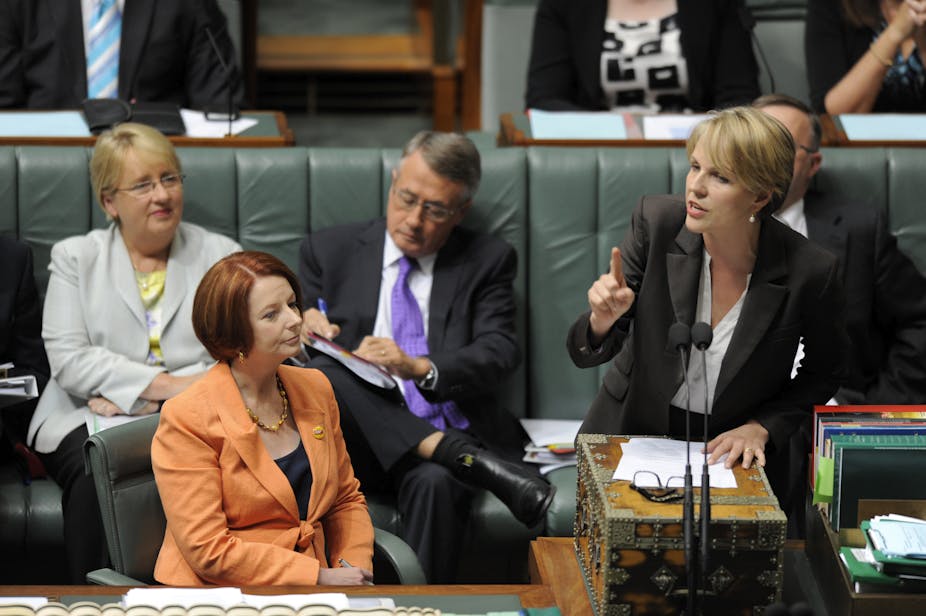
Prime Minister Julia Gillard and Health Minister Tanya Plibersek have announced they will return health payments to Victoria that had previously been cut from its allocation under the National Health Reform Agreement.
To save face, they say that they will punish Victoria by providing the money directly to hospitals. This is a punishment that is far more likely to end up hurting the Commonwealth than Victoria.
In practical terms, Victoria won. It gets its money back and the money ends up precisely where it would have gone anyway if the Commonwealth had paid it out under the National Health Reform Agreement.
From the Commonwealth’s point of view, not only did it lose by being forced to pay the money out, but it has once more entered the shark-infested constitutional waters of executive expenditure without parliamentary authorisation.
The Commonwealth is gambling on Victoria not challenging its method of granting the money. The Prime Minister recently asked rhetorically:
“Is Premier Baillieu really saying he would take a court case to deny hospitals in Victoria more money? Is he really saying they’d spend all of that money on legal costs to stop money going to patients?”
But there is no need for Victoria to commence a challenge. There is already a challenger ready to take on the issue. He is the challenger who previously beat the Commonwealth in the chaplaincy case, Ron Williams, and he is apparently ready for another tilt at the Commonwealth.
Until 2009 the Commonwealth took the rather optimistic view that it could spend money on anything it chose, as long as the money was covered by an appropriation by Parliament. This proposition was challenged by another individual, Bryan Pape, in a case about the validity of the Commonwealth’s payments to tax-payers during the global financial crisis. The High Court held that an appropriation was not sufficient to support the expenditure of the money – there needed to be some other constitutional head of power to support legislation that authorised such expenditure.
A prudent Commonwealth government would then have reviewed all its expenditure programs to ensure that they were properly supported by heads of legislative power, but instead it appeared to ignore the High Court’s ruling and carry on with business as usual.
Then came Williams who challenged the Commonwealth’s expenditure on a chaplaincy program for schools.
In this case, not only did the High Court find that there needed to be a separate head of power to support such expenditure, but that there needed to be actual legislation (not just a hypothetical power to legislate) to authorise such expenditure of public money.
The High Court stressed the importance of parliamentary scrutiny of public expenditure through the legislative process and that the constitutional procedure for making grants to the States under s 96 of the Constitution should not be lightly by-passed.

This time the Commonwealth did respond. It rammed through Parliament, in two days, the Financial Framework Legislation Amendment Act (No 3) 2012 that authorised the Executive to spend money upon more than 400 broadly described programs and subjects, listed in regulations. In doing so, Parliament effectively abdicated its responsibility to scrutinise public expenditure through the enactment of legislation and dismissed the federal considerations that had so concerned the High Court.
Indeed, it was a provocative act of defiance of the High Court. It was also a provocative act of defiance towards Williams. One of the programs for which expenditure was authorised by this Act was the chaplaincy program. Williams has since been raising funds to launch another challenge – this time to the 2012 Act.
The Act is highly vulnerable to constitutional challenge. As the former Chief Justice of New South Wales, Jim Spigelman, observed, some programs have been “identified in such a general language that they could not withstand constitutional scrutiny”. He too has regarded the Act as a provocation to the High Court and an approach to legislating that is not consistent with the rule of law.
Whether or not the High Court might strike down the entire law, read it down to its valid application or sever the parts that have no constitutional support, remains to be seen.
So where does the recent decision on health funding fit into this fight? Health funding is currently overseen by the National Health Reform Act 2011 (Cth). The expenditure is expressly authorized by s 15A of the Federal Financial Relations Act 2009 (Cth) and is constitutionally supported by s 96.
Instead of using this constitutionally valid system, the Commonwealth now wants to pay the money directly to hospitals, in defiance of its own legislation, by-passing s 96 of the Constitution and without legislative authorisation – exactly what the High Court said it should not do. Perhaps it will attempt to include this expenditure under the scheme it created in the Financial Framework Legislation Amendment Act (No 3) 2012.
But, Victoria would be unlikely to challenge it, because there is at least a plausible head of power to support Commonwealth health funding. The challenge by Williams to the chaplaincy scheme is much more likely to bring down the scaffolding of the Financial Framework Legislation Amendment Act (No 3) 2012, and no doubt Victoria will intervene to support it.
What is most significant about the Commonwealth’s approach is what it tells the High Court – that the Commonwealth Executive will continue to defy the Court and ignore its views on federalism, section 96 and the need for parliamentary scrutiny over public expenditure.
Pity the poor Commonwealth Solicitor-General having to defend the Commonwealth’s law before the High Court in such circumstances. Williams must be leaping with joy. So, no doubt, is the Victorian Government.