

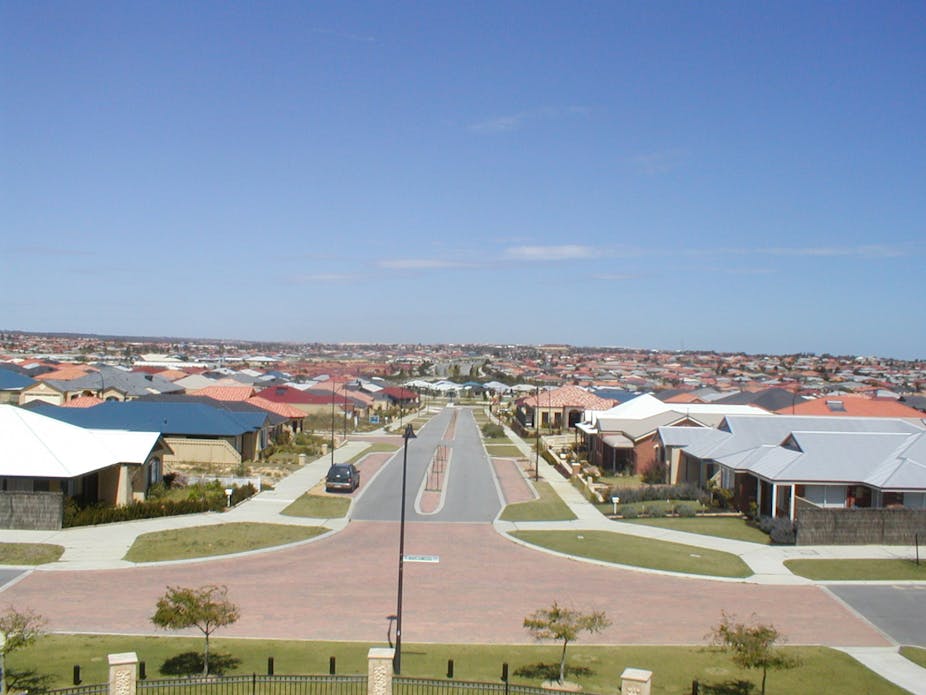
Home truths: are planners really to blame for our housing “shortage”?

Is Australia becoming a nation of renters, and are planners to blame? Newspaper headlines accompanying the release of a new report on housing supply and affordability, by the federal government’s independent National Housing Supply Council, suggest we’re being priced out of our own homes. In fact…

3kt3hgq3-1363031265
What’s the evidence linking inefficient planning approval processes to expensive housing in Sydney and other state capitals? Nicole Gurran

Is Australia becoming a nation of renters, and are planners to blame? Newspaper headlines accompanying the release of a new report on housing supply and affordability, by the federal government’s independent National Housing Supply Council, suggest we’re being priced out of our own homes.

In fact, the actual report, released on March 1, finds that overall rates of home ownership – around 70% of Australians – remain stable, although fewer young people are taking out a mortgage, and fewer new households are forming.

Popular demographers have dubbed this the KIPPERS phenomenon (Kids In Parents Pockets and Eroding Retirement Savings), and worse. Yet in truth, and as the supply council’s report points out, the real affordability problem in Australia is at the bottom end of the market, where moderate and low income renters struggle with high rents, often in overcrowded conditions, and are unable to raise the deposits needed to attain home ownership.

Supply failure – that is – insufficient construction of new houses – is provided as the major explanation for these affordability problems. Indeed, as the supply council’s data shows overall, housing output in Australia has reduced over the past decade, and particularly since 2005, although actual trends differ across the states and territories.

For instance, housing production in NSW remained buoyant until around the middle of 2005, when it was overtaken by Queensland and Victoria. The supply council’s latest report, along with a series of previous publications by industry peaks and government, blames land use planning systems for this supply shortage, and by extension, for the affordability problems affecting low and moderate income renters and those seeking to enter home ownership. Most of these reports are self referencing, so they’re easy to summarise.

In essence, it’s claimed that lengthy decision time frames (the time needed to get planning approval for a development), uncertainty (whether a planning approval will be forthcoming, and how long it will take), and development contributions (towards the costs of infrastructure for new development), are the main problems. Planning reform – initiatives for faster decision times, “red tape” reduction, and increased codification (automatic approval rights) is the recommended response.

So, what’s the evidence linking inefficient planning approval processes to expensive housing in Sydney and other state capitals? To what extent might faster planning decisions and more liberal regulation boost supply in NSW or elsewhere? Are pedantic planners or parochial councillors systematically refusing applications for new housing developments?

In fact, data produced by planning agencies shows around 95% of all development applications in NSW and Victoria are approved, a rate which has been more or less stable for the past five years.

So the problem’s not due to planning obstruction, nor does Sydney – where housing supply and affordability problems are most severe – do worse than other Australian cities. It’s actually much faster to get a planning approval in Sydney (around 78 days for all approvals) than in Melbourne (at around 125 days), according to the Productivity Commission’s 2011 review of Australian planning, zoning and development assessment systems.

So we need to look more closely at claims that planning regulation is constraining housing supply and that relaxing controls through planning reform would boost production and affordability.

NSW has already given this a pretty good try, under reforms introduced in 2005 to enable ‘major projects’ (including housing developments worth over $50m) impunity from existing planning requirements, and an express line straight to Ministerial approval. Yet these notorious ‘Part 3A’ provisions – didn’t lift production. Rather, in the year of their introduction dwelling approvals in NSW fell for the first time, below those of Queensland and Victoria.

So why does the commentary focus on the planning system when other issues, such as the availability of credit – have a much bigger impact? It’s true that planning systems should be improved but recent surveys of the development industry suggest that the key supply issue is stagnant market conditions constrained by limited development finance and weak household confidence following the GFC.

Rather than just fiddling with development codes and land use zones, governments could support affordable housing supply through some of the property taxation reforms suggested by the Henry Taxation Review, some major reforms to infrastructure funding (rather than making the users pay), reforming housing finance and improving accessibility to make more parts of Australian cities attractive places to live.

Planning has a role here by coordinating infrastructure, land uses and transportation, enhancing and preserving local amenity and environmental quality, and establishing the conditions of certainty needed to support investment. These amenities do command a premium – which is why house prices are often higher in established suburbs and in well planned new release areas. But reducing expectations for the quality or accessibility of new development won’t do much for new housing production or for overall affordability.

To really fix Australia’s affordability crisis, governments must provide adequate funding and other support to Australia’s non-profit housing developers who are targeting the area of greatest housing shortage.

It’s cheaper to talk red tape reduction than directly support affordable housing or fund new infrastructure. These take political commitment and resources, both of which do appear to be in short supply.

Articles also by These Authors

Sign in to Favourite

Want to follow The Conversation?

Sign up to our free newsletter to get the day's top stories in your inbox each morning, with a special wrap on Saturday.

Help evidence based journalism become the norm and donate

Join the conversation

70 Comments sorted by

  1. Gavin Putland

    logged in via Facebook

    The problem starts with unaffordable rents, which current negative-gearing rules do nothing to alleviate. To claim negative gearing, you don't need to add to the supply of housing; you can simply buy an existing home, thereby forcing a prospective owner-occupant onto the rental market. You don't even need to have a tenant in place; you only need to claim that the property is "available" for rent. Hence you can demand too much rent or be too discriminatory in accepting tenants.

    These observations suggest a two-part solution:

    (1) Allow negative gearing only if the property is actually rented. If it is continuously vacant for (e.g.) 6 weeks, limit or disallow deduction of expenses for the whole 6 weeks.

    (2) To encourage construction, exempt future purchases of new homes from rule (1) for (e.g.) five years after construction.

    report
  2. Robert Nelson

    Associate Director Student Experience at Monash University

    The authors argue that housing shortages cannot be blamed on regulation because the regulatory process is speedy. That's a very incomplete measure of regulation, i.e. how quickly it approves new plans, because it ignores the substance of those plans. Planning regulation, irrespective of how rapidly it approves applications, is the cause of appallingly low plot ratios, which means that Australia exploits its land in the most inefficient way. With its cocktail of setbacks, height limits and mandatory…

    Read more
    1. Kevin Bain

      Teacher

      In reply to Robert Nelson

      Robert, your comment about appallingly low plot ratios (I presume this means accommodation density) doesn't gell with my impression (I'm not an expert) of the trend being in the opposite direction: the observable growth of dual occupancy of 1/4 acre blocks and unit/apartment development in the established "middle suburbs" of Melbourne. This is facilitated by the primacy of State regulations favouring higher density housing over Council discretion. Hence we seem to have more building to fencelines…

      Read more
    2. Robert Nelson

      Associate Director Student Experience at Monash University

      In reply to Kevin Bain

      Sure, Kevin! It's a fair question that most Australians would ask: aren't we dense enough and why can't we continue to take advantage of our abundant space and maintain the low capital to land ratio which also seems to have some cultural appeal to those of us who have grown up in leafy suburbs? The comprehensive answer is given in an accessible text (The space wasters: https://www.planning.org.au/documents/item/3512) but the short answer specifically in relation to Gurran & Phibbs's topic is that the inefficient use of land means structurally pricey building stock. Especially in inner and middle suburbs, supply is tiny and price is high. It is extremely relevant to affordability and it surprises me that Gurran & Phibbs dismiss this key dynamic in such a cavalier spirit as somehow "fiddling" with trivial things that don't count.

      report
    3. Leith van Onselen

      Economist

      In reply to Robert Nelson

      The UK has had strict growth controls since the green belts were first implemented in the late-1940s, which has led to the UK having some of the highest urban densities in Europe and amongst the smallest housing space per person in Europe. Yet their urban land prices and housing costs are amongst the most expensive in the world, despite "exploiting land in an efficient way". Why? Because they have strangled land supply through highly restrictive planning.

      Tell me why Australia should head down this same path?

      report
    4. Kevin Bain

      Teacher

      In reply to Robert Nelson

      Robert, I will look at your document but "structurally pricey building stock" - are you talking about the cost of the buildings? I understood that the growth of 2 storey Mcmansions was due to the innovation of "tilt-up" concrete panel construction eg. the "Henley box", back in the 1990s, providing larger house sizes at cheaper erection cost. No commentary in this forum that the growth of average house sizes continues apace, while number of occupants diminishes. One of the welfare groups said Australia's homeless housing problem could be solved if every bedroom in the country had one person in it.

      report
    5. Angela Ballard

      Consultant/Facilitator at Atmosphere Consulting

      In reply to Kevin Bain

      There are all sorts of amenities that come with more people per hectare. Excellent mass/public transport requires 60 people per hectare (most European and Asian cities are above this. Brisbane has 9. (in 1962 the figure was 22/h....urban sprawl, contraception, smaller families, bigger homes etc.) Just because we have space to spread out doesn't mean we should...especially when carbon/climate/peak oil issues on the horizon require redensification and a focus on food security within cooee of a bioregional centre/city. There is much much more to the planning issue than simply allowing people to have the lifestyles they think they can afford when it is the whole damn planet - and increasingly the poor - that bears the cost.

      report
    6. Robert Nelson

      Associate Director Student Experience at Monash University

      In reply to Leith van Onselen

      If fewer apartments had been built in London, Birmingham or Leeds, the available stock would be yet dearer than it is now, even if that seems high enough. In all events, our case is quite different and very much as Angela represents it below, with almost agrarian sparsity in suburbs quite close to town. We have plenty of land on which we can accommodate millions more without changing the footprint of our cities.

      But Leith, where are you getting your figures from to support the claim that the UK has 'some of the highest urban densities in Europe'? I am not so sure. Even in Greater London, many established suburbs like Blackheath are full of private gardens and are nowhere near as dense as Paris, which is consistently six storey (±1) as far as the eye can see. An awful lot of London is two or three storeys with yards front and back.

      report
    7. Stephen John Ralph

      carer

      In reply to Robert Nelson

      Hi Robert

      where is the water coming from......whats going to power the homes....how to dealeith the transport infrastructure ...... are the schools going to be there???????

      report
    8. Robert Nelson

      Associate Director Student Experience at Monash University

      In reply to Stephen John Ralph

      Well, I'm not holding my breath for any great changes to occur so suddenly. Find a roomy leafy suburb near you and ask if it's going to resemble Paris any time soon? As things take on, however, residential development has an organic synergy with commerce and government businesses, where greater demand brings greater services. Just as we now see supermarkets at the bottom of tall buildings, so you could expect to see more schools, vets, bakers, pretty much anything where customers might turn up. With greater density, transport is much easier and less reliant on cars; often a bike or even your own pins will suffice. The extra power and water are serious problems but remember that we are profligate with both resources at the moment, with our gardens requiring enormous volumes of water and our free-standing houses that neither keep one another cool in summer nor warm in winter.

      report
    9. Stephen John Ralph

      carer

      In reply to Robert Nelson

      Hi Robert

      paris in melbourne...............hmmm

      i used to live in melbourne - now in torquay/jan juc. Every time i go back to the big smoke i'm so glad i dont live there. i realise many peeps love the bigness of it, the bright lights and cafe latte etc

      but not for me (as gershwin wrote).

      i like the romance of your vision, but i think you are putting a paris state of mind on a melbourn state of reality.

      quite often those bakers and supermarkets at the bottom of tall buildings have "for lease" signs up.

      report
    10. Robert Tony Brklje

      retired

      In reply to Robert Nelson

      Supply and demand, the best way is to tackle both ends of the market at once and actively financially penalised low density housing investors in order to drive up home ownership ratios.
      Escalating council rates and state property taxes both used to load up the cost on low density housing where more than one property is owned and force investors out of that market and into medium and high density rental housing.
      The other of course is the release of state and federal land in metropolitan areas in direct to end user auctions one plot at a time, this to reduce pressure on existing properties and to promote new construction.
      High ownership ration promote safe low crime neighbourhoods as a result of the majority of owners having a invested interest in their local community.

      report
  3. Gary Cassidy

    "So why does the commentary focus on the planning system when other issues, such as the availability of credit – have a much bigger impact?"

    Wasn't the loose availability of credit a primary factor in the recent worldwide property boom where the value of new and existing housing sky-rocketed?

    report
    1. Andrew Smith

      Education Consultant at Australian & International Education Centre

      In reply to Gary Cassidy

      Complicit also was "upselling" with plentiful credit, i.e. developers and real estate industry building more expensive houses (not necessarily better quality), complemented by the RE media and glossy images of a perfect house etc.

      BBC's Robert Peston saw this as a significant issue in the UK re. property, where many were encouraged (by media) to buy, renovate etc. through constant reinforcement by lifestyle programs, newspaper supplements etc., many found out later they could not quite afford it......

      report
  4. Meg Evans

    Elder at Tutor - positive ageing, cooking, TESOL, philosophy for children, reading recove

    I think we have got very stuck in our idea of housing as a speculative venture yielding highest possible returns for owners rather than 'places to live'.

    Consequently we over invest in vast, energy-hungry edifices that seal us off from others and from the natural environment.

    Affordable housing requires a new way of thinking! Small, passive-solar houses congregated around a central natural environment to promote casual interactions and community!

    When will Australians get off their obsession with their homes as grandiose castles and exhibitions of perceived status?

    report
    1. Stephen John Ralph

      carer

      In reply to Meg Evans

      Hi meg

      good points.....

      further many peeps see renting as a viable option considering the huge initial and ongoing costs of owning. The down side is that later on with retirement, renting has the potential to be a noose around the neck.

      The kipper idea has a lot of merit.....providing the parents are not exposed to emotional blackmail, it has enormous benefits. Even spending the money to modify a house will provide benefit.

      This idea allows for the old-fashioned extended family model…

      Read more
    2. Angela Ballard

      Consultant/Facilitator at Atmosphere Consulting

      In reply to Meg Evans

      Couldn't have said it better Meg! Though I would like to see 'community' involved in the design process a la social housing in some scandanavian examples - now that creates community and a strong sense of ownership and pride.

      report
  5. William Bruce

    Artist

    Fact is that there is plenty of land in Australia and due to ridiculous compliance costs a huge, huge number of kids CAN never own a home ...it's outrageous!!...and also due to this, many many kids will be milked by wealthy real estate owners for rest of their lives AND will likely be a drag on the "welfare state".....I thought it WAS a big Australian value to own ones home?...
    THE BEST THING Govts can EVER do is to get everyone owning a home...it makes people RESPONSIBLE & WORK!!....and I curse…

    Read more
    1. Michael Hay

      retired

      In reply to William Bruce

      William, it is good to read someone who appears to be riled about this subject. Keep writing !
      My solution is for Government (State and Federal) to embark upon building adequate, low-cost 3 bedroom homes (as the basic unit) situated in regional centres.
      These houses would be State owned and rented at a rate suited to the unemployment benefit being paid at the time.
      Allowing that people living below the poverty line will never own their own private property, it is logical to have low-rent housing made available. One cannot expect commercial builders to build for such a purpose, and thus it behoves our procrastinating politicians to step up to the mark, stop blithering and actually make some sensible decisions.
      And while they are on the job, they could eliminate Negative Gearing in its entirety !

      report
  6. Leith van Onselen

    Economist

    The author's arguments are contradicted by the 2011 Productivity Commission report into planning, which found Australia's residential planning processes to be overly slow and bureacratic:

    http://www.pc.gov.au/__data/assets/pdf_file/0011/108848/08-planning-chapter05.pdf

    The rapid escalation of vacant land costs on the fringes of Australia's cities (often undesirable locations) is evidence enough that the land market is being distorted through excessive regulation, lack of competition between land holders and developers (due to the imposition of growth boundaries and restrictive zoning), and inadequate infrastructure planning and provision.

    report
    1. Rex Gibbs

      Engineer/Director

      In reply to Leith van Onselen

      As one experienced in development achieving effective densities around 28 residents per Ha which seems to be the maximum Australians outside central Sydney will tolerate I can tell you that the biggest single impact on cost is provision of services - road, water, fire, stormwater etc and the biggest 'avoidable' cost is Augmentation' charges from Utility suppliers who have monopoly powers and the real escalation of the cost of greenfield land. The real cost of the dwelling units has fallen while their quality has improved. The cost of Land has increased as Governments such as SA' through the Land Management Corporation have controlled land release and as processes where big developers have purchased Greenfield land in near fringe areas which has then been rezoned but adjacent areas have not been.

      report
  7. Rex Gibbs

    Engineer/Director

    This shallow article is not up to The Conversation's usual standards. Perhaps an editor should have intervened.

    It is not the approval of the building project that costs so much nor the disallowance of substandard homes although having seen Sydney's housing stock one might think differently.

    Land use Zoning can take 2 to 4 years. We had a project in regional NSW held up for 2 years because the planning 'rules' were not written around community title. They did not preclude it but did not specifically…

    Read more
    1. William Bruce

      Artist

      In reply to Rex Gibbs

      Rex (Developer) notes: "One can cheapskate the building (omit one toilet, remove garaging, downspec services or reduce building standards. This could save 15%"....
      I say absolute Bull****...let people innovate ...redesign existing structures..let people responsibly SOLVE their own problems. With some land & no services one could even build a home for $25K....not $300k.

      Fact is with existing technology & cheap building supplies (& used ones) and a little suitable land & NO restrictions ....one…

      Read more
    2. Chris O'Neill

      Telecommunications Engineer

      In reply to Rex Gibbs

      "Those who argue that negative gearing is ruining everything"

      I think you're making a strawman argument. No-one is saying that negative gearing is the sole cause of all problems. The one definite consequence of it is that it pushes home ownership from occupiers to landlords, regardless of property costs.

      Also, negative gearing doesn't just apply to just one year of financing as you implied. Landlords normally use negative gearing for many years on each property.

      report
    3. Steve Hindle

      logged in via email @bigpond.com

      In reply to Rex Gibbs

      I remember as a child (in the 1970s) going into the council with my Father (builder) to get some house plans approved. He handed them in at the front desk and we sat down at reception and waited for them to be approved. It took about 10mins, which according to my father was exceptional as it normally took about an hour.

      report
  8. Meg Thornton

    Dilletante

    The authors of this piece have pointed out the main problem in the housing market happens down at what might be termed the "tight end" - the end of the market which has traditionally been serviced mainly by state and commonwealth housing provisions. Lower income families (particularly lower income young families, where there are kids in the picture) are always going to be struggling to save the deposit required to be able to afford housing purchases, even in the best economic conditions. This isn…

    Read more
    1. Angela Ballard

      Consultant/Facilitator at Atmosphere Consulting

      In reply to Meg Thornton

      Mmm yes public servants were always in as far as lenders were concerned but now there is no such thing as a permanent public servant - in Queensland at any rate

      report
  9. Stephen Nicholson

    Town Planner

    There are multiple contributing factors. In my observations, a key is the illusion of urban development as a way to sure-fire profit, as seemingly told to us by land owners/investors, developers, consultants, real estate agents, the media (who rely on RE advertising) and politicians (State and local).

    People pay too much for development sites with inadequate understanding of the costs and risks. Then sit on their investment because it is uneconomic to develop. Even when the market picks up…

    Read more
  10. John Doyle

    architect

    All types of houses have their advantages, and disadvantages. The continental european experience is to rent more than to buy. Few seem to mind. Here we traditionally stigmatised renting yet we must have rental availability. Not all citizens are permanent residents etc. Young people used to group rent and get away from their parents homes. This is difficult now and the patter of 30 year old feet at home is a common sound.
    I think the problem here is we still dream of large land areas for our houses…

    Read more
    1. Chris O'Neill

      Telecommunications Engineer

      In reply to John Doyle

      "One planning flaw which doesn't help our position is the zoning of work separate from living."

      Our planners didn't always make that mistake, not as much as they do now anyway. If you look at Spotswood and Sunshine in Melbourne, you'll see that there are residential and industrial areas alternating that are only a couple of blocks wide. In suburbs further out, the exclusive areas are much bigger.

      report
  11. David Maslow

    Independent Researcher

    I left Australia 40 years ago. The only things that have changed are more and bigger roads, more office towers and the red brick bung has become the mcmansion. Yet I read that barely a quarter of households have children under 15 years. The huge majority of households are 1 or 2 persons and the fastest growing segment is the single person household! It's not just the planners who are at fault, it's the whole culture that is stuck in a rut! Build medium and high density housing for 1-2 person households along rail lines, including a portion dedicated to well managed rental (like every other country) or perish.

    Oh, and the whole public/private development industry appears to be an organised crime ring that controls everything to do with housing!

    report
    1. Chris O'Neill

      Telecommunications Engineer

      In reply to David Maslow

      "Build medium and high density housing for 1-2 person households along rail lines"

      This is happening to some degree because the land values in such locations are very high (which the original owners pocketed, usually with very little tax even though their unusual profit took little effort on their part) but it would happen a lot faster if there was a significant land tax.

      report
  12. Chris O'Neill

    Telecommunications Engineer

    "Is Australia becoming a nation of renters, and are planners to blame?"

    I'm surprised that anyone doesn't already know the answer to that question considering that the answer has been known for many years. Landlording and renting have a big tax advantage over owner occupation (because of negative gearing if you don't already know).

    "In fact, the actual report finds that overall rates of home ownership – around 70% of Australians – remain stable, although fewer young people are taking out a mortgage, and fewer new households are forming."

    When it should be increasing because of the ageing population, i.e. stability is actually a failure in the present circumstances.

    report
    1. William Bruce

      Artist

      In reply to Chris O'Neill

      "In fact, the actual report finds that overall rates of home ownership – around 70% of Australians – remain stable,

      For how long has this been so I wonder? Regardless, why aspire to this, why not shoot for 95%?

      report
  13. David

    logged in via Twitter

    Sydney is a rich city by all measures - housing WILL be expensive. There is plenty of evidence, and anecdotal evidence, of supply of land not being a problem. Green field is MUCH easier for big developers to deal with - rather than brown field developments and flats.

    In my view the two biggest issues are negative gearing and stamp duty. Stamp duty discourages people from moving or downsizing which contributes to supply problems (in addition to others). Negative gearing encourages hoarding of property, particularly, as time goes on more and more expensive properties.

    report
    1. John Doyle

      architect

      In reply to David

      Negative gearing is important for the rental market. Without negative gearing owners couldn't afford to rent their extra properties. I had a house costing $4000/month mortgage and renting for $1700/month
      The only comeback was to negative gear, otherwise even in a good suburb like Balmain no one would have touched it. Eventually one might collect a capital gain as a long term goal.
      Even with hoarding the properties will still be homes for renters.
      Another issue with high prices is that without high prices cost of renovation work would not be practicable as the actual cost of renos [which are expensive] is matched by the worth of the property so that in the end one doesn't overcapitalise, hopefully.

      report
    2. Gary Cassidy

      In reply to John Doyle

      "Negative gearing is important for the rental market. Without negative gearing owners couldn't afford to rent their extra properties. I had a house costing $4000/month mortgage and renting for $1700/month"

      So without negative gearing the investor would have a $2300 shortfall, add negative gearing and the shortfall becomes approximately $1330 (for 100k income earner). Presumably the savy investor would have done his/her sums and accepted that they can live with a $1330/month loss in immediate income (to be redeemed later by capital gains and growth in rent).

      Now assume that negative gearing is not available and the same savy investor can only afford a $1330/month loss, add the rent and that investor could only afford a $3030/month mortgage. With a $3030/month mortgage the credit available to the investor is reduced, hence driving down the cost of housing.

      report
    3. John Doyle

      architect

      In reply to Gary Cassidy

      It's not up to the investor to drive down the cost of housing. He has to work with what is there.
      Your sums work if there was a capital input to reduce the mortgage, so that $3030 is the monthly cost, which it wasn't in this case.

      report
    4. Chris O'Neill

      Telecommunications Engineer

      In reply to John Doyle

      "It's not up to the investor to drive down the cost of housing."

      The point is that investors are driving up the cost of property because they are helped out by the government but owner occupiers who are competing with them are not. Refer to articles at http://blog.lvrg.org.au/

      report
    5. William Bruce

      Artist

      In reply to John Doyle

      In USA home interest payments are tax deductible I believe!....Regardless why not here? What can't Govt lend to kids buying a home at a cheap rate if it is sensible?...After all they can just print the money.....AND it's cheaper than providing LIFELONG welfare for trailer trash...
      There is no excuse for low home ownership in a Country this...about time we leave the old world political/banking/Investor bias/corruption behind!

      report
    6. William Bruce

      Artist

      In reply to David

      Too right about stamp property stamp duty & entry & exit TAXES....
      And, Sydney has Millions of acres of WORLD CLASS waterfront land orv Harbour View Land TOTALLY undeveloped...You can Start with the whole Nth side of Harbour East of say Clifton Gardens to Spit,,,,& Nth & South Heads ....There is more SUPERB HABOR oriented & NEAR CITY land to develop than one can poke a stick at ...AND IT'S NEAR the City...why not develop some of this?....One could EASY develop a million superb homes from Spit Bridge to City....& that excludes 10 times that area nearby Nth hear etc...Politics & the PS & EXPERTS are NOT the solution, they are the problem ......AND really OUR STUPIDITY & FAILURE to CHALLENGE their "stupid rules" is the problem.
      We ought get back to the old way...ie. it's the Govts responsibility to put in services AND maintain OUR public owned utilities for ALL the people & business (& not sell them to foreign owners because they are Monopolies)......

      report
    7. Gary Cassidy

      In reply to John Doyle

      Hi John,

      I agree that investors have to work with what's there and try to maximise any available benefits. My basic example was to demonstrate how negative gearing acts to gear up available credit, thus driving up property prices. You also stated that you couldn't afford your investment with the credit gearing available through negative gearing. It should be up to government to have in place appropriate policy.

      Some of my issues with negative gearing are:
      * It is a benefit to only a small percentage of the population (predominately the richer end of the population).
      * The benefit is greater for higher income earners (in contrast to our progressive income tax system).
      * The benefit is greater for high growth type investments (where the investor takes on a greater immediate loss for expected greater long term gain) - High growth investments are typically in already established areas and populated by higher income residents.
      * It subsidises a non-productive investment class.

      report
    8. John Doyle

      architect

      In reply to Gary Cassidy

      Well, Gary, I wasn't saying that negative gearing is an all good system, but it's always a top consideration for small investors as well as the big end of town. However, within whatever other confines there are and which we haven't thought through what alternatives might work better, it still provides a stock of housing that allows for renting. In my case and I am sure for many others I don't think I benefited from home ownership over the long term, 30 years or so. Although there was a period from the mid 80's to the early noughties when on paper house prices rocketed, costs weren't that far behind. My first house, purchased in 1976 for $24,000 sold [by a later owner] for $1,424,000 just a few years ago. We didn't benefit from that as the graph got steeper as the years went on.

      report
    9. Chris O'Neill

      Telecommunications Engineer

      In reply to John Doyle

      "it (negative gearing) still provides a stock of housing that allows for renting"

      At the expense of removing a stock of housing that would otherwise be available for owner occupation, i.e. negative gearing is pretty much a zero sum game as far as the total stock of housing is concerned.

      I should point out the blindingly obvious which is that negative gearing has not created a single square inch of land which is the majority of the cost of housing. The only time that negative gearing could possibly improve housing availability is when it is used to finance construction of housing. However, the rental yield of new buildings (excluding land) is normally higher than the interest cost of the loan needed to finance the building, so negative gearing doesn't normally apply to the building content of property, it just applies to the land content.

      report
    10. Chris O'Neill

      Telecommunications Engineer

      In reply to John Doyle

      "I don't think I benefited from home ownership over the long term, 30 years or so. ... My first house, purchased in 1976 for $24,000 sold [by a later owner] for $1,424,000 just a few years ago. We didn't benefit from that as the graph got steeper as the years went on."

      So you got out of the housing market at the wrong time. Them's the breaks.

      report
    11. John Doyle

      architect

      In reply to Chris O'Neill

      The fact is, in spite of all your reasoning, that people need rental accommodation.
      This is one way they get some.

      report
    12. John Doyle

      architect

      In reply to Chris O'Neill

      My case is not the point. The point was that even with the enormous rise in values it is not a given that these values translate to riches.

      report
    13. Chris O'Neill

      Telecommunications Engineer

      In reply to John Doyle

      "My case is not the point."

      So why did you bring it up?

      "The point was that even with the enormous rise in values it is not a given that these values translate to riches."

      Maybe but it's not about instant "riches".

      report
    14. Chris O'Neill

      Telecommunications Engineer

      In reply to John Doyle

      "people need rental accommodation."

      No, people need accommodation.

      Why should the government be spending billions favouring one form of accommodation over another? Surely there are far more efficient ways of actually increasing the accommodation available, rather than just changing the ownership of the existing accommodation.

      report
    15. John Doyle

      architect

      In reply to Chris O'Neill

      Are you just trying to have the last word, Chris?
      By all means be my guest. You're not contributing anything now

      report
    16. John Doyle

      architect

      In reply to Chris O'Neill

      Instead of these unsubstantiated comments, let's see you prove what you say. What are these billions? How many? where are the statistics? Suggest some of the efficient alternate ways to improve accommodation and how they might be implemented. Make a contribution instead of just bellyaching.

      report
    17. Chris O'Neill

      Telecommunications Engineer

      In reply to John Doyle

      Are you trying to blame me for shortcomings in your arguments? OK, if it's that important to you.

      report
    18. Chris O'Neill

      Telecommunications Engineer

      In reply to John Doyle

      "What are these billions?"

      I'm surprised you dispute the cost after you pointed out a single instance of the cost ($27,700 p.a. x marginal tax rate) which is multiplied by quite a large number of properties across Australia. Here's one citation, $2.9 billion in 2009-10: http://www.macrobusiness.com.au/2013/02/busting-negative-gearings-myths/

      and $35.5 billion in the past 17 years: http://www.propertyobserver.com.au/negative-gearing/wednesday-flicker-3-negative-gearing-has-worsened-the-housing

      Read more
  14. Venise Alstergren

    Venise Alstergren is a Friend of The Conversation.

    photographer, blogger.

    There's a few elephants in this room which people are happily ignoring.

    1) Low cost housing/rental cannot be in the outer suburbs, because these suburbs are only to be accessed by car.
    2) Sydney may have lots of available land. Melbourne has not.
    3) Where is the infrastructure for new suburban lots? No schools, no public transport, no amenities.
    4) Public transport in Victoria was built on railway lines in about 1890-1910. We are still using it.
    5) Why didn't we go upwards before allowing…

    Read more
    1. Stephen John Ralph

      carer

      In reply to Venise Alstergren

      Hi Venise

      sydney may have lots of available land................dunno. perhaps there's still abit out west aways, but those pesky mountains may get in the way.

      i'd hate to see areas south of wollongong completely lose the beauty & character they have (at the moment). Wollongong is an urban mess, and Shell harbour is growing like topsy.

      I think kiama and surrounds is one of the best spots in Oz, but that will probably be gone far too soon.

      sadly the coast anywhere in vic & nsw these days is becoming an urban getaway or satellite suburb of some city or other...

      and sadly melbourne has lots of room to move......outwards past melton and gisborne, south east past cranbourne and pakenham..............down the geelong corridor past werribee and onto lara.

      report
    2. Venise Alstergren

      Venise Alstergren is a Friend of The Conversation.

      photographer, blogger.

      In reply to Stephen John Ralph

      Hi Stephen,

      Thanks for your comment. But, have you any idea how far away Melton, Gisborne, Lara, Cranbourne and Werribee-not to mention Pakenham-are from an inner suburb? For me to get to these places would take me well over an hour and a half. And no one has ever accused me of being a slow driver; in fact the saga of speeding fines and demerit points racked up to my name makes for a depressing read.

      All of these places at least have a train service, but haven't you noticed the amount of people using rail transport? Haven't you noticed how crowded the trains are? At the rate of Melbourne's population explosion we will end up being shoved onto trains the way the Japanese do it-like packing sardines.

      Putting on more trains would seem to be the answer-but it isn't.

      report
  15. James Hill

    Industrial Designer

    All the problems outlined so far, in the article and the commentary, combined with the TRILLION dollar private mortgage debt enabled by the Howard regime, almost guarantee that the contractionary austerity measures promised by an incoming Abbot administration, will, at last, plunge Australia into the roiling economic turmoil of the GFC, upon which brink it has been precariously poised for the last five years, finely balanced by the heroic efforts of a very competent Labor federal administration…

    Read more
    1. Chris O'Neill

      Telecommunications Engineer

      In reply to James Hill

      "Adam Smith's observation that "A dwelling house, as such adds nothing to the income of its inhabitants""

      And yet there is this thing called the "wealth effect" (very much in vogue before the GFC) where, as people get "wealthier", i.e. their properties increase in market value, they get the idea that they can spend more. Obviously they never cared about Adam Smith.

      report
  16. Anthony Peterson

    logged in via Twitter

    Housing shortage? At what price? Are we talking new residential blocks at 6-12 months average wages like our parents and grandparents enjoyed? I think there would be no shortage of buyers. There's certainly no shortage of rural property owners willing to sub-divide. What stands in the way of willing buyers and sellers? Those who stand to lose the most from falling property prices. "There be dragons and all kinds of beasties," he says in his best pirate voice.

    report
  17. Dale Bloom

    Analyst

    The photo at the top looks totally horrific, and shouldn't this article be stating that fewer houses should be built.

    The birth rate has been below replacement levels for many years, so why is there a continued demade for new houses?

    Oh sorry.

    Forgot that Australia has one of the fastest growing populations in the world due to immigration (which maintains profits in the real estate and ponzi demography industry).

    report
    1. Andrew Smith

      Education Consultant at Australian & International Education Centre

      In reply to Dale Bloom

      Australia does not have one of the fastest let alone high population growth rates, yet the real estate spruikers are happy for people to belive this, as are the anti population and anti immigration advocates.

      Permanent resident population is more or less stagnant (especially if WA is excluded), while temporary residents have most impact upon formal population growth through inclusion under 12/16 rule i.e. 457 temp workers, international students, 2nd visa backpackers, returning Oz citizens (if more come ack to Oz) and dependents.

      Most of these latter groups are not normal profile e.g. most students start with homestays (helping to pay mortgage of owner), hostels, apartments and of course sharing.

      report
    2. Dale Bloom

      Analyst

      In reply to Andrew Smith

      “The preliminary estimated resident population (ERP) of Australia at 30 June 2012 was 22,683,600 people. This reflects an increase of 359,600 people since 31 June 2011…

      “The preliminary net overseas migration recorded for the year ended 30 June 2012 (208,300 people) was 22.3%, or 38,100 people, higher than the net overseas migration recorded for the year ended 30 June 2011”

      http://www.abs.gov.au/ausstats/abs@.nsf/mf/3101.0

      Damn those pesky backpackers invading Australia.

      But regardless of the backpackers, or the total insanity of the Government’s immigration policy, Australia now has to build new accommodation for over 300,000 people each and every year.

      I doubt whether Australia can afford the long term infrastructure costs, and this will likely bankrupt Australia, but real estate agents and ponzi demographers should be able to get out and retire early before then.

      report
    3. Andrew Smith

      Education Consultant at Australian & International Education Centre

      In reply to Dale Bloom

      Not sure of your statistical literacy but Australia does not need to build 300K housing units per year..... there are many new developments coming online, many will be empty for some years..... I would not be so pessimistic to think that infrastrcuture costs will bankrupt Australia.

      The major users of infrastructure will be Australian citizens and permanent residents, not the pesky foreigners coming for temporary visits.

      report
    4. Dale Bloom

      Analyst

      In reply to Andrew Smith

      The Federal government is right on to it, and fully aware of the pressures of our expanding population, and the need for sustainability.

      For example:

      “In addition to these measures, the Government will provide a further $81.4 million in new investments to help cities become more productive, sustainable and liveable. These commitments include:

      $60 million for managed motorways that allow more efficient use of our road infrastructure, bringing mums and dads home from work faster”

      http://www.environment.gov.au/sustainability/population/index.html

      $60 million to get “mums and dads home from work faster” will help a lot of course.

      Unfortunately, we have an obesity disease sweeping across the country in terms of weight gain, and we are fast becoming an obese country in terms of population numbers also.

      report
  18. Peter Redshaw

    Retired

    Planers are only a small part of the issue and I would suggest a very small part at that. And if we were to blame planners, which group of planners are we to blame. The ones who work for government developing the strategic plans. The ones who work for the government who manage the development assessment process. Or the planners who work for the private sector development industry. After all planners work across all of these areas of the planning process.

    But of course planners can only work…

    Read more
  19. Tim Sneesby

    Consultant Urban Planner at SGS Economics and Planning

    Great article Nicole and Peter. It's good to see some evidence used to counter the claims by property developer lobby groups, other research groups and the MSM. It's interesting that those pointing the finger at planners regarding the unaffordability and ostensible shortage problem only ever focus on the supply side. The demand side is really the elephant in the room, with negative gearing and population growth contributing significantly to the problem. Of course the problem is always more complex…

    Read more
  20. Tony Recsei

    Environmental consultant

    Has the law of supply and demand been forgotten? In the current situation the shortage of land results in excessive prices. In times of shortage more credit or greater subsidies will only increase demand and therefore prices further. A significant factor boosting land prices is high-density policies. The National Housing Council State of Supply Report 2008 clearly shows since 1987 when high-density policies started to bite the previously steady prices of houses began going through the roof while…

    Read more
    1. Chris O'Neill

      Telecommunications Engineer

      In reply to Tony Recsei

      "Another factor is the reluctance of landowners and developers holding large tracts of land to sell, unless they can make sizable profits. This ‘land warehousing’ or ‘land hoarding’, can maintain the cost of land at a higher rate than it otherwise would be."

      Yet another reason why there should be a significant land tax. Land tax captures a fraction of the value inherent in land instead of letting virtually all of it become privately acquired. http://scrapbook.lvrg.org.au/2007/03/adequacy-of-land-value-capture-for.html

      "The whole culture has to change."

      The culture won't change while it remains bi-partisan. You might think Labor Party principles would be in favour of cultural change but the Labor Party has been captured by land owning interests to practically the same degree as the conservative parties.

      report