

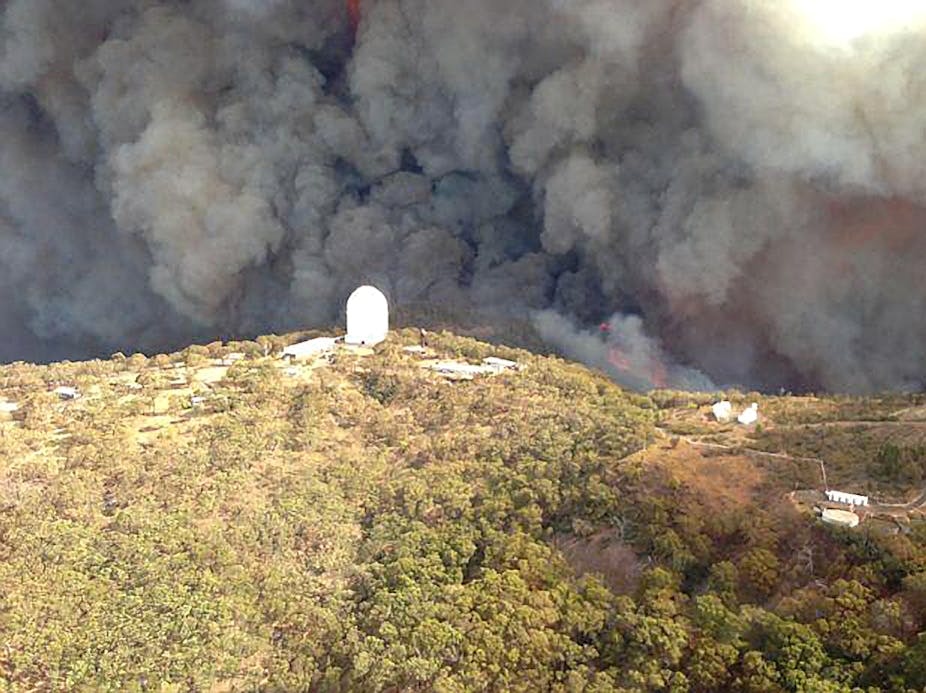
Australia’s biggest astronomical observatory was burned in a bushfire near Coonabarabran in Western NSW overnight, threatening over $100 million worth of research infrastructure and the largest optical telescope in the country.
All 18 staff were safely evacuated from the Siding Spring Observatory (SSO) in the Warrumbungle Mountains at around 4pm yesterday and the facility will be closed for the next fortnight, according to a press release issued by the Australian National University, which operates the Observatory.
“The priority at this stage is the safety and wellbeing of staff and their families, a number of whom have lost their homes in the fire,” the university’s statement said, adding that among the facilities damaged were the the Lodge that housed visiting, a number of cottages, sheds and the Visitors Centre.
“An initial visual assessment indicated that no telescopes appear to have received major damage, but the impact of the fire on the instruments will not be known until later today,” with senior staff and a counsellor scheduled to travel to the site this Wednesday.
While the ANU’s assets are covered by insurance, the university is considering an emergency appeal to support affected staff and their families, the statement said.
The telescopes at the SSO include the 3.9m diameter Anglo-Australian Telescope (AAT) of the Australian Astronomical Observatory, the largest optical telescope in Australia, the ANU’s Skymapper telescope and the Uppsala Near Earth Object Survey Telescope.
ARC Super Science Fellow at the Australian Astronomical Observatory Dr Amanda Bauer, who uses the 3.9m AAT telescope for her research, said that initial reports from investigators on the ground were that all telescopes survived the fire.
“The telescopes look like they are OK, there’s no obvious damage to the outside of the structures,” said Dr Bauer, who live blogged the fire at her personal website.
“There were measures taken to protect the facilities, especially in light of the Mount Stromlo fires 10 years ago,” she said, referring to the destruction of the Mount Stromlo Observatory in the 2003 Canberra bushfires.
“There have been some controlled burnings over the last six months that may have helped the situation,” said Dr Bauer.
Nobel Prize-winning astronomer and ANU professor Brian Schmidt said that the Skymapper telescope had survived the fire.
“There will certainly be some damage, especially to the conduits and stuff on the outside. I don’t I don’t think they will be operating tonight,” he said.
Dr Schmidt described the SSO as “the nexus of Australian optical astronomy.”
“It contains all of our forefront facilities. It’s responsible for training probably over half of all Australian astronomy students and there is more than $100 million worth of infrastructure there,” he said, adding that measures taken to minimise the risk from bushfires had helped save the SSO from wholesale devastation.
“It was going through and cleaning out some of the trees, putting fire safe screens on every window, using fire retardant paint everywhere, a whole range of measures,” he said.
Monash University astronomer Dr Michael Brown said that webcams at the site recorded photos of the fire as it approached the Observatory.

“The webcams are normally there to keep an eye on the weather or see if a remotely controlled telescope has malfunctioned,” said Dr Brown.
“Most of those webcams stayed operative as the fire went through but at one stage the Rural Fire Service sent out a message saying don’t increase the traffic to those webcams because they were using them to monitor the fire.”

Dr Brown said he was “cautiously optimistic” about the state of the telescopes.
“It looks like none of the telescopes burnt down, but it’s possible some of them have damage to their wires,” he said.
“One of the weather stations reported, at one point, temperatures of 100 degree celsuis, but several of the webcams on the site are still functioning.”

Barry W. Brook
Professor of Climate Science, ARC Future Fellow at University of Adelaide
One of the RFS photos shows the Visitor's Centre fairly clearly, and it looks to be intact:
https://fbcdn-sphotos-c-a.akamaihd.net/hphotos-ak-ash3/64913_10151382337105552_1273498246_n.jpg
This event is very personal for me. From age 12 to 18 I lived on the Mountain, and so know the whole area where the photos are coming from intimately. I continued to visit my parents on site until 1997. It is very sad to see spot fires in my old front yard, but from the updated images this morning, all of the resident's houses seem to have survived - at least as observed from the outside.
Unfortunately the Lodge is completely destroyed. However, and most importantly, all of the Telescopes, including the ANU collection, the AAT and workshop, the Uppsala and APT, and UK Schmidt facilities, seem fine! I hope they rebuild the lodge - having onsite facilities is really important to the functioning of SSO.
Bob Buick
Retired medical consultant
I can understand the average voter building a luxury home on a sand-hill on an unstable shore-line, a low-set bungalow on a flood-plain, or an inflammable house in a combustible forest. We all naturally express sympathy and offer help when the inevitable finally happens.
What I can't understand is how supposedly intelligent administrators can locate an expensive scientific installation in a gum forest, without surrounding it without an adequate fire-break. I mean, if they built a boat, surrounded by water, wouldn't they make it watertight? Perhaps I'm missing something here.
Michael J. I. Brown
ARC Future Fellow and Senior Lecturer at Monash University
In fact much work was done to prepare the observatory for fires, and it looks like the bulk of the telescopes have survived. Amazingly, even the internet connections to many of the telescopes remained online throughout the fires.
7.30 interviewed with Brian Schmidt last night and he discussed these points (http://www.abc.net.au/7.30/content/2013/s3669539.htm). Its a good interview and Brian does discuss the location of the observatory too.
I am disappointed but not surprised that the lodge burnt down. I have stayed there many times and (compared to the telescope domes) its design probably made it hard to fire proof.
Bob Buick
Retired medical consultant
Thanks for the extra information. It's not as bad as it seemed. It's like building a boat that leaks, but doesn't sink. The question is whether that's good enough.
Photographs can be misleading, but they seem to show an alarming proximity of inflammable gums to the buildings. It's easy to be wise after the event, but the final arbiter is how complete the protection was and it obviously partly failed. I'd hardly pat myself on the back for that.
Michael J. I. Brown
ARC Future Fellow and Senior Lecturer at Monash University
Some of the photos are misleading if you don't know the site. For example, the trees in the 2nd last image are more than 100 metres in front of the AAT dome.
The loss of the lodge is clearly a bad thing, but it was a relatively old building (1960s or 1970s) located on top of a ridge. Given its location and design, I do not know if it could have been retrofitted to be fire proof at reasonable cost. I also do not know when it caught fire. The webcam images suggest it was on fire several hours after the fire front passed when the observatory was still cutoff from nearby towns.
John Nicol
logged in via email @bigpond.com
While it is good to know that only the accommodation at Siding Springs and not the more valuable telescopes themselves, were burnt, it beggars belief that, after the death and disaster in Victoria, the destruction by fire of the valuable, tax payer funded, telescope at Mt Stomlo, the burning of homes in Canberra, that more complete precautions beyond a couple of coats of paint, were not taken to preserve a $100 m facility.
The removal of sufficient trees in the surrounding bushland to ENSURE…
Read moreMichael J. I. Brown
ARC Future Fellow and Senior Lecturer at Monash University
More complete preparations were made than just a few coats of paint. For example, there was (approved) removal of some trees and screens were fitted to windows. This was discussed during Brian Schmidt’s interview on 7.30 (http://www.abc.net.au/7.30/content/2013/s3669539.htm).
The site was evacuated during the early afternoon and people did not return to the site until the following morning. Thus far it looks like all the major telescopes are OK, and (remarkably) many internet connections on the mountain remained online throughout the fires. This is good news. However, there clearly were some failings (e.g., the loss of the lodge) and I am sure the ANU and AAO will learn from this and make improvements for (inevitable) future fires.
John Walker
Project Manager - Security
Just wondering if the complex has a site specific Risk Management Plan.
AND what are the approved procedures in the plan to mitigate the damage of a likely bush fire event? If so, this document should demonstrate that the observatory is genuinely serious about the risks of a major bush fire.
Michael J. I. Brown
ARC Future Fellow and Senior Lecturer at Monash University
I'm not an ANU or AAO staff member, so it is a little tricky for me to track down all the relevant documents.
That said, "The Mountain’s Burning: A case study" is available online at http://facilities.anu.edu.au/index.php?pid=132 and several of the lessons discussed in this document were applied to Siding Spring.
Leonie Moore
student
I am so sorry that this beautiful area has been decimated by fire. I visited the Warrumbungles and Siding Springs Observatory in 2011, and I'm so glad I did so. I hope the observatory can recover quickly, as well as the surrounding areas and the National Park.