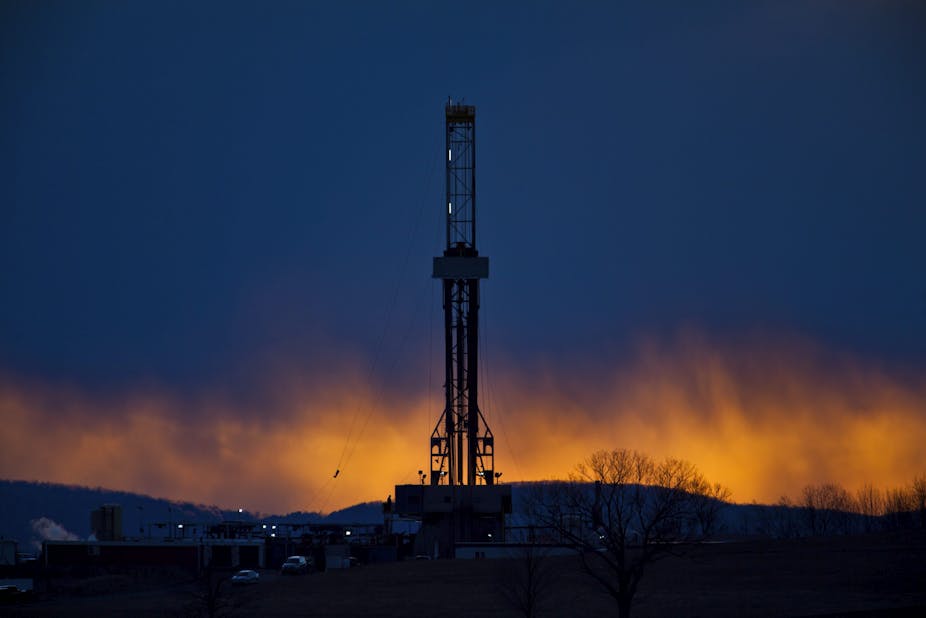
Instead of increased reliance on gas imports expected five years ago the US now has an abundance of cheap gas for domestic use, and is even projecting LNG exports. Reliance on oil imports has fallen from a peak of 60% (2005) to a current 45%; by 2040 it’s projected to be 37%. The most recent report of the US Energy Information Administration includes projections that shale gas will supply around half of US gas production by 2040. “Tight oil” will make up about one-third of its oil needs.
These resources are part of a broader category referred to as non-conventional petroleum (NCP) – a category Australia is embracing as well through coal seam gas mining and the Queensland Government’s very recent go-ahead for shale oil mining. The category includes both oil (deep-ocean, on-shore “tight oil”, “heavy oil”, oil from shale and from tar-sands) and gas (shale gas and coal bed methane, otherwise known as coal seam gas).
Technology – including horizontal drilling, sophisticated detection methods, hydraulic fracturing or “fracking” – has been cited as the basis for the supposed “game-changer” of the NCP boom. But at least as important has been the sustained three-fold increase in international oil prices since the early 2000s, and investors’ belief that this price will not soon revert to those earlier levels.
Economic effects
More than a few commentators think the emerging NCP boom will promote US economic recovery.
Any such energy-driven recovery could occur through regional investment multiplier effects, as well as cheap and plentiful gas to lure the return of energy-intensive industries.
Oil imports into the US may be reduced (with possible modest downward effects on international prices), but we could also see large US-bound revenues from its exports of liquefied natural gas (LNG). The latter would be in competition with growing LNG exports from rival suppliers. This includes Australia, which is now projected within a year or two to surpass Qatar as the world’s largest LNG exporter.
In oil markets there is essentially a single world price (correcting for transport costs, grades, sulphur content etc). But gas markets remain regionally segmented. This is reflected in the short term advantage from shale-influenced low gas prices in the US compared with much higher gas prices in the EU and East Asia, where, as a regionally tradable commodity, its price is linked to the high oil prices emerging since around 2004.
However, once the competitive effects of international LNG trade hit the US domestic market for gas, this locational advantage for gas-intensive industries will be eroded. Further, with technology transfer, major expansion of non-conventional gas may not long be confined to the US (and Australia). Similar gas resources are widespread internationally. China’s are estimated as at least comparable with the US, albeit with large technical and environment constraints. The impact of such constraints in the US is considered in the next part.
For all these reasons, some analyses of US LNG export prospects are not so bullish, though others have argued that a fully globalised gas market is decades away.
There is also growth in US export revenues from US coal. This is largely from reductions in US domestic use of high polluting and CO2-intensive coal in its own electricity generation sector, where it has been displaced by cleaner gas-fired capacity. Australia would be a major coal exporting rival, having long been globally about the largest exporter of both coking and steaming coal for electricity generation (but now rivalled by Indonesia), though very far from being the largest producer (which is China).
Geopolitical effects
As already noted, the price of oil (as distinct from gas) is set globally. Further, as David Goldwyn has said:
Reduced oil imports would not provide immunity from supply disruptions. Indeed, as has been seen since the advent of the Arab Spring political upheaval, the effects of useful increases in US production can be overwhelmed by disruptions in producing countries.
Some analysts claim that the NCP boom can be a foundation for reasserting US global primacy. Indeed, a special policy unit has been set up in the State Department in support of enhancing US global energy strategy.
However, such a reassertion of US primacy would have to be within a system of world power that is no longer unipolar (1990, 2003) with the US as ‘global hegemon’. This multipolar trend reflects three factors:
- the “uneven development” implicit in the rise of China and other major G20 states
- the uneven contractionary effects of the GFC since 2008 (adversely affecting the EU and its unity in particular)
- the recent foreign policy mistakes of the US in the Middle East and West Asia.
These latter mistakes have been costly both in fiscal-economic terms and in terms of lost US international prestige. These mistakes in “grand strategy” were in large part bound up with misconceived oil policy, especially in the Middle East.
A US National Intelligence Council report claims that in a multipolar world “power will shift to networks and coalitions”. How this possible shift may impact on Australia’s status as another purported “energy super-power” will be considered in a later article.
If the US NCP boom sustains its macro-economic recovery at a faster rate than some of its rivals and allies, it will enhance US geopolitical power in general terms. But it is unlikely to be an imperial panacea claimed by some.
The NCP boom may also present more particular threats to powers viewed as US rivals or adversaries, notably some OPEC states and Russia, reducing their market power or political leverage.
Among the OPEC states, Iran is by far the major holder of natural gas reserves; it has the world’s second largest proven reserves after Russia. But economic sanctions on Iran, now considerably tightened as a result of US pressure, have precluded gas (and now oil) as a source of such export revenues.
Both China and India have a substantial need for diverse, secure and relatively low-cost supplies of natural gas. Enhanced gas supplies would reduce dependence on coal-fired electricity that threaten the planet’s climate stability, as well as dependence on nuclear power with its acknowledged hazards. Thus it is of global concern that Iranian gas exports are denied to these economies because of tight international sanctions promoted by the US.
As to Russia, expanding US exports of LNG to the EU will undercut its leverage as the EU’s major supplier of gas imported by pipeline. US LNG exports would also tend to reduce Russian export revenues, with an adverse impact on its economy. Hence, Russia is looking for new gas markets in East Asia. The US, in its “new great game” with Russia, to that extent has an interest in diversifying gas supplies to China and the rest of Asia.
In forthcoming articles, Barry will discuss US non-conventional petroleum’s environmental constraints and consequences, and consequences for Australian energy policy.
John Newlands
tree changer
While the US is turning to smaller cars and has restored domestic oil production to 1994 levels I see no way that country can be self sufficient in oil and gas by 2040. The mistake is to extrapolate a blip into a long term trend. With the help of China and India we will have squandered the world's hydrocarbon resources by then and there will be no alternative to zero carbon energy and using less. Meanwhile we will have added tens of billions of tonnes of CO2 to the atmosphere.
For detailed analysis see any of the daily articles in The Oil Drum website. They cover decline rates in 'fracked' wells and US reliance on Canadian tar sands. I think in hindsight these projections will be regarded as wishful thinking that mask underlying anxiety.
Michel Stasse
logged in via LinkedIn
Actually, the US could become self sufficient......... by cutting consumption by 80%!
Lynne De Weaver
Lynne De Weaver is a Friend of The Conversation.
Managing Director
Why do you not mention the impact of CSG mining on water resources? There is a huge environmental input cost that has been totally overlooked in your calculations, especially in light of the growing worldwide food and water shortages. I will certainly look forward to reading your next articles.
Michel Stasse
logged in via LinkedIn
Ah, The Shale Ponzi........ because that's what it is: a Ponzi scheme, aimed at gathering in sucker-investors to boost share prices of oil and gas companies, with the hope that some miracle will occur to make financially broke societies capable of paying three or four times the price for oil and gas than their infrastructure for daily life was set up to run on, back when it seemed to be running OK. This is just not going to happen.
Read moreLet's start with shale gas. The gas is there in the "tight…
Robert McDougall
Small Business Owner
another report talked about the economics of CSg drilling.
Basically, as you mention, the rate of flow and the volume of the resources has been wildly optomistic, with companies becoming highly leveraged to facilitate the drilling side of the industry.
This has resulted in these companies having to keep on drilling just to keep up with the interest expense associated with the debt they needed to take on to expand their production capacity to facilitate the expansion of the industry.
What happens when the economics catches up and these companies go broke? Who do we turn to clean up the mess? Particularly when your looking at the thousands of wells over vast stretches of land.
George Takacs
Physicist
Barry,
Thanks for a very informative article. One point which was not covered was the implications of adding the emissions from exploiting unconventional reserves of oil and gas for our overall carbon budget.
If one accepts the work of Meinshausen, Allen and others regarding how much more carbon dioxide we can emit to have a 75% chance of limiting warming to 2 degrees Celsius (565 Gt), then existing conventional oil and gas reserves by themselves, without coal, are enough to exceed this budget…
Read moreMichel Stasse
logged in via LinkedIn
Good point George. However, as you stated yourself, you assumed that conventional oil can be exploited more cheaply. Fact is, this is no longer the case, which is why we will never see oil below $90 ever again.
Both sources of oil can only see oil prices rising for ever now..... unless demand drops off most dramatically in the event of a full on economic depression occurring. IOW, we are between a rock and a hard place. And raising the temperature further is unthinkable........ surely we can't be THAT stupid...... can we?
Robert McDougall
Small Business Owner
yes, we can, particularly if those making the decisions wont be around or are only interested in monetary return.
We probably aren't able to burn even half of what is identified as reserves without doing a slow roast.
Investing billions in infrastructure to promote the continuing use of fossil fuels is only going to make the situation worse.
We are dealing with the legacy of decades of powerful corporations locked into a shortsighted "returns to shareholder" obsession, without which we would most likely already have the answers to sustainable energy generation.
Barry Naughten
Energy Economist at Australian National University
George
Read moreThanks for your comments. The IEA has been strong in underlining the need to impliment urgently the 450ppm target, equivalent to 2 degrees temperature rise since industrialisation. It projects consequences for the global and national energy sectors with and without nuclear. These projections include a significant 'bridging' role for gas as an alternative to coal-fired electricity. However, this role for gas is viewed as a shorter term expedient in the affluent and high emitting OECD countries…
David Arnault
novelist
Many of the comments are correct about the impact of the US's reluctance to address climate change and their madness in pursuing fracking as a solution. It appears most likely to be a disaster in the making. What hasn't been addressed is the impact on agricultural production and I would direct readers to George Monbiot's article in the Guardian Weekly, October 16, 2012. Starvation on a planetary scale awaits, but such a scenario doesn't figure into the calculations of the economists. Nor does it come into the caluclations of Australia's political leaders. It should.
Robert McDougall
Small Business Owner
My question is that if CSG and fracking tech is such a good, safe, long practiced and environmentally conscious solution, why did it need to be excluded from the US Clean Air Act and Clean Water Act, with the US EPA forbidden from investigating it by Dick Cheney (ex vice president and CEO of Haliburton, the company that designed the tech and does most of the global drilling)
wilma western
logged in via email @bigpond.com
Excellent article and comments,especially those by Michel Stasse.Could Barry and Michel comment on the following questions ?
To what extent is the US shale gas bubble supported by US govt subsidies under so-called self-sufficiency and energy security policies?
To what extent are US-led trade embargoes against Iran backed by US energy companies when the ostensible motives are to punish the Iranian government and deter an Israeli military attack on Iran?
To what extent is Australia's csg gasrush plus pressure for processing plants and other infrastructure motivated by a "get in while the going's good" before The Us and Indonesia start exporting?
Barry Naughten
Energy Economist at Australian National University
Thanks Wilma
Three very good questions. My responses as follows:
(1) The following report to US congress details some relevant subsidies:
Read morehttp://www.jec.senate.gov/public/index.cfm?a=Files.Serve&File_id=def3390e-c933-4420-a076-19f786cd3af0 As to the petroleum extraction sector generally, Obama has committed to removal of tax-breaks to the value of approx. $4 billion annually. My understanding is that this would require Congressional approval so would be blocked by the Republican majority in…
Mike Hansen
Mr
Ray Pierrehumbert, Professor in Geophysical Sciences at the University of Chicago is also skeptical of the "Saudi America" claims.
He reports on a discussion at the last American Geophysical Union conference.
http://www.slate.com/articles/health_and_science/science/2013/02/u_s_shale_oil_are_we_headed_to_a_new_era_of_oil_abundance.single.html#pagebreak_anchor_2
This is the punchline.
"Does all the new American oil give us yet another way to fry ourselves? At 0.1159 metric tons of carbon…
Read moreBarry Naughten
Energy Economist at Australian National University
Mike
Thanks for your comment.
I found your reference to Ray Pierrehumbert's work useful indeed.
I checked out his wikipedia link and uncovered there his short essay from Nature on Jean-Baptiste Joseph Fourier's foundational contribution to the science of the greenhouse effect and the planetary energy balance. It is a great piece of writing. One discovers he is also a specialist in 'snowball earth'.
http://en.wikipedia.org/wiki/Raymond_Pierrehumbert
http://geosci.uchicago.edu/~rtp1/papers/NatureFourier.pdf
Michael Ekin Smyth
Investor
US non-conventional petroleum and gas production is already lowering energy costs in America and helping to power a manufacturing renaissance. It is also altering America's international strategic role in a positive way. Washington now has significantly more room for manoeuvre in a number of regions. But the major impact will not come from US production; it will come from the spread of US technologies.
Read moreIt will be NCP and gas production in other areas, particularly China, Poland and the Ukraine…
Michel Stasse
logged in via LinkedIn
The " lowering energy costs in America" is only temporary. The initial drilling frenzy caused a glut, but already the "off a cliff" depletion rate of fracked wells is pushing the companies involved to the brink of bankruptcy....... and prices are already starting to rise. WTI actually went over $100 this week for the first time in ages....
The drilling costs are high, as are the decline rates ("While some have been able to yield as much as 1,000 barrels a day, the rate then falls off to 65…
Read moreRobert McDougall
Small Business Owner
would be interesting if the economics discussions also included the costs associated with NCP, i.e. aquifer and waterway pollution, increased health costs in the extractive regions, displacement of existing industries, forgone technological development in renewables etc etc.
Michael Ekin Smyth
Investor
The shale gas revolution roles on and it is causing major ructions in the structure of the energy industry.
Read moreRussia's Gazprom, the Kremlin's cash cow, is facing major difficulties. It has had to cut prices in Europe dramatically and it has been forced to cancel the multi-billion dollar Barents Sea development - which was to export gas to the US market. As the US is the world's no. 2 producer, and will soon be the no. 1, there is no market. Alexey Miller, the cocky Gazprom boss who said the shale…