


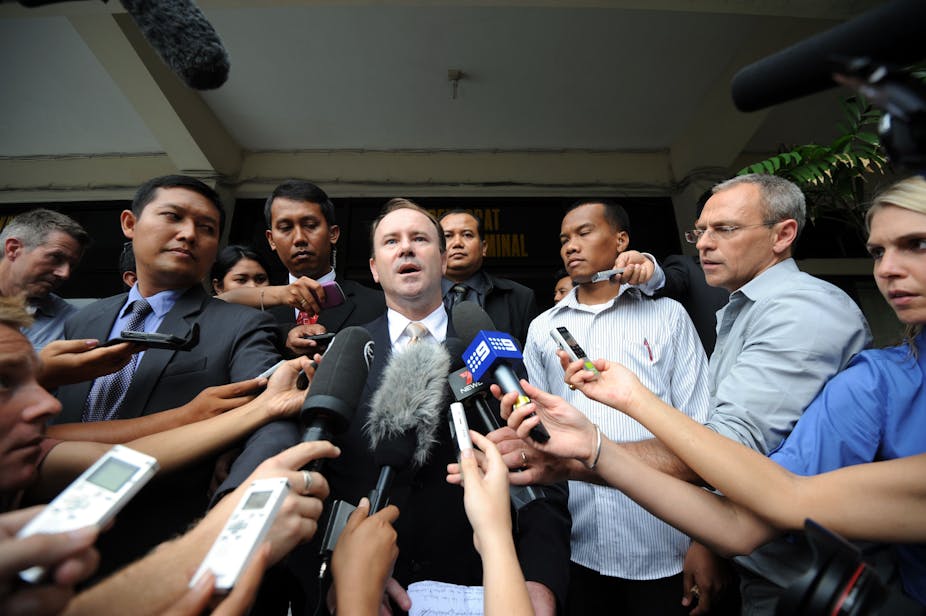
This week the nation has been in an uproar over the arrest of a 14 year old Australian boy in Indonesia, accused of buying drugs.
TV news reports discussed the terrible conditions of the prison, where youth offenders are generally held in the same cells as adults. But after intense diplomatic efforts it seems that if he’s if convicted it’s unlikely he will face the usual prison term and will instead be returned to Australia.
Even the Prime Minister was moved to call the boy and his father, to assure him the government was doing everything possible to help.
In the meantime, the boy is being held in a separate cell from adult offenders, and his father was allowed to sleep in an adjacent office.
Indonesian children
But there is no such care for Indonesian children incarcerated in Australia. As of June this year, the Indonesian embassy estimated there were about 25 Indonesian children being held in adult jails on people smuggling charges.
One child had a birth certificate showing he was just 14 years old. Another report says a boy claiming to be only 16, was detained in Hakea prison alongside convicted sex offenders. These children had not even been convicted yet and were awaiting trial. Surely they could have been held in community detention?
The lack of protection for kids seeking asylum is even worse.
Best interests
Today, the same politicians seeking to protect the 14 year old Australian boy in Indonesia will be voting on an amendment that will allow our government to deport children back to situations of danger and against their best interests.
The recent High Court case throwing out the Malaysian refugee swap arrangements also looked at the Immigration Guardianship of Children Act, and found that unaccompanied children could only be removed on written authority from the Minister for Immigration, which must not be against a child’s best interest.
The Gillard Government’s proposed amendment to this Act removes the barrier of “best interest”, allowing for the deportation of unaccompanied children to places regardless of any potential danger to the child.
Given the community response over the jailing of one of our own children overseas, this is not something we would accept for Australian kids. It is repugnant that the Government thinks we are happy for them to endanger other people’s children.
Immigration minister
Advocates have long called for this Act to be amended, as it creates a direct conflict of interest for the immigration minister. Currently, he is both guardian, jailer and the deporter of children.
Under the Migration Act the minister has responsibilities to detain all unlawful non-citizens in the migration zone, and is the final arbiter of whether a person is granted a visa or should be returned to, for example, Afghanistan.
At the same time, under the Immigration Guardianship Act, the minister is the guardian of that same person if they are an unaccompanied minor, holding that child’s best interests at heart.
It is hard to see how returning an unaccompanied Hazara child back to ongoing conflict in Afghanistan could possibly be in any child’s best interests, yet that is what has happened to children in the recent past.
Amending the act
Since at least 2009 the Department of Immigration has agreed that “the IGOC Act is outdated and not designed for the purpose for which it is now used.”
Two years later and still nothing has been done, yet it took only 1 month to lodge an amendment allowing for the deportation of children.
Changes to law to protect children involve years of waiting – changes to abuse children’s human rights takes merely days.
Malaysian deal
Many have argued that the Malaysian deal is humanitarian as it will stop people risking their lives on asylum boats.
However, as we know that Malaysia has deported asylum seekers back to countries where they have later disappeared, this may be a false justification.
Asylum seekers may not be risking their lives on the seas between Indonesia and Australia, but instead will be at risk of deportation to danger from Malaysia.
The government has argued we need these changes to protect our borders. But if we need to abuse the rights of children, then what is the value of the Australian way of life we are protecting?