

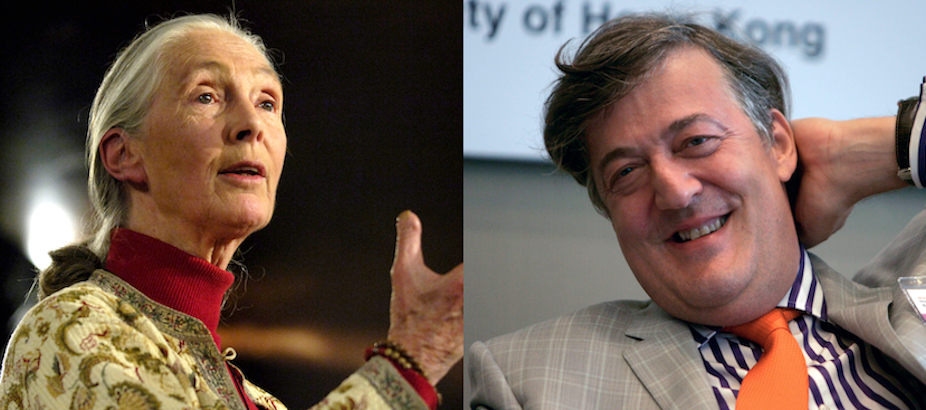
Do you recognise the people in the picture above? They are, of course, Jane Goodall – British primatologist and anthropologist – and the actor, author and comedian Stephen Fry.
Recognising the identity of these people from their faces may have seemed effortless. But for some people, recognising the faces of famous people is very difficult. In fact, such people often fail to recognise the faces of their children, spouse, parents, close friends, work colleagues and sometimes even themselves in a mirror.
This inability to recognise faces is known as “face blindness” or prosopagnosia (from Greek: “prosopon” = “face”; “agnosia” = “not knowing”). Prosopagnosia is not the same as forgetting names (which happens to everyone!), rather it’s the problem of not being able to use someone’s face to determine their identity.
The following quote from David Fine, a prosopagnosic whose story appeared in the British Medical Journal in 2011, illustrates just how severe prosopagnosia can be and the effects the condition can have on mental health, relationships and occupational success:
“I often fail to recognise my children or even my wife … I have failed to acknowledge friends and, more distressingly, those in authority.
At school I would get lines for not raising my cap to a teacher … As a young man I ignored girls whom I had met the night before – not a good mating strategy.
I find networking all but impossible, and social situations, from parties to conferences, may cause acute anxiety… I know other staff members by their uniforms and badges. In party clothes, with different hairstyles, they are strangers to me.”
People with prosopagnosia know they are looking at a face but the face does not convey information about identity. As such, people find they use other cues, such as voice, gait or context, to identify people. To quote David Fine again:
“I memorise hair, jewellery, and favourite clothes. I recognise gaits, tics, and voices … Above all I rely on context: a person of a certain type in our corridor is my colleague — but in the supermarket is probably a stranger.”
People with prosopagnosia can usually see perfectly well, and as such they can often tell other similar objects apart, such as two cars. Many people with prosopagnosia are also able to extract other types of information from faces, such as the expression displayed and the direction of the person’s eye gaze.
In these cases, prosopagnosia is a selective impairment in extracting identifying information from a face.

Acquired prosopagnosia
Some cases of prosopagnosia are acquired, in which a person who was previously able to recognise faces has a traumatic brain injury – such as a stroke – which damages the parts of the brain used to recognise faces.
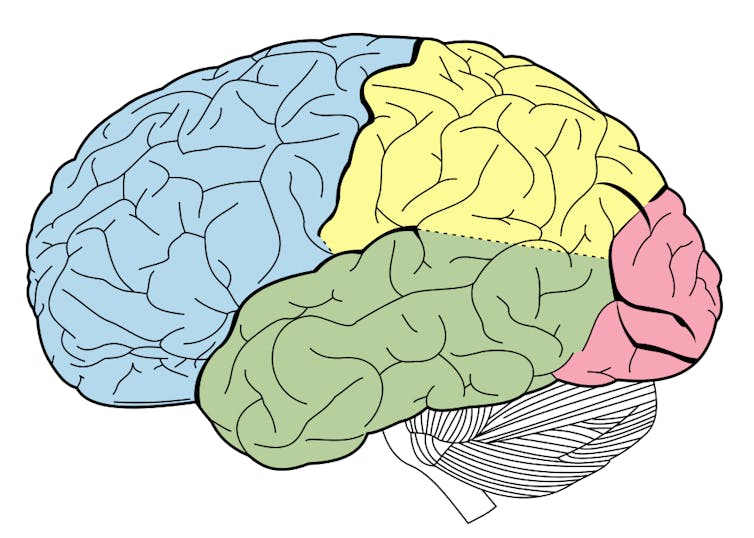
Many brain regions are involved in processing faces, however damage to regions involved in face and object processing in the occipital and temporal lobes (see image below) are most likely to result in prosopagnosia.
Congenital prosopagnosia
Cases of acquired prosopagnosia have been reported in the neurological literature since the mid-19th century. More recently, it has also become apparent that people can also have severe difficulty recognising faces without having a brain injury.
These people have what is known as congenital or developmental prosopagnosia and have failed to develop face identity recognition mechanisms. People with congenital prosopagnosia, such as David Fine, have been unable to recognise faces for as long as they can remember.
There are a number of high-profile individuals who have had lifelong face recognition difficulties. These include popular scientist Dr. Karl Kruszelnicki, portrait painter Chuck Close, neuroscientist Oliver Sacks and, as you may have guessed, the two people in the image at the top of this story: Stephen Fry and Jane Goodall.
In 2007, we established the Australian Prosopagnosia Register where people who suspect they have congenital prosopagnosia are able to register their interest to participate in research.
These people report severe, recurring, everyday face recognition difficulties, such as failing to recognise their child at day care or having difficulty following the plot of movies because they cannot differentiate the actors.
The prevalence of congenital prosopagnosia is estimated at between 2-2.9% of the adult educated population. Given this, it’s perhaps not surprising that hundreds of people have registered with our website, and thousands of people have registered on similar registers in the US and UK.
Thanks to the generosity of those who volunteer their time, we now know that congenital prosopagnosia sometimes runs in families, and therefore may have a genetic basis.
Research has also shown that people with prosopagnosia seem to have difficulty seeing the face as a whole and instead seem to focus on individual parts. Moreover, they may spend more time looking at parts of the face that aren’t that useful for distinguishing between faces – such as the hairline – rather than other regions which may be more diagnostic, such as the eyes.
Research is also beginning to reveal the neural basis of congenital prosopagnosia. And people are working on developing training programs that people with prosopagnosia can use to improve their face recognition.
So next time you see someone and instantly know who they are, consider yourself lucky: imagine if that never happened.
Guy Curtis
Senior Lecturer at School of Psychology and Exercise Science, Murdoch University
I once heard Karl Kruszelnicki talk about his prospagnosia on the radio some years ago. At the time he put it down to his social isolation as a child no giving him the practice he needed to recognise faces at the time when the relevant parts of his brain were developing. Given the more recent research, some of which is linked to in Romina's article, I wonder to what extent his explanation of his own problems in recognising faces would still be considered scientifically plausible?
Romina Palermo
Associate Professor, ARC Centre of Excellence in Cognition and its Disorders & School of Psychology at University of Western Australia
Hi Guy,
Although experience does affect the development of face recognition mechanisms (e.g., children are typically better at differentiating between human than monkey faces because they have more experience differentiating between human than monkey faces), the mechanisms involved in individuating faces are mature early - at least by 3-5 years of age but perhaps much earlier. There is also evidence that children with very little experience with faces are able to adequately recognise faces (e…
Read moreGuy Curtis
Senior Lecturer at School of Psychology and Exercise Science, Murdoch University
Thanks Romina, It didn't make a great deal of intuitive sense to me when I heard him say it. Lots of kids don't have a many peers to play with or a lot of friends but they should see enough people in their environment, from parents, to teachers and other adults that exposure per se is not the problem.
Ian Donald Lowe
Seeker of Truth
Isn't it true Rominia, that very young children, even newborn babies have the ability to recognise their primary carer's face as part of the imprinting process. I think looking at institutionalised children, who have had this link broken might give skewed results and lead to some skewed results.
Indeed, breaking family and social bonds, shortening attention span, increased focus on (false) images of celebrities and a general lack of social skills can all be seen as ways to degrade facial recognition and increase social isolation. One is not seperate from the other in the modern world, wouldn't you agree?
Colin MacGillivray
Retired architect
I am lucky enough to have the opposite ability. I regularly have "fancy meeting you here" experiences. Faces are unique. In forty years of approaching a person who is totally out of context and unexpected, I've never been wrong and embarrassed.
Last time was at an Auckland hotel in January- a bald guy I used to play golf with 29 years ago. I've another 30 examples. I came back to Sarawak to live after 20 years away and have bumped into ten old acquaintances in 3 years. Every face on the planet is utterly different. Sad for those who can't enjoy the fact.
Romina Palermo
Associate Professor, ARC Centre of Excellence in Cognition and its Disorders & School of Psychology at University of Western Australia
Hi Colin,
Just as there are people who are very poor at recognising faces, there are also people (like yourself) who are very good at recognising faces. Richard Russell and colleagues have called people with this ability "super-recognisers".
Colin MacGillivray
Retired architect
My mother was a "super recogniser" though neither she nor I realised it. When I was a kid growing up in London, 50 years ago, she would often spot a celebrity from TV on the bus or at a market. Even saw Prince Charles in Harrods when I was aged about 6. I think most people don't look at faces with an eye to recognising them. There was a BBC doco on prosopagnosia with a London Times journalist featured some time back. Fascinating topic.
John Harland
bicycle technician
I have been able to walk up and introduce myself to people I have only seen in photos, quite confident of the identity of the person. Also remembering people from long ago.
The ability is central to my own self-identity and the lack of it in some people baffles me although a friend is prosopagnosic.
It took her a long time to realise that the two people she had met in different aspects of her life were both me. Without facial recognition, she had not been able to draw the link I had made immediately and had assumed that she had made. It took quite some time to work that out.
Kerri Worthington
housekeeper
I'm also good at recognising faces, and remembering the owners' names. It seems to creep people out, though, like the time I bounced up to someone and announced I'd met her several years earlier in our obstetrician's rooms.
Maybe that's why some people pretend they're really bad at remembering faces/names??
Ian Donald Lowe
Seeker of Truth
Wouldn't it be more accurate to say that very few people are affected by the condition you are describing (prosopagnosia) and the reason why people are so bad at remembering anything specific from the past is nothing less than social engineering and brainwashing via the "flickering images on the cave wall'?
To others, I say; Look at people, in the eyes. Learn their name and remember. Look at the world around you and take it all in, without judgement, without fear and without distractions. Being distracted, unfocused and absent are all ways to drift through life in a dream-state. Full conciousness requires full awareness and that is a process that is being lost and the dream turning into a nightmare.
Ian Donald Lowe
Seeker of Truth
Fifty years ago, knowing and recognising people on sight was not considered a special ability, it was the norm.
Fifty - sixty years ago also correlates (roughly) with the development and release of television into most areas of the world in a meaningful way. (There were sets around before that time but they were expensive and had small screens.) The flickering electronic images have replaced the real world as the primary focus for many people and that could go a long way to explaining this state of mass amnesia that is not prosopagnosia, which is a very rare, very specific condition.
Ask yourself, which is real and which is not. The real world, or the world of television?
terry lockwood
maths teacher
Legend has it that dogs recognise each other through smell more so than visual cues. You mention that we are not so good at differentiating monkey faces compared with human faces due to lack of exposure to the former. Is it possible that other animals use visual clues more than we credit them for simply because we are not tuned in to them?
And what about our ability to distinguish faces from race groups other than our own? Given the very white bread, anglo-saxon world I grew up in, am I likely to have a diminished ability to recognise individuals from other racial groups? The now out-dated 'they all look the same to me' syndrome.
Ian Donald Lowe
Seeker of Truth
The truth is, we have all forgotten who we are and who we are meant to be. It's no wonder that we don't really see ourselves in the mirror sometimes. We have become something we never intended to be and lost ourselves in confusion and the noises of the world. We must keep exercising our memories, we must try and remember and keep reinforcing that memory by being open to new concepts and learning. We must free our minds from the fog and lift our heads to the light of full awareness.
Memory is not lost. It is damaged. It can be repaired and restored.
Jacques de Vos Malan
author
I wonder whether dogs use facial recognition at all? Many dogs I know seem to pay more attention to gait, tone of voice (and presumably scent) than anything else.
John Harland
bicycle technician
Dog eyesight is tuned more to movement than static resolution. This allows them to recognise characteristic movement far better than we can. Together with their excellent hearing and sense of smell as aids in recognising others, there is little reason to suppose that they would have much ability to recognise faces.
Monika Merkes
Honorary Associate, Australian Institute for Primary Care & Ageing at La Trobe University
Apparently some birds can recognise people's faces, e.g.
http://www.sciencedaily.com/releases/2012/06/120622163056.htm
http://www.globalanimal.org/2011/06/29/do-crows-have-an-elephants-memory/44019/
Antonio Manuel Santos Cristovao
logged in via Facebook
If I look to my old photos I don't recognize me.
Michael Lenehan
retired
I can usually cope (but not brilliantly) with recognising most people by their faces in the flesh - but when watching a movie I am the most unpleasant person to be with.
I constantly have to ask my wife is that the same person who was on the screen a minute or so ago? I really only enjoy movies where the main characters have totally different colour hair as it's very difficult for me to identify them from their faces alone.
So it would seem on the basis of this ridiculously small sample of one that the other cues (smell, gait, tone of voice, familiarity) are possibly very important for us all when meeting someone "face to face" and may suggest that some people do not work primarily from visual clues in terms of identifying individuals.
Dianna Arthur
Dianna Arthur is a Friend of The Conversation.
Environmentalist
I feel for you Michael, your wife is a far more patient and understanding person than I.
I hate being interrupted during a movie to give an explanation of events.
I also cannot imagine how increasingly difficult our world is to navigate if suffering from this condition.
For example, giving evidence about a crime scene.
Meeting up with friends in public.
Finding that salesperson who was helpful/unhelpful.
And much more.
Ian Donald Lowe
Seeker of Truth
Romina
Wouldn't it be more accurate to say that very few people are affected by the condition you are describing (prosopagnosia) and the reason why people are so bad at remembering anything specific from the past is nothing less than social engineering and brainwashing via the "flickering images on the cave wall", called television in our age?
I would be most appreciative if you could respond.