


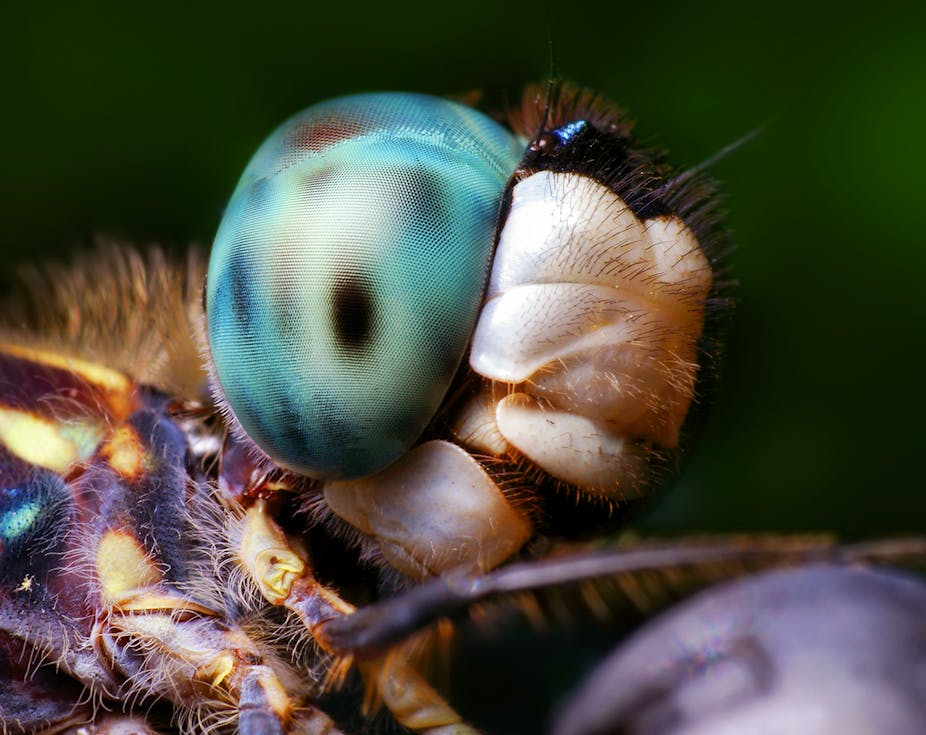
Invertebrates are all around us – crawling, squirming and buzzing about their business. From forests canopies to ocean depths, they form about 80% of the known species on Earth. By virtue of their sheer biomass, invertebrates are the movers, shakers and ecosystem makers of our planet. A one hectare patch of Amazonian rainforest, for example, contains a few dozen birds and mammals, but well over a billion invertebrates – 93% of the animal biomass.
Despite this astonishing abundance, it is becoming increasingly clear that invertebrates are far from invulnerable to human pressures. A recently released report by the Zoological Society of London – Spineless: Status and Trends of the World’s Invertebrates – estimates that one-fifth of invertebrates are at risk of extinction. This is the same as the proportion of threatened vertebrates. However, vertebrates’ plight receives vastly more attention.
It is worrying that invertebrates appear to be following the same path towards extinction as vertebrates – largely without us even noticing.
Not only do we risk losing a large component of the natural world, we are also depleting the essential foundations of healthy ecosystems upon which humans depend. Almost every marine fish that forms part of the human food chain will have fed on invertebrates at some time during its development. In terrestrial ecosystems, invertebrates perform a vast array of essential functions: they spread organic matter through soils, pollinate crops, and reprocess our waste.
The “Spineless” report reveals that freshwater species tend to be the most imperilled of invertebrates. Approximately 40% of freshwater invertebrate species are threatened by pollution, 26% by dam construction and water abstraction, and 19% by loss of habitat from residential and commercial developments.
Conservation measures to safeguard these species are severely lacking. Poor humans rely on freshwater resources, and failing to conserve these species is letting them down. Filter-feeding invertebrates, for example, play an important role in the ability of freshwater systems to self-regulate. They act as a natural water purification plant by removing phytoplankton, bacteria and organic matter from the water column.
Invertebrate conservation must succeed in the face of many challenges. Their level of diversity is bewildering, and often very little is known about their basic ecology. Many are still yet to be named or described. Complete assessments of the highly species-rich invertebrate groups is prohibitively time consuming and costly. This is particularly true in light of the current threat level, which necessitates that information be obtained as soon as possible.
But for all the difficulties facing invertebrate conservation, there are also many opportunities. A ten hectare reserve is too small for a viable population of vertebrates, but is often enough to sustain a large breeding population of an invertebrate species. Off-reserve preservation is also extremely cost effective: large numbers of invertebrate species can typically be breed in a laboratory for a fraction of the cost of a single pair of rare mammals.
The key barrier to achieving any of this, however, is getting people to care enough about invertebrates to take these steps.
Beating backboned bias
With a few striking exceptions, invertebrates are too small to really impose themselves upon our senses. And as animals get smaller, our concern for them tends to diminish.
Technology has helped to overcome this bias in spatial perspective. Through the camera lens, it is possible communicate the wonder of the invertebrate world close up. BBC’s Life in the Undergrowth, for example, weaved stunning photography and intriguing narrative to expose millions of viewers to the fascinating behaviour and life histories of invertebrates.
Invertebrates also fail to conform to human aesthetic values. They are often seen as alien and unfathomably “other” – a real hindrance when competing with cute cuddly bears and eerily evocative apes for limited conservation funds.
The “Spineless” report advocates taking a leaf out of the book of vertebrate conservationists by identifying and marketing iconic species – the “insect cheetahs” and “worm rhinos” of the invertebrate world. These flagship species could then be used to drive landscape conservation approaches that aim to cover the needs other invertebrates.
The creation of such invertebrate icons has so far met with some success. For example, efforts are underway to restore critical habitat of the much-loved Monarch Butterfly – now the subject of a feature film - in North America.
But truly engaging people in invertebrate conservation will still require a major attitudinal shift. A tiger beetle is every bit as charismatic as its mammalian counterpart, in its own way.
Building an appreciation for a diversity of life forms, even ones that scurry around on stilt-like legs and cover their prey in corrosive liquid to aid digestion, sounds like a tall order. But by limiting our interest and conservation actions to large and furry organisms, we are neglecting some of the most fascinating animals on the planet.
Filtering out the overwhelming diversity that surrounds us also creates a skewed perspective of the world in which we can’t fully appreciate our own place in an interconnected web of life – so fundamentally dependent upon “the little things that run the world.”