


On 10 December 1992 former Prime Minister Paul Keating delivered his “Redfern Park Speech” in Sydney. Now regarded as one of Australia’s greatest political speeches it was the point at which a Prime Minister publicly acknowledged the largely adverse impact European settlement has had on Aboriginal Australians. As Keating stated in his speech:
“We committed the murders. We took the children from their mothers. We practiced discrimination and exclusion. It was our ignorance and our prejudice.”
At the time the importance of this speech was largely ignored by the mainstream Australian media. However, it took place almost a year after the death of Aboriginal land rights campaigner Eddie Koiki Mabo, and some six months after the landmark decision of the High Court to overturn the legal doctrine of Terra Nullius. In doing so the High Court recognised that indigenous Australians had legal claims against the dispossession of their lands.
The Mabo Judgment as it has come to be known empowered indigenous Australia in a way that had not been possible in previous decades. It gave this community bargaining power and triggered a substantial change in how Aboriginal people were viewed by governments and many corporations, in particular those in the mining and resource industries. The focus shifted from welfare to economic self-determination.
These issues were the focus of the second annual Indigenous Business, Enterprise and Corporations Conference held in Perth on 3-4 December by the Centre for Social Impact (CSI) at the University of Western Australia (UWA).
I was given the honour of being asked to speak at the conference and in doing so I had the opportunity to reflect on the progress in economic self-determination that Australia’s indigenous community has made over the past two decades since Paul Keating gave his speech.
Unlocking the economic potential of indigenous communities
In opening my address I drew upon a book chapter, published in 2007 in the International Handbook of Research on Indigenous Entrepreneurship edited by Leo-Paul Dana and Robert Anderson. The chapter, co-authored with Duncan Ord, who is now Deputy Director General of the WA Department of Indigenous Affairs, was entitled: “Unlocking the economic potential of an Australian indigenous community”.
It focused on a research study undertaken in 2004 that examined the economic contribution of the Noongar people to the West Australian economy. The Noongar people are the traditional owners of the south-west area of Western Australia with lands that extend from Geraldton in the Mid-West to Esperance in the Great Southern regions of the state.
In the introduction we wrote:
“The impact of European settlement on indigenous Australia over the past two centuries has been significant, and largely detrimental. Indigenous communities in Australia are still among the most socially and economically disadvantaged in the developed world despite substantial financial investment by federal and state government authorities in indigenous education, health and housing programs…the collective economic value of this community is significant, but remains trapped in a welfare paradigm when a pragmatic economic approach is required.”
With a population at the time of around 21,000 people, the Noongar was estimated in 2004 to make a contribution of between $500 million to $700 million per annum to the WA economy. This was generated by Noongar households and businesses, with household expenditure alone to be estimated at around $250 million per annum.
Our study recommended that action be taken to create a significant number of Noongar businesses over a seven year period with the aim of helping to unlock the economic potential of the community and create employment. It was funded by the South West Aboriginal Land and Sea Council (the Noongar Land Council) and was designed to facilitate negotiations with the State Government over land rights claims. Although it was completed eight years ago, the study continues to be a work in progress.
When I look today at the status of Australia’s Aboriginal and Torres Strait Islander communities, and reflect on what progress has been made since Paul Keating’s landmark speech, it seems that progress has been painfully slow.
Key barriers to indigenous economic self-determination
Research into indigenous economic development and participation of Aboriginal communities in the mainstream economy highlights three key barriers to economic self-determination. The first barrier is a lack of educational qualifications and skills by many people within the indigenous community. The second barrier is the lack of employment opportunities for indigenous people within their local communities. The third barrier is the marginalisation and exclusion from mainstream society that confronts many people of indigenous background.
This last barrier is perhaps one of the most insidious. As Professor Dennis Foley from the University of Newcastle noted in his paper “An Examination of Indigenous Australian Entrepreneurs”, published in the Journal of Developmental Entrepreneurship in 2003; racial discrimination towards indigenous Australians is so common that it is only acknowledged if it takes the form of physical violence and social exclusion. He quoted from the Human Rights and Equal Opportunity Commission report from 1991 that stated:
“Many Aboriginal people have grown so used to being verbally abused and called by insulting names over the whole period of contact with whites that they tend to focus their complaints upon physical harassment and discriminatory exclusion from social ventures.”
Dennis was also at the UWA CSI conference. His research has highlighted the challenges that face many indigenous entrepreneurs who find they not only face prejudice from the mainstream community, but also from their own community. As one of his case study examples cited in his paper explains:
“I had to buy a reliable motor vehicle for the business, with 95% Bank finance I purchased a small Korean sedan, straight away family stopped talking to me. They thought I was rich all of a sudden and was rude in not sharing this fictional wealth with them. The trouble was I was the first person in my entire family to purchase a new car and they [the wider family] could not understand it. Even today, things are strained. They see me no longer Aboriginal as I wear a tie, a suit and drive a new vehicle. They don’t understand.”
Addressing prejudice is a complex issue that is likely to require a generational change before any significant improvement can be seen. However, an improvement in the socio-economic status of the indigenous community through enterprise and entrepreneurship will go a long way to breaking down some of these barriers.
Indigenous business ownership and employment
The Australian Bureau of Statistics (ABS) estimates that in 2006 there were around 6,800 indigenous Australians who worked in their own business. This represents about 6% of the total indigenous population. It compares to the non-indigenous community where 17% of the population are owner-managers of their own businesses.
Statistics on Aboriginal employment are revealing. About 40% of the indigenous workforce has part-time employment and 60% work in low-skilled jobs. As shown in the figure below, the labour force participation and unemployment rates amongst indigenous Australians over the period from 2002 to 2008 improved substantially. However, compared to the mainstream community, indigenous Australians experience much higher rates of unemployment and underemployment.
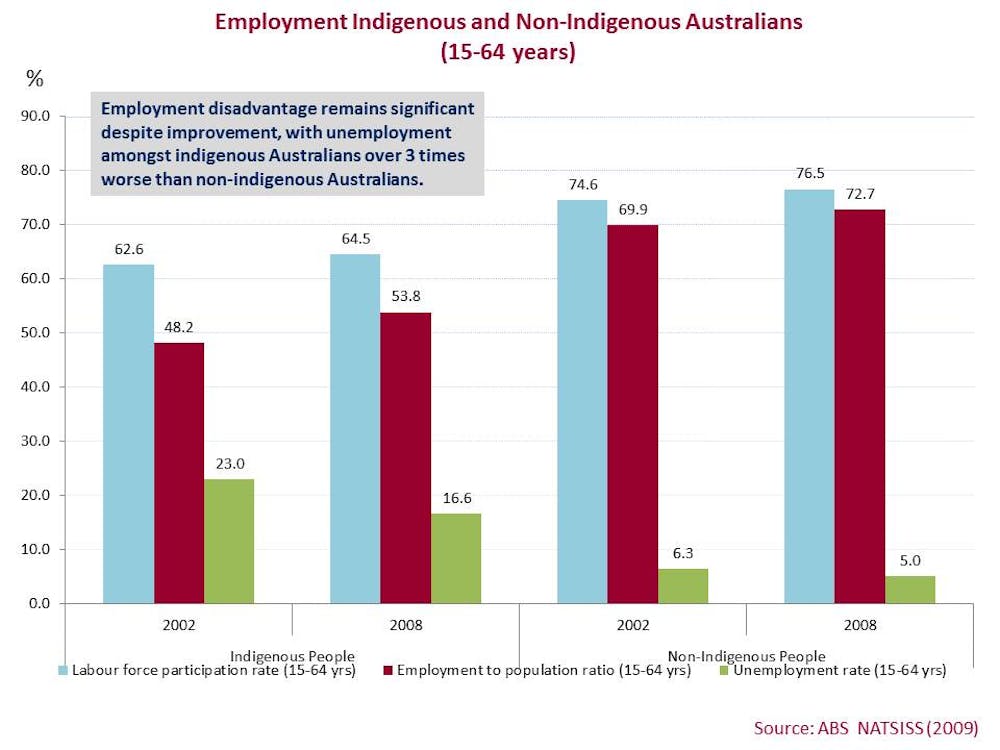
This data suggests that while unemployment within the broader population was only 5%, it was around 17% for indigenous Australians. Economic self-determination and the emergence of indigenous entrepreneurs are less likely to emerge from within a community that suffers from high unemployment. It is from the experience gained in paid employment that many entrepreneurs develop the skills and ideas for future ventures.
Educational disadvantage
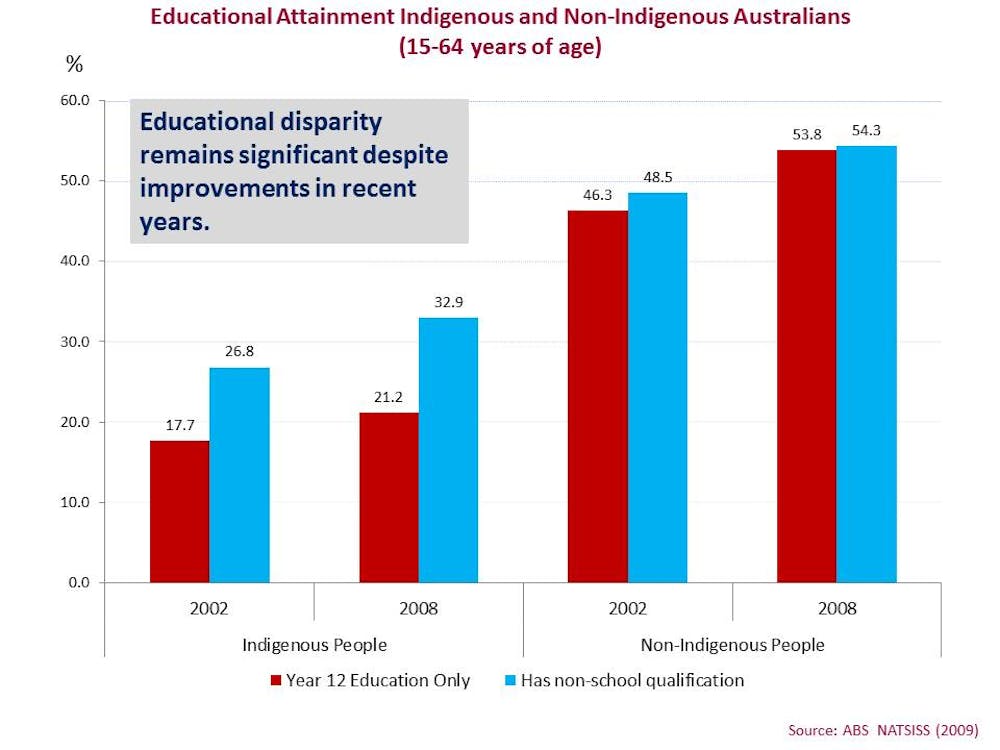
In addition to the need for better employment prospects, the indigenous community in Australia suffers from low levels of educational attainment. As illustrated in the figure below, the proportion of indigenous people completing Year 12 or post-secondary qualifications has increased significantly during recent years. However, the relative educational disparity between indigenous and non-indigenous people remains substantial.
Raising the start-up capital
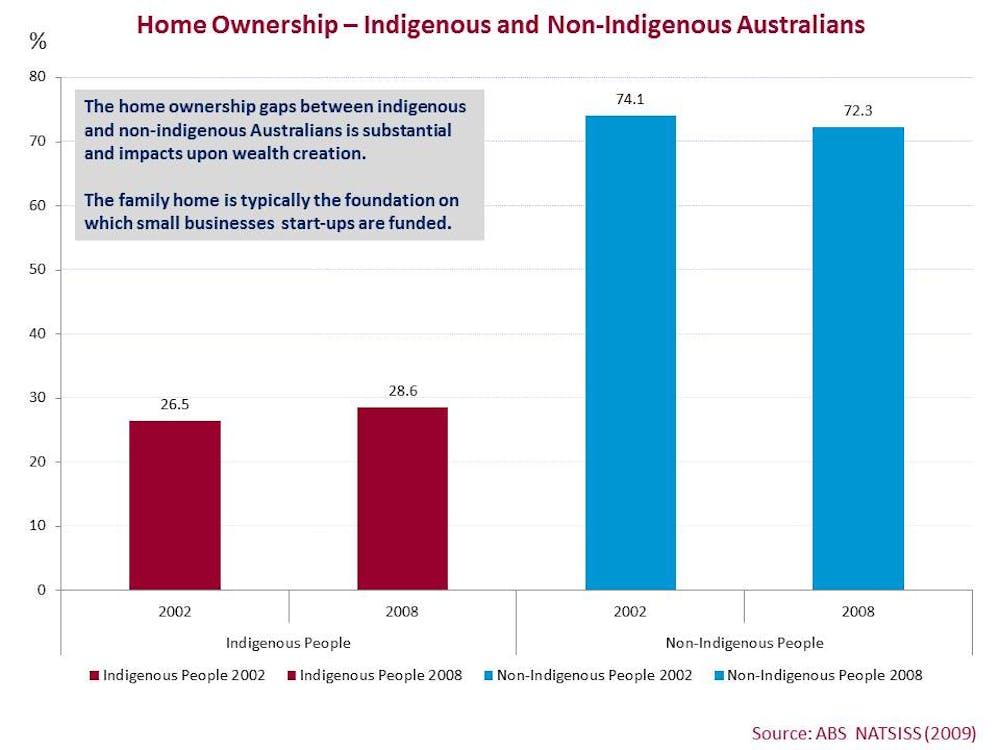
Another area of concern is the relatively low level of home ownership amongst indigenous Australians. As shown in the following graph, even though home ownership levels have increased for indigenous people, they lag substantially behind the wider community. This has implications for indigenous entrepreneurship because it is often the equity in the family home that many entrepreneurs use to help fund their new business ventures.
A further indicator of the challenges facing indigenous enterprise is illustrated in the diagram below. This is a question from the ABS survey of indigenous communities and asks how easily a person could raise $2,000 within a week if required. As shown, 85% of non-indigenous Australians felt that they could easily raise this level of money in a week if required. By comparison only 46% of indigenous Australians could do this.
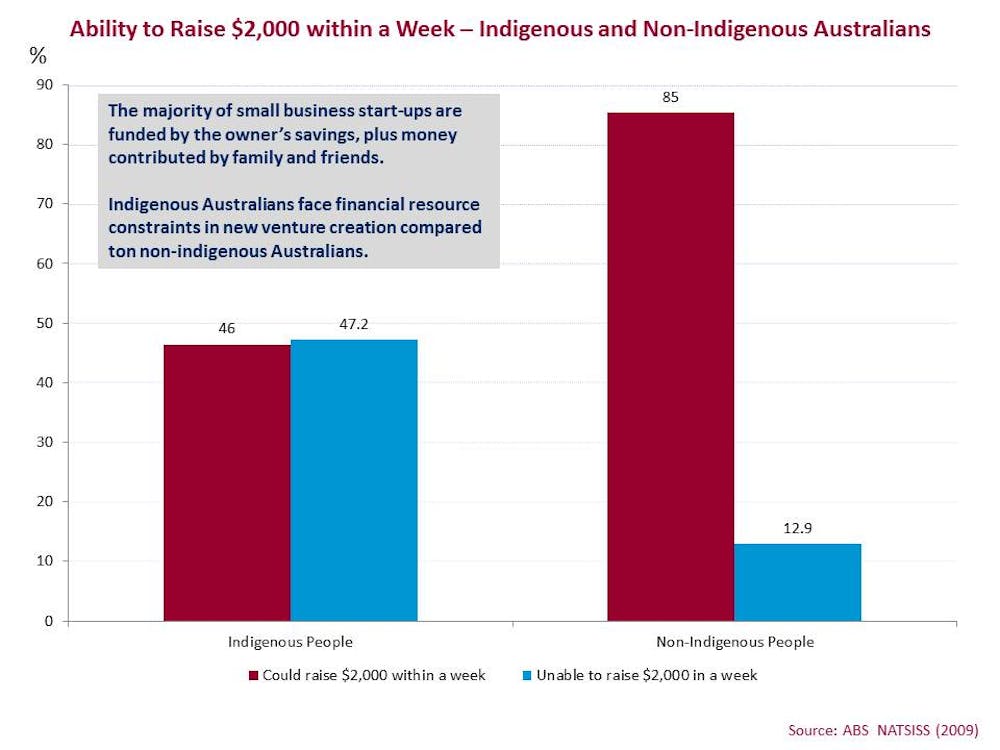
The ability to quickly raise cash of this kind is a potential measure of how readily a community can find the necessary working capital to help fund a new business venture, or support the cash flow requirements of an existing small enterprise. Once again, this data highlights the challenges facing indigenous entrepreneurship.
Indigenous entrepreneurship – searching for brave spirits
Another of the speakers at the UWA CSI conference was Professor Kevin Hindle, CEO of the Mentor Entrepreneurship Group. Professor Hindle’s speech focused on the emerging field of indigenous entrepreneurship. Having built a distinguished academic career in entrepreneurship, Kevin has devoted much of time over the past decade to advancing the cause of indigenous economic self-development through enterprise. This has involved travelling the world as well as the more remote regions of Australia, visiting indigenous communities and seeking to build models of enterprise that can be applied in a useful way by these people.
In 2005 he published a paper with co-author Michele Lansdowne in the Journal of Small Business and Entrepreneurship entitled “Brave Spirits on New Paths: Towards a Globally Relevant Paradigm of Indigenous Entrepreneurship Research”. A key finding from this paper was the critical importance of cultural heritage to the study of indigenous enterprise and entrepreneurship. This was a point he highlighted in his talk at the CSI conference, and it is summarised in the concluding paragraph of his paper:
“The major lesson learned in this study was that Indigenous entrepreneurs can use their heritage—they don’t have to lose it when they set out in pursuit of venture success. The Dreaming in Australia, the realm of the Great Spirit in the Americas and all Indigenous spiritual and cultural traditions, wherever they are found, can be positive entrepreneurial forces. These traditions offer not a closed book of immutable scripture, but an open universe of continuous possibility.”
The opportunities of indigenous entrepreneurship are real and there are numerous best practice examples from Australia and other countries such as Canada, New Zealand and the United States. However, there must also be recognition that Aboriginal communities face significantly greater barriers than their counterparts in the mainstream community. Twenty years after Paul Keating’s Redfern Park Speech and the Mabo Judgment there remains much that Australia still needs to do. As Duncan Ord and I noted in our book chapter:
“The social and economic disadvantage of indigenous Australian communities blights an otherwise admirable economic and social track record for Australia, and poses a major long-term challenge for the nation. Failure to address the problems of the Australian indigenous community will result in further social and political dysfunction within the national psyche and serve as a cancer within the body politic. Economic self-determination via employment, enterprise and entrepreneurship is a key to the long-term reconciliation of indigenous with non-indigenous Australia.”