I would wager that if an average citizen from Athens of 1000 BC were to appear suddenly among us, he or she would be among the brightest and most intellectually alive of our colleagues and companions, with a good memory, a broad range of ideas, and a clear-sighted view of important issues.
So Stanford geneticist Gerald R. Crabtree begins back-to-back Forum pieces for Trends in Genetics, entitled “Our Fragile Intellect” (Parts I and II). Crabtree’s thesis: humanity is “almost certainly” losing its superior intellectual and emotional capacities.
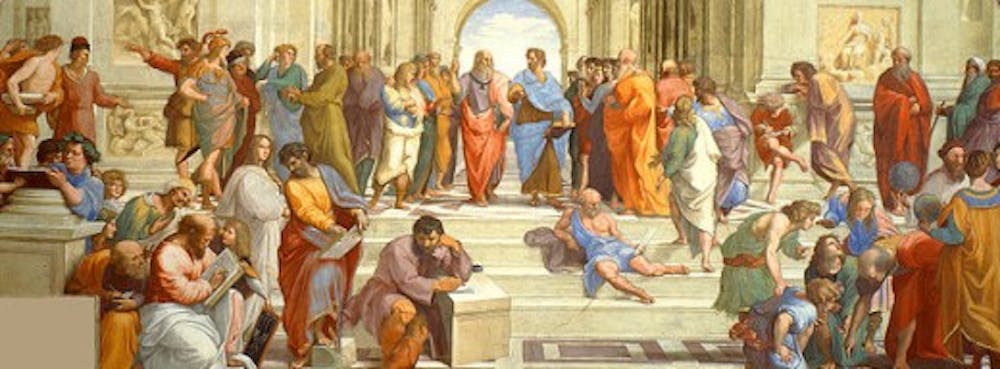
Crabtree doesn’t seem to be arguing for the intellectual vibrancy of the Akademia or the Lyceum. These places, and their celebrated occupants like Plato and Aristotle graced Athens only 600 years later, well beyond Crabtree’s inferred date of humanity’s intellectual zenith.
And he doesn’t confine himself to Athens. “I would also like to make this wager”, he goes on, “for the ancient inhabitants of Africa, Asia, India, or the Americas, of perhaps 2000-6000 years ago.” He’s arguing that humans – throughout the world – have been steadily losing their marbles for the last three to six millenia.
Well, Professor Crabtree, I’ll see your Athenian intellectual Titan. And I’ll raise you a bottle of 1998 St Henri and a $100 book voucher.
I’m not at all opposed to expansive predictions. But they should be tempered by critical thought. And wherever possible they should be reformulated as hypotheses and tested. Crabtree makes a few predictions that should, with progress in genomics, become testable. But it may surprise you to learn that his argument for why our intellect is fragile doesn’t stand basic scrutiny.
So many ways of being dumber
Crabtree’s main point boils down to this: human intellectual function depends on the action of lots of genes. In Part I, Crabtree briefly reviews the evidence that more than ten percent of all human genes – 2000 to 5000 in all – contribute to human intellectual and emotional function.
These genes don’t simply each contribute a tiny bit to intelligence, with the genetic component of any individual’s IQ being the sum of all these minute contributions. Instead, they interact “as links in a chain, failure of any one of which leads to intellectual disability”. The idea that various genes interact is far from controversial. But the case that breaking any one of these genetic links can be catastrophic does not compel me. I am sure that many crucial genes behave this way, but I would be staggered if every one of the 2-5000 was quite so brittle in its functioning.
With so many genes involved, it becomes a mathematic certainty that in the 120 or so generations since the pre-Golden-Age bronze-age “golden age” of the Athenian intellect, “we have all sustained two or more mutations harmful to our intellectual and emotional stability”.
There is some serious genetics behind this argument, and while the conclusions might not follow as crisply as Crabtree argues, it makes for an interesting read on the big-picture state of intelligence genetics. But would selection not have eliminated most of those mistakes?
Crabtree recognises that his case for genetic fragility of the human intellect conceals a flaw: if the human intellect is so fragile, then how could it have evolved to reach the mythic Olympus it inhabited 3000 years ago? In Part II, Crabtree lays out his theory for the main selective forces that shaped human intelligence, and for how changes in the last few thousand years have relaxed that selection. “Extraordinary natural selection”, he argues, “was necessary to optimize and maintain such a large set of intelligence genes”.
And where did that selection come from? Crabtree has some ideas: Errors of judgment. Inability to comprehend the aerodynamics and gyroscopic stabilization of a spear while hunting a large, dangerous animal. Finding adequate food and shelter.
In short, selection happens as a result of not dying. In the kind of world in which merely prevailing over the elements, slaying the occasional mammoth and keeping warm on a cold evening ensured success. The “Survival of the Fittest” world beloved of Darwin’s early supporters. And by creators of museum dioramas.
Which explains why Crabtree thinks humanity’s slide began three millenia before Big Brother even started filming. Agriculture and high-density living, he argued, in selecting for immune resistance to epidemic diseases might have softened selection on intelligence. And that living communally probably reduced the relentless selection by buffering our ancestors from mistakes in judgement and comprehension.
The idea that group living dimmed the harsh selection on day-to-day survival skills intrigues me, and certainly merits testing. But to suggest that this was the end rather than a Renaissance for selection on intelligence reflects a narrow view of how selection works, particularly in humans.
Selection – a social and sexual situation
When The Conversation editor, Matt de Neef drew my attention to Crabtree’s articles last week, I was preparing a keynote talk at the Applied Linguistics Association of Australia conference in Perth on the evolution of language. While the deep evolutionary causes by which human capacity for language emerged remain murky and contentions, the ways in which we use language today reveal a lot about the forces that have shaped and embellished our capacity for speech, and for writing and comprehending it.
As societies grew larger and more complex, our social worlds grew apace. More people to interact with every day, to speak with, to manipulate and to avoid being manipulated by. More people to court, and more ardent and eloquent suitors to thwart (or accept). The skills that made our ancestors successful shifted; from survival Bear Grylls style to navigating sexual, social and status complexity Sex and the City style.
A few days ago Jason Collins, made exactly this important point in his excellent blog Evolving Economics:
The problem is that Crabtree does not see sexual selection as an “extreme” selective force, when it is. Consider Wade and Shuster’s estimate that sexual selection accounts for 55 per cent of total selection in Homo sapiens. Or take Greg Clark’s data from A Farewell to Alms, with the rich having twice the children of the poor. The link between resources and reproductive success is strong across societies, and assuming a link between resources and intelligence (which if anything appears to be getting stronger), the intelligent have been reaping a reproductive bounty for some time. For those less fortunate, survival without reproduction is still a genetic dead-end.
Humans are complex animals. Our intelligence is a complex adaptation. And the diverse and surprising ways in which we use it today suggest that we owe it to more than a handful of simplistic evolutionary scenarios. Recent evidence suggests that the advent of farming did not halt the course of natural selection, but rather that it diverted it. From where we stand it is almost impossible to discern what directions human evolution, including the evolution of our intellects, might currently be taking.
But I would gladly wage that if humanity is getting dumber it isn’t via natural selection.
Dale Bloom
Analyst
I tend to think there has been a loss of basic survival skills in many societies.
It really takes minimal thought and minimal skills to get food from a supermarket shelf.
On the issue of intelligence vs evolution, there would be cause for alarm, as feminism seems to have upset the balance substantially. Graduate women generally have less children than non-graduate women, and many corporate high-flyer women have no children at all.
The meek shall inherit the earth still holds true.
“Of…
Read moreRoy Niles
logged in via Facebook
Intelligence is not determined by the presence of a particular gene as much as it is by the strategies that they carry and that evolve over time from our experiences. We don't seem to have the same needs in modern life for the type of individual intelligence that the Greeks did. And when we do, we don't have the daily opportunities to effectively use it. In many ways our superstitions, that seem to have become almost instinctive, are worse than theirs.
I'm speaking of course of the intractability of such as Christians and Muslims generation after generation. Very hard for new thinking strategies to become at all instinctive in that cultural milieu. More likely the opposite is happening.
Craig Savage
Professor of Theoretical Physics at Australian National University
There is data on this for the last 100 years or so, and this reveals the Flynn effect: that IQ scores on standard tests have been steadily rising.
Flynn has written extensively on this, most recently: Are we getting smarter, James Flynn (2012).
Roy Niles
logged in via Facebook
Unfortunately these tests measure more of what you've been taught and learned to think than what you're capable of understanding or analyzing on your own.
Roy Niles
logged in via Facebook
Not that we might not have turned the dumbness corner and are getting smarter again. But our US Republican party members drift to a new low in smartness would belie that.
Franco Donatelli
Public Servant
Absolutely right, but the Flynn effect is actually so marked (something like a point of IQ every 3-4 years) that it's unlikely to be primarily caused by genetics. Environmental factors would be more likely to cause those significant impacts over relatively short timescales.
Rob Brooks
Rob Brooks is a Friend of The Conversation.
Professor of Evolutionary Ecology; Director, Evolution & Ecology Research Centre at University of New South Wales
Crabtree did have a box on the Flynn effect. He was quite dismissive - suggesting it is all about "teaching to the test" and the removal of lead paints etc which had bad effects on children's IQ performance and intelligence. I think he was too dismissive, but I didn't have space to discuss this further.
I agree with Franco that Flynn effect changes are too quick to be due to gene frequency changes, but they could arise from environmental effects or interesting (and largely undiscovered) interactions between genotypes and environments.
Chris Lloyd
Professor of Business Statistics, Melbourne Business School at University of Melbourne
Interesting and witty article.
However I was not completely clear on what was being claimed in the last section. Is it an empirical fact that richer people have more children? So that natural selection for Smartness is still with us? If so, is this an argument for making it harder for the poor to have kids???
Rob Brooks
Rob Brooks is a Friend of The Conversation.
Professor of Evolutionary Ecology; Director, Evolution & Ecology Research Centre at University of New South Wales
Throughout history, but especially in the 10,000 years since agriculture arose, wealthy and powerful people have left more surviving descendants, on average, than the poor and the powerless. Wealthy men and (sometimes) women could attract the best mates, hire people to help, and they could always afford to eat and keep relatively good sanitation. And intelligent people tended to be more wealthy and rise to positions of high staus.
That such a pattern existed in the past is no guarantee that it does so now (although Jason Collins was arguing that the intelligence-wealth connection is probably stronger now than ever), or that it will in the future.
The past patterns arose incidentally. They are not enforced or coerced. And there could be no evolutionary justification for mandating who breeds and who doesn't, even though we can predict who will and who won't.
Geoff Ebbs
logged in via Twitter
The rise of the book, saw the loss of the ability to remember and quote epic poems, but a huge expansion in the overall body of knowledge. We can extrapolate that to all technologies spectacles, calculators etc. Yes, the gene pool is not being sharpened up in the way that it was without these crutches, but as a society we are getting much smarter.
As individuals some of us are smart enough to keep inventing and managing the technology, so some of us are much, much more finely tuned than the visiting Athenian would be.
Roy Niles
logged in via Facebook
They built the Parthenon.
Rob Brooks
Rob Brooks is a Friend of The Conversation.
Professor of Evolutionary Ecology; Director, Evolution & Ecology Research Centre at University of New South Wales
Good points. I think Socrates was apparently virulently opposed to writing because he expected it would lead to the atrophy of memory and all the old-school skills he held in greatest regard. An attitude some colleagues of mine take to smart phones and Wikipedia.
Peter Ormonde
Peter Ormonde is a Friend of The Conversation.
Farmer
So - you reckon the advent of farming did not bring evolution to a shuddering halt eh? You come down to the front bar of the Croesus and Fiddle and watch Woolibuddha's finest getting themselves legless of a Friday Saturday and many days in between. Not so much has farming stopped evolution as hurled into reverse Mr Rob.
Rob Brooks
Rob Brooks is a Friend of The Conversation.
Professor of Evolutionary Ecology; Director, Evolution & Ecology Research Centre at University of New South Wales
And yet, the ability to hold all that Bundy & Coke or Toohey's New and avoid being evicted from the gene pool in a fight or on the drive back to the homestead might well select on some latent intelligence. Like my first VW Beetle, the only "reverse" is a slow slide back down the hill you've just climbed.
Renjit Ebroo
Coach
How does one explain the 20th century which some call the "century of blood"?
How does one explain the fact that one of the most prosperous societies (think Europe) in human history seems to show signs of imploding?
How is this happening despite access to the very best that Western civilization has to offer?
Read moreThe ancient Greeks also had access to the best of human wisdom at the time and yet a time came when Europe, according to some versions of history, had been taken over by "barbarians…
Rob Pike
commenter
From the opening paragraph of Gerald R. Crabtree:
I would wager that if an average citizen from Athens of 1000 BC were to appear suddenly among us, he or she would be among the brightest and most intellectually alive of our colleagues and companions, with a good memory, a broad range of ideas, and a clear-sighted view of important issues.
I'd like to take him up on this wager. What is the probability that the average Athenian citizen of 1000BC could read and write? From wikipedia (https…
Read moreRob Pike
commenter
I basing my comment here that 'intellectualism' has a manifestation through the ability to 'read/write' (and various degrees to reason, etc). Saying that a genetically 'superior' average Athenian can manifest 'intellectualism' given the opportunity to read/write (or reason, etc) will out perform a human of these times is a very 'un-intellectual' manifestation of these times.
Emma Anderson
Artist and Science Junkie
It's pretty difficult not to be impressed with people who come up with atomic-like theories of matter before the magnifying glass was even invented, among many other ancient Greek and other old world contributions.
On the other hand, intelligence is not as simple as science and engineering skills. In all societies there are specialists of all kinds and each kind requires a skill set that has been honed over multiple generations through culture and individual practice. A shaman requires detailed knowledge too.
I raise you one Gardner's theory of multiple intelligences and a dose of internal validity of the measurement tool does not maketh external validity.
Nav Dhami
logged in via LinkedIn
I read this article, and then re-read the last sentence below (from another source):
Read more"Laplace, an ardent believer in causal determinism, in 1814 proposed a super-intelligent entity that would be able to see the entire course of events in the Universe, across all time, if it were given the precise location and momentum of every particle in the Universe. But causal determinism was seriously undermined in the 1920s and 30s, first by Werner Heisenberg’s uncertainty principle, and then by Kurt Godel…