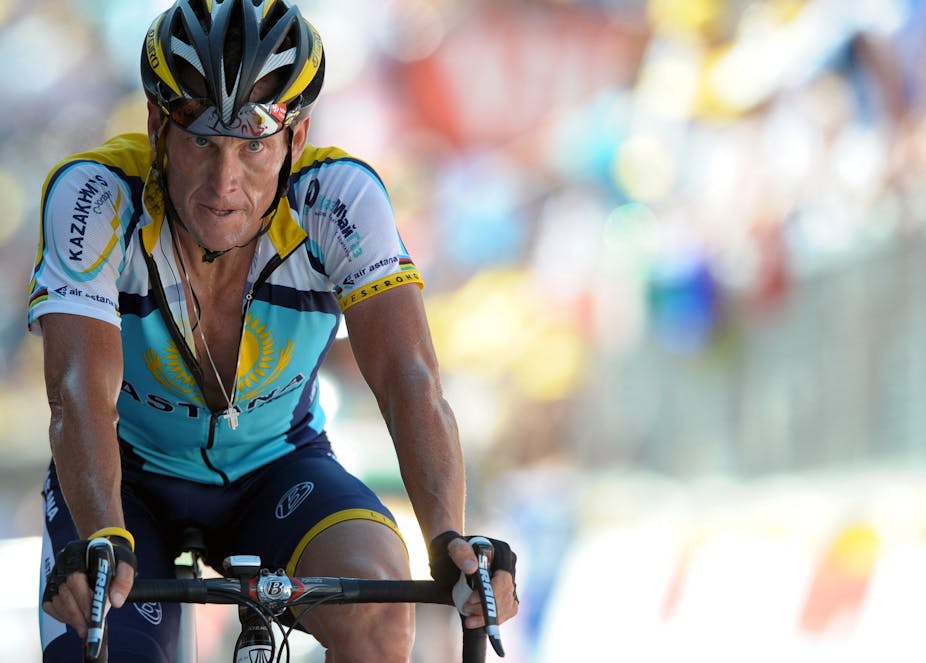
Lance Armstrong was no ordinary cyclist. His was a business model that changed the face of professional cycling, perfecting techniques of media management and being the vehicle by which cycling administrators globalised the sport.
It is no wonder some still go a long way to defend him or simply muddy the waters.
In 1999, when Armstrong miraculously, or incredibly – in the fullest sense of the word – was first on the road in the Tour de France, it was heralded as the Tour of Redemption.
It was a new clean start for professional cycling following the previous year’s Festina tour which saw a number of riders arrested for doping by the French police.
Among the Festina riders arrested was former Australian national road team and current GreenEdge director, Neil Stephens.
Hence, it was with a sense of déjà vu that I listened to Cycling Australia’s President Klaus Mueller claim on ABC News 24 on Saturday that “the scene has changed enormously”.
Mueller, who is also a Melbourne barrister, was at pains to stress the “uncertainty” surrounding the USADA case against the Texan.
The problem for the sceptics, or even the rational, was that the script Mueller seemed to be reading from was the same one the powers-that-be in world cycling have been using to defend Armstrong since 1999.
Mueller bemoaned “how politicised the process has been”, a reference in line with Armstrong’s own claims that he’s been the victim of a “witch hunt”.
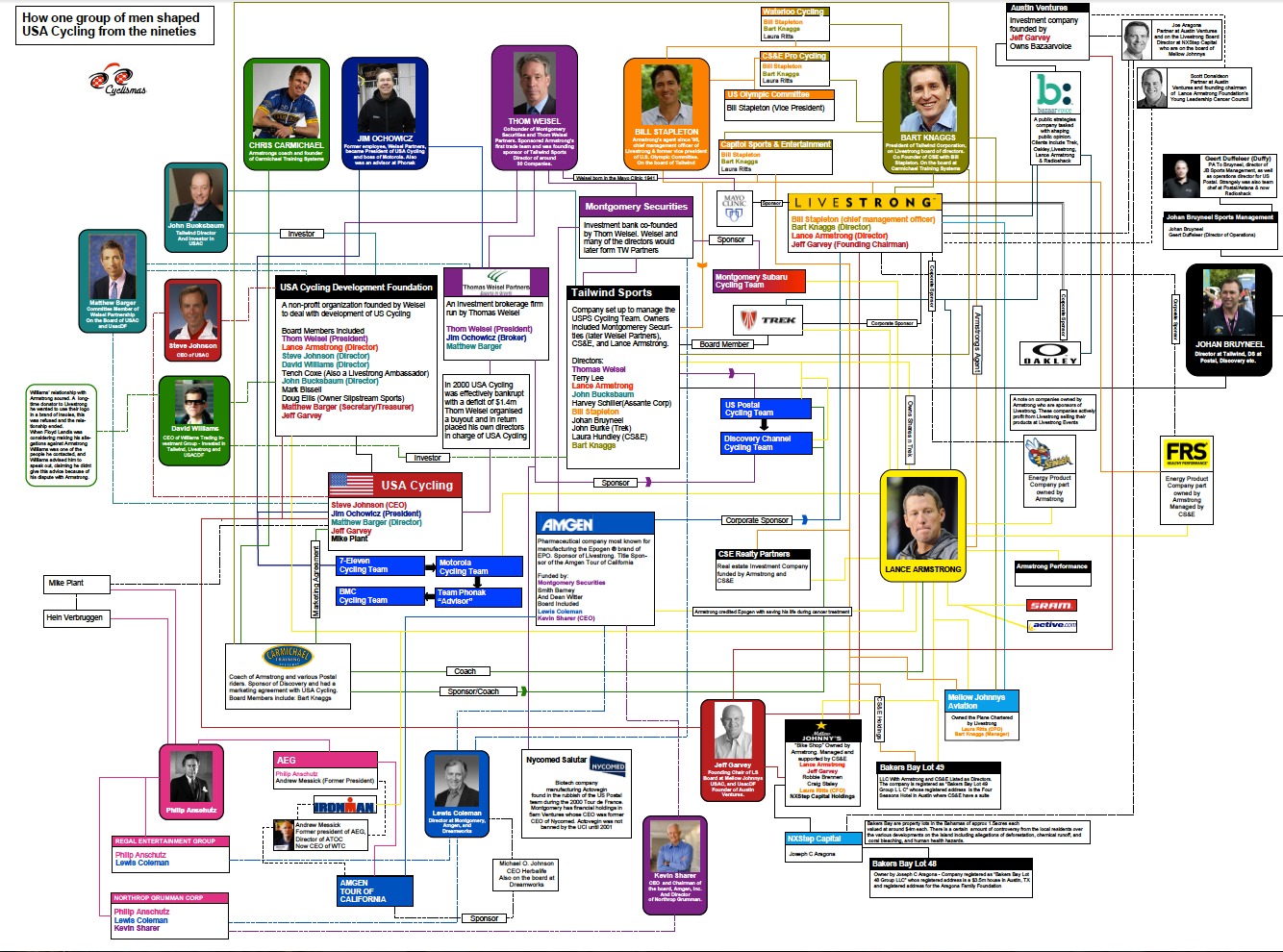
What Mueller ignores, of course, is that it has been Armstrong and former Bill Clinton advisor Mark Fabiani who have politicised the case and exerted political pressure on the US Federal Prosecutors office to drop the criminal case which went well beyond the doping allegations.
In more recent times Armstrong, through his business networks and his cancer business Livestrong, has attempted to lobby politicians to cut funding to USADA.
Mueller’s case was further backed by his claim that the:
jurisdiction of USADA is very unclear and uncertain … that leaves everyone with a question as to the outcome. I am not sure [the USADA] has any jurisdiction … certainly the UCI [Union Cycliste Internationale – world cycling’s ruling body] has that jurisdiction … they should decide”.
Unfortunately, here again Mueller seemed to reading from the script of Armstrong and his allies within the International Cycling Union (UCI). The UCI, who it has been alleged have covered up positive doping tests and accepted payments from Armstrong, attempted to claim in July that they, and not USADA, had jurisdiction in the case.
USADA of course rejected the attack on their jurisdiction. The French Anti-Doping Agency claimed on Saturday that people within the UCI and the International Olympic Committee (IOC) regularly tipped off Armstrong in advance of doping controls so he could take measures to beat the testers.
Speaking plainly
But even if Mueller was still “unclear and uncertain” about the question of jurisdiction, the plain words of the World Anti-Doping Code (WADA Code) and a letter from World Anti-Doping Agency (WADA) Director General David Howman, himself a barrister, should have helped resolve the matter once and for all.
Howman was clear on the meaning of the rules that applied and that WADA did not agree with the public comments made by UCI regarding jurisdiction:
With respect to your [the UCI’s] statements that the UCI has results management authority in connection with the USPS Cases [US Postal Services – the cycling team Armstrong raced for from 1998 to 2004] you have misinterpreted the Code.
Mueller then raised the chestnut of “concern over process” and the “lack of transparency” and that the charges against Armstrong were not sufficient for him to “answer the case” against him.
Along with Howman’s letter to the UCI, which stated the UCI had never complained about the lack of due process in relation to USADA proceedings, there are here two obvious aspects ignored by Mueller.
Only last week a US Federal Court judge dismissed Armstrong’s challenges regarding due process as being “without merit”. In case Mueller missed it, even the Herald Sun reported the story.
The “concern over process” and the “lack of transparency” was based on the fact USADA had not detailed the names of the witnesses and incidents in its original letter charging Armstrong.
USADA had made it clear this was because of fear Armstrong would try to pressure and intimidate the witnesses before the hearing of the case against him.
In 2011 ESPN reported Armstrong had allegedly threatened his former teammate Tyler Hamilton for cooperating with a stalled criminal investigation.
Armstrong has something of a reputation in the media for strong-arm tactics, one of the most famous being his chasing down of the Italian rider, Filippo Simeoni during the 2004 Tour de France after Simeoni had testified in an Italian court case against Armstrong’s cycling doctor and associate Dr Ferrari.
It is also important to note that the same rules that apply to USADA in respect of due process, procedural fairness or natural justice apply to Cycling Australia and the Australian Sports Anti-Doping Authority (ASADA).
But never has Mueller or any other Cycling Australia official raised doubt about any perceived failures to afford natural justice in that process.
Passports
Mueller brought us back to the age-old mantra which, as already noted in passing, has its roots in the 1999 Tour of Redemption: that cycling has been “enormously proactive in fighting the curse of doping in the last seven years, if not longer”.
Mueller cited the example of the introduction of the Biological Passport, a system which analyses the longitudinal (over many years) blood profiles of cyclists in order to detect a probability of the likelihood of doping, as an example of this proactivity.
The Biological Passport was discussed at length in a report I co-authored on doping in Australian cycling and at the New Pathways for Pro Cycling Conference held in Geelong to coincide with the 2010 World Championships.
Prior to that conference I had already foreshadowed the problem of the “cancer” in cycling and Deakin University had offered itself as a space to pursue a way forward – an offer that Cycling Australia and the UCI refused to take up.
It’s maybe interesting to point out in passing that one of the passport’s main proponents and developers Michael Ashenden resigned from the UCI Biological Passport committee because of deficiencies in the process.
Credibility
Is it any wonder then the sceptics still have some trouble swallowing the words of those that administer the sport of cycling? In the end Mueller’s veiled defence of Armstrong raises the problem highlighted by David Howman in the conclusion of his letter to UCI President Pat McQuaid:
By adopting its current position UCI is sadly destroying the credibility it has slowly been regaining in the past years in the fight against doping.
Old networks and alliances don’t appear to die easily.
Further reading:
Lance Armstrong drops his doping fight with USADA – what now?
John Phillip
John Phillip is a Friend of The Conversation.
Grumpy Old Man
Sorry mate, but this reeks of a Lindy Chamberlain type of 'judgement'. All you have to do to convince people that Armstrong doped is to show a SINGLE positive. Repeating rumours and innuendo is NOT evidence.
Martin Hardie
Lecturer in Law at Deakin University
Hi John,
Thanks for the comment. It is always nice to hear from another grumpy old man.
But the Lindy Chamberlain analogy just won't work. You see no one actually saw the dingo do it. In the Armstrong case there is direct witness testimony from ten current and former cyclists that they saw the dingo do it, and they did it with the dingo. Direct evidence from witnesses is the best form of evidence a court could ever have. Especially, if the dingo chooses not to contest it. In such a case the…
Read moreGary Cassidy
"there is direct witness testimony from ten current and former cyclists"
Who are they? Where are they? At the moment your argument is a case of "the police said he did it - so he did it".
If USADA have a solid case they need to release it to the public. This will act as a deterrent to future cheats.
Martin Hardie
Lecturer in Law at Deakin University
Gary, not that is not the situation. It is quite different, using your analogy, here the police said X happened and the accused chose not to contest the charges, and in that situation, there was no need for a public hearing of the evidence. This may well in fact be the strategy of the accused in this case as it is they that have decided not to fight the charges put to them and hence it is they that have chosen to keep the evidence under raps.
But in any event, my story is not about that evidence but about the claims of Mueller that USADA did not have jurisdiction according to the rules.
I have written much that is critical of the system, but in this case the jurisdiction of USADA to do what they did is in now doubt.
I hope that helps.
Martin
Gary Cassidy
"But in any event, my story is not about that evidence but about the claims of Mueller that USADA did not have jurisdiction according to the rules."
Yes, very interesting and informative. Thanks.
John Phillip
John Phillip is a Friend of The Conversation.
Grumpy Old Man
Hey, Martin, thanks for the reply. I am still not convinced of his guilt. When the evidence comes out, which it undoubtedly will, I may have to reassess. Until then it's the word of a group of positive 'testers' against a 7 year champion. Additionally, it seems bizarre that the recollection of these people can be considered reliable 15 years after the alleged first event and unless substantial evidence as to Armstrong's guilt comes to the fore for EACH event, I find it hard to see how he could be stripped of all 7 titles. Is it just done as a 'job lot'?
If Armstrong has his titles removed, who wins those editions of the TdF? Anyways, thanks again.
Endre Iberer
QA Manager
Interesting article which lacks only one thing...evidence! There is no smoking gun here despite your assertions of "eyewitness" accounts.
Even if the consistent doping allegations were true, the fact that Armstrong passed all of the tests means that he kept within the rules as they applied at the time. If you want to change the rules and the testing methods to catch people with smarter chemists that the ruling body, then go ahead but don't try and rewrite history.
Martin Hardie
Lecturer in Law at Deakin University
And it goes on .... If you read the letter from USADA to Armstrong and his co-conspirators you will see the charges. You will also see in the article why all the details of the evidence were not been made public.
But if Armstrong was Australian the rules would mean that he could be found to have broken the rules by ASADA without you even knowing what the charges are or having any idea on what evidence. In Australia these things are kept confidential until any appeal to CAS. So in comparison to here there is a lot more information on the table and a lot more evidence.
But as I say in conclusion old alliances don't die easily - even for the fans.
Mike Hansen
Mr
Martin. Do not assume that all cycling fans have their head in the sand over this issue. Anthony Tan pointed out on this week's SBS Cycling Central (sorry no link - only my recollection) that if Armstrong was disqualified from the 2005 TDF, Cadel Evans in 8th place would be the first rider not tainted by drug charges. Tan was also waving about a chart which I gather suggested that around 40 of the last 70 odd place getters have also been charged at some point.
The problem is that now everyone…
Read moreMartin Hardie
Lecturer in Law at Deakin University
Hi Mike
I don't assume that cycling fans have their heads in the sand. I know very well that many of them do not.
What i chose to write about was not the evidence against Lance, or that cycling fans were not facing up to the issue, but it was the manner in which Cycling Australia's President Mueller had come out on the topic.
I didn't see Mueller's interview live but was alerted to it by a hardcore cycling fan who wrote to me and said it was "disgraceful". That fan was also a lawyer…
Read moreMartin Hardie
Lecturer in Law at Deakin University
Mike
this might help re the evidence and your point about Bruyneel:
http://playtrue.wada-ama.org/news/wada-statement-on-lance-armstrongs-decision-not-to-seek-arbitration/?utm_source=rss&utm_medium=rss&utm_campaign=wada-statement-on-lance-armstrongs-decision-not-to-seek-arbitration
Martin
Ben Koh
Sports Doctor. PhD social Research into Athlete Motivation. ACSM (Health Fitness Instructor and Exercise Specialist). Ex-elite swimmer.
Hi Martin
Great article and good fodder for discourse!
You mentioned "...The Biological Passport was discussed at length in a report I co-authored on doping in Australian cycling and ... I had already foreshadowed the problem of the “cancer” in cycling and Deakin University had offered itself as a space to pursue a way forward – an offer that Cycling Australia and the UCI refused to take up..." and "...But if Armstrong was Australian the rules would mean that he could be found to have broken…
Read moreBen Koh
Sports Doctor. PhD social Research into Athlete Motivation. ACSM (Health Fitness Instructor and Exercise Specialist). Ex-elite swimmer.
By the way, I have just placed an order in Amazon for "Wish I was Twenty One Now: Beyond Doping in the Australian Peloton (Volume 2) "!
:)
Martin Hardie
Lecturer in Law at Deakin University
Ben
My comment about the issues not being public is because in Australia the process within ASADA is confidential. It becomes public only once the Anti-Doping Rule Violation Panel makes a finding and places an athlete's name on the register or for example if they dismiss a case. Even then the evidence is not disclosed publicly. The only time it falls into the public realm is if the athlete takes the case to the Court of Arbitration of Sport.
Thus it makes it very difficult for the public to…
Read moreJohn Harland
bicycle technician
Old emnities die hard, too. Lance has the kind of personality that makes firm friends and fervent enemies.
So we have dope takers whom Lance has crossed up in some way in the past now sinking in the boot, alleging that he did the same.
Still reads like double jeopardy to me.
Also, as Endre points out: was any alleged offense that he doped in some way, or that he exceeded the then-allowable threshold for a substance or process? It does not make sense to ban something that is undetectable with contemporary technology and it is an injustice to apply more-advanced technology retospectively.
You don't win seven Tours de France on dope alone.
Gary Cassidy
"it is an injustice to apply more-advanced technology retospectively"
I believe it is just. If an athlete has found a way to cheat that can't be detected, it is still cheating. Hopefully the Blood Passport system has the ability to retest samples any time in the future when technology may advance to detect more substances. If it was common knowledge that if you cheat undetected today, but there is a good chance you'll be caught in the future, that would be a pretty good deterrent.
Anthony Nolan
Ruminant
Just a drive by but I reckon that official scripts claiming that "'we didn't know nuffin'" and "it's all better now" are about as credible as reports from TEPCO that all is well at Fukushima. Just sayin'.
Martin Hardie
Lecturer in Law at Deakin University
Anthony
You can come to my house for dinner anytime!
Martin
Julie Rohan
Retired psychologist and academic
Thanks for this post. I have been a pro cycling fan for many years and of course knew doping existed. I always suspected Lance (and others) and can only applaud USADA for having the moral compass to tread where many feared to go. In the articles and posts I have read what continues to astound me is the level of corruption. I know Paul Krimmage and David Walsh and others have been talking about it for years (to their credit) and hope that the LA case is in part some vindication for them but to think that the UCI has been complicit in a cover-up is nothing short of incredulous. Although it is speculative I would be interested in your thoughts about 1) how do you think the UCI will respond to USADA's stripping of the titles and 2) do you think that other agencies, such as USA Cycling and Cycling Australia have been complicit?
Martin Hardie
Lecturer in Law at Deakin University
i think the facts can speak for themselves on those ones Julia .... Paul Kimmage has had something to say about the UCI today http://www.cyclingnews.com/features/kimmage-uci-needs-root-and-branch-surgery
Brad Gooda
Cycling fan
Hi Martin,
Great article.
I suspect that even a confession won't convince some fans.
Mark Gregory
Senior Lecturer in Electrical and Computer Engineering at RMIT University
Great article, would appreciate another one now that the evidence has hit the streets and the first high profile Australian casualty has occurred. Should we forgive Australian's that doped and then lied for all these years? Are they an appropriate role model for Australian youth? Should they have key positions in Australian cycling now that their forced to confront the past and irrefutable evidence?
regards,
Mark Gregory