
It’s time to abolish negative gearing

Few Australian housing policies are more contentious than negative gearing. Despite the publicity it has received and its popularity with government and property investors, little analysis of negative gearing can be found within easy reach, with much of it accessible only in academic journals. Only…

Hs7fxd8s-1348810024
Australia’s housing and rental affordability crisis is often cited as a justification for negative gearing. AAP

Few Australian housing policies are more contentious than negative gearing.

Despite the publicity it has received and its popularity with government and property investors, little analysis of negative gearing can be found within easy reach, with much of it accessible only in academic journals. Only an occasional fragment is found in the mainstream media.

Australia’s policy on negative gearing is considered a sacred cow by investors and politicians, with Prime Minister Julia Gillard, Treasurer Wayne Swan and Federal Housing and Homelessness Minister Brendan O'Connor ruling out changes to this policy. The reason for this obstinacy is that negative gearing allows a property investor to deduct losses against the investor’s personal tax liability at their marginal tax rate (MTR), a tax-minimisation strategy adopted by 1,110,922 taxpayers who vote. Property is run at a net loss when interest payments and property-related expenses like repairs and maintenance exceed rental income.

The strong Australian economy has not experienced a recession since the early 1990s. This, along with reduced personal tax burdens, real rising incomes, extensive property subsidies and tax breaks, and rapid increases in property values, delivered an economic environment conducive to negative gearing. From 1996 to 2010, housing prices surged by 130%, adjusted for inflation and quality.

The present housing and rental affordability crisis is placing tremendous financial stress on many Australians as housing and rental prices have outpaced wages, and provided the spark for the public to question the validity of subsidising investors, whether they choose to gamble on making a return by selling property at a higher price or eventually becoming cash-flow positive when rents rise to exceed outgoings.
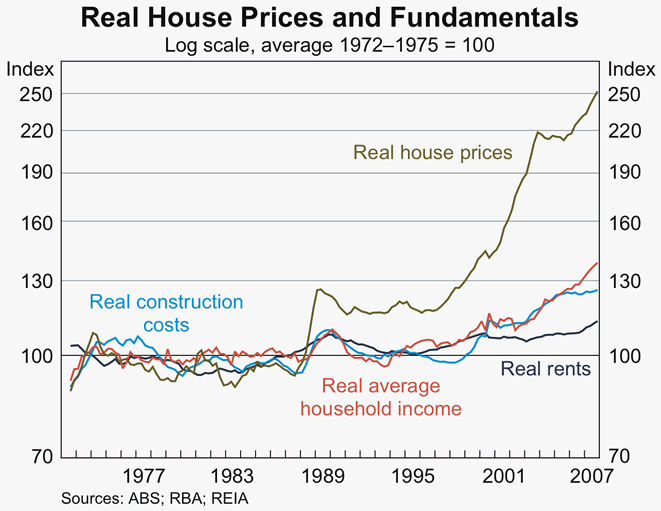
Despite the fact that negative gearing has existed for a long time, much assertion but surprisingly little evidence has been made to justify this policy across all classes of investment, whether it be shares, business, or property investment. The supporters of negative gearing provide negligible evidence to show that is it a sound policy.

Deductibility and tax minimisation under negative gearing

It is common sense that both businesses and investors should be allowed to deduct the costs directly incurred in making an income, but labour is unable to do so. A salaried employee incurs substantial costs in the course of earning a wage (for instance, accommodation, travelling to and from the workplace, and childcare) but government policy bars deduction of these costs against wages.

There is a double standard in operation here. From a distributional or equity perspective, this policy is biased towards the wealthy, as business and investment capital ownership is concentrated into this class, which relies proportionately less upon wages.

The disparity between wage earners and investors is exacerbated when negative gearing is considered. The net income loss from an investment property reduces the investor’s personal tax liability, even though that loss was generated elsewhere. Earning a wage and earning income from an investment are two separate activities and should be treated as such. Business commentator Alan Kohler accurately summarised the inconsistency between investment and employment:

Five years ago Treasurer Peter Costello told Australians: “Work for a living and we’ll tax you at close to 50 cents in the dollar; speculate and we’ll only take 25 cents. Not only that but, as a special deal – while stocks last – we’ll pay half your speculating costs.”

To sum up this line of reasoning, investors are unduly advantaged by the present taxation arrangements relative to labour. Investment capital is overwhelmingly concentrated in the wealthiest households, who deduct investments costs against income generated, have the highest personal incomes and thus MTRs, can deduct investment losses against their personal tax liability (negative gearing), can carry forward losses and lower their effective MTRs.

Clearly, the tax system is biased towards the rich in terms of cost deduction and tax liability minimisation. Some of this bias can be reduced by maintaining consistency: labour should be allowed to deduct costs against wages but disallow negative gearing for investors.

Increasing the rental stock and lowering rents

This is the primary argument in favour of negative gearing: that it provides an incentive to investors to purchase property for rent, thus increasing the supply of rental properties as a proportion of the total housing stock. As the reasoning goes, negative gearing holds rental prices down, benefiting tenants.

The evidence shows otherwise. 92% of residential property investment is for the purchase of existing dwellings rather than those newly constructed, meaning that former owner-occupiers and tenants have to purchase or rent elsewhere, respectively, thus resulting in little to no net increase in the supply of rental dwellings.

In the long term, it makes little sense for the supply of rental properties to increase compared to the total residential stock unless there is a profound upward swing in housing prices, with investors spurred into the market on expectations of making a substantial profit through realising capital gains upon sale. Accordingly, there is little incentive when long term data from Australia and other countries shows that housing prices track inflation, despite numerous and ongoing booms and busts.

Negative gearing is also badly targeted as high-income professionals and millionaires also allegedly receive lower rents. If policymakers are concerned about rental affordability, there are other options to pursue. The obvious candidate is the Centrelink Commonwealth Rent Assistance (CRA) scheme, a subsidy provided to low-income tenants.

The effects of quarantining negative gearing in the 1980s

The favourite scare story promulgated by the housing lobby is that when the Hawke/Keating government quarantined negative gearing during 1985-87, it caused rental prices to surge, quickly leading to its reinstatement. Fortunately, not only did the evidence refute this urban myth, it showed that negative gearing can be safely quarantined, if not abolished.

Rents rose in Perth and Sydney only, remained steady in Melbourne and Canberra, and fell in Brisbane, Adelaide, Hobart and Darwin. If the lobby was correct, quarantining should have adversely affected all capital city rental markets equally, not just two out of eight (even when factoring in a lagged response). There were confounding factors at work: rising interest rates, introduction of capital gains tax and a stock market bubble.

Oddly enough, while the lobby claims that quarantining will increase rents, the inverse is not considered: rents have escalated from 2006 onwards while negative gearing was in effect. Perhaps they could claim that rents would have been higher otherwise. This, however, is an ad infinitum argument; that is, negative gearing is not generous enough, so by increasing the scope of tax deductibility, it can serve to further constrain rents.

How much does negative gearing cost?

ATO data provides an estimate of the cost of negative gearing. In 1993-94 it was $850 million, fluctuating around the $1 billion mark over the next several years. As investors piled into the market, the cost rapidly escalated to a peak of $3.8 billion in 2007-08 before falling to $2.9 billion in 2009-10. Over the last seventeen years, negative gearing has cost taxpayers an inflation-adjusted $33.5 billion (2012 dollars).

What to do?

Policy outcomes can be enhanced by quarantining negative gearing deductions to the purchase of newly constructed properties, but not for established properties. It would be even better to remove it, as it makes little sense to subsidise property investors, regardless of the reasons for investment when there are better policies for helping low-income tenants.

Also, the negative gearing debate presupposes the existence of income taxation, which has no justification when evidence suggests that substantial amounts of tax revenue can be raised from far more efficient bases. Productive individuals and business already bear the brunt of income tax, which is merely one of 125 burdensome taxes.

According to the property lobby, it’s too dangerous to reform negative gearing, let alone abolish it. Fortunately, there’s no requirement for anyone to believe the lobby, given the weight of evidence against their assertions and the fact that they have enough conflicts of interest to fill a book.

Join the conversation

19 Comments sorted by

  1. Bruce Moon

    Bystander!

    Philip

    Nothing in your article is new.

    Perhaps the most important point is missing; the full ATO impact.

    Despite fluctuating property prices, typically bricks and mortar increase in value over time. To that end, the appeal of property investment for mum'n'dads is the capital gain.

    You assert negative gearing is the domain of the wealthy. Elsewhere, statistics show this not to be the case - a large proportion of investment properties are 'owned' by middle income earners (typically later…

    Read more
    1. Misha Ketchell

      Managing Editor at The Conversation

      In reply to Bruce Moon

      It seems to me that negative gearing can only encourage speculation on capital gains. That's not creating value in the market and not in the national interset. I also think it's strange that income derived from ownership of assets should be taxed at half the rate of income from labour. I don't understand the rationale behind the distinction.

      report
    2. Daniel Kinsman

      logged in via Twitter

      In reply to Bruce Moon

      "Despite your proposition that negative gearing skews property values up - you overlook the view that it also skews rents down"

      This is addressed in the article, where the author indicates it is an "urban myth".

      "You assert negative gearing is the domain of the wealthy. Elsewhere, statistics show this not to be the case - a large proportion of investment properties are 'owned' by middle income earners (typically later in the working life)."

      I would assert that "middle income earner" + "investment properties" = wealthy.

      report
    3. Bruce Moon

      Bystander!

      In reply to Misha Ketchell

      Misha

      Nothing is necessarily perfect in the Australian tax system. Anomalies abound.

      I suggest it an urban myth that negative gearing encourages speculation on capital gains.

      Investors who enter a contract based on speculation are fools. The business model MUST stack up without property price gain - if achieved, that's the icing.

      It matters little whether we seek to make mountains out of housing investment via negative gearing - the fact is that all money borrowed for investment is…

      Read more
    4. Bruce Moon

      Bystander!

      In reply to Daniel Kinsman

      Daniel

      I suggest you look at the content of the article. Stating it to be an Urban Myth is one thing, citing research to show otherwise is another.

      Financial research I read shows that rents need to increase in the order of approximately 5 to 8% if negative gearing is not available. As a retired person without a tax liability, that sort of research is important to me as I contemplate my investment portfolio.

      I would suggest to you that a middle income earner with a negatively geared investment…

      Read more
    5. Daniel Kinsman

      logged in via Twitter

      In reply to Bruce Moon

      The author clearly cites the overall rental price *decreases* during the 85-87 negative gearing quarantine as justification for the urban "myth" status. As for your citations, excuse me if I reject "the research I read" as a credible source.

      The rich almost never consider themselves as such, because they judge themselves by their peers rather than the community at large. Here is surveyed evidence from America clearly indicating this: http://economix.blogs.nytimes.com/2011/04/19/rich-people-still-dont-realize-theyre-rich/

      For reference, I earn less than $100k and consider myself very wealthy.

      report
  2. Mark Naber

    logged in via Facebook

    Using the same logic then renters should have their respective rents becoming tax deductible. That would be fair!

    However we know this would require taxes would need to be hiked to sustain this and of course renters don't have the powerful lobby groups that investors and developers do, no to mention the politicians the industry has on their payroll.

    report
  3. Colin MacGillivray

    Retired architect

    Negative gearing needs property price increase of 4% or more to work for the investor.
    A friend in Queensland has just sold a negatively geared property in Queensland for $290k which he bought 6 years ago for $310k. So he had a capital loss and payed a lot more to the bank in interest than he saved in tax.
    He would have been better to pay his tax and put the excess income in the bank.

    report
  4. Garry Baker

    researcher

    I too think there's flaws in the logic of the editorial, insofar as various asset classes wax and wane with the times, yet valuations ultimately get back to yields, and sometimes property rental provides a terrible yield, so the real benefit is expected from capital gain. For the meek who live a life of risk avoidance, perhaps they are better off in a term deposit somewhere, and be less pro-active with a passive investment. Risk must enter all of these discussions, because as sure as green apples…

    Read more
  5. Jason Thompson

    logged in via Facebook

    What disturbs me most about the tone of this genre of articles relating to negative gearing and the comments that follow is that there always seems to be an undercurrent of 'sticking it to the fascist wealthy landlords' despite the fact that most people (like myself) who happen to own a property which is rented out are far from wealthy, not very fascist and are not trying to 'stick it to renters'.

    The main reason I held onto my old place it because it's on the coast and I'd like to move back there one day. Regardless of the capital gain, to sell it and then re-purchase down the track would sting me at least $50,000 in stamp duty - for nothing! Now there's a tax you should be focusing on because, believe me, there's not a lot of financial benefit in negative gearing so far this decade.

    report
    1. James Sanders

      logged in via email @gmail.com

      In reply to Jason Thompson

      True, stamp duty should be abolished.

      But the idea that negative gearing provides a social benefit to renters doesn't stack up.

      The key statement is this: "92% of residential property investment is for the purchase of existing dwellings rather than those newly constructed"

      Negative gearers mostly invest, or hold onto, property in areas where they are likely to have capital gains. So they increase overall demand in the areas which are most desirable - where there is good public infrastructure and better paying jobs.

      So the negative gearing tax deduction is completely perverse - most of this infrastructure is often paid for by the taxpayer - and it ultimately maintains the values of, and demand for, those properties.

      And this is the pearler - why should people receive a subsidy to own property that already exists, yet renters excluded from the property market by virtue of capital gain, pay tax on their only source of income (wages or business activity)?

      report
    2. Jason Thompson

      logged in via Facebook

      In reply to James Sanders

      Hmmm... I don't know about all this.

      Would it be more socially acceptable for people to sell their properties and then invest the proceeds in the bank, shares, or superannuation and let a big institution or company do the tax-dodging or rack-up the asset losses for them, instead? I'm not sure it's any different or fairer for people to claim tax losses against those that occur at arm's length through a bank or share-fund rather than those that they attempt to handle, themselves, through purchasing…

      Read more
    3. Chris O'Neill

      Telecommunications Engineer

      In reply to Jason Thompson

      "I'm not sure it's any different or fairer for people to claim tax losses against those that occur at arm's length through a bank or share-fund rather than those that they attempt to handle, themselves, through purchasing a commercial or other property and renting it out."

      It isn't. It just doesn't happen on the scale of property investment even if it happens at all.

      report
    4. Chris O'Neill

      Telecommunications Engineer

      In reply to Jason Thompson

      "I think it would also be difficult to get around the problem of people positively gearing a property - Would that suddenly become an income even though it wasn't previously counted as a loss?"

      It would previously be counted as a loss, but only deductible against future net property income, as occurred briefly under the Hawke government.

      report
  6. Gary Murphy

    Independent Thinker

    I think a lot of the people who have gotten into property and inflated the prices in the last couple of decades have been doing it quite speculatively (ie relying on capital gains). Now that it is becoming obvious that property prices aren't always going to rise and can in fact fall the demand will probably remain low.

    Abolishing negative gearing now would make property investment an even worse prospect. There are many people in society who can't afford / don't want to own their own house. So we do need other people to invest in residential property.

    With such a housing stock shortfall it is a seller's market as far as renting is concerned - so any excuse will do

    report
    1. Arthur James Egleton Robey

      Industrial Electrician

      In reply to Gary Murphy

      If whatever system we have in Australia is the worlds best practice then I guess that we have the worlds cheapest housing and rental.
      Perhaps we have a constraint on land, that is why our housing is so expensive.
      Or perhaps it is all one huge ponzi bubble. Nah. It can't be that. We are not the USA, are we?
      The bubble started in 1972 and as bubbles are symmetrical we can expect undershoot to start in 2042.
      Then again, with all baby boomers down sizing at once, just who are they going to sell to?
      With the collapse of another bubble, China where are the next generations going to find work to pay your mark-to-fantasy property prices.
      As Dr. Chris Martenson said on The Crash Course. "Too Much Debt."
      The Boomers are going to be hoist on their own petard.
      The historical value of a 3 bedroom home has always been 16 kg of silver.
      Fiat currencies have always ended in hyperinflation.
      Lots of Luck LeRoy.

      report
    2. leo smith

      pensioner

      In reply to Arthur James Egleton Robey

      Does negative gearing bring down rents? I feel that negative gearing should be abolished because investors should not be allowed to use the workers tax money for furthering their own bank accounts whether it is in bricks and mortar or speculating on the share market. If negative gearing is abolished it will bring house prices down. Also rents will fall because the owner wont have to ask such exorbitant rents.Also the government will save money on rent assistance which the property owner receives anyway. A much fairer way to balance the budget (Dont you think so Mr Swan)

      also

      report
  7. Chris O'Neill

    Telecommunications Engineer

    "Five years ago Treasurer Peter Costello told Australians: “Work for a living and we’ll tax you at close to 50 cents in the dollar; speculate and we’ll only take 25 cents."

    And to think that this is the same man who actually reduced the tax rate on speculation. What an incredible piece of shameless hypocrisy. But this type of behaviour is often rewarded in Australian politics.

    report
  8. Chris O'Neill

    Telecommunications Engineer

    One way to understand how bizarre negative gearing on property is is to consider a high value piece of land with a dump of a building on it that is rented out. Negative gearing laws allow you to get negative gearing on the entire value of the property (if a bank will loan you the entire value), yet the vast majority of the negative gearing is simply subsidizing land speculation.

    Buildings don't need negative gearing. The rental value of buildings themselves normally exceeds the interest cost of the loan for the building value. Negative gearing is only needed for speculation on the land component of property value.

    report