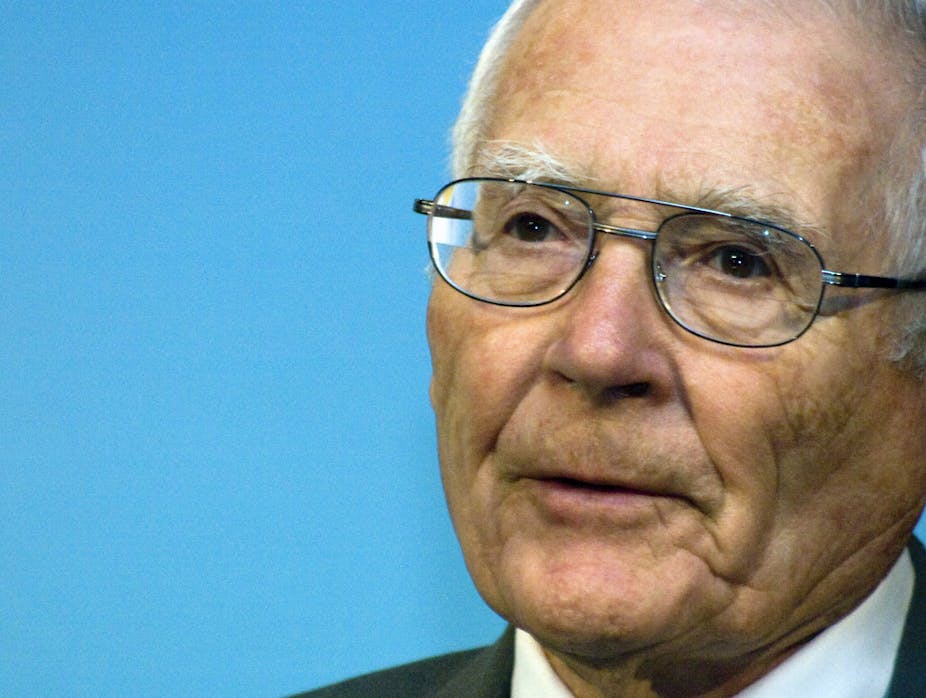
Recent statements by James Lovelock, the distinguished physicist, are not easy to reconcile with his statements, writings and books over the years, including The Vanishing Face of Gaia; The Revenge of Gaia and others.
As recently as March 30th, 2011, it was reported: “Professor James Lovelock, the scientist who developed Gaia theory, has said it is too late to try and save the planet. The man who achieved global fame for his theory that the whole earth is a single organism now believes that we can only hope that the earth will take care of itself in the face of completely unpredictable climate change.”

But now Lovelock says:
The world has not warmed up very much since the millennium. Twelve years is a reasonable time … it (the temperature) has stayed almost constant, whereas it should have been rising – carbon dioxide is rising, no question about that …
The problem is we don’t know what the climate is doing. We thought we knew 20 years ago. That led to some alarmist books – mine included – because it looked clear-cut, but it hasn’t happened …
The climate is doing its usual tricks. There’s nothing much really happening yet. We were supposed to be halfway toward a frying world now.
Unfortunately, these statements by James Lovelock are inconsistent with up-to-date climate data sets. These indicate:
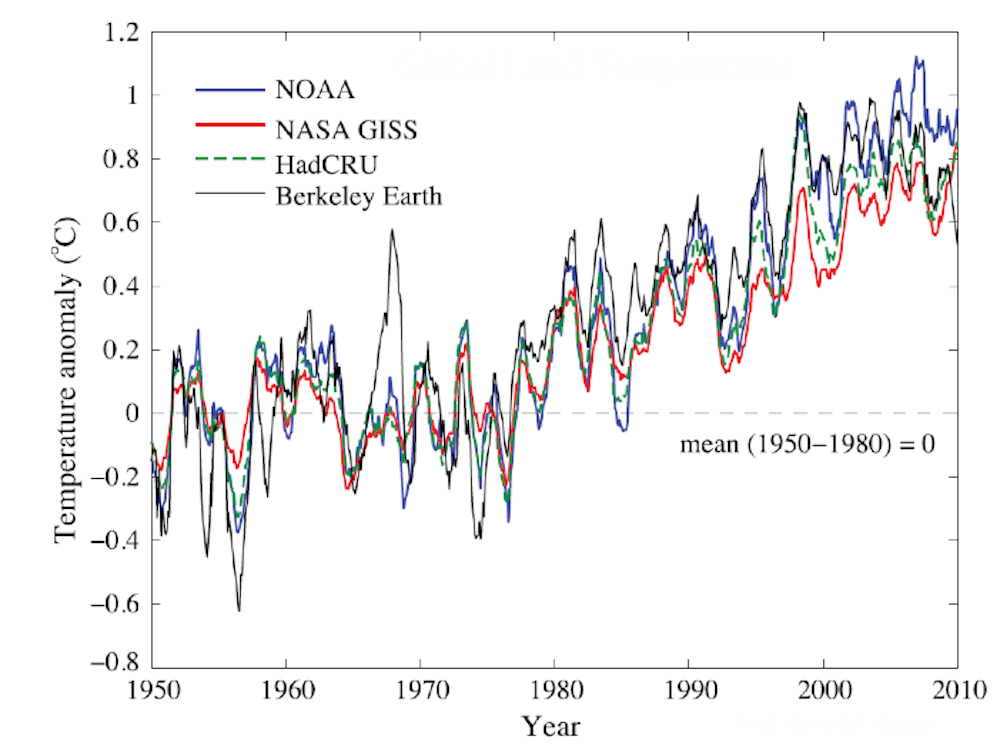
- the 1st decade of the 21st century includes unprecedented instrumentally measured peak temperature records, including a peak temperatures about ~2005-8 of up to 1.1 degrees Celsius above the 1950-1980 reference mean measured by NOAA, NASA and HadCRU, as compiled by the Berkeley Earth Surface Tempeature analysis group (see Figure 1). According to NOAA, mean temperature maxima between 1998 and 2010 have risen by ~0.17 degrees Celsius (0.014C/year), whereas mean temperature minima rose between 2000 and 2009 by ~0.2 degrees Celsius (0.022C/year) (see Figure 1)
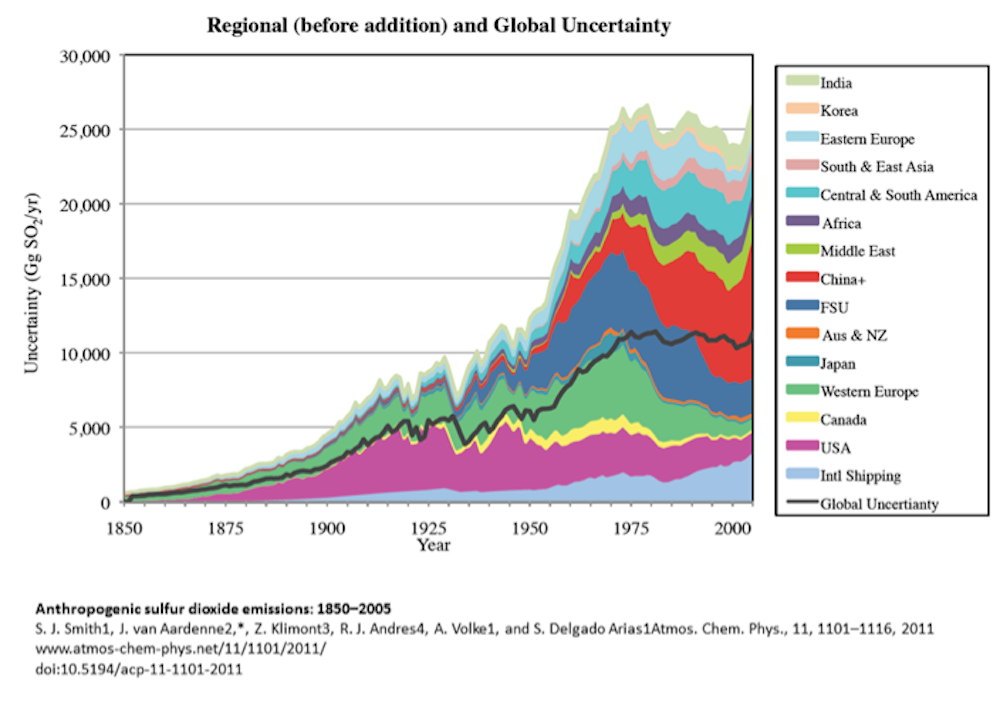
Figure 2: Anthropogenic sulphur dioxide emissions 1850-2005 Atmos.Chem.Phys - the mean temperature rise gradient between ~2000-2010 was somewhat shallower than the mean maxima during 1975-1998 (0.43C/year) which is accounted for by:
- a sharp reduction in the emission of SO₂ from about 1974-5 to about ~2000, which decreased the direct and indirect aerosol shielding effect and cloud aerosol albedo shielding effect (see Figure 2). A renewed rise in SO₂ emissions from about 2000, largely from China, accounts for part of the relative cooling at that stage
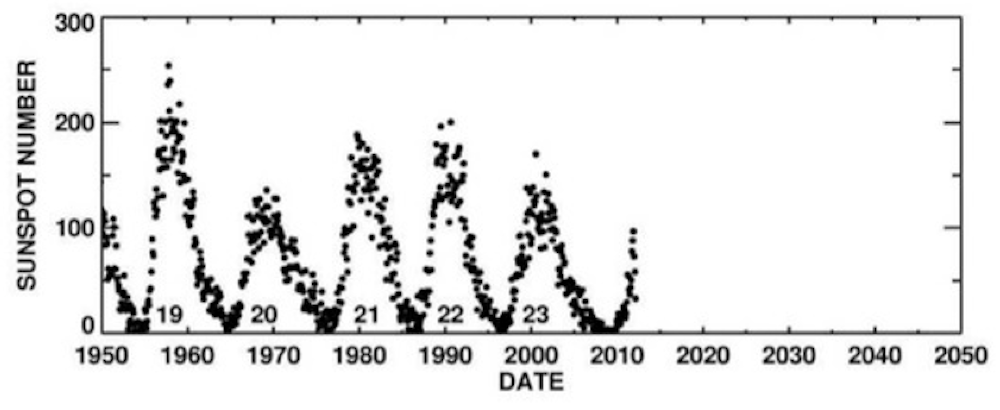
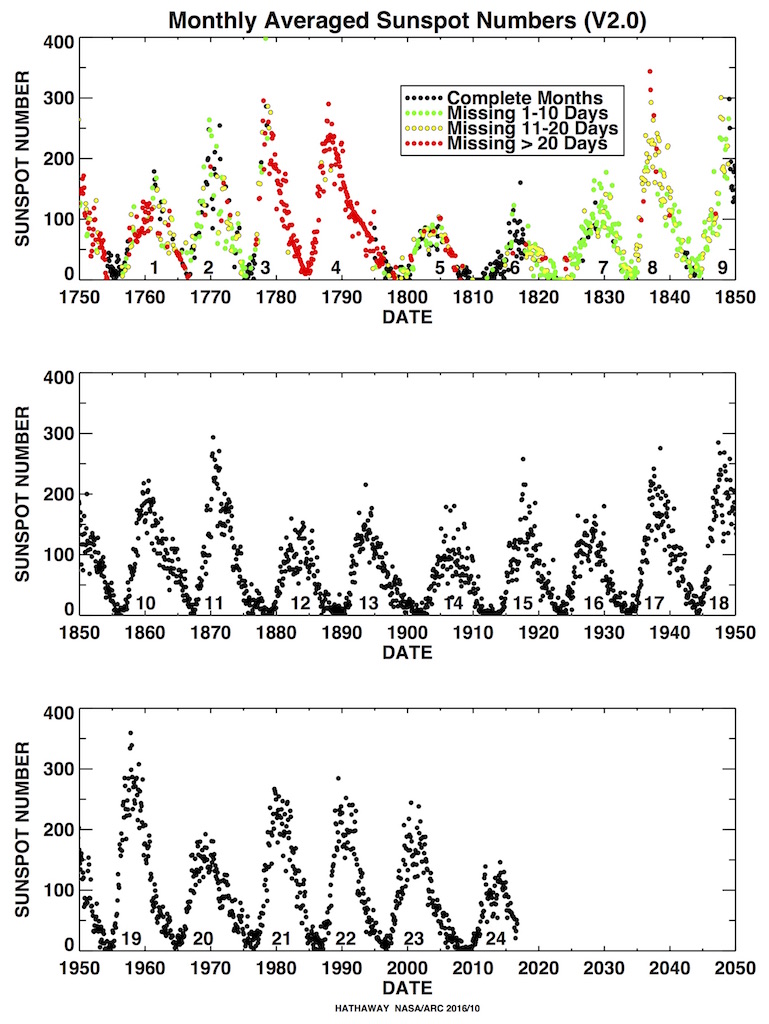
- the minima in the 11-years sun-spot cycle from about 2002 (see Figure 3)
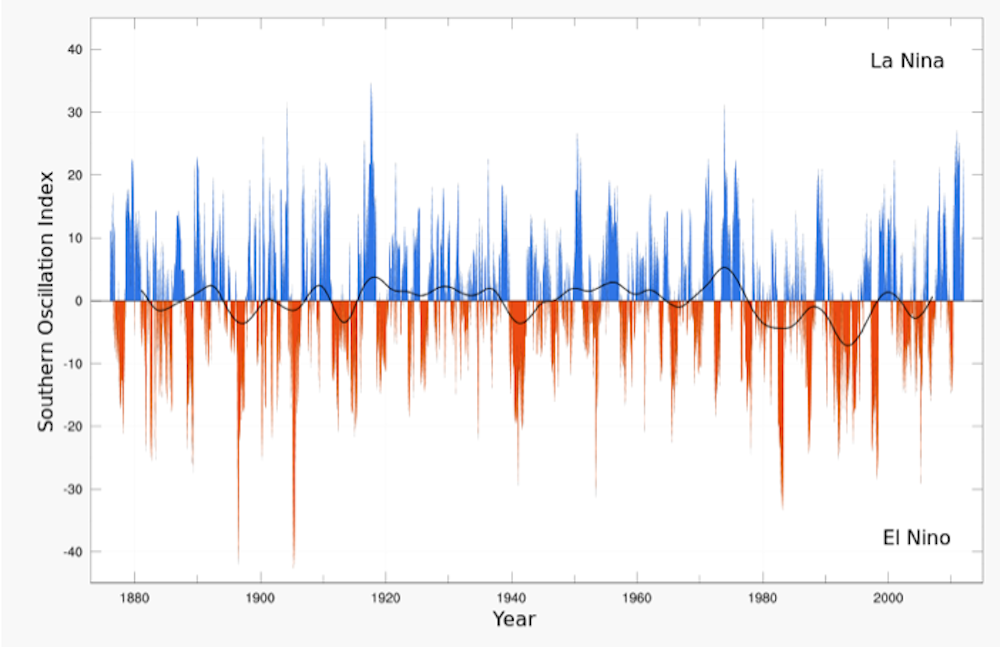
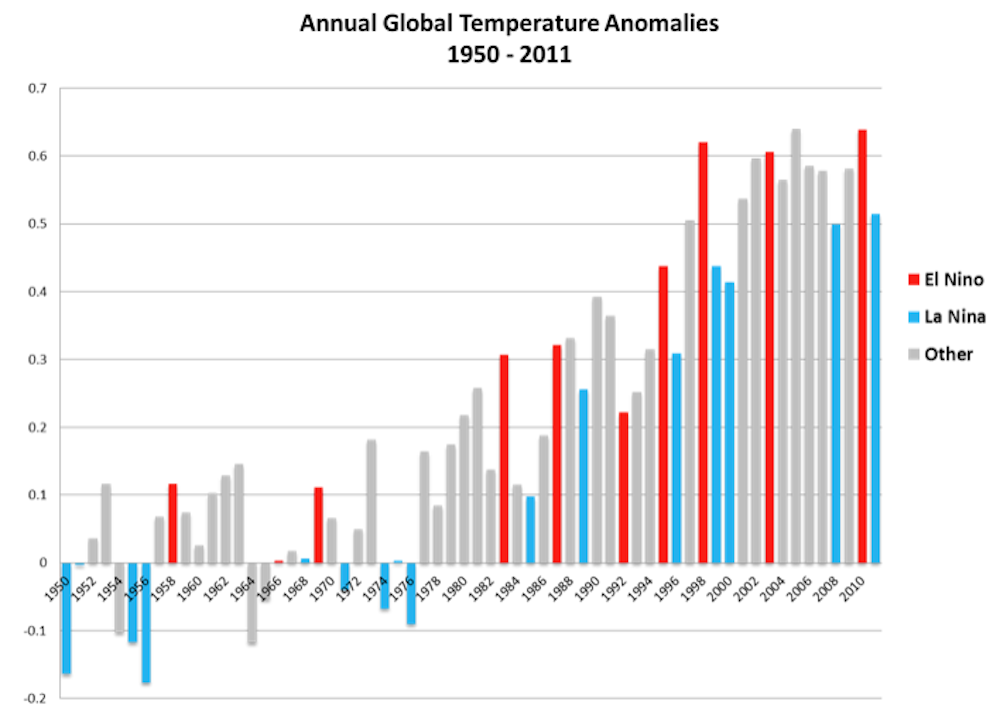
- the prevalence of La Niña conditions toward the end of the first decade of the 21st century (see Figures 4 and 5).
It is a strawman argument to expect temperature trends to change smoothly, or to highlight periods when temperatures have risen at low rates or even declined, and at the same time overlook the mean decadal trend where measured temperatures have risen during the 20th – early 21st centuries by more than 1.0 degrees Celsius (see Figure 1).
A far greater rise is currently masked by sulphur aerosols of short (one to two years) atmospheric residence time, without which mean global temperatures would have risen above 2.0 degrees C since the early 20th century.
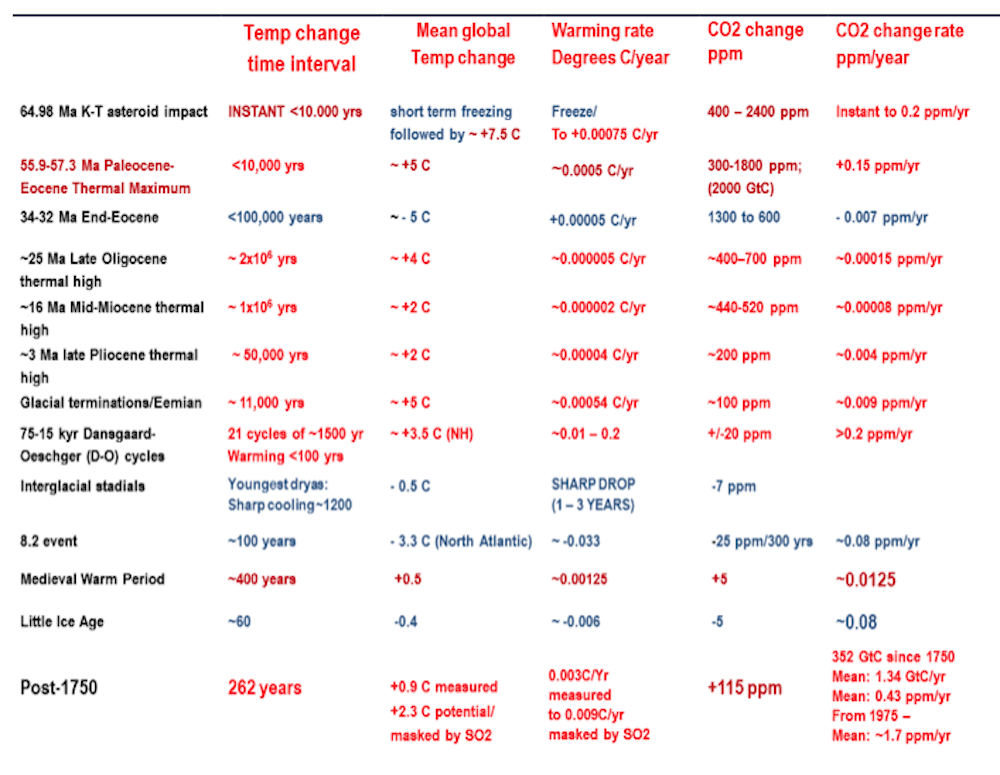
Given the above it remains a mystery as to the nature of the evidence or reasons underlying James Lovelock’s statements. It is particularly perplexing, since 20th century greenhouse and temperature rise rates are orders of magnitude higher than during any previous period, excepting intra-glacial Dansgaard-Oeschger cycles (see Table 1)
Popular notion on media and TV shows juxtapose a “belief” versus “scepticism” in climate change. Science, however, is not about “belief” but about measurements and empirical evidence consistent with the basic laws of nature. It is practising scientists who are the true sceptics – examining and re-examining their methods, data, observations and explanations numerous times, subsequently subjected to rigorous review procedures, prior to peer-review publications.
“Everyone is entitled to his opinions but not to his facts” (Senator Daniel Moynihan)
Comments on this article are now closed.
Marc Hendrickx
Geologist
Seems Lovelock agrees with me! Why? The models are not reflecting reality. Who would have thought it! Comforting to know that entrenched views are open to fresh thinking.
Andrew, you have made a number of alarmist statements on this website.
You have stated:
"The release to date of over 500 billion tons of carbon (GtC) through emissions and land clearing (original atmospheric CO2 inventory - 590 GtC) is shifting the Earth’s climate toward ice-free conditions such as existed pre-34 million years ago, within a few centuries - a geological blink of an eye…"
" within a few centuries" As I pointed out this is utter alarmist nonsense due to the presence of the Circum-antarctic current that gave the ice age to start with. Do you still stand by your alarmist statement?
Ian Ashman
Manager
Clearly you are a genius Marc....like most geologists...
Michael Brown
Professional, academic, company director
Thanks or the update Andrew, but as a scientist, I still find Freeman Dyson's pithy analysis more convincing than yours:
http://www.independent.co.uk/environment/climate-change/letters-to-a-heretic-an-email-conversation-with-climate-change-sceptic-professor-freeman-dyson-2224912.html
Especially "Sixth, summing up the other five reasons, the climate of the earth is an immensely complicated system and nobody is close to understanding it."
Andrew Glikson
logged in via email @iinet.net.au
Michael,
There are interesting lessons which can be learnt from James Lovelock (real or apparent) reversal:
1. Nothing would delight climate scientists (and everyone else) more than if the world is not warming, or at the very least if warming is not anthropogenic.
2. It is not a correct scientific approach to "believe" or "disbelieve" any particular statement by any particular scientist, i.e. whether it is Lovelock, Dyson, Hansen or Schellnhuber.
3. Instead, scientists acquainted…
Read moreAndrew Glikson
logged in via email @iinet.net.au
Michael,
The statement you quote: "the climate of the earth is an immensely complicated system and nobody is close to understanding it"
Can be compared to statements of the following type:
'The development of life on Earth is too complex for the theory of Darwinian evolution to be able to account for it",
or "The behaviour of the Earth crust and mantle are too complex for plate tectonic theory to account for it"
or "The univese is too complex for Hoyle's expanding universe theory to account for it"
or "the human body is too complex for medical science to understand and find ways of curing illnesses"
As of course you are aware, whereas the details of complex systems are almost never fully documented and understood, there is a stage at which the principles of major scientific theories advance beyond reasonable doubt, including the role of greenhouse gases (CO2, CH4, O3, N2O etc) in regulating the atmosphere of planetary bodies.
Alvin Stone
logged in via Facebook
The bit I find interesting in the article Michael references is that Freeman Dyson backs out of the correspondence when he is asked tough empirical questions.
The fact he admits to not understanding the detail is also a concern. It suggest his position is taken without a full understanding of the science itself and that he hasn't chosen to pursue that understanding any further.
I'm sure there are good reasons for it but it does his weaken his pithy statement and his position on climate change somewhat.
Marc Hendrickx
Geologist
Andrew cherry picks whatever data set he thinks supports his extremely alarmist position. Arguing about which year of the last 10 is the hottest is ridiculous. The fact remains that the warming that was forecast by the models has not eventuated. It seems this is one of the reasons Lovelock recanted his position. That's why he said the following:
“The climate is doing its usual tricks. There’s nothing much really happening yet. We were supposed to be halfway toward a frying world now,” he said.
“The world has not warmed up very much since the millennium. Twelve years is a reasonable time… it (the temperature) has stayed almost constant, whereas it should have been rising -- carbon dioxide is rising, no question about that,” he added.
Mike Hansen
Mr
Marc - there is no shortage of peer reviewed science pointing out that the world continues to warm.
The paper that Alvin Stone linked to
http://news.sciencemag.org/sciencenow/2012/04/scienceshot-no-letup-in-worlds.html?ref=em
The paper by Foster and Rahmsdorf.
http://iopscience.iop.org/1748-9326/6/4/044022
discussed here
http://tamino.wordpress.com/2011/12/06/the-real-global-warming-signal/
And also discussed here with some additional analysis from John Nielsen-Gammon the Texas State Climatologist and Professor of Atmospheric Sciences at Texas A&M University
http://blog.chron.com/climateabyss/2012/04/about-the-lack-of-warming/
If course we have been here before.
http://www.skepticalscience.com/graphics.php?g=47
What have you got apart from accusing Dr Glikson of "alarmism"?
Marc Hendrickx
Geologist
Gee, nice collection of blog posts there Mike, and is that one peer reviewed paper? That all YOU got?
I can read a graph and it flat lines after 1998. It also diverges wildly from model predictions. It seems that even Lovelock can now see this.
"We were supposed to be halfway toward a frying world now,”Clearly we are not.
David Arthur
n/a
You didn't read Glikson's article, did you?
Tim Scanlon
Author and Scientist
Marc, did you even read those blog posts? Because they reference the relevant data sources and scientific papers they used.
But of course it is easier to dismiss something if you haven't bothered to read it, isn't it Marc.
How about the GISS data: http://data.giss.nasa.gov/gistemp/graphs_v3/
http://data.giss.nasa.gov/gistemp/references.html
http://data.giss.nasa.gov/gistemp/
Marc Hendrickx
Geologist
Models don't match the data that shows a virtual standstill since the late 1990s. If it were otherwise dear old Lovelock would have no cause to recant. Ben Santer's 17 years almost up!
Mike Hansen
Mr
Good one Marc. There are actually 2.
I laughed when you criticised a poster in the "climate dice" thread for linking to a blog and then 2 comments later linked to Roger Pielke's blog.
https://theconversation.edu.au/if-you-want-to-roll-the-climate-dice-you-should-know-the-odds-6462
But hey - I am not going to argue with you. I agree that peer reviewed science is the gold standard. However with much peer reviewed science behind paywalls, who is going to pass up the opportunity to read what the author says about his/her paper.
So can we do that again
Here is author Grant Foster discussing his peer reviewed paper
http://www.snolab.ca/public/JournalClub/FosterRahmstorf2011.pdf
on why the idea that global warming has stopped or even slowed is "crap".
http://tamino.wordpress.com/2011/12/06/the-real-global-warming-signal/
So Marc - apart from "Look over there it's a wombat" do you have anything?
Marc Hendrickx
Geologist
Authors discussing their own papers in sheltered workshops, in the absence of criticism. Mike's version of the scientific method.
Tim Scanlon
Author and Scientist
Incorrect.
Plus, the GISS data is annomally data, not a model. The model is only to take into account spatial variability, i.e. combine sites.
Of course we can go to straight temperature data if you want:
http://www.bom.gov.au/cgi-bin/climate/change/global/trendmaps.cgi?map=global_t®ion=global&season=0112&period=1970
http://www.bom.gov.au/climate/change/datasets/datasets.shtml
Annomally but, the raw data is linked:
http://www.bom.gov.au/cgi-bin/climate/change/global/timeseries.cgi?graph=global_t®ion=global&season=0112&ave_yr=15
I take it you didn't read Santer's recent paper that showed the increase in temp over the past decade.....
Marc Hendrickx
Geologist
See comments re Santer above. It seems you are unable to see the implications.
The net result being that, as it appears Lovelock has also discovered, to use his words:
Marc Hendrickx
Geologist
...and here they are...
“The climate is doing its usual tricks. There’s nothing much really happening yet. We were supposed to be halfway toward a frying world now,” he said.
“The world has not warmed up very much since the millennium. Twelve years is a reasonable time… it (the temperature) has stayed almost constant, whereas it should have been rising — carbon dioxide is rising, no question about that,” he added.
Yoron Hamber
Thinking
I agree on that earth is a non linear 'system', also on that we do not have all facts we need, but will we ever :) What we have is a lot more than three decades ago and we keep collecting data.
The main problem those days are those sticking their head in the sand, refusing the funds needed for collecting more evidence. Look at NASA fundings for studying earth for example, and then consider if you can think up a cheaper way of collecting a lot of data in real time.
That kind of non funding makes me wonder what people think over there? That you by ignoring what happens can make it go away? And that global warming being a political issue naturally makes it a 'non issue' practically?
Science, and people huh :)
Gives me a headache.
David Semmens
logged in via Twitter
That criticism is completely hollow when you've cited exactly 0 peer-reviewed papers to support your arguments...
Alvin Stone
logged in via Facebook
I have to say I am uncomfortable with the prediction of an ice-free world in 300 years, although without reference to papers one way or another, I don't have the tools to make a considered judgement.
That said, the statement that "we were supposed to be halfway toward a frying world now," is pure Lovelock. It's another exaggeration used to justify the case for his new position. It is in the same ballpark, as two people living on an ice-cap by 2100, that he used when he was pumping up the threat of global warming.
Both are very nice media sound bites (and, boy, weren't they picked up) but neither are serious engagements with the forecasts of mainstream climate scientists.
I really do feel, that this whole reversal would have been much ado about nothing if Lovelock wasn't such a high profile media tart.
James Szabadics
Technical Development and R&D Manager, Plantation Timber Industry
Looking at the GISS data it would seem that the temperature is plateaued around 0.7 above the 1961 to 1990 average.
http://data.giss.nasa.gov/gistemp/graphs_v3/Fig.C.gif
Mike Hansen
Mr
As it did in Jan '70 to Nov '77, Nov '77 to Nov '86, Sep '87 to Nov '96, Mar '97 to Oct '02, and Oct '02 to Dec '11
http://www.skepticalscience.com/pics/NCDC_Escalator.gif
Comment removed by moderator.
Ian Ashman
Manager
Marc is simply a non-peer-reviewed troll.
His function here is to post waffle and then brag about it on whatever denialist forum he usually inhabits. Ego strokes are his payoff.
Yoron Hamber
Thinking
I really enjoyed reading about Foster & Rahmstorf . Nice choice of papers you made there.Mike :)
Danny Bloom
logged in via Facebook
UH? what about -- How MSNBC's Ian Johnston Mis-Reported the James Lovelock Non-Story That Went Viral
How the MSNBC Ian Johnston take-down article on James Lovelock
Read morehappened and why now? This week, this month. When in fact, there was no news event going on to report. I got the inside scoop here, if you care to know how MSNBC missed the boat on this one and threw a lopsided inside sinker that went nowhere and reported nothing but marketing hype for Lovelock's 2013 book.
Since when did MSNBC get…
gerald spezio
foot soldier planet earth
Danny, your peeyar explanation is a mandatory hypothesis.
#2 hypothesis; Lovelock is 92 years old & may have gone a bit dotty.
When I would view him on you tube giggling about tragedies to come from climate change, I suspected that he may be a bit dotty.
Danny Bloom
logged in via Facebook
and there was no backtracking on climate change by Dr Lovelock. He merely said that his earlier time frame that by 21oo it would be all over for humankind was wrong, and of course it, i always said that the date is more like 2500 AD, 30 generations from now and still have time, sign me: "James Lovelock's Accidental Student", danny bloom, 1949-2032, director POLAR CITIES PROJECT:
http://pcillu101.blogspot.com
Sean Lamb
Science Denier
Not easy to reconcile his recent remarks with previous comments, but very easy to reconcile it with reality!
The history of climate change science can be summed up in a few basic points.
Read more1. An observation that CO2 gas had some insulating effects - made many decades ago.
2. The exact warming factor of CO2 can't really be accurately measured experimentally (global system to complex to model accurately) but can only be measured experiencially [sic].
3. First generation was ice-core data which…
Hugh Sturgess
Student
You "few basic points" don't really sum up history, they're statements of what you believe to be fact.
1. "Many decades ago" presumably means "150 years ago". You're not getting off to a good start with such vagueness.
2. "The exact warming factor of CO2 can't really be accurately measured experimentally." Then how would you suggest we do so? "Experiencially [sic]" (sic indeed). What does this mean? That we should go outside and "feel" whether the world has warmed since the beginning of the…
Read moreSean Lamb
Science Denier
My dear Mr Sturgess, I am certainly not claiming to be either more knowledgeable than either you or the article author, I am just claiming to be correct. It is the old dialectic: Wrong but Wromantic versus Right but Repulsive.
"Experientally" means of or pertaining to experience. To put it in terms you might understand better "suck it and see", it other words we will have a better idea of the relationship between CO2 and temperature as we collect more data points on the graph. And collect them…
Read moreDavid Arthur
n/a
In 1996 when the "policy-makers" (economists and politicians, generally non-cogniscent regarding science) decided to limit warming to 2 deg C, this was code for atmospheric CO2 to not exceed 550 ppm; that is, climate sensitivity (the temperature rise due to a doubling of atmospheric CO2) was thought to be around 2 deg C.
By early this decade, further work showed that climate sensitivity is closer to 3 deg C than 2, so the upper limit of atmospheric CO2 was decreased to 450 ppm.
What the economists…
Read moreHugh Sturgess
Student
Dear Mr Lamb, Esq.
So you acknowledge you don't know any more than either myself or the author of this article (or any of the tens of thousands of scientists with whom you disagree), but you are nevertheless right and we are all wrong. I see.
Thank you for your consideration, but I am aware of what you were getting at with your reference to "experiencial [sic]" research. I was hinting at the possibility that even if we were to abandon the scientific tradition of prediction and simple watch…
Read moreYoron Hamber
Thinking
And when you grow up you too will become a ?
Awhhh...
:)
And Bless what?
Your ignorance?
Sean Lamb
Science Denier
Well it might be a prudent approach, but there is no reasonable likelihood of avoiding 450 ppm - just based on the future projections of mineral carbon extraction.
So we are going to find out if these models are correct or not.
Sean Lamb
Science Denier
Dear Mr Hamber,
I have an excellent career in data-entry and barcoding - I thank you for your concern.
I have no doubt your career, income and qualifications are vastly superior to mine.
My extremely modest claim is that as we experience increased CO2 levels, inevitably we are going to have dramatically change our climate models. This, incidentally, was James Lovelock's opinion also, except he thinks the levels of CO2 and temperature over the last decade already necessitate a rethink.
And James Lovelock outranks both my extremely modest skill-set and your vastly more prestigious credentials.
Sean Lamb
Science Denier
Dear Mr Sturgess,
Although you correctly conclude I do not work in the field of science and I humbly accept your judgement that I have no great grasp of science or the scientific method, allow to share an anecdote of the fallibility of both scientists and the scientific method.
Some years ago medical scientists began to acquire the tools to look at the genetic basis of disease. There were some great successes with diseases that had very clearly defined familial basis (eg Cystic Fibrosis or…
Read moreYoron Hamber
Thinking
Well, why find yourself offended if I place you too in those eminent stratas of, what was it now? Ahh 'alpha-male-chimpanzee scientists'? After all, it was your idea, not mine :)
Yoron Hamber
Thinking
As for the rest of it, calm down a little. You're getting, and taking it yourself, far to personal. When you want a point to be made it's rather good not to call those you disagree with chimpanzees for example. You wouldn't do it in your pub, would you :) And if you did?
I tried to see what you thought but I got to admit that I lost it reading invectives :) although sort of funny, I didn't find them that appropriate to the subject..
David Arthur
n/a
Projections of future mineral carbon extraction? Projections?
China is working toward energy self-reliance, based on solar PV and wind turbines.
Hugh Sturgess
Student
Dear Mr. Lamb, Esq.
Thank you for replying to my reply to your reply.
Of course, that doesn't mean that medical science was wrong about the fact that those genes were the products of mutation. They were. Those papers weren't "rubbish", as very, very few of them would have gone so far as to say "this is the reason, I have it, you don't, nyah nyah". Genetic analysis is not "comparatively simple" - the way only a few tens of thousands of genes code for the vastly complex human organism is still…
Read moreYoron Hamber
Thinking
Here are some CO2 statistics that I put together 2009. Haven' checked the ones for 2011 but I would expect them to be worse.
(G77 consists of 130 developing countries.)
China 6 103 metric tons spread per 1339 ..million inhabitants
Read moreUSA 5 752 metric tons spread per 307 ….million inhabitants
G77 4 569 metric tons spread per 2464 ..million inhabitants
EEC 3 914 metric tons spread per 492 …million inhabitants
India 1 510 metric tons spread per 1166 ..million inhabitants
Canada 545 metric…
Yoron Hamber
Thinking
And no. With all respect David. China will turn to nuclear power, on that I'm pretty sure. As it is they have a ever growing demand for energy, and if they want their economy to continue to grow? That's the cheapest, well sort of, quickest way you can guarantee a 'energy' as I guess. As it is they use coal as I understands it, and build new ones every day last I looked. But they will turn to nuclear power in the future.
Which will make life interesting :)
It'¨s a lot of people in a limited space there.
So you don't want accidents.
David Arthur
n/a
China is going gang-busters developing non-nuclear renewable power generation.
Meanwhile, I read in the UK Guardian that "Conservative thinktanks step up attacks against Obama's clean energy strategy", (http://www.guardian.co.uk/environment/2012/may/08/conservative-thinktanks-obama-energy-plans), also that UN climate chief Christina Figueres reckons electing voting in climate-sceptic Republicans would hand competitive technological edge to China and Europe ("Republican presidential win would…
Read moreDavid Arthur
n/a
Mr Lamb, Prof Glikson is here explaining how, in this case, Dr Lovelock is incorrect about cessation of warming. Prof Glikson presents substantial further evidence in his previous The Conversation pieces, which I recommend.
Andrew Glikson
logged in via email @iinet.net.au
REGARDING THE ROLE OF THE CIRCUM ANTARCTIC OCEAN CURRENT VIS-A-VIS ANTARCTIC ICE MELT
http://www.nasa.gov/home/hqnews/2012/apr/HQ12-135_Asteroid_Imapcts_Earth_Rocks.html
RELEASE : 12-126 Warm Ocean Currents Cause Majority of Ice Loss from Antarctica WASHINGTON -- Warm ocean currents attacking the underside of ice shelves are the dominant cause of recent ice loss from Antarctica, a new study using measurements from NASA's Ice, Cloud, and land Elevation Satellite (ICESat) revealed.
An…
Read moreMarc Hendrickx
Geologist
Are you seriously suggesting this article supports your contention that the world will be in your own words "ice free " in a few centuries? It does nothing of the sort.
Here's Hansen's take from his 1981 paper that received so much praise here recently from you and others recently ....“Melting of the world's ice sheets is another possible effect of CO2 warming. If they melted entirely sea level would rise ~70m. However, their natural response time is thousands of years, and it is not certain whether CO2 warming will cause ice sheets to shrink or grow. For example, if the ocean warms but the air above the ice sheets remains below freezing, the effect could be increased snowfall, net ice sheet growth, and thus lowering of sea level.” P. 965 Hansen 1981 Science 213
Alvin Stone
logged in via Facebook
The difference Mark between the two conclusions - 31 years.
Marc Hendrickx
Geologist
Don't you just love science by press release.
Lets do some simple math. Antarctica has 30 million cubic kilometers of ice. According to NASA GRACE satellite measurements it lost about 100km3 per year for the period 2002 to present. To be "Ice Free" as Andrew suggests given those figures continue at the same rate would take 300,000 years. That's a 3 with 5 zeros after it. Andrew is suggesting there are only 2. That's 3 orders of magnitude difference.Therefore I suggest he is being un-necessarily alarmist. Do you agree?
David Arthur
n/a
Rignot et al, "Acceleration of the contribution of the Greenland and Antarctic ice sheets to sea level rise", Geophysical Research Letters, (38), L05503, doi:10.1029/2011GL046583, 2011.
You are familiar with the concept of acceleration?
In news just in, Pritchard et al, "Antarctic ice-sheet loss driven by basal melting of ice shelves" Nature 484, 502–505 (26 April 2012) doi:10.1038/nature10968
Read more"Accurate prediction of global sea-level rise requires that we understand the cause of recent…
Mike Hansen
Mr
"Lets do some simple math"
Sort of gives the game away Marc with "simple" being the operative word.
Are you suggesting that ice sheet melting is going to be linear? Did you say you were a geologist?
Marc Hendrickx
Geologist
Simple math model for a simple audience.
Ok Mike the math whizz. In order to meet Glickson's unrealistic, alarmist 300 year goal line for ice on the planet can you provide the equation for the curve?
How realistic do you think this is?
How much extra warming would be required to achieve this?
Would this accord with basic physics?
Given the implied sea level rise is nigh on 70 m have you purchased suitable property for your descendants?
Marc Hendrickx
Geologist
And the ice free in 300 years bit?
Yoron Hamber
Thinking
Antarctica melting is one thing, and yeah that should take a considerable amount of time as it has kilometers deep ice. But if its western slope gets lubricated from under by running water then that ice mass easily might start to move faster and out into deep water, where it breaks up into smaller pieces that also will melt faster as they drift away. And that is a very real worry. As for if those pieces will start a new ice-age :) Nope..
Eh, that's Hansen too btw :)
Yoron Hamber
Thinking
Ouch, that would be very very fast, and probably quite impossible for most fauna and flora to survive, even though one always can assume that there might be a revival by those that did, ignoring humans for this. I don't think that is possible myself, but it all depends I guess? There are two new studies out and I will cite myself here.
One that looked at the mid-Pliocene where we had a similar temperature that is expected in a medium scenario which as for now comes to about 3.6 degrees F (2 degrees…
Read moreDavid Arthur
n/a
It's quite plausible that there won't be any floating ice other than annual freezes in three centuries' time. There may still be substantial amounts of multi-year terrestrial ice on Greenland and on East Antarctica in particular.
What region do you project to be ice-free in 300 years?
Marc Hendrickx
Geologist
According to Andrew Glikson: everywhere.
David Arthur
n/a
Marc, I've just had a look at Prof Glikson's Conversation piece "As emissions rise, we may be heading for an ice-free planet". He makes it quite clear that there is a good likelihood of anthropogenic greenhouse gas emissions initiating processes leading to an ice-free planet.
What he does NOT do is suggest that an ice-free planet can occur within three centuries.
My expectation is that unless we cease recycling geosequestered carbon to the atmosphere within the next couple of decades, emissions of greenhouse gases from cryosphere and ocean and ensuing further warming will become self-sustaining, to result in an ice-free Arctic, Greenland and Antarctic Peninsula within a couple of millenia, NOT within a few centuries.
This may well be accompanied with substantial loss of East Antarctic ice sheet, resulting in sea level rise of tens of millenia.
Marc Hendrickx
Geologist
I was referring to Andrew's comments on another piece where he stated:
"The release to date of over 500 billion tons of carbon (GtC) through emissions and land clearing (original atmospheric CO2 inventory - 590 GtC) is shifting the Earth’s climate toward ice-free conditions such as existed pre-34 million years ago, within a few centuries - a geological blink of an eye…"
This is blatant alarmism, Andrew is yet to reply directly.
Ian Ashman
Manager
"Simple math model for a simple audience."
Rude Troll.
David Arthur
n/a
Thanks Marc.
So Prof Glikson's guesstimate (at some unreported time) differs from mine by an order of magnitude; I'm not sure that qualifies as "blatant alarmism", especially as many of my comments in these pages are correcting the apparent misunderstandings of others.
David Arthur
n/a
"a few centuries" is not necessarily 300 years.
Spiro Vlachos
AL
A guesstimate or a forecast of anything more than a few years into the future is blatantly unscientific. Figure one displays a temperature anomaly that has increased since the 1980's. Do we know if it is mean reverting or has the mean shifted? Is it a deterministic trend? If so, why did it begin in the 1980's? Is the mean the correct long term mean? Are we moving away from the long term mean, or moving towards it? Can we compare direct measurements of temperature anomalies to those generated by proxy? Is it a stochastic trend? If so we cannot forecast it beyond a few periods into the future. Statements of long term forecasts are merely pop science. We don't want undergraduates to do it, so why is it made acceptable by peer reviewers in climate science? It seems that climate scientists have many questions to answer and the science is not settled at all.
Mike Hansen
Mr
You say
"A guesstimate or a forecast of anything more than a few years into the future is blatantly unscientific
Total nonsense supported only by a lot of hand waving.
Solar physicists make the following prediction about our sun based on their understanding of stellar evolution.
Read morehttp://en.wikipedia.org/wiki/Stellar_evolution
"in about 5 billion years, it will enter a red giant phase. Its outer layers will expand as the hydrogen fuel at the core is consumed and the core will contract and…
Spiro Vlachos
AL
How clever to compare a deterministic sequence with temperature estimates. My point was that temperature and carbon dioxide concentrations have a long term stable mean. Hand waving is occurring since in the past 30 or so years there is somewhat of an upward movement and this has been assumed to be deterministic, or in pop science, ever-increasing. If you would like to read about stochastic trends in global temperature read Kaufmann, Stock and Kauppi:
http://www.economics.harvard.edu/faculty/stock/files/Temperature%2BStochastic%2BTrend.pdf
Yoron Hamber
Thinking
I'm not sure what you mean? That those guys doubt the human impact on/of greenhouse gases? Or just that they describe it in form of statistics from a 'random walk' perspective. As far as I understand none of them doubt the impact, although they model it mathematically and rather sophisticated.
Statistics is indeed a powerful tool used wisely. Here's what Robert K. Kaufmann said in real climate 2005.
"First, lets be very specific about the mathematical formula for a random walk. The simplest…
Read moreSpiro Vlachos
AL
The point that I am making is that temperature as with other natural phenomena such as sunspots and man made phenomena such as exchange rates have stochastic trends not linear deterministic trends. Our best forecast of a stochastic trend is, as said by Kaufmann in your post, today's level. A stochastic trend can be high for a long time and likewise can be low for a long time. There can be factors that affect a stochastic trend, as Kaupfmann et al show net radiative forcing, but we could also include other meteorological phenomena such as El-nino, El-nina, and other natural phenemona such as sunspots.
Yoron Hamber
Thinking
Oh yes :)
And that's data gathering, one also need to see that Earth is non linear to its nature. As with most approaches we use mathematically statistics can present us with a nice curve of some kind, but the underlying procedures are non linear, not linear. They all come into each other and where you put your 'cut offs', sort of, will always give a bias. And what data you use as well as what presumptions you have will also give a impact on that curve.
It would be nice if mathematics was a…
Read moreDavid Arthur
n/a
Thanks Spiro. You write: "My point was that temperature and carbon dioxide concentrations have a long term stable mean."
Now, while global average temperature may be substantially dependent on atmospheric carbon dioxide levels, the same does NOT hold for anthropogenic carbon dioxide. That's a wholly artificial addition of greenhouse gas to the atmosphere, a major perturbation.
Even there, you're wrong about stochastic trends; atmospheric conditions are determined by numerous factors, most of which are reasonably well understood.
I encourage you to read through Prof Glikson's The Conversation pieces. What you call "hand-waving" about the last few decades says more about your understanding of atmospheric physics than it says about the science.
David Arthur
n/a
A stochastic process may well have an expected value equal to its initial value if and only if there is no net driving force.
In this case, the driving force favouring heat accumulation is the ongoing addition of heat-retaining ('greenhouse') gases to the atmosphere.
We need also remember that, even when addition of greenhouse gases ceases, there will be continued warming as the earth system continues storing heat. This situation will continue until earth's temperature rises far enough for top of atmosphere radiative balance to be restored.
Meanwhile, a confounding factor will be addition of further greenhouse gases (CO2 and CH4) from temperature-dependent reservoirs, such as oceans and permafrost, and possibly other terrestrial carbon reservoirs such as forests and soils.
Bob Bingham
Mr.
Lovelock is a physicist who claims that the Earth is a living organism and he also claimed that we were killing it and we would all die a nasty death. Well it was a lovely story by a lovely old man but not much of it was based on facts.
Perhaps we should listen to climate scientists who say that we are wrecking the Earths environment and it is our grandchildren who are going to suffer.
Paul Wilson
Academic
So you are happy to accept his view when it coincides with yours and then try to personally discredit him when he disagrees with you.
This is why people are losing faith with climate science.
It is pure advocacy akin to the politics of the NSW ALP Right rather than science.
Mike Hansen
Mr
Three sentences. Three logical fallacies.
Bob Bingham never said he supported Lovelock - in fact he said the opposite.
Philip in reading your posts here and elsewhere, they are distinguished by their lack of reference to the science.
Alvin Stone
logged in via Facebook
This is all rather simple really. No one said climate change wasn't occurring.
All that happened was that Lovelock overstated the likely outcomes. He has always been good for an exaggerated quote and as a former journo, I know there is a tendency to bite on that kind of thing.
Meanwhile, the measurements continue as expected, with a consistent climate trend amidst the noise. If it aint the atmosphere - then it's the ocean. See http://news.sciencemag.org/sciencenow/2012/04/scienceshot-no-letup-in-worlds.html?ref=em
James Szabadics
Technical Development and R&D Manager, Plantation Timber Industry
As expected? Ocean heat content in the ARGO era shows a slight rise but no dramatic acceleration and thankfully the rate of change is well below the rate of change predictied by Hansen.
http://bobtisdale.files.wordpress.com/2012/01/figure-112.png
Sea level rise also appears to be dipping below long term trend and not accelerating - maybe you expected that but not many did.
http://sealevel.colorado.edu/files/2012_rel2/sl_ns_global.png
Mike Hansen
Mr
Statistician Grant Foster takes apart the fake science in the Tisdale graph.
http://tamino.wordpress.com/2011/05/09/favorite-denier-tricks-or-how-to-hide-the-incline/
The sea level dip that is shown in the second graph is due to "La Nina"
Unexpected? Here is a press release from NASA in August 2011
http://www.jpl.nasa.gov/news/news.cfm?release=2011-262
"...while 2010 began with a sizable El Niño, by year's end, it was replaced by one of the strongest La Niñas in recent memory.
"Data…
Read moreWil B
B.Sc, GDipAppSci, MEnvSc, Environmental Planner
I realise that this isn't how human society generally works, but I really couldn't give a rat's arse about James Lovelock's opinion on this matter. His publishing record in the relevant area is slight at best. I'd be far more impressed by someone like <a href="http://archanth.anu.edu.au/staff/dr-andrew-glikson">Andrew Glikson of ANU</a>. Oh look, he's here!
Marc Hendrickx
Geologist
Why would Andrew Glikson impress you? His expertise is in the geology of planetary impacts. Perhaps this explains why he sees cataclysms where ever he looks.
Fred Pribac
logged in via email @internode.on.net
Marc,
you have made this point, or similar points, before in your postings and blogs. It amounts to a convenient and disrespectful playing of the man, not the ball.
It's also of interest to note that you don't tout this point when pooh poohing the overwhelming consensus from published climate scientists.
Furthermore, it leads to the natural question? What is your principal area of published expertise? Because, according to your own logic, if it's not climate science I shouldn't take what you say seriously!
Marc Hendrickx
Geologist
Fred, perhaps I have not been clear enough. Andrew has as much right to comment as anyone else, and i have long been less concerned about qualifications rather than the veracity of arguments. The point was raised in response to comments made about Lovelock ("his publishing record ..etc") However when Andrew makes outrageous statements like the world will be ice free in a few hundred years he should expect some difficult questions.
Fred Pribac
logged in via email @internode.on.net
OK. That's fair enough - my apologies.
James Szabadics
Technical Development and R&D Manager, Plantation Timber Industry
The final graph (figure 5) in the article illustrates the flattening in the rate of change in temperature starting around the late 90s that lovelock is talking about. Rapid increase from late 70s slows dramatically around the change in the millenium. Rate of change since then is much less. Is this really very difficult to comprehend what he is talking about?
Man made aerosols are not long lived and do not mix and circulate evenly around the globe - they are unlike CO2 in this regard. NASA…
Read moreIan Ashman
Manager
Wow, I just has a look at this guys anti-ABC blog. Tinfoil laden.
Colin MacGillivray
Retired architect
Talkfests- Kyoto, Poznan, Washington, Bali, Vienna, Copenhagen, Durban etc etc.
Until politicians get elected with a manifesto of reducing CO2 emissions the will to do something will not thrive.
It's a really hard sell- Modify your standard of living now so that your great grandchildren have an easier time.
Most politics concerns tomorrow or, at best the next 5 years. Not a good recipe for long term strategies.
My guess is nothing effective will be done this century.
Marc Hendrickx
Geologist
There is a good case to be made for a switch away from fossil fuels as our main source of energy, unfortunately articles like this that push "alarm" over considered rational action are not helping.
It will be nice to see the foundation stone of Australa's first next gen nuclear plant being laid.
Yoron Hamber
Thinking
Japan has stopped.
Sure you want to meet their problems?
Here is a Russian report giving quite different numbers for Chernobyl relative the western worlds estimates..http://www.ens-newswire.com/ens/apr2010/2010-04-26-01.html
Yoron Hamber
Thinking
Sorry,. something slightly wrong with that link.
Try this one instead.
http://www.ens-newswire.com/ens/apr2010/2010-04-26-01.html
Harrison Pitts
Archaeology Student
Their problems are in using out-dated nuclear technology that was known to be dangerous before the first one was even erected. New nuclear technology is leading towards almost complete use of nuclear waste within the nuclear reaction, cutting storage of hazardous material left over from thousands of years waste to a hundred.
Technological innovation is also there to make sure that nuclear reaction does not occur without induction, in that a nuclear reaction would stop rather than go out of control at the loss of power.
If we build smart, safe nuclear reactors instead of the 1970's design of fuel rods in water we seem hell bent on using, nuclear reactors are quite safe. Not sure that we'd particularly need them here in Australia with our extensive wind, solar and geothermal possibilities though.
Alvin Stone
logged in via Facebook
I worked for a couple of energy companies before I came to the Centre of Excellence and one of those was involved with nuclear facilities in a very large way.
The issues with developing nuclear in Australia are as much economic and logistical as they are with the disposal of nuclear waste.
The approval process is incredibly long, the cost of construction is enormous (far greater than any other baseload option), construction time is very long (usually between 10-25 years on real world examples as opposed to planning estimates) and there is a serious lack of skilled workers in the nuclear power industry because there has been so little construction for almost three decades.
While I do not discount nuclear as an option, I think the genuine hurdles are probably not fully understood outside the energy industry.
Yoron Hamber
Thinking
As with all new technology. You have to weight it against its environmental effects. I would dearly like to see new reactors that was safe and where the waste material could be used, bu they do not exist. And they have been talked about for a very long time, and you can find wiki articles almost sounding as if they do exist, but they don't. And they are also untested practically, which is a must.
http://en.wikipedia.org/wiki/Generation_IV_reactor
And I agree, you have a lot of natural resources in Australia, use those and do it locally adapted. Then look at what more energy you need, but not before trying the natural 'recycle able' ones. That way you at least will minimize the amount of accidents occurring, assuming they will happen :)
And history insists on that they will, no matter what we think us planning for.
David Arthur
n/a
Prof Glikson sets out factors to which slowdown in surface-level atmospheric warming over the last decade or two may be attributed. As well as ENSO cycling and variation in solar intensity, Prof Glikson refers to the resumption of sunlight-reflecting aerosol pollution, this time from China (in the 1950-1970's, it was USA, Europe, USSR and Japan(?)).
So long as there is ice to melt, then accumulating heat may be stored as latent heat (in the ice phase transition
David Arthur
n/a
Prof Glikson sets out factors to which slowdown in surface-level atmospheric warming over the last decade or two may be attributed. As well as ENSO cycling and variation in solar intensity, Prof Glikson refers to the resumption of sunlight-reflecting aerosol pollution, this time from China (in the 1950-1970's, it was USA, Europe, USSR and Japan(?)).
A further factor may be thermostasis due to polar ice. So long as there is ice to melt, then accumulating heat may be stored as latent (phase transition ice → water) rather than sensible (temperature change) heat, and temperature change throughout the climate system (atmosphere + ocean) will be less pronounced.
It's sort of the same as keeping your stubbies cold at a party by putting them in a bathtub full of melting ice.
Mark Harrigan
Dr
Okay, so James Lovelock (not a climate scientist but an eminent physicist of days past and an environmentalist), without studying the topic has said "The world has not warmed up very much since the millennium. Twelve years is a reasonable time ... it (the temperature) has stayed almost constant, whereas it should have been rising - carbon dioxide is rising, no question about that"
All this shows is that he hasn't actually studied the problem (like most skeptics actually)
The fact is that in…
Read moreMichael Shand
Michael Shand is a Friend of The Conversation.
Software Tester
"Hmmmm, why are people not buying my books anymore? maybe I was wrong, maybe the whole thing was a mistake, maybe I can sell more books denying climate change? what a fool I have been" - Quote from irrelevant old man lovelock
John Harland
bicycle technician
Wasn't James Lovelock's theory just a simplistic interpretation of the work of Lyn Margulis?