Lance Armstrong drops his doping fight with USADA – what now?

It seems as if the case against Lance Armstrong has ended not with a bang but a whimper. The American seven-times Tour de France champion issued a statement earlier today, stating that “enough is enough” and that he would no longer engage with the US Anti-Doping Agency (USADA), whose ongoing doping…

C9yk96rp-1345785150
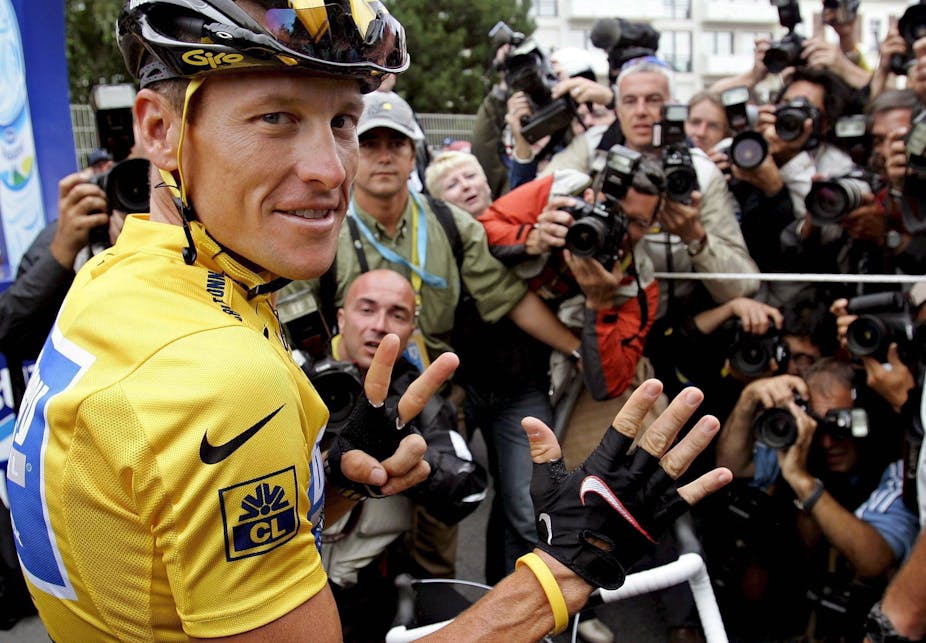
The seven-times Tour de France winner looks set to lose his titles. Gero Breloer/EPA

It seems as if the case against Lance Armstrong has ended not with a bang but a whimper.

The American seven-times Tour de France champion issued a statement earlier today, stating that “enough is enough” and that he would no longer engage with the US Anti-Doping Agency (USADA), whose ongoing doping allegations he described as a “charade”. There was, he added:

zero physical evidence to support [USADA’s] outlandish and heinous claims. The only physical evidence here is the hundreds of controls I have passed with flying colours. I made myself available around the clock and around the world […]

From the beginning, […] this investigation has not been about learning the truth or cleaning up cycling, but about punishing me at all costs.

In short, Armstrong maintains his innocence, but will not contest the doping case brought by USADA and thus will accept any sanctions the organisation imposes.

After a US court decided a few days ago it had no jurisdiction to interfere with the USADA proceedings, Armstrong was left with two possible moves:

1) Contest the USADA allegations in arbitration

And what allegations they were, running the full gamut of drug use and blood manipulation, and their prolonged cover-up:

… numerous riders, team personnel and others will testify based on personal knowledge acquired either through observing Armstrong dope or through Armstrong’s admissions of doping to them that Lance Armstrong used EPO, blood transfusions, testosterone and cortisone during the period from before 1998 through 2005 and that he had previously used EPO, testosterone and HGH through 1996 …

[…] Doping is further evidenced by the data from blood collections obtained by the UCI from Lance Armstrong in 2009 and 2010. This data is fully consistent with blood manipulation including EPO use and/or blood transfusions.

The above would most likely include testimony from Armstrong’s former teammates Tyler Hamilton, Floyd Landis and others who have already levelled various allegations over the last several years.

This process would have been a donnybrook of the first order – a dozen or so high profile athletes laying out testimony (and being cross-examined) in front of the world’s media, discussing the intricacies of doping at the highest levels of cycling for more than a decade.
Ben Macmahon/AAP

Not only that – the involved parties would be a series of Armstrong’s former teammates, and the evidence would have become as specific as the dissection of Armstrong’s original blood-testing results.

This undoubtedly would have been the highest profile doping case in history – bigger in scale, bigger in scope and bigger in consequences than anything that’s gone before.

And there is no doubt USADA will not blink – team doctor Luis Garcia del Moral and consultant doctor Michele Ferrari, both named in the same US Postal Service case as Armstrong, are already listed as sanctioned for life on the USADA webpage.

Considering this, it is no surprise that Amstrong has decided to:

2) Not contest the allegations in arbitration, and accept any punishment.

This makes no difference to his road cycling career after retirement, but will affect his ability to participate in future World Triathlon Corporation (WTC) events.

It will also almost certainly mean the loss of his seven Tour de France titles, the possible revocation of his bronze medal from the 2000 Olympics and further sanctions for prize monies lost etcetera – not to mention further personal financial consequences from lost revenue, sponsorship and the like.

Regardless of his guilt or innocence, it is a simple matter to understand how contesting this process would have appeared.

Where are we now?

So what actually happened? We don’t know.

We are left with an enormous black hole where there should be information. USADA has revealed maddeningly little information on these matters – merely what and who they involve.

The primary alternative motive offered by Armstrong – a personal vendetta mounted by the USADA – would have to be extreme if true. It is hard to imagine the animus that he must have generated to make a bevy of professional cyclists break ranks and discuss this matter openly under examination, considering their historical reticence to ever discuss such issues.

But we really don’t know. And once more, we are merely left with inconsistencies and frustrations. No doubt this will result in the usual sound and fury in conversation – supporters of Armstrong will note angrily that he has never failed a drug test; detractors will note that former sprint star Marion Jones used to declare precisely the same thing – before she admitted using performance-enhancing drugs, and was jailed for initially lying about it.

None of these arguments are new – nor are serious allegations and personal enmity towards Armstrong recent phenomena. After being promised a definitive answer, we are left once again wondering precisely what happened.

Where to from here?

The only real winner after today’s events is cycling, but not because of any laudatory action on the part of the multiple regulatory bodies involved – in this case the USADA, USA Cycling and the UCI.

The whole case points to a systemic mismanagement of drug control as regulation has either, depending on your perspective, failed to bring a legitimate case against the sport’s most high-profile and flagrant drug user for around 15 years; or viciously persecuted the only household name in global cycling, who is entirely innocent.

But cycling still wins, as Armstrong’s move defuses the situation entirely and guarantees the promised media circus will not eventuate at anything like the planned intensity.

It seems likely that the only thing most people could agree on right now would be Judge Spark’s final conclusion from his arbitration earlier in the week:

As mystifying as USADA’s election to proceed at this date and in this manner may be, it is equally perplexing that these three national and international bodies are apparently unable to work together to accomplish their shared goal – the regulation and promotion of cycling.

Further reading:
Is the Lance Armstrong affair a race to the bottom for cycling?
Lance Armstrong charged with ‘blood doping’ and EPO-use … so how do they work?
Frank Schleck, the Tour de France and doping: so what’s xipamide?
Contador, doping and the need for speed
Alberto Contador banned for doping, but what is clenbuterol?

Join the conversation

47 Comments sorted by

  1. Mark Goyne

    Lawyer

    I don't know why he didn't contest the charges. A sports law practitioner would have got him off. If you don't catch a person out when they won the event, that should be it. Coming back 7 yrs later is wrong.

    report
    1. Seamus Gardiner

      Citizen

      In reply to Mark Goyne

      Mark,
      Since you're a lawyer I was hoping for some more technical illumination upon the matter. Why is it, you think, that Mr Armstrong has not proceeded with contesting an administrative charge when he has so vigorously defended all charges in the past?

      report
    2. Ben Koh

      Sports Doctor. PhD social Research into Athlete Motivation. ACSM (Health Fitness Instructor and Exercise Specialist). Ex-elite swimmer.

      In reply to Mark Goyne

      Mark

      I think the issue is that this case is judged as much by the court of public opinion as it is in the court of arbitration. Since WADA works on the basis of strict liability and is able to proceed not just on physical/physiological evidence, but also on witness account of use of banned "method" as described in the Code, it becomes an issue of what is the economic option with the least losses.

      Using the letter of notice to Lance Armstrong (cc: various other defendants) from Lisa McCumber…

      Read more
    3. Jack Arnold

      Director

      In reply to Seamus Gardiner

      The USADA has failed to present any substantial evidence that Armstrong has taken banned substances. In all other jurisdictions the alleged offender would be a no brainer NOT GUILTY decision.

      report
    4. Seamus Gardiner

      Citizen

      In reply to Jack Arnold

      Jack,
      USADA has failed to present the evidence to you. As you take no part in the administrative process, this is right. You, like me, will have to wait to see how this plays out and see what the evidence that USADA are holding close to their chest actually is. In the meantime perhaps we should not pole vault to conclusions that this is some grubby underhand process designed to lop off the head of some tall poppy. I'll remind you that Mr Armstrong was perfectly capable of contesting USADAs position but declined to do so. He is not guilty of anything, but he has declined to contest assertions of his guilt.

      report
    5. Ben Koh

      Sports Doctor. PhD social Research into Athlete Motivation. ACSM (Health Fitness Instructor and Exercise Specialist). Ex-elite swimmer.

      In reply to Seamus Gardiner

      Hi Sean

      You mentioned "...I'll remind you that Mr Armstrong was perfectly capable of contesting USADAs position but declined to do so. He is not guilty of anything, but he has declined to contest assertions of his guilt...."

      While I agree with most of the points you have raised in this and other posts on the matter, I think it is presumptive for anyone to assume that an individual's decision to pursue or not pursue a case through the legal system is an indication of guilt or otherwise.

      As…

      Read more
    6. Seamus Gardiner

      Citizen

      In reply to Ben Koh

      Hi Ben,
      Thanks for the reply. I see your point but I do have an issue with a couple of things that you've raised:
      In respect to the question of presumptive guilt, USADA have made allegations against Armstrong of conspiracy and doping: essentially finding him guilty by doing so (via administrative process). It is not Armstrong's lack of contestation that determines his guilt it is USADA's decision based upon the evidence that they have gathered. Armstrong not contesting does not make the evidence…

      Read more
    7. Doug Green

      logged in via email @gmail.com

      In reply to Ben Koh

      Ben, the crucial difference between the case you cited is that Marion Jones was guilty of cheating yet she fought the charges, Lance Armstrong, one of the fiercest competitors of all time, is self-confessedly innocent but he is not fighting the charges.

      I cannot fault what you say in a technical and legal sense.

      However IF I was innocent AND a group of my ex-team mates, for whatever reason, conspired to slander me and report me for cheating AND my stellar sporting record, my income and my reputation…

      Read more
    8. Ben Koh

      Sports Doctor. PhD social Research into Athlete Motivation. ACSM (Health Fitness Instructor and Exercise Specialist). Ex-elite swimmer.

      In reply to Doug Green

      Hi Doug,

      Good points and all with merit. However, for the purpose of academic discourse here's my thoughts:

      You mentioned "... IF I was innocent AND a group of my ex-team mates, for whatever reason, conspired to slander me and report me for cheating....[I will legally defend my case]"

      In my opinion, I think the issue of asserting a right needs to be balanced against the cost-benefit of proceeding through the legal route.

      Taking a different but equivalent context of defamation (paraphrased…

      Read more
    9. Ben Koh

      Sports Doctor. PhD social Research into Athlete Motivation. ACSM (Health Fitness Instructor and Exercise Specialist). Ex-elite swimmer.

      In reply to Seamus Gardiner

      Hi Sean

      Thank you for your comments.

      You mentioned <... In respect to the question of presumptive guilt, USADA have made allegations against Armstrong of conspiracy and doping: essentially finding him guilty by doing so (via administrative process)...>

      Yes that is the USADA perception and interpretation of the anti-doping Code based on the information they have. In court, both parties will be able to argue their interpretation of the Code from their own perspective and framing of the information…

      Read more
    10. Seamus Gardiner

      Citizen

      In reply to Ben Koh

      Good points, I'm sure we'll continue to disagree... I'm still baffled by your last point- you give the impression that Armstrong is beyond Right, that is, he is beyond questions of right or wron.. I'm assuming that this is something you impute that he believes of himself, not something that it is to be thought about him by others....

      report
    11. Doug Green

      logged in via email @gmail.com

      In reply to Ben Koh

      Ben, I can't disagree with you about the trauma, emotional and financial, involved in being involved in a court action. Only a fool would embark on this course frivolously, needlessly and/or without advice. And it is a truism often observed that our legal system, while it adjudicates the law, it often serves justice less well.

      However we are not talking about whether someone should pursue a court case against their neighbor who called them an idiot down at the pub. We are talking about a world…

      Read more
    12. Ben Koh

      Sports Doctor. PhD social Research into Athlete Motivation. ACSM (Health Fitness Instructor and Exercise Specialist). Ex-elite swimmer.

      In reply to Seamus Gardiner

      I am not inferring, or intend to give the impression, that Armstrong is beyond Right (or wrong). Everyone has the prerogative to question in favour or against Armstrong. It simply to show that right or wrong way not matter in the end.

      In Armstrong's first book, he titled it "It's not about the Bike": The binding theme throughout the book was that Armstrong's determination was not about cycling or continuing to compete, rather that it was a practical and tangible goal that he knows how to achieve…

      Read more
    13. Ben Koh

      Sports Doctor. PhD social Research into Athlete Motivation. ACSM (Health Fitness Instructor and Exercise Specialist). Ex-elite swimmer.

      In reply to Doug Green

      Doug,

      Without meaning to come across as an unbiased Armstrong advocate (I am not swayed either way), there is also the perspective of a moral high ground.

      "...We are talking about a world class athlete, and household name, whose whole commercial, brand and emblematic worth post-sport is prefaced upon him not having cheated. Such an accusation, could cause him huge harm not only financially, but reputation-wise...."

      These are extrinsic, comparative constructs that may mean very little to…

      Read more
    14. Seamus Gardiner

      Citizen

      In reply to Ben Koh

      Ben,
      I see your what you meant, I do disagree fundamentally. I think this is an important time in sports. The 'right' does matter, especially in respect of a role model and a leader in the sport such as Armstrong. No-one expects our top athletes to be angels, we just want them to fight fair. Irrespective of whether this is just public opinion or contested as matters of fact in a court ethical behaviors do matter. This is now in doubt at the top levels of cycling.
      Sure, this will go away and 'right or wrong way (sic) not matter in the end' but it does matter, otherwise this is just exporting the problem to next year or the year after. Athletes have to know that unethical behaviour will be sanctioned, regardless of when it occurred-ore wise why have the sport regulated at all?

      report
    15. Ben Koh

      Sports Doctor. PhD social Research into Athlete Motivation. ACSM (Health Fitness Instructor and Exercise Specialist). Ex-elite swimmer.

      In reply to Seamus Gardiner

      When you refer to the "right" in what context are you referring to? If our terms of reference is in this forum and in the context of what Armstrong should or should not decide to do, then as per my earlier posts, what is right or wrong is a matter for Armstrong to decide for himself.

      If as your latest post suggest, the terms of reference is the fundamental moral and technical issue of what is right or wrong in doping in sports, either by liberal or strict interpretation of the WADA code and/or…

      Read more
    16. Seamus Gardiner

      Citizen

      In reply to Ben Koh

      No, Ben, to paraphrase you what matters in the business of sport is excellence in sporting performance alone. I disagree fundamentally on your lassaiz faire attitude towards performance enhancement. There are more things that matter in sport than excellence in sporting performance alone... I can't believe that you see no problem with surreptitious use of PEDs so I must have misinterpreted your post. Yes?

      report
    17. Ben Koh

      Sports Doctor. PhD social Research into Athlete Motivation. ACSM (Health Fitness Instructor and Exercise Specialist). Ex-elite swimmer.

      In reply to Seamus Gardiner

      No.
      It is not a lassaiz faire attitude. It just stating the hypocrisy and inconsistency of application of the Code with respect to PESM use. If we want to stick to the strict interpretation of the Code, be consistent. If pragmatism dictates that inconsistency (e.g. use of technology in sport) is a modern day reality, then at least be honest and true to that fact. Cherry picking what PESM to accept and/or reject satisfy neither camp.

      report
    18. Seamus Gardiner

      Citizen

      In reply to Ben Koh

      Your post is opaque, are you objecting to technological advances? Training technologies? Nutrition! What are you stating is inconsistent or hypocritical?

      report
    19. Ben Koh

      Sports Doctor. PhD social Research into Athlete Motivation. ACSM (Health Fitness Instructor and Exercise Specialist). Ex-elite swimmer.

      In reply to Seamus Gardiner

      I am not sure how you are defining being opaque or transparent.
      My responses have merely sought to address the issues you have raised.
      It seems your discussion seems to extend further and further away from the original terms of reference. It is hard to address a moving target.

      Again, if the terms of reference is on what Armstrong should/should not do, then it is Armstrong's choice and no one else.

      If the terms of reference is the rules in sport, then it is beyond the scope of this discussion…

      Read more
    20. Seamus Gardiner

      Citizen

      In reply to Ben Koh

      It's naive to think there will no no inconsistencies in applying the rules of sport- just as in criminal law. There's a difference between a recreational drug like caffeine, a slippery helmet or wetsuit and blood doping or EPO, which is the impression that I gained from your previous post. You are right this conversation is tangential, although apropos.

      report
    21. Seamus Gardiner

      Citizen

      In reply to Seamus Gardiner

      Well... The evidence is out.... I was waiting for the sound of a million yellow plastic bracelets hitting the floor but its drowned out with the cries of 'but he never failed a d...............'

      report
  2. Mark Harrigan

    Dr

    I have no diea whether or not Armstrong is innocent or guilty. But the current outcome seems both a travesty of prcoedural fairness and a denial of the presumption of innocence.

    It was particularly shocking to me, and I think shameful, for the head of the world anti doping authority, John Fahey, to claim that Armstrongs decision not to contest the charge was such that "he effectively has admitted to the charges" and that "There's no other interpretation" to the question "that Lance Armstrong is essentially pleading guilty by his decision not to contest the charges?"

    That is clearly false. There are plenty of other interpretatations of varying degrees of plausibility - but we don't, or ought not, to convict on suspicion.

    report
    1. Seamus Gardiner

      Citizen

      In reply to Mark Harrigan

      Lance Armstrong is not contesting the charge, he is denying himself procedural fairness. He is fully able to contest the charge and clear his name if he so wishes.

      To state that he is guilty is technically incorrect (as you say, Mark) but stripping him of his victories is correct in the same way that entering no plea entitles a criminal court to convict upon reasonable evidence. The difference being that he is not undergoing a 'trial' of the evidence. But this is not a court of law, sufficient evidence may have been presented to USADA to make administrative judgement based upon their procedural rules. This evidence, and the rules whereby these judgements are made, are obscure. Personally, I agree with fahey and the author, I would like to see the evidence made public in order to clear the matter. However I am personally satisfied of his likely guilt, I cannot think of another reasonable explanation that explains the body of circumstantial and physiological evidence.

      report
    2. Mike Hansen

      Mr

      In reply to Seamus Gardiner

      "...explains the body of circumstantial and physiological evidence" ?
      "I would like to see the evidence made public..."
      So would I but you appear to have been given an advance preview. No?

      I guess pro cycling has only itself to blame for years of not policing drug use.

      There has been plenty of online chatter (and a celebrated question asked at a Wiggins press conference) about the dominating performance of Wiggins and Froome in this year's TDF and other races. Froome it seems has come from nowhere whereas Wiggins at least has a track record of superb performances at the Olympics. Is this "circumstantial" evidence?

      Perhaps this is the way it should be - that everyone in professional cycling is considered a drug cheat unless they can prove otherwise. But how do they prove otherwise?

      report
    3. Seamus Gardiner

      Citizen

      In reply to Mike Hansen

      Advance preview? There's this thing called the internet and Lance Armstrong's haematocrit results have been on his website for some months:

      http://www.cyclingnews.com/features/analysis-armstrongs-tour-blood-levels-debated

      Testimony from colleagues as widely reported in the media:

      http://www.abc.net.au/news/2012-08-25/usada-confirms-armstrong-life-ban/4222288

      This is what I meant by 'evidence'. What I meant by more evidence is the further physiological data collected from Mr Armstrong…

      Read more
    4. Mike Hansen

      Mr

      In reply to Seamus Gardiner

      You are really pissing into the wind Sean.
      The ABC article quotes Floyd Landis - sorry Landis is not a credible witness. I watched his "unbelievable" stage 17 2006 TDF ride live on TV (when he was doped up on testosterone). You did not need to be from USADA to guess he was on something.
      http://en.wikipedia.org/wiki/Floyd_Landis
      You then quote a story which claims Armstrong was doping in 2009 - although "natural factors could possibly be an explanation". Why would he be doping in 2009? That was his come back ride.

      USADA's claim to have testimony from former team mates of doping during the period when he was winning the TDF (and doping was widespread in the sport) has much more credibility - but that is the evidence that has not been released.

      I understand that Bruyneel is still fighting his case so I would imagine that it will eventually all become public.

      report
    5. Seamus Gardiner

      Citizen

      In reply to Mike Hansen

      Thanks for the ad hom, not very inventive... Please do better next time.

      Why would he dope in 2009? The same reasons he would dope at any year. To win.

      Flandis' testimony is not likely to be more or less credible than any other, especially now that he has nothing to gain by lying. Which testimony form his previous teammates will you accept?

      report
    6. Mike Hansen

      Mr

      In reply to Seamus Gardiner

      This following link explains what an ad hominem is. But if you are offended by my use of a colloquialism, I apologize.
      http://en.wikipedia.org/wiki/Ad_hominem

      To answer your question, if USADA have the evidence they claim to have, it would remove all doubt. I am not however a fan of conviction by Internet.

      report
    7. Mark Harrigan

      Dr

      In reply to Seamus Gardiner

      Sean, I can't agree. This is a difference between not entering a plea and having a court still deliberate, in an open transparent fashion, and what has happened here. If the USADA were to submitt their evidence to proper testing and argue their case to am impartical observer (or judge) who then made an assessment (with or without Mr Armstrongs testimony) I might have a different view. At the moment it appears to be allegation, prosection and conviction without any of the procedural fairness we normally associated with such matters

      report
    8. Jack Arnold

      Director

      In reply to Mark Harrigan

      John Fahey was an inconsequential NRL player, an undistinguished Liberal Party Premier & now appears to be also a bully hiding behind a legal strategy of innuendo & doubt.

      If the USADA has evidence of this alleged doping let them bring it forward as plaintiff. Otherwise, the USADA appears to be part of a CIA style conspiracy to discredit a very tall poppy who has passed over 500 doping tests without exception.

      This appears to be a sporting wannabe attempting to take down a true champion.

      report
    9. Jack Arnold

      Director

      In reply to Seamus Gardiner

      Oh dear, silly me ... and here's me thinking that the US, UK Australia & all other British based justice systems had a presumption of innocence until the offender is found guilty by a jury of their peers.

      No evidence presented at a properly constituted court, so no charges are laid, so Armstrong is innocent until proven guilty ... QED

      The USADA is running a witch hunt just like the Australian Carroll case where Queensland Police pursued an alleged offender (accused of murder) through the court system for about 25 years DESPITE 11/11 senior judges finding that the person was innocent.

      report
    10. Seamus Gardiner

      Citizen

      In reply to Jack Arnold

      Yes the USADA ruling is exactly the same as the Carroll case. Except one was a criminal case. Oh, and one was based on beyond reasonable doubt against balance of probabilities. Oh, and was is a tribunal not a court. Oh, and one is subject to Australian law and one to American administrative procedural law. Other than these exceptions you're totally correct.

      report
    11. Jack Arnold

      Director

      In reply to Seamus Gardiner

      Oh dear ... silence does NOT mean anything except exercising the Right to Silence. A court cannot make any adverse assertions from silence by an accused person ... at least in Australia. The Barrier OFascist NSW Liberal notional government would like to change this long established rule protecting the accused from the overwhelming power of the state because the NSW Police are, in general, poorly recruited & inadequately trained to conduct criminal proceedings & removal of the Right to Silence is the cheapest option available to an uncaring government.

      report
  3. Peter Evans

    logged in via Twitter

    Has the UCI commented yet? I wouldn't be so sure that the UCI will agree to the 7 TdF titles being stripped, because most of the cyclists who came second also have drug use records, and USADA can't touch them as they are non-Americans. I think this move by Armstrong is to force the UCI's hand and declare what they'll do, and my guess is they'll do nothing - there's simply too much scope for stuff to get right out of control. This could put the UCI and USADA in conflict and USADA would lose that battle for public opinion (or wreck the sport of professional cycling).

    report
  4. Ben Koh

    Sports Doctor. PhD social Research into Athlete Motivation. ACSM (Health Fitness Instructor and Exercise Specialist). Ex-elite swimmer.

    Book Sequel:

    It's Not About the Right: My Journey through the Strife

    report
  5. Stephanus Cecil Barnard

    Town planner and freelance writer at Kalahariozzie

    Well, there we have it. It was a relentless witchhunt by the USADA that finally came to a head. I found the self-righteous comments by the head of the world anti doping authority, John Fahey, on ABC News that Lance has admited guitl by his actions quite nauseating.

    Lance Armstrong will remain a hero in my eyes, and John Fahey and his cronies sore losers forever.

    report
  6. Phil Dolan

    Viticulturist

    In an Ideal world there would be no drugs in sport and it's good that the authorities are trying to stamp it out. This however is going over the top. He was tested five hundred times, but is being charged on what others say. What are they trying to prove?
    Armstrong is a great champion and has done a huge amount for charity. If he was using drugs he hid it well so get over it and think how to stop it in future.

    report
  7. Doug Green

    logged in via email @gmail.com

    Drugs or not, I think it can pretty safely be said that Lance Armstrong has demonstrated an almost superhuman level of determination and competitiveness throughout his life and career. And a similar level of tolerance to pain, illness, irritation, discomfort, long odds etc.

    For him to say of the case against him that 'enough is enough' and to just walk away, given the devastating ramifications for his stellar sporting career, his income, and his reputation, beggars belief. If it was me (and I was innocent) I would fight to the last ounce of flesh and borrowed dollar to prove my innocence, and I don't possess a fraction of Armstrong's legendary determination and fighting ability.

    report
  8. Joe Gartner

    Tilter

    'snip'

    The sound of 100000 little yellow plastic rings being cut-off

    report