

Las Malvinas or Falkland Islands: British or Argentinean?

The first buildings in Las Malvinas – or the Falklands as the British call the islands in the South Atlantic – were houses made of stone and were built by Argentinean hands. It was in 1831 when forty men – led by Luis Vernet, the first Argentinean commander in Las Malvinas – settled here. Along with…

8ns5kfkt-1332898714
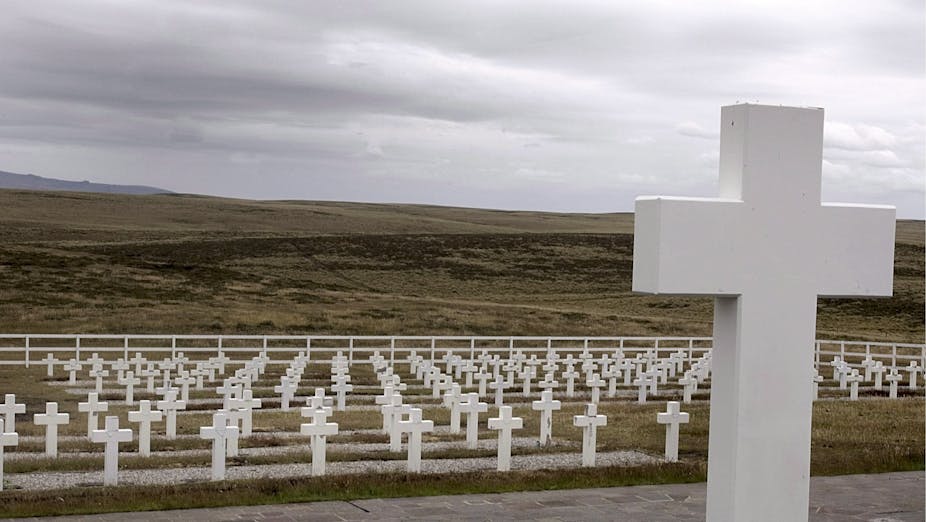
Graves of Argentinean servicemen killed by UK forces in the 1982 war. AAP/EPA/Flight Sergeant Andy Carnall
3gwd5jbh-1332898660
Protestors hurl paint at the HSBC bank in Buenos Aires after the UK announced Prince William would be posted to Las Malvinas. AAP/EPA/Leo La Valle

The first buildings in Las Malvinas – or the Falklands as the British call the islands in the South Atlantic – were houses made of stone and were built by Argentinean hands.

It was in 1831 when forty men – led by Luis Vernet, the first Argentinean commander in Las Malvinas – settled here. Along with him came his wife, María who gave birth a girl who was christened Malvinas. The Argentinean settlement in this merciless land didn’t last long though.

In 1833 the British colonial power invaded Las Mavinas, and what happen afterwards is now called “ethnic cleansing” – hundreds of English settlers were artificially introduced while all Argentineans were expelled.

The British invasion and the thorny question of who owns Las Malvinas – has been reignited with unprecedented fervour on April 2, the date marking the 30th anniversary of the Argentinean and British war, in 1982. The tension between Buenos Aires and London has escalated.

The Union Jack is torched outside the British embassy in Buenos Aires. AAP/EPA/Daniel Feldman

The war of 1982 was a folly led by the madness of the then Argentinean dictator General Leopoldo Galtieri, who couldn’t find anything better to do than recover the islands by force. The conflict, which lasted 74 days, caused the death of 649 Argentinean soldiers, 255 British and three civilians. His military jaunt – more of an attempt to divert attention from his crumbling dictatorship than anything – had nothing to do with the genuine aspiration of Argentina to recover Las Malvinas.

The current push by Argentina to recover Las Malvinas, encapsulated by the energetic diplomatic offensive of the Argentinean president Cristina Kirchner, is today not only genuine but also legitimate. President Kirchner has described the recovery of Las Malvinas as a “struggle against colonisation".

Kirchner has transformed the recovery of Las Malvinas into a central piece of her renewed political mandate; she was re-elected recently with an overwhelming majority. And – in contrast to the military adventurism of 1982 – President Kirchner’s renewed claim for La Malvinas is not a political “gambit”, as the British media and commentators have tried to discredit it.

“A struggle against colonialism”: Argentinean President Cristina Kirchner AAP/EPA/Leo La Valle

President Kirchner is articulating a genuine national aspiration and she is playing by the rules. Her foreign minister Héctor Timerman has been tireless running up and down the corridors of the UN trying to get the British government to sit down and discuss a peaceful solution to the conflict. He has sought mediation at all levels of the UN, General Secretary, General Assembly and the Security Council. All of them have pledged to help.

But London has plainly ignored the diplomatic efforts made by Buenos Aires and has stated that it will not negotiate over the sovereignty unless the inhabitants of the islands wish to do so.

Similarly, the UK has never acknowledged the United Nations 1514 resolution – the Declaration over the Independence of Countries and Colonial People – that establishes that any attempt to break the national unity and territorial integrity of a country is incompatible with the principles and purposes of the UN.

The uncooperative approach taken by London has been further worsened by the UN British ambassador Mark Lyall Grant “warning” Argentina that any attempt to use the April 2 anniversary to launch a “military adventure” would be confronted by a “robust defence.” As if the Argentinean government was planning to do so.

Lyall Grant’s unhelpful statement is a reflection of the aggressive approach taken by London, one that has been accompanied by the British government’s hasty militarisation of Las Malvinas and the Southern Atlantic.

“British out from Las Malvinas: we shall return” – graffiti in Buenos Aires. Antonio Castillo

In the last few months this remote part of the world has witnessed the arrival of several Typhoon II – the latest generation of warplanes (they have been used in Afghanistan, Libya and Iraq); HMS Dauntless – the most advanced war ship of the British navy; and HMS Vanguard – a nuclear submarine. This in contravention of the 1967 Treaty of Tlalelolco that banned nuclear arms in Latin America, the Pacific and Caribbean region.

“Great Britain has transformed Las Malvinas Island into a key military base for the control of the South Atlantic, the inter-oceanic access and projection into the Antarctica securing the exploitation of the natural resources of the South Atlantic that belongs to the Argentinean people,” an Argentinean Ministry of Foreign Affairs communiqué said.

Buenos Aires has no doubt that the militarisation of the zone – a bit disproportionate by all accounts – has nothing to do with the defence of the 2,500 British citizens living in Las Malvinas. But it has everything to do with the control of the vast natural resources in the area.

The British government announced an ambitious plan to drill in the area that seems to contain, according to some experts, the equivalent of 60 million barrels of crude oil.

The British action is in contravention of the United Nations ban on unilateral development and exploitation of territories still under dispute. On this, one has to concur with Argentina’s foreign affairs minister Héctor Timerman that the British government is acting “above the judicial international order.”
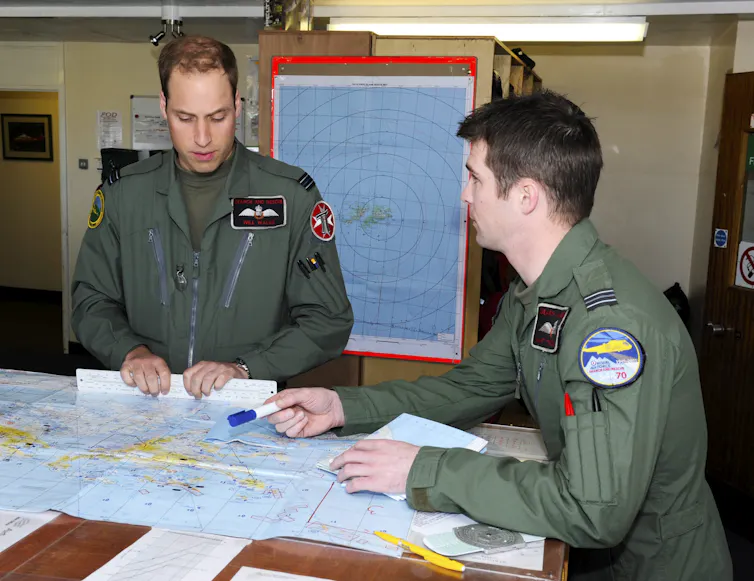
Prince William poses with a map of Las Malvinas ahead of his posting to the British possession. AAP/EPA/Sgt Andry Malthouse Abipp

The militarisation of the South Atlantic and certainly the British colonial presence in the region has not gone down well in Latin America. After all, this is a region that has suffered to this day the damaging effects of imperialism and colonisation; first under Spanish colonial rule and then under US imperialism.

No wonder Las Malvinas’ sovereignty is no longer an Argentinean aspiration only. It has become a Latin American claim. The largest majority of Latin American countries have acted in block to support Argentina’s legitimate claim, including Chile – a traditionally pro-English country that under the military dictatorship of General Pinochet provided logistic support to the British in the war of 1982. Last December several Latin American countries announced they would block any ships navigating under the “Falklands” flag.

In addition several Latin American leaders have expressed their support for Argentina’s claim. Ecuadorean president Rafael Correa wrote on Twitter an impassionate message: “Las Malvinas is a Latin American cause, dear Argentina not one step back!”

In the light of this overwhelming domestic and regional support, it is very unlikely that President Cristina Kirchner will take a step back. On the contrary, she will strengthen her position around a legitimate post-colonial ideal sharply expressed by Cuba’s leader Fidel Castro – “the English have nothing to do here, they have to negotiate and leave.”

Articles also by This Author

Sign in to Favourite

Want to follow The Conversation?

Sign up to our free newsletter to get the day's top stories in your inbox each morning, with a special wrap on Saturday.

Spinner
Help evidence based journalism become the norm and donate

Join the conversation

91 Comments sorted by

  1. Chris H

    Psychologist

    Notwithstanding the crimes of the past and general Geo-politic biffo, has anyone seriously looked at what would happen to the current residents if the islands went back to Argentinian control? Has Argentinean President Cristina Kirchner put forward any workable ideas on that? What are the implications for other countries where original inhabitants have been ousted or sidelined by newer arrivals... such as ours, or Argentina for that matter, which is also a product of colonialism. Seems to me the implications of this debate are a little broader than any of the stakeholders are indicating.

    report
  2. Mat Hardy

    Lecturer in Middle East Studies at Deakin University

    This is possibly the most one-sided article I have ever seen at the Conversation. It reads like a press release from the Argentinean Consulate.

    The only thing that makes the Falklands a "thorny question" is the fact that Argentina still thinks a few months of occupation in the early 1800s out-does 150 years of British settlement. To use terms like "ethnic cleansing" is inflammatory, asinine and completely insulting to populations that have actually experienced some form of genocidal extermination…

    Read more
    1. Stiofán Mac Suibhne

      Contrarian / Epistemologist

      In reply to Mat Hardy

      The article is duff. Anti-British propaganda. This website does have some quality control issues. There is a particulalr shallowness to this piece, sort of mid teen quality analysis. Dangerous to start delegitimising the choice of the Falkland Islanders who wish not to change their constitutional settlement. Argentina's long history of military dictatorship / fascist regimes would not be much of an inducement for the Falkland Islanders.

      How would it be different for Australia if the Indonesians…

      Read more
    2. Antonio Castillo

      Program Director, Journalism at RMIT University

      In reply to Mat Hardy

      With all these Hardies, the Jones, the Carters, the Mac Suibhnes, the Browns, the Kites et al -- I was wondering if you are members of the "barmy army"?

      I have been living and working in HK - it was given back to China. That was the right thing to do. Eventually Las Malvinas will be given back to Argentina. That is right thing to do too.

      Old English nostalgic colonial power belongs to a bygone era.

      Cheers (with a Malbec from Mendoza)

      Antonio

      report
    3. Stiofán Mac Suibhne

      Contrarian / Epistemologist

      In reply to Antonio Castillo

      You are making a complete prat of yourself. I am Irish. Perhaps your ignorance is complete. Anglo-Saxon indeed. I have never been in any army, barmy or otherwise. Why don't you address the points that are being made instead of descending into vacuous sporty banter. I don't subscribe to the doctrine of my enemy's enemy is my friend. You probably ought to state your biases. We can have different perspectives, it's just that your article is rubbish.

      report
    4. Roger Jones

      Australian Citizen

      In reply to Antonio Castillo

      Would it be too much to ask that a lecturer at Sydney University actually engaged in reasonable and mature debate rather than turn to sillyness. I can't speak for the others but I am Australian. The Falkland Islands effect me not one iota. Neither does the situation in Syria. That doesn't mean I don't have an opinion. My opinion of your article is that it is under-researched, is based on poor assumptions and is biased. You now have the opportunity to come back and address the issues I have questioned and show that I am wrong.

      I mean you are vreally a lecturer in Internations Relations aren't you? Please show us that your students receive knowledgable, unbiased teaching?

      report
    5. Pluto Stewart

      Student

      In reply to Antonio Castillo

      Hong Kong is completely different to the Falklands. It was a loan for 99 years that began in 1898 until 1997. Britain honoured the agreement as any respectable government would
      A quick look at the wikipedia page would have prevented you from making such an inane and unfounded comparison:
      http://en.wikipedia.org/wiki/Convention_for_the_Extension_of_Hong_Kong_Territory

      Argentina have behaved despicably throughout, invading, losing and then bullying the islanders for having committed the appalling crime of wanting self-determination.

      Have the Argentinian people not learnt from the first time round? Do they not realise that stoking up excessive nationalistic fervour is Kirchner's way of covering up her failing internal policies and the ridicule she is exposed to on the international stage?

      She is a disgrace to modern politics. The Argentinian people need to have a good look at themselves in the mirror.

      report
    6. Pluto Stewart

      Student

      In reply to Antonio Castillo

      Also, having looked at your profile, it seems ironic, not to say hypocritical, that a man who has written on the topic of democracy, is unwilling to accept that the inhabitants of the islands have the right to choose who governs them!!

      report
    7. Mister Kite

      Project Manager

      In reply to Antonio Castillo

      Antonio - you appear to be judging us based on the spelling of our surnames, not the content of our arguments.

      Is this all you've got by way of response - some tired and empty banalities about 'English colonial power"?

      As Pluto points out, the Hong Kong analogy is completely flawed. Hong Kong was a tract of land that (for the most part) Britain leased for a period of time before duly handing back. The Falklands in comparison were a group of isolated islands uninhabited save for various small, short lived, and in Argentina's case rather lawless, settlements plus an itinerant poplation of sealers. And, as Andrew points out, quibbling about who landed where 180 years or more so ago is trivial compared to the rights of people who have been living there for up to 8 generations.

      I don't wish to be overly critical but you appear to have only a very superficial knowledge of this whole issue?

      report
    8. Simon Jowitt

      Research Fellow in Economic Geology at Monash University

      In reply to Antonio Castillo

      Antonio, re "Hardies, the Jones, the Carters, the Mac Suibhnes, the Browns, the Kites"; don't forget that the long history of immigration between Europe and Argentina has led to parts of the Argentina population having "Anglo Saxon" (even though this is a misnomer in the case of Mac Suibhnes) surnames, the wonderfully named Carlos MacAllister being a case in point: http://en.wikipedia.org/wiki/Carlos_Mac_Allister.

      report
    9. Simon Jowitt

      Research Fellow in Economic Geology at Monash University

      In reply to Simon Jowitt

      Oh, and I think you may have offended a significant proportion of the Welsh diaspora by calling "Jones" Anglo Saxon, given the names' Celtic Welsh origins...

      report
    10. Mark Carter

      logged in via Facebook

      In reply to Antonio Castillo

      That was a rather weak reply Antonio. Is such 'poisoning of the well' typically an accepted line of reasoning in your field?

      Considering its centuries-long and ongoing subjugation of indigenous people, settler-colony Argentina going around saying it wants land back because it was there first is downright cheeky. Perhaps Argentina should get its own house in order before agitating to throw others out of theirs.

      http://www.amnesty.org/en/region/argentina

      report
    11. Andrew Hack

      IT Project Manager

      In reply to Antonio Castillo

      It was a 99 year lease that expired, upon which Britain honoured the agreement and handed it back to China.

      report
  3. Roger Jones

    Australian Citizen

    This is a disappointingly shallow article by the Professor. I would hope his Latin American origins are not causing a biased view?

    He summarises the case for the islands being legitimately Argentinian based on the Argentinian settlement of 1831. However, first occupation of the islands is unclear and disputed. It is recorded that a Dutchman named Sebald discovered the islands in 1600 after which the Dutch, French, British and Spanish took various turns occupying or using the islands depending…

    Read more
    1. Antonio Castillo

      Program Director, Journalism at RMIT University

      In reply to Roger Jones

      Dear Mr Jones,
      How do you know I'm from a Latin American origins? You wrote: "I would hope his Latin American origins are not causing a biased view?.
      I could be an Australian with a Spanish name? or perhaps Filipino.
      Un abrazo
      Antonio

      report
    2. Roger Jones

      Australian Citizen

      In reply to Antonio Castillo

      Hi Antonio, my profuse apologies. I was under the impression you were of Chilean origin from what I read on your website. This is clearly a wrong assumption on my part. Having said that your article shows a clear bias towards Argentina. Would you care to comment on the response posts?

      report
    3. Antonio Castillo

      Program Director, Journalism at RMIT University

      In reply to Roger Jones

      Thank Mr Jones,
      I'm just a humble lecturer and journalist
      And please accept my apologies I haven't replied yet to the Anglo-Saxon pro-British diatribe. But I will. Soon.
      Have a nice evening
      Antonio

      report
    4. Roger Jones

      Australian Citizen

      In reply to Antonio Castillo

      Now who is making assumptions about ethnic origins?

      I'm hoping that this might be a mature debate with balanced opinions. Calling my points a diatribe does not bode well.

      report
    5. Stiofán Mac Suibhne

      Contrarian / Epistemologist

      In reply to Roger Jones

      Diatribe ► noun
      a forceful and bitter verbal attack against someone or something: a diatribe against the Roman Catholic Church.

      Oxford Dictionary of English (2nd Edition revised)

      I see no diatribe in your comments. The article itself might be approaching a diatribe though.

      report
    6. Michael Betts

      Analyst

      In reply to Antonio Castillo

      As a person born in the Falkland Islands and currently living there (I am a 8th generation Islander), I feel that this article is highly inaccurate and highly offensive.

      Firstly, it is not only Britain who calls the islands in question the Falkland Islands, those Islands are called the Falkland Islands. Only Argentina calls my home by that offensive M word.

      Antonio, it is attitudes like yours and senseless and highly bias and inaccurate articles like this cause the restlessness. All the Islanders…

      Read more
    7. Mat Hardy

      Lecturer in Middle East Studies at Deakin University

      In reply to Michael Betts

      Sorry Michael. Apparently your views on the matter don't count. Others have 'legitimate aspirations', don't you know.

      report
    8. Mark Carter

      logged in via Facebook

      In reply to Antonio Castillo

      Antonio,
      I for one am really looking forward to an explanation form you as to why modern Argentina (founded on the subjugation and disenfranchisement of indigenous people by european settlers, a situation continuing into modern times) has any moral right to today subjugate and disenfranchise a people who have occupied those islands for nearly two centuries.
      I also await a consistent and coherent setting out of why any modern political conduct must be rooted on correcting the territorial 'wrongs' of the 1830s, complete with an advocation of handing over the Balkans to Turkey, Vanuatu to Australia, Belgium to the Netherlands and Ecuador back to Colombia.
      Yours in anticipation
      Mark Carter

      report
    9. Roger Jones

      Australian Citizen

      In reply to Mark Carter

      Hey Mark, I wouldn't hold your breath. One of the things I've really enjoyed about The Conversation site is the authors of the articles participating in the debate. This particular blogg has been devoid of attempts by the author to clarify or strengthen points made. Indeed the only entries made by Antonio have been childish name calling.

      Is this the quality of lecturer at Sydney University these days? Poor research, opinion in place of fact, skewed logic, quoting twitter comments, etc? Very disappointing.

      report
    10. Tim Hawes

      Mr.

      In reply to Antonio Castillo

      Roger,

      Antonio may well be from anywhere, but he certainly went to University in Chile and has taken an interest in Latin American affairs (looking at his Uni of Sydney bio).

      I think we should take the personal out of the debate. Let's be honest, Antonio's bias in this story is not the issue, there's nothing about a bias which means it is inherently incorrect. The issue is how the article does not attempt to see both sides and includes factual obfuscation at best, or factual errors at worst, while maintaining a pre-tense of being balanced and well considered.

      report
    11. Roger Jones

      Australian Citizen

      In reply to Antonio Castillo

      Antonio said:
      "And please accept my apologies I haven't replied yet to the Anglo-Saxon pro-British diatribe. But I will. Soon. "

      That was three days ago and he has not responded because he recognises his argument is full of holes. Again I ask about the standard of lecturer at Sydney University?

      report
  4. Mark Carter

    logged in via Facebook

    So the actions of some naval commanders in the 1830s is grounds for the ethnic cleansing of british citizens from the Falklands today? Bizarre.

    report
  5. Roger Jones

    Australian Citizen

    I might also add some points about the accuracy of the article.

    Antonio says the first buildings on the Islands were built by Argentineans in 1831. Wrong, the French build a stone-bulit settlement in 1764.

    HMS Vanguard is not stationed there but is currently stationed in International waters of the South Atlantic.

    The Treaty of Tialelolco includes Latin America and the Carribbean but does not include the International waters of the Atlantic or the Pacific.

    In anyone's language the British military forces are defensive and pale against the substantial Argentinean forces (243 aircraft), 42 ships and an Army of 110,000.

    report
  6. Andrew Brown

    Engineer

    This article seems to gloss over the most important point - that of self determination. What happens to the Falkland Islands should be in the hands of its inhabitants. To ignore their wishes is unreasonable and, in my opinion, indefensible. Quibbling over which person landed where in the 1830's is of no consequence in comparison to this principle.

    report
  7. Mister Kite

    Project Manager

    Ok, first factual inaccuracy (aka lie) comes in at line 1. There are the remnants of stone buildings on Pebble Island dating from the British settlement the previous century (1760s). Not a promising start for what is clearly going to be a highly biased and subjective article.

    Paragraph 2 - it's pertinent to note at this juncture that Vernet was a German born businessman who led an enterprise to cull wild cattle on the islands. He did not set out to claim them on behalf of Argentina and actually…

    Read more
  8. Russell Walton

    Russell Walton is a Friend of The Conversation.

    Retired

    60 million barrels of oil is petty cash to the average oil company, certainly not in the 'vast natural resources' category----is the figure a typo? Perhaps 6 billion, 60 billion?

    60 billion is definitely worth fighting over, I'd predict that Argentina (usually bankrupt) would press its claim to the Falklands very vigorously if the reserves were of that magnitude.

    I wouldn't accept Castro as an exemplar of principled diplomacy.

    report
    1. Russell Walton

      Russell Walton is a Friend of The Conversation.

      Retired

      In reply to Stiofán Mac Suibhne

      Stiofan,

      Yes, certainly another perspective on the tragedy. However, I can't help contrasting the British effort in defence of the Falklanders with the rather cynical way they sold out the Chagos islanders. Different ethnicities might be the reason, or hydrocarbons.

      I don't have the expertise to argue the legal case as to which country has sovereignty of the Falklands, I can say the issue was certainly important to Argentines when I briefly visited the country in the summer of '82 and obviously still is.

      There are historical aspects that might not be apparent, the British attacked Argentina in the 19th century and presumably, if successful, would have incorporated the country into their empire. To the Argentines, there's a sense of 'unfinished business' in regard to the Falklands.

      report
    2. Marcelo Vasquez

      logged in via Twitter

      In reply to Russell Walton

      At about 19 million barrels the US consumes in a day, 60 million would last us a few minutes more than 36 hours... :))

      report
  9. James Walker

    logged in via Facebook

    The article can be put into perspective by considering an Australian example:

    how would we react if one of our politicians got up and said that because of our historical claims to the islands of Vanuatu (ie the blackbirding raids of the 19thC) Australia should occupy the islands?

    I hope everyone would consider such a politician insane. So why aren't Argentinian politicians doing exactly the same thing considered insane?

    report
  10. gregg dawson

    logged in via Twitter

    There are two sides to it; the money and the people. Argentina should be looking at this from a democratic stance, as in 'Which is better for the people who actually live there?', not merely as a means of cash injection.

    report
  11. Gavin Moodie

    Principal Policy Adviser

    I express no view on the competing claims for jurisdiction over the Falklands/Las Malvinas. But I suggest that Argentina is not pursuing its claims in the most advantageous way.

    Strengthening Argentina's claims is a project for 50 years, not 5. I would build social and cultural relations between the Falkland Islanders and a sister region in Argentina. I would hope that over 2 generations greater trust and cooperation may be built between Falkland Islanders and Argentinian people. That would be a far stronger ground for Argentina's claim than disputed claims of precedence and international law.

    report
    1. Marcelo Vasquez

      logged in via Twitter

      In reply to Gavin Moodie

      That was being done when I was still living in Argentina. Islanders were going to Argentina for medical treatments and sending their kids to school, flights between Stanley and several Argentinean cities were performed daily and consumer goods were imported from Argentina. Unfortunately, things coincided to make war desirable both to Gral. Galtieri and Mrs. Thachter, as a means to boost their decreasing popularity. Mrs. Thatcher ended outsmarting Galtieri, it is as simple as that. It takes two to tango.

      report
  12. Jane K

    Project manager

    In contrast to the opinions so far expressed about this article I think this raises a timely question. Perhaps our own situation as a former English colony makes it a little hard to look at objectively. Its great to have a voice from a different cultural perspective pointing this out and those who have been nit-picking about details are really missing the point.

    The issue here is - should a former colonial power ( UK) really maintain control of a far flung group of islands such as the Fauklands…

    Read more
    1. Roger Jones

      Australian Citizen

      In reply to Jane K

      I agree, it is great to hear different points of view but surely the case should be based upon fact and logic. The article is full of incorrect fact and biased logic.

      Are you suggesting that no matter how badly the article is written, how inaccurate and biased, because it is written by Antonio who has a Latin American origin then that is OK?

      report
    2. Stiofán Mac Suibhne

      Contrarian / Epistemologist

      In reply to Jane K

      'Its great to have a voice from a different cultural perspective pointing this out and those who have been nit-picking about details are really missing the point."

      The above is true only on the basis of "dont let the facts get in the way of a good story".

      This 'handing back' issue is pivotal. Argentina is a colonial entity itself, created by Spain. I think it is highly questionable that the setttled will of the Faukland Islanders to remain in their current constitutional settlement be set aside. let the starting point be protecting their right to self determination. If Argentina wants to advance its territorial ambitions it needs only to go on a charm offensive with the those that it would seek to rule and they can vote to join Argentina.

      report
    3. Pluto Stewart

      Student

      In reply to Jane K

      Jane, it appears that you are willing to set aside all the facts in favour of a geographical claim (which, incidentally is of little relevance):

      "those who have been nit-picking about details are really missing the point."

      I would hardly suggest that the democratic rights of the islanders who have repeatedly insisted their wish to remain British is nitpicking.
      The British gov has asserted time and again that if the Falkland islanders change their mind then the islands will be handed over…

      Read more
    4. Marcelo Vasquez

      logged in via Twitter

      In reply to Stiofán Mac Suibhne

      Stiofán,

      After 71 years of bouncing through the world and having lived in many countries, I find myself having learned not too many truths, but one is that things belong to those who can conquer them, and, what is far more important, keep them.

      I am Argentinean born, but living in the USA, which I have made my adoptive country of thirty plus years. I am also an anglophile, since my father, at an early age, drilled into my then tender mind that "La culpa la tuvo Liniers" (Liniers was at fault…

      Read more
    5. Marcelo Vasquez

      logged in via Twitter

      In reply to Marcelo Vasquez

      errata: where "surrounded" is written, it should be "surrendered" - "William Carr Beresford had surrendered..."

      report
    6. Marcelo Vasquez

      logged in via Twitter

      In reply to Pluto Stewart

      I see that the point, for Mr. Cameron, will be how much international support can Mrs. Kirchner gather and how long will the people of Great Britain hold to the idea that the immense economic and political cost of holding the Falklands is going to be worth the effort. My view is that internal support is quickly being ablated by these two pesky factors.

      report
    7. Russell Walton

      Russell Walton is a Friend of The Conversation.

      Retired

      In reply to Marcelo Vasquez

      Marcelo Vasquez,

      Yes, I tried to point out on an earlier post how important the issue is to Argentines.

      Even if the area contains vast resources, oil infrastructure is very vulnerable to asymmetric warfare, so the British would need to station a considerable naval force in the area to protect the production platforms. I also doubt if the UK has the resources and will to do so.

      report
    8. Michael von Blucher

      Computer Database Programmer

      In reply to Jane K

      Some very wrong points:

      "Unlikely to be economically viable as a independant nation".

      The Falklands is self governing and currently running at a surplus.
      The only thing Brittain provides is Defense and Foreign Policy.
      Neither of which would be needed if the Argentinians would just leave the Islanders alone and stop threatening them.

      Hong Kong is not applicable:
      Hong Kong was a piece of China, that was leased for a period and handed pack at the end of the lease.
      The Falklands are…

      Read more
    9. Mat Hardy

      Lecturer in Middle East Studies at Deakin University

      In reply to Michael von Blucher

      Actually why don't we give Australia back to the Dutch, based upon Dirk Hartog's construction of a plate on a pole at Shark Bay in 1616?

      report
    10. Marcelo Vasquez

      logged in via Twitter

      In reply to Russell Walton

      My point, Mr. Walton, is that I believe the next battle will be fought in the aisles of the UN and the Capitols of the nations of the world...

      And also, inside the UK.

      report
    11. Marcelo Vasquez

      logged in via Twitter

      In reply to Mat Hardy

      Hold it there!

      Give it back to the aborigines, that would be the gesture, wouldn't it?

      :))

      report
    12. Russell Walton

      Russell Walton is a Friend of The Conversation.

      Retired

      In reply to Marcelo Vasquez

      Marcelo Vasquez,

      Yes, of course, that's obvious, however the stakes and self interest always determine the way the battles are fought, i.e. by diplomacy or 'other means', which is the important point. I doubt that the Falklands/Malvinas issue will cause much diplomatic interest unless there's a lot of oil involved.

      report
    13. Michael von Blucher

      Computer Database Programmer

      In reply to Marcelo Vasquez

      Something I forgot to mention is that some of the Islanders themselves have Argentine herritage.
      From nine generations ago and of course earlier.

      In 1833, the Argentine Garrison was removed, six others of various nationality were also removed as undesirables.

      The remaining settlers were allowed to stay. Many of these settlers would have been Argentinian.

      The idea of resettling the current population in Brittain is just stupid.

      At the end of the day, they "The Islanders" need to be considered.

      If Argentina really wants the Falklands, it should be doing everything it can to get the Islanders on side.
      Currently, Argentina is just driving a wedge between them.

      report
    14. Stiofán Mac Suibhne

      Contrarian / Epistemologist

      In reply to Marcelo Vasquez

      I think your perspective is both interesting and considered. Unlike the article that has brought here! You should contribute something to the website on this topic. In the end I don't doubt that RealPolitik will intervene and the oh so special relationships between the UK-USA will be seen for what it is. But your comments on the brainwashing of Argentinian school children is depressingly honest.

      I think jaw jaw is preferable to war war. I hope the Argentinians don't whip themselves up into such…

      Read more
    15. Roger Jones

      Australian Citizen

      In reply to Marcelo Vasquez

      Actually if the Argentinian case was so strong why hasn't it been decided by the actual authority here, The International Court? Because it has already been tried and thrown out. Whereas the UN, that spectacular "all in stew" of political posturing love debating this sort of stuff. This stuff only comes up when Argentinian pollies want a distraction from social or economic woes.

      report
    16. Marcelo Vasquez

      logged in via Twitter

      In reply to Stiofán Mac Suibhne

      Dear Stiofán,

      I am sure there are some Argentineans who, like me, are able to see things from a realistic and rather cynical point of view, but I don't think there are many when it comes to the Falklands issue. If there would be any Argies here, they would be hammering me just for using that name to identify the islands.

      Since 1945, governments - either de facto or democratic - have done a pretty good job at convincing the people that the Falklands/Malvinas belong to Argentina, so it will…

      Read more
    17. Marcelo Vasquez

      logged in via Twitter

      In reply to Roger Jones

      Mr. Jones,

      If I remember well, the case was unilaterally introduced by the UK to the International Court of Le Hague, to be thrown out by the latter when Argentina protested and announced that she would not abide by the decisions of the court.

      Before you risk an opinion on this, you may want to research the results of other Argentinean territorial disputes resolved by this and other mediators so you can better understand the Argentinean position.

      report
    18. Roger Jones

      Australian Citizen

      In reply to Marcelo Vasquez

      Marcelo, your point highlights just how muddied and complex is the issue. The case presented by Antonio as being obvious and clear cut is in fact anything but. The International Court deals with legal claims, that did not suit Argentina. The UN is not sitting down to consider who has sovereignty over the Falklands for the first time. This dispute has run hot and cold at the UN for years. Why hasn't Argentina had a result yet? Could it be that their case, whilst emotionally supported by some neighbouring countries lacks empathy from many others. If Spain have been unsuccessful in arguing the return of Gibraltar what chance Argentina the Falklands.

      To bring this home. My comments were based on how light-weight this article was and how disappointed I have been to find a lecturer of International Relations at Sydney University presenting junk like this. The discussion outside of the article has been much stronger than the article itself.

      report
    19. Michael von Blucher

      Computer Database Programmer

      In reply to Marcelo Vasquez

      We can't blaim the Argentine people for this mess.

      As Marcelo has pointed out, every Argentine government since 1945 has pushed this issue in to the hearts and minds of every Argentinian. That's generations of programming. Very hard to unravel.

      Governments have a lot to answer for, both Argentine and British.

      However, at the end of the day, the Islanders have a herritage on the Islands that can be dated back to the 1820s, perhaps even slightly ealrier.

      For many of the current Islanders, the Falklands is the only land they've known.

      For that reason, I'd side with the Islanders and their rights to determine their own future.

      report
  13. Michael von Blucher

    Computer Database Programmer

    The article misses much of the Falkland Islands history.
    First landing was in 1690 when the Brittish named them and of course everyone knows the Brittish attitude of the time. If you name them you claim them

    That was what 135 years before Argentina become a country?

    Likewise in 1829, the Argentines were clearly warned by the Brittish that the Falkland Islands were Brittish.
    They ignored the warning.
    The only people evicted by the Brittish in 1832 were the illegal, trespassing Argentine garison…

    Read more
  14. Bradley Wood

    Web Designer

    I expected from the title of this article that it would be a reasoned analysis of both sides of a contentious territorial issue. Instead it was completely skewed. I congratulate the other commentators on pulling apart this authors polemic. The author once challenged was then shown as being unable to engage in reasoned debate. This article was unworthy of this forum and though the surrounding debate it stirred showed the calibre of its readers the author should not be allowed to contribute any further articles.

    report
  15. Jane K

    Project manager

    An interesting fact to add to this discussion is that the Faulklands are 709 kms from Argentina. To put this into perspective Tasmania is 609 kms from Victoria. The distance of the Faulklands from England is 12,736 kms. ( My facts only come from the internet so I am more than happy to be corrected).

    While geographical distance is not the only factor to consider in whether the islands should be handed back to Argentina or not, I think this does illustrate why Argentineans are overwhelmingly in…

    Read more
    1. Roger Jones

      Australian Citizen

      In reply to Jane K

      Sorry Jane but the geography is not the issue. If it was then most of the Torres Strait islands would belong to Papua New Guinea. Guam would be lost by the USA, and so on. The point is the Falkland Islands were discovered uninhabited by a variety of Europeans before being claimed and settled by Britain well before Argentina was even a Nation.

      I suspect if Tasmania had been settled by France then we would happily co-exist alongside them, probably entering into economic union but still two independent countries. Australia has no desire to seize Vanuatu because it is closer to us that it is to France.

      Before you feel too bad for the poor Argentinians you might want to read the history of conquest and subjugation that formed the modern Argentina. Their treatment of Patagonia was horrendous.

      report
    2. Michael von Blucher

      Computer Database Programmer

      In reply to Jane K

      Jane K.

      Bass Strait is only 240 km wide. Your looking at Melbourne - Hobart Distance.

      Falkland Islands are 460 km from the Coast of Argentina,
      You must have looked up the Argentine capital and Port Stanley distances.

      At 460 km, the Falkland Islands although on the South American continental shelf,
      are well outside the Argentine 200km exclusive economic zone.

      Distance has little to do with the Argument.

      Argentina just has a habit of claiming "other" peoples stuff.

      Brittain claimed them in 1690, well before Argentina was a country.

      The were invaded twice by Argentina.
      Once in 1831 and again in 1982.

      Both times repelled by Brittain.

      Let the Falklanders decide their own fate and that of their islands.

      report
    3. Michael von Blucher

      Computer Database Programmer

      In reply to Michael von Blucher

      Forgot to mention.

      The only things Brittain is responsible for with regards the Falkland Islands is defense and foreign policy
      They are self governing in every other way.
      They control the fishing licenses and the oil, including any licensing and taxes thereof.
      At present the islands run at a surplus,
      Something Argentina does its best to destroy with its economic vandalism.

      report
    4. Marcelo Vasquez

      logged in via Twitter

      In reply to Michael von Blucher

      Mr. von Blucher,

      Your argument is moot.

      The UK invaded Buenos Aires twice, and twice were repelled, so we are even at this point :))

      report
    5. Michael von Blucher

      Computer Database Programmer

      In reply to Marcelo Vasquez

      Which is fair enough.

      However, Britain isn't harping on about wanting Buenos Aires.

      Argentina is harping on about wanting the Falklands, which the Islanders seriously dislike.

      Argentina has a President that say she wants peace and will always use peaceful means,
      but effectively wages economic and political warfare against the islanders.

      I think Argentina's approach is only going to harden the resolve of both the Islanders and the British.

      It is entirely counter productive.

      Argentina should be wooing the Islanders to get them on side, not alienating and isolating them.

      She hardens their hearts she does and cuts of her nose to spite her face.

      report
  16. Stephen Phillip

    Test developer

    Well, this is certainly the least scholarly article I have read on this site. So much so that I suspected a massive wind-up, and checked the date it was posted. A day late, it appears - and I discern no clever April Fool's Day reference in the text.

    report
    1. Michael von Blucher

      Computer Database Programmer

      In reply to Marcelo Vasquez

      Well recommended and a good read too.

      On another note:
      I don't think President Kirchner's use of the word "Enclave" is doing her any good.

      To be an Enclave, the territory in question (Falkland Islands) has to be completely surrounded by the 2nd country, in this case Argentina.
      I can't see how Argentina completely surrounds the Falkland Islands.
      Hell, they don't even share a border.
      They don't even sit in Argentina's territorial waters.
      Every time she opens her mouth she puts her shoes in it,
      yet the Argentine people can't seem to get enough of her.

      Very odd indeed.

      report
    2. Marcelo Vasquez

      logged in via Twitter

      In reply to Michael von Blucher

      Michael,

      The geographic argument is based on that the archipelago is sitting within the epicontinental platform of the Mar Argentino (Argentinean Sea) and occupied by force by a foreign power, thus the reason why Kirchner refers to the occupation as an enclave of colonialism.

      While Argentina, since its war of independence from Spain has never ceased to claim the islands as part of the national territory, the claim has known periods both of loudness and laissez-faire. Juan Domingo Peron, the…

      Read more
    3. Michael von Blucher

      Computer Database Programmer

      In reply to Marcelo Vasquez

      Lots of useful information there Marcelo and as I've seen thus far always balanced.

      Technically the word enclave doesn't really sit, but there probably isn't another word that would suffice or
      perhaps there is, but like a lot of words in English, maybe obscure and difficult to make sense of.

      I can understand the attitude of the average Argentinean in the street. My wife is Filippino and her parents were and still are staunch Marcos supporters for the very same reasons. I gave up trying to convince them Marcos was not such a great bloke long ago.

      We'll have to watch and see how things pan out.

      Knowing the British as well as I do, they'll harden their resolve as will the Falklanders.
      The end result will be fortress Falklands and I can't see that sitting well with Argentina,
      but that is the way the British will move.

      report
    4. Tim Staddon

      logged in via LinkedIn

      In reply to Marcelo Vasquez

      "While Argentina, since its war of independence from Spain has never ceased to claim the islands as part of the national territory..."

      You posted a link upthread to the history of the islands and urged people to read it. Well, I did and I'm struggling to understand how their claim fits in with the timeline. Here's what I saw - in chronological order:

      1. The Papal Bull "Inter caetera" divided the New World between Spain and Portugal.
      2. The Dutch saw the islands but never landed.
      3. The English…

      Read more
    5. Tim Staddon

      logged in via LinkedIn

      In reply to Marcelo Vasquez

      No reply?

      Ah well. Something else to mull over:

      "...Declaration over the Independence of Countries and Colonial People – that establishes that any attempt to break the national unity and territorial integrity of a country is incompatible with the principles and purposes of the UN."

      Since 100% of the native population of the Falklands identify as British (with a second claim by Spain still acknowledged) and since Argentina's only presence on the islands has been (1) one failed invasion…

      Read more
  17. Daryl Deal

    retired

    They say, those who fail to learn the lessons in history, are but doomed forever to repeat the exact same mistakes as her predecessors.

    There are quite a number of missing points in regard to who owns the Falkland Islands.

    The primary reason, driving Kirchner is about the grab for the yet to be proven oil and gas deposits, thought to exist within the Falkland Islands economic zone. It is only about money, no more, no less.

    Kirchner, also has very large unpaid debts with the US, still accruing…

    Read more
  18. Mila Villarreal

    logged in via Facebook

    ping-pong Pomms double standards! Before you open your BIG MOUTH start returning everything, totally, but absolutely everything you had STOLEN, USURPED, PIRATED and MISAPPROPRIATED from countries around the world over the centuries. RETURN THE ISLAS MALVINAS ARGENTINAS TO THE ARGENTINE REPUBLIC, GIBRALTAR to the Spanish people, the Benin Bronzes to Nigeria plundering during another britons INVASION, the bones of the Australians aborigines, the Greek Marbles to the Greeks and …the list continue… Annually…

    Read more
    1. Stiofán Mac Suibhne

      Contrarian / Epistemologist

      In reply to Mila Villarreal

      We're you drunk when you typed this nonsense? Or just an ignoramus? I can't see it adds anything to type in capitals. Get a grip.

      report
    2. Tim Hawes

      Mr.

      In reply to Stiofán Mac Suibhne

      I wouldn't get too upset. It looks like she's copied & pasted that comment on a few sites. I can't figure out if its meant to be self parody or not though...

      report
  19. John Atherton

    logged in via Facebook

    This article is not only an insult to the people of the Falklands, but to history! The British claim over the Falkland Islands pre-dates the the existence of the Republic of Argentina. Perhaps the author and some of the people commenting should pay more attention to facts rather than propaganda! For instance, perhaps the author should take into account that in the 1830s those 40 men sought permission form the British to enter the Falklands. which was granted but then revoked after they attempted…

    Read more
  20. Magdalena Köhler

    Student

    Well as you probably don't know, the inhabitants of these Islands were not the first who lived there. I'm studying this at Heidelberg, Germany's best university and with full neutrality and I can say that Louis de Bougainville established the first settlement in the east of "Isla Soledad". This settlement still is the "agglomeration" on the islands, it is now called Puerto Argentino or Port Stanley so that it is very probable that the french were the biggest quantity and the first who settled there…

    Read more
    1. Tim Staddon

      logged in via LinkedIn

      In reply to Magdalena Köhler

      I'd say yes.

      The Spanish destroyed the British colony in 1780, removed the Spanish governor (a subordinate to the Buenos Aires colonial administration) in 1806, and withdrew completely in 1811, a year after effectively giving Buenos Aires control over its own affairs.

      Problem Argentina has is that both parties - British and Spanish - left plaques asserting their continued sovereignty. Neither plaque was removed so both Spanish and British claims were left intact. The Falkland Islands was then…

      Read more
  21. Andrew Thomas

    Projects

    Poisonous little man, aren't you. Do you peddle your lies in lecture halls full of impressionable young people? If I was in one of your propoganda sessions, I'd relish railroading you - in person.

    Do some reading and you'll see Kirchner's position is the same - terrible economic troubles, no transparency, rampant corruption... and a side show about a few islands the Argentinians once sent a small garrison to but never settled, to distract the locals. Put that in your lecture, new-world liar.

    report
    1. Tim Staddon

      logged in via LinkedIn

      In reply to Andrew Thomas

      Well considered response however I don't think everyone over here (England) does understand the reasons for Argentina's claims.

      Or rather, we all suspect it's about the oil and fishing rights but geographically, historically, socially and legally their claim is totally illogical.

      Geographically, the only populace that could've possibly settled the Falkland islands before the Europeans arrived would've been from the Isla Grande de Tierra del Fuego region. So... Yaghan, Patagonians and Chileans…

      Read more
  22. Christopher Seymour

    Business owner

    The ridiculous reality is that if only the Argentineans started acting like decent humans, they would get the Islands back. The Islanders don't really want their isolation - or even if they do thweir children or grandchildren won't.

    The best thing the Argentines could do would be to encourage reciprocal economic activity instead of slamming it. Get an air service working and welcome the Islanders to Buenos Airies. Put together an attractive package ahead of the referendum. Offer economic and…

    Read more
  23. Johnathan E

    Historian

    This is without a doubt the most appalling article I have ever read. Even as a work of fiction it is incredibly offensive, offensive to those who died in the Falklands War and offensive to the people of the Falklands who are having to contend with Argentina's disgraceful behaviour towards them.

    This article is incredibly inaccurate, completely ignoring many truths beginning with the first settlers on the Islands, the British, who were there before there ever was an Argentina, to the present day…

    Read more
  24. Boyd Robinson

    Manager

    Where are the original inhabitants of Argentina Antonio? I suspect they suffered a far worse fate than being evicted. Would Kristina Kirchner bring to the Falkland Islanders the misery that the failed corrupt autocracy that is the Argentine political establishment has wrought on the poor Argentine people? You know the answer Antonio. Try and keep to reality when you get swept up in Pan-Latino nationalism!

    report
    1. Tim Staddon

      logged in via LinkedIn

      In reply to Boyd Robinson

      Assuming there ever were inhabitants of the Falklands prior to European settlement, they probably went home to, er, Patagonia? Chile? Isla Grande de Tierra del Fuego? Navarino Island?

      Because as we all know, the "Argentine" lands closest to the Falklands were, until some more horse trading by Argentina in the late 19th century, not originally Argentine at all.

      That's the greatest laugh in all this: if you follow Argentina's "moral" argument, then quite a lot of the land south of the River Plate should revert back to its rightful owners, i.e. Chile.

      If we take their argument even further, to its full logical conclusion, then we must also assert that the "rightful owners", Chile, only have to ask permission from Argentina to set foot on Argentine soil before claiming their rightful sovereignty. And, better yet, perhaps they can achieve this simply by having a passing American pirate acting as the middle man.

      report
  25. Ken Westmoreland

    logged in via Facebook

    Reading what Argentine diplomats and academics have said about how Britain is isolated on the issue and most of the world supports Argentina the Falklands, I remember Indonesia saying the same thing about how it had more support in the so-called 'international community' for its position in East Timor than Portugal, from ASEAN, the Organisation of the Islamic Conference, and, err... Australia.

    The brainwashing that goes on in Argentina over 'Las Malvinas' is shocking, with children's shows on…

    Read more