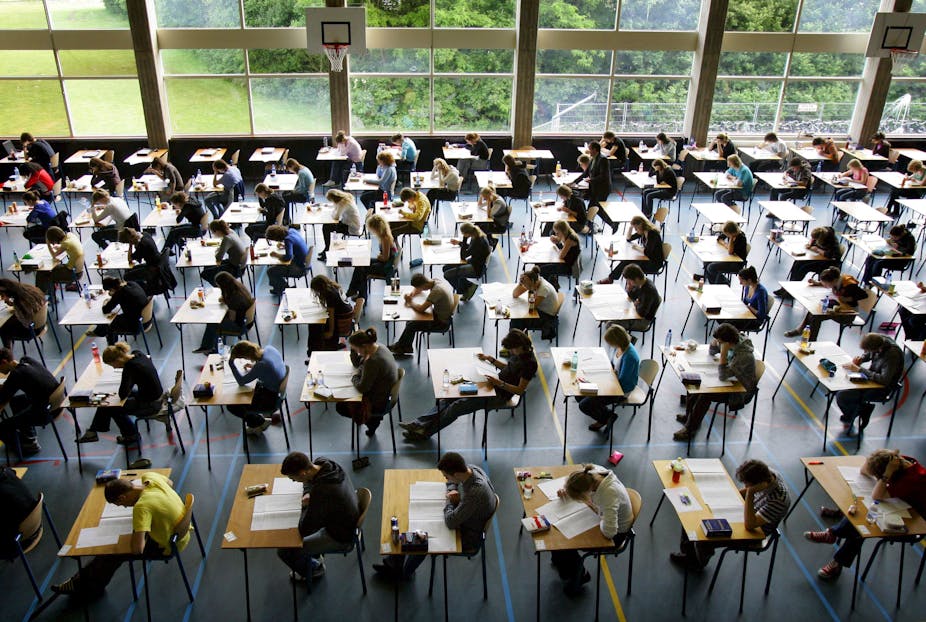
Results from the Chinese university entrance exam, the Gaokao, were released last week. For students, it’s the long culmination of years focusing on tests and learning by rote.
Again and again, East Asian countries appear at the top in world education rankings. So the assumption goes, all Australia needs to do is to learn from the “best at tests”, and we, too, could make it up the ladder.
This was the fundamental basis of a recent Grattan Institute report into the education systems in Hong Kong, Korea, Shanghai and Singapore. Yet the assumptions underlying Catching up: learning from the best school systems in East Asia, cannot go unchallenged: they are misleading and even dangerous.
Australian vs Asian education
From my experience in Australia and East Asia, it is Australian students who have a far superior educational experience in which a wider range of subjects are taught and where the core business of learning goes beyond narrow test results.
The report’s author Dr Ben Jensen told a public audience after the release of the report that Hong Kong’s education system was “the best in the world” because they had got the “how” of education right. Teacher education in Singapore was the “gold standard”, while Shanghai had professional learning in schools with a focus on “continual improvement”.
Having lived and worked in Hong Kong and Singapore, I saw a major disconnect between these reports and my experiences. Closer to my experience was the Program for International Assessment (PISA) 2004 context information findings with Hong Kong students revealing they had a bad perception of their schooling with more than half claiming school had done little to prepare them for adult life.
This was at the same time that the test delivered by PISA – an OECD sponsored literacy, numeracy, science and “problem solving” exam – had these students ranked among the best in maths, problem solving and science.
A testing paradox
This paradox highlights the key problem with the East Asian education systems, as well as the danger of holding them up as something to emulate.
What the Grattan report calls an “unrelenting” focus on learning in the East Asian system basically refers to performing well in tests. Learning is not defined with any clarity, while recall of content reigns supreme.
Singapore’s teacher education program has cut subjects such as the history and philosophy of education and curriculum and assessment design because these subjects were not “leading to sufficient increases in student learning”. Certainly they are not assessed in PISA so why not get rid of them? They wanted a focus on “mastery of content”, which in practice means content recall in tests.
In the seminar, Dr Jensen advised that these countries spend much less than Australia on technology. This is also not surprising since the PISA tests don’t require any skills associated with the use of technologies in any way, shape or form. So why would you waste resources on them and not focus on tests, tests and more tests?
We are also advised that Hong Kong maintains high levels of equity. This is in a system where in 2010 only 35,000 out of 127,000 Form 5 students were allowed to proceed to Form 6 – even though 67% of them met the requirements. This is in a country where 13-year-old mainland Chinese students and 11 year-old-migrant Pakistani students are placed in 6-year-old classes because their Cantonese and English is “not up to standard”.
The justification is that such students cannot be allocated resources to upgrade their skills in these areas since they would then have an advantage over Hong Kong students not offered such an option. You can be assured when they are 15 years old they will not participate in the PISA cohort.
The report maintains that the problem-solving aspect of the PISA test ensures that rote learning cannot explain this performance. But Hong Kong students practice books full of the examples of “problem solving”. I can assure you that you can teach problem solving strategies like the ones included in PISA, and in fact, you can practice them day in and day out.
New research
I have recently returned from working in a teacher education institution in Hong Kong and conducting research in local schools that involved systematic observations of 3- to 15-year-olds in low socio-economic zones.
I have observed none of the phenomena ascribed to the Hong Kong system in the report.
Dr Jensen needs to realise that just because something is stated in a policy document does not mean that it is reflected in practice across schools in Hong Kong.
The report maintains that “effective intervention begins with a deep analysis of learning”. Learning is the focus – yet all the examples of learning are solely related to the regurgitation of facts in a test. There are no references to being creative or showing the ability to work towards an agreed goal in a collaborative partnership.
I have been in situations where I have asked Asian students “what do you think?” And they reply “tell us what you think and we will think the same”. Is that really the mark of a gold star education system?
julie boyd
educator
I absolutely agree with this. The disconnects between educational needs of students and the test driven disaster that American education has become are truly frightening. Asian education may have some benefits, but the issue of compliance and forced diligence are driving some students to self-harm. This puts the old 'phonics or whole language' arguments of the 80's and 90's into the shade. In my 40 years of professional life across education, business and corporate sector, politics and community I believe we are in a much worse position because of the belief that Australia needs to look elsewhere. We need to look to excellent practice locally and stop the 'grass is always greener' arguments. And thank you, Nicola, for stating your lack of affiliations. The number of educational consultants who have been 'bought' by self-interested companies is truly frightening.
Riddley Walker
.
Australian education used to be something other countries looked to for good ideas and models. Not now. Successive State and Federal governments of both colours have reduced the skill sets, funding and creativity of teachers. Now we have Gillard and Garrett slaving over U.S. style teach to the test "learning", NAPLAN and so on.
We should be looking to the Finnish models, currently producing the worlds highest standards in education, not the world's lowest.
Here's a good start: http://greens.org.au/policies/care-for-people/education
David Elson
logged in via Facebook
According to a number of studies...at a certain point funding is not always linked to increased education outcomes.
Ie; Australia is amongst the top spenders on education, however our standards are falling.
It could be that rather than throwing more money at the problem we need to make changes to the way education is conducted?
Regan Forrest
logged in via Twitter
The last paragraph of this article clinches it. Would it be cynical to suggest that such unquestioning acceptance of authority is precisely what some people are looking for in our education system?
Peter Gerard
Retired medical practitioner
The reply in the last paragraph was a sarcastic quip and not meant to be taken seriously.
Read moreI also think the Asian style of learning is obviously working, as students with an Asian backgroung are entering the, so called, status courses in increasing numbers. It is therefore a little disingenuous to suggest other students should not adopt this approach. Unless you have a very retentive memory, rote learning, at primary and high school levels seems obligatory if you aspire to a high university entry…
Nicola Yelland
Professor of Education at Victoria University
The last paragraph was not intended as a sarcastic quip at all. I was reporting on a real experience with a Masters class in HK. I guess by the 'so called status courses' you are meaning medicine and law? I would offer a counter argument that while there is certainly no doubt that practitioners in these fields need to know 'stuff' - their capacity to know it 'off by heart' ready to recall in the event of a new case - is reduced by the advent of new technologies and the internet in particular. New…
Read moreMark Harrigan
Dr
Nicola, I didn't take the last paragraph as sarcasm. Though these sort of "responses" may be as much an indicator of certain asian cultures embodying respect for elders and authority and the importance placed on preservng "face". Do you have evidence that is peculiarly a characteristic of a different education system?
Also, your last comment "these are difficult to test! and Australian kids are quite good at these" I think goes to the heart of a dilemma I articulated in my earlier post.
How…
Read morePeter Gerard
Retired medical practitioner
If the comment " Tell us what you think and we will think the same " wasn't sarcasm, then it reflects reality, especially in some Social Science schools.
The object of a secondary school education is to produce students who read fluently and widely, write grammatically correct essays, and have proficiency in basic mathematics. These are essential for any form of employment or tertiary education. If a student leaves school without these basic skills the school has failed in its prime objective. Apart from the above, I think a weekly class in ethics/philosophy where discussion is encouraged is essential in view of the wide variability in home backgrounds and the secular nature of our society.
Peter Gerard
Retired medical practitioner
If you want to teach children at primary and high school levels effectively adopt the curricula and methods of the 1950's [or thereabouts] era. Of course that would mean that discipline in class would be essential and children wouldn't be given certificates for just turning up each day. Traditional exams/tests are a vital tool of assessment and encourages competition among students. There will always be those at the top and those who struggle; that's life. But even those who do not excel academically…
Read moreLorna Jarrett
PhD candidate, science education; Physics teacher
Curricula and methods from the days of the White Australia policy, increasing availability of fossil-fuels, institutionalised sexism and a world population of 2.5 billion?
Ahhh, the almost-magical qualities of recall-bias and nostalgia! To say nothing of not being aware of:
(a) former classmates who faked literacy in order to avoid corporal punishment (much easier to fake rote-memorisation than real learning)
(b) what actually goes on in schools these days.
Just because you don't understand something doesn't mean it's "gobbledegook" - it can also mean that you haven't made the effort to understand it.
Lorna Jarrett
PhD candidate, science education; Physics teacher
I can recite the entirety of Browning's "My last duchess". Meh.
Peter Gerard
Retired medical practitioner
You were obviously a capable student. What about some of your class mates? How many of them completed high school without adequate skills in reading , writing and maths?
It's not a question of understanding [ eventually]modern, non-scientific, academic vocabulary and sentence construction, and even what is meant; it's just that there is so much 'padding' and 'in house' forms of expression it is a painful process to find that meaning and any useful conclusions. I'm referring of course to publications under the broad heading of social studies, including education. Why
Also I've been informed, by a relative I trust, that when doing a DipEd, there was no room for independent thought [ie] a contrary viewpoint, in essays and exams. That is ' Think and say what we think and say'
David Elson
logged in via Facebook
Apparently Australians students are falling behind not just in areas of rote learning but in terms of problem solving and analyse abilities see relevant ABC link below: -
"BEN JENSEN: We are comparing children's problem solving abilities. If it was all about rote learning they would be further behind on the league tables."
http://www.abc.net.au/am/content/2012/s3432871.htm
Nicola Yelland
Professor of Education at Victoria University
Yes! i saw that and understand - but i also know that you can 'train' students in the problem solving that is involved in these tests!
Philip Dowling
IT teacher
Any particular skill can be disassembled and the various components taught separately. Team sports have been using this approach for years and is in all their manuals.
Even "higher level" skills can be approached in the same way. Thus project management certifications such as Prince 2 use this approach.
Of course, it has been recognised for years that IQ tests measure your ability to do IQ tests. Similarly for all other tests.
Michael Leonard Furtado
Doctor at University of Queensland
Nicola, thanks for a very fine and provocative article that raises many doubts about prevailing conservative wisdom on the superiority of Asian school effects. I left India for the West many years ago to avail of an education system, emphasising individuality, critical thinking and the primacy of human rights.
As these attributes of a first class Western education have come under attack by those seeking more 'productive' school outcomes in this part of the world, it has become fashionable to…
Read moreMark Harrigan
Dr
Thank you. Very interesting article. Reading between the lines it would appear the asian countries you mention skew the results of their testing by controlling who sits and who does not - hardly an equitab;e access to education.
Yet you define, in effect, a dilemma. How do we (objectively or at least inter-subjectively) measure student progress and performance (including feedback to them) without some sort of testing regime? At the same time how do we ensure that the results of such assessment…
Read moreDennis Alexander
logged in via LinkedIn
There are a number of important assumptions that underlay education:
1. Education and learning are not the same thing
2. Teaching and learning are not the same thing
3. Assessment and testing are not the same thing
4. Feedback and testing are not the same thing
5. Performance on tests and demonstration of learning are not the same thing
6. Ranking or Grading and Assessment of Learning are not the same thing
7. Curriculum and Learning Outcomes are not (necessarily) the same thing
8. Content is not the same thing as learning outcomes or learning
9. "Teacher quality" and "teaching quality" are not the same thing and are not necessarily connected
10. "Teaching quality" is much more important than "teacher quality"
11. Education is one area where application the research on teaching and learning screams out for attention
Philip Dowling
IT teacher
Some very good distinctions here.
Adam Suess
logged in via Twitter
Great article and love that it is providing a balance to the debate.
Pushing people and institutions towards exam performance results can have serious unintended consequences such as this, "Chinese High School Allegedly Gave Students IV Drips While They Studied For Exams" - http://goo.gl/Y7df8
I must admit having lived and worked in East Asia, countries such as Singapore and Hong Kong at face value appear to socially and culturally give greater support and funding towards education. Very similar to how Australia displays its broad social and cultural support towards sporting achievement in our youth. Perhaps this would be something to consider first before aspiring to be the best bunch of 'rankers'.
Philip Dowling
IT teacher
“what do you think?” And they reply “tell us what you think and we will think the same”. Is that really the mark of a gold star education system?
Read moreThis rhetorical question is not so much an indictment of an educational system as an indication of a cultural politeness.
I suspect that the students will agree with the thoughts in that class but are smart enough to also much the thoughts of teachers in other classes.
My children have learned which thoughts are allowed to be expressed in their classes…
David Elson
logged in via Facebook
I think rote learning has a place in education for certain core basic skills...
And sadly in these areas of literacy and numeracy Australia has certain fallen far far behind the rising middle classes of Asia.
http://www.abc.net.au/news/2011-11-15/coag-report-shows-australian-students-not-performing/3666272
Christopher White
PhD candidate
"My children have learned which thoughts are allowed to be expressed in their classes in Australia.
If they are outside the spectrum of Labor to Green political thought they are wrong.Any facts that do not meet this orthodoxy are wrong."
While those within the spectrum of conservative political ideology and free-market capitalism are right?
What your children need to learn - along with pretty much everyone else - are the skills of critical thinking, logical analysis, and creative problem solving. That way, they will hopefully be able to not only respond with their own arguments, but successfully and logically support them.
Muvaffak GOZAYDIN
President of ONLINE Learning Co non-profit
Hi everybody:
I am from Turkey.
An engineer educated in USA
A General Manager of electronic manufacturing company for 25 years
Dedicated to online learning for the last 17 years
I classify formal learning
1.- K12 from grade one to 12
2.- Higher education
a) teaching universities which prepares people for life for living to make
money
b) Research universities which does research for everything, raise members
of the universities
1.- K12
PISA is very discussable thing.
It is a good measure but not the end of the world .
It seems Chinese are prepared spesifically for PISA.
Australia is using educational technology to good extend .
I suggest you should take a close look at MITx + Harvardx
Also in Turkey we started complete IT education
Free tablets to 16 million students
Free course contents to every body
Free etextbooks to everybody
Only one model in the world .
Cost is $ 4-5 billion
Lorna Jarrett
PhD candidate, science education; Physics teacher
I've only got one issue with this article - "rote-learning" should read "rote-memorisation".
Being able to recall facts memorised by rote is NOT learning!
Philip Dowling
IT teacher
Oh, great. Fact free physics.
David Elson
logged in via Facebook
Lol, a great deal of mathematics and sciences (ie phsyics) require some of the basic to have been memorised (and understood).
Rote learning CAN assist with this. - Note I'm not advocating rote learning as an end in itself.
I think a bigger problem in the Australian schooling system is the desire to include so much that is not essential for children to learn....
- Diluting and removing time away from more important core subjects.
Lorna Jarrett
PhD candidate, science education; Physics teacher
Philip,
Feel free to enrol in my class this Semester :)
Lorna Jarrett
PhD candidate, science education; Physics teacher
David,
You can memorise a "fact" in physics (or science in general) - or you can understand the *reason* for that fact being the case. With the deeper understanding, rote memorisation becomes redundant.
E.g. you can rote-learn that F=ma and not F=m/a etc. - but if you understand the nature of force, mass and acceleration (and the units they're measured in), then it's obvious that F=m/a makes no sense, so rote-memorisation of the formula is not necessary because it can be derived as needed. Of course, with repetition, formulas do get memorised and this speeds up problem-solving - but that's secondary. Yes, it's possible to rote-memorise, and use to solve numerical problems, a whole bunch of formulas without understanding the concepts they represent - but that's not learning physics, and the lack of understanding becomes apparent as soon as a novel problem format or even something as simple as a qualitative question is asked.
Google Mazur and peer instruction for a start.
Gil Hardwick
Anthropologist
I find myself disappointed by your shallow treatment of far more profound and enduring cultural trajectories, Nicola, especially in your simplistic and somewhat negative contrasting of selective East Asian with Western education.
You neither expand on your idea of 'creativity', little more than a current fashion in Australia, whatever it's supposed to mean anyway, but more on that later.
First, the idea that the general education of children is an end in itself needs to be challenged. It is…
Read moreNicola Yelland
Professor of Education at Victoria University
Thanks for the interesting conversation!
Another interesting issue centres on the billion dollar tutorial industry - particularly in HK. When i was there recently there was a letter to the editor of the south china morning post basically saying that these schools were so popular because teachers and students could not cope with the pressure of the exam oriented system. The letter also thought that a shift to school based assessment would only increase the pressure. The issue remains that the…
Read moreampersat
logged in via Twitter
"there was a letter to the editor of the south china morning post"
Not the most sound evidence to build your argument that rote learning is of little(relative) importance. Like most things in this world, no-one truly knows the impact the rote learning has on an individual.
I think you've made some great points that are worth investigating further. So a great piece overall
Christopher White
PhD candidate
I think the point made that students need to learn "the basics" as well as how to creatively apply them is well made.
I also agree that the only way to genuinely understand the success or otherwise of educational systems is to undertake a comparative longitudinal study of the learning and life outcomes of those students subjected to them. Even a retrospective study would yield valuable information.
Does anyone here know if such a study has yet been undertaken with regard to the East Asian and Australian systems?
Christopher White
PhD candidate
I think the point made that students need to learn "the basics" as well as how to creatively apply them is well made.
I also agree that the only way to genuinely understand the success or otherwise of educational systems is to undertake a comparative longitudinal study of the learning and life outcomes of those students subjected to them. Even a retrospective study would yield valuable information.
Does anyone here know if such a study has yet been undertaken with regard to the East Asian and Australian systems?
Nicola Yelland
Professor of Education at Victoria University
i agree with this! i would love to be able to follow students through - the system in a very long term way. The new 3-3-4 schooling model in HK allows more students to progress to Form 6 but not sure what happens then - i don't think it is matched with more university places. Its still only the minority/ elite who get in - so the unmet demand would be an interesting thing to follow. And what do the top ten students get up to in a country would be interesting!
Michael Gioiello
High school music teacher/ freelance Opera singer
Unfortunately, the Asian system does not allow students the "Freedom" to think outside the box, therfore, stiffling creaitivity. Teaching by rote is primative. Maybe one day when the political and cultural system is changed in Asia, students will feel at ease to "think outside the box". At the moment it is not encouraged. One wonders whether this is a cultural problem or a systematic phenonemon crated by Asia's ruling class, so as to maintain control for their own selfish means.
David Elson
logged in via Facebook
There is a cultural element here, where respect for authority reigns supreme; teachers and parents in particular.
So obviously it's not possible for Australia to copy Asian education systems in their entirety. - although I think a focus on the basics, and on some rote learning could play a role in improving standards.
Simply tossing more money doesn't seem to work.