


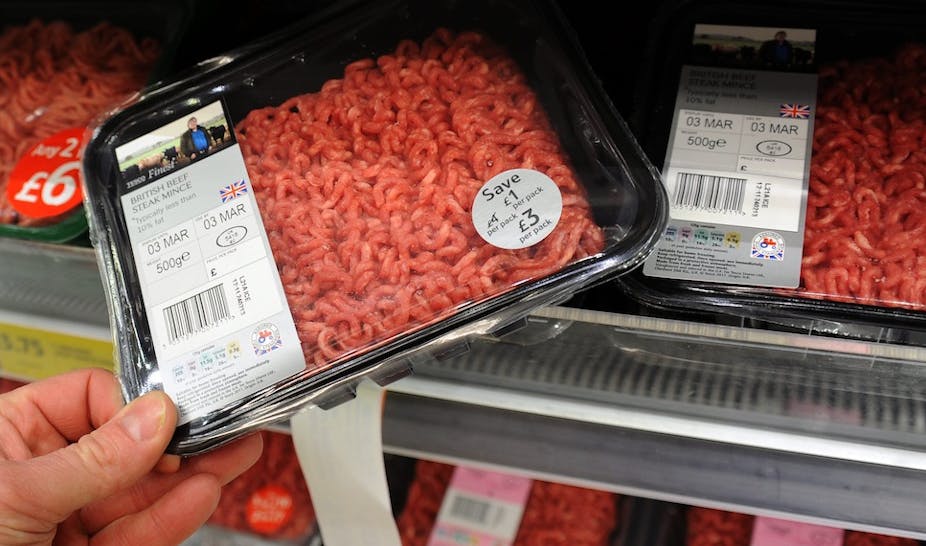
The discovery of horseflesh in a number of otherwise-labelled meat products in Europe is being described as a scandal but it is an entirely predictable result of industrialised animal exploitation organised according to the values of neoliberal ideology within globalised capitalism.
All forms of life are transformed into commodities and deregulated industries are allowed to police themselves as they seek to obtain the greatest profits using the cheapest ingredients, which, in this case, means the corpses of sentient beings.
The scandal is not so much that the flesh of certain animals rather than others has turned up where it wasn’t expected. The entire industry is ghoulish and repellent. There may indeed be some specific crimes involved but more generally the entire meat system that kills billions upon billions of animals every year is “a crime of stupefying proportions” as South African novelist JM Coetzee puts it in The Lives of Animals. Or as Charles Patterson calls it in his book, an “Eternal Treblinka”.
Certainly, there is a scandal here in the sense that commodities have been misleadingly identified. In relation to food in general, this is a serious concern as individuals may have serious, even fatal, reactions to certain substances.
Meat, with its susceptibility to contamination and disease, needs extra vigilance but inspections have been sharply reduced due to severe budget cuts and in the name of efficiency, cutting red tape and letting businesses regulate themselves.
Much of the scandal seems to focus on the fact that products labelled as beef actually contain the flesh of horses. This violates a cultural taboo in some countries, although horse flesh is regularly consumed in France and Belgium. Much less mention is made of the fact that when the discovery was made in November 2012 in Ireland, a third of beef samples contained horse DNA but over 85% contained pig DNA.
Contamination of beef products by pork products sounds less shocking because many people eat both cows and pigs, whereas horses are given special status. That is illogical, although it should not be taken as an argument to say that one might as well eat horses too. Rather, it raises the question of why we should not be repelled and disgusted by the idea of eating any animals at all.
It seems like an ethical inconsistency to find it wrong to eat a horse while accepting the idea of eating a chicken or a pig. Why not eat your cat or your dog? Why love one and kill the other? Humans may place particular symbolic value on horses or assert that cows and pigs are “raised to be slaughtered,” as if this was a justification rather than simply a statement of a grim and horrendous fact. Regardless of the uses we put them to, all animals want to live.
Even if it seems less scandalous to consume the flesh of pigs instead of horses, there are other reasons to be alarmed. While horsemeat has been deliberately mislabelled, the presence of pig DNA in products labelled as beef may be due to the fact that processing plants are unsanitary and the machinery used to kill and dismember animals is not cleaned thoroughly. This in itself is worrisome for reasons of contamination and public health.
Canadians learned about this in relation to the biggest recall to date of beef in Canada in 2012 from Alberta’s XL Foods. The Canadian Food Inspection Agency reported unsanitary tools and work areas, improper labelling, mixing of edible and inedible parts of animal corpses and problems with building maintenance that led to direct contamination of meat. It is also worth noting that the recall followed the discovery of E. coli contamination by USDA inspectors, and that this had been missed by Canadian inspections, which suggests additional problems.
Mislabelling the flesh of some animals as that of others is only part of the problem. Adulteration of meat is widespread, especially as consumers demand low prices. To make more profits, processors add other cheap material to bulk up the meat, injecting water, fat and concentrated proteins, obtained from the skin and fat of pigs and cows and identified as “seasoning.” So adulteration of meat is legal and widespread. Legally, in UK, beefburgers can contain less than half beef. Taco Bell’s taco meat filling reportedly contained only 35 percent beef and the rest consists of chemicals and industrial additives.
Responding to a class-action lawsuit charging the corporation with false advertising, Taco Bell responded with admirable frankness, stating in major US newspaper advertisements entitled “Thanks for giving us a reason to sue you”:
“Plain ground beef tastes boring …The only reason we add anything to our beef is to give the meat flavor and quality. Otherwise we’d end up with nothing more than the bland flavor of ground beef, and that doesn’t make for great-tasting tacos.”
In the case of horsemeat, consumers are getting other chemical additives. Many of the horses were probably shipped from North America, where the industry uses racing horses and pets that have been treated with phenylbutazone and other drugs that are carcinogenic for humans who ingest them.
While the horse slaughter lobby claims that records are kept to indicate which horses have been treated with these drugs, it is clear that this is a complete sham. Of course, the presence of drugs in horseflesh should be seen in the context of drugs given to livestock generally.
In 2010 the US Food and Drug Administration reported that in 2009, 29 million pounds of antibiotics were given to animals used for food, accounting for 80 percent of all antibiotics used. The serious implications for development of antibiotic-resistant bacteria are now being recognised, as are the devastating environmental consequences of global meat production.
The horsemeat scandal is simply one more illustration of the absurdity and brutality of this globalised system. Rather than supporting all this for what the industry itself acknowledges as “bland flavour,” sensible and compassionate people will adopt a vegan diet.