Letting go: why athletes play on past their prime

Any hopes that Lleyton Hewitt could revisit past glories in his 2013 Australian Open campaign were dashed last night when he lost in straight sets to Serbia’s Janko Tipsarevic. It now seems impossible to deny, as Greg Baum wrote for The Age, that “the post-Hewitt era looms ever nearer”. The recent retirement…

Dwf7jn25-1358209963
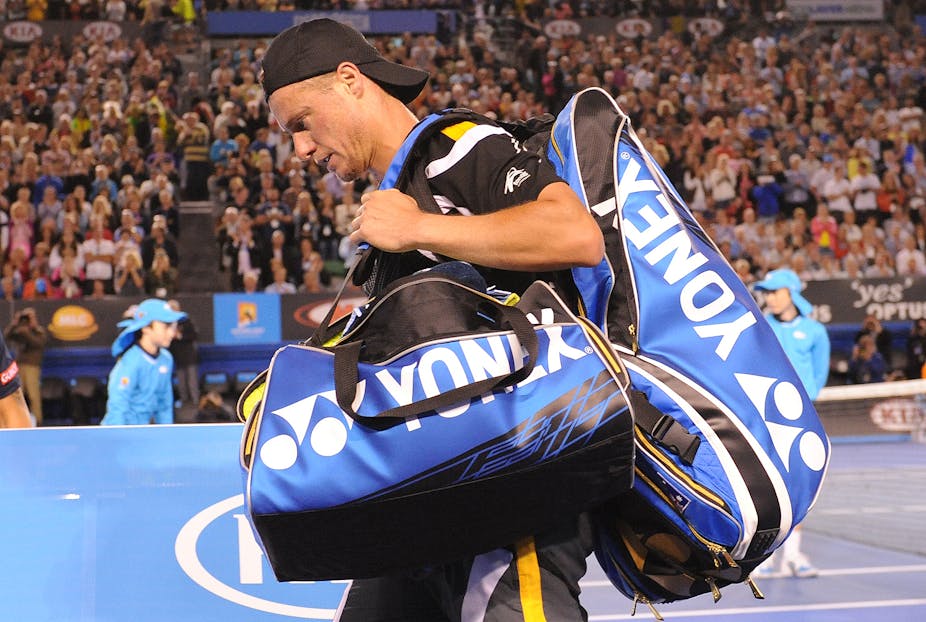
Lleyton Hewitt went down in straight sets in the first round of the Australian Open last night. AAP/Julian Smith

Any hopes that Lleyton Hewitt could revisit past glories in his 2013 Australian Open campaign were dashed last night when he lost in straight sets to Serbia’s Janko Tipsarevic. It now seems impossible to deny, as Greg Baum wrote for The Age, that “the post-Hewitt era looms ever nearer”.

The recent retirement of former Australian cricket captain Ricky Ponting sparked similar debate about athletes playing on past their prime. While there is no doubt as to the significant contribution and influence Ponting had on the game of cricket, many have questioned whether his retirement from the sport should have occurred some time before he was plagued by run of poor batting scores.

And in Australian Rules football, the oldest player in the league, Essendon’s Dustin Fletcher, will “go round” for another year during the 2013 season.

Why is it that athletes seem unable or unwilling to withdraw from sport before their best days are long behind them? Retirement from sport is inevitable; so why do athletes choose not to bow out gracefully before the general public starts demanding they go? After all, athletes who can retire on their own terms are much more likely to transition well out of the sport than those who are forced into retirement through injury or by being cut from their team.

Sport has long been regarded as a place where young boys learn the traditional values associated with being a man, such as competition, toughness and winning at all costs. One of the ways men can demonstrate their masculine identity is through “doing” masculinity (as opposed to being masculine), and sport is one of the most common ways. The male body, therefore, becomes a central aspect of masculine identity.

Towards the end of careers when athletes’ bodies are succumbing to the brutal nature of elite sport, the realisation that one’s body cannot do what it used to be able to do can lead to masculine identity becoming vulnerable.

For many men, it is extremely difficult to acknowledge that their bodies are failing them. Continuing to play on beyond one’s physical prime may therefore be due to an unwillingness to recognise the physical limitations of a failing body.

How well an athlete retires from sport depends on how much of their identity is wrapped up in being a sportsman. For those whose whole identity is solely comprised of being an athlete, leaving the sport is much more difficult: if they are not an athlete then who are they?

But people do not stop being sportsmen simply because they have retired from sport, neither do they stop being men. So the problem lies not in what they are able to do to but what they want to do, as nothing compares to life as an athlete.

Some sportsmen extend their careers by changing tactics or position, such as Essendon’s Dustin Fletcher, who no longer takes a direct opponent onfield. AAP IMage/Martin Philbey

Existence as an elite athlete is often described as being the “perfect life". Not only are our male sporting superstars paid extremely well for doing what they love, they are given hero status in society. Particularly in Australia, where sport has such significance, the recognition, stardom and rewards that are associated with being an elite sportsman are difficult to give up.

When an athlete does retire, whether forced to or by choice, a period of readjustment occurs. Even those who spend the later part of their careers preparing for life after sport still experience difficulties leaving their former life behind. This can in part due to athletes still being comparatively young when they retire. Even Ricky Ponting at 37 still has another 30 years in which to build an alternative career.

It is through this subsequent career that masculine identity is then reconstructed. Success in post-sporting career employment is one of the fundamental ways in which masculinity is reaffirmed, suggesting that the importance of a new career path is crucial to successfully withdrawing from elite sport.

Given the sole focus on sport as a career path from a young age, alternative careers are often overlooked. With such a small percentage of aspiring young athletes making it to the elite level, is it any wonder those who do want to hang onto it for as long as possible?

Athletes know when their performance starts to decline so the end of their career is not necessarily a surprise, but playing beyond their prime does delay the consequences of having to cope with life after sport. Many still feel they have much to contribute.

Perhaps this is why so many former athletes seek careers in commentary; it is a means by which they can still contribute to and hold onto the sport that has been a significant and enjoyable part of their lives.

It should be noted that retiring female athletes no doubt also have difficulty adjusting to life without sport. But sport shapes masculine identity in such a distinct manner that male athletes have been the focus of this discussion.

Retirement from sport does not have to be all doom and gloom. The new era offers new challenges and alternative pathways to success, through which masculine identity can be reaffirmed.

The question then is not whether there is life after sport, but rather when is the right time to let go?

Sign in to Favourite

Want to follow The Conversation?

Sign up to our free newsletter to get the day's top stories in your inbox each morning, with a special wrap on Saturday.

Donate and become a friend of The Conversation

Join the conversation

22 Comments sorted by

  1. Tim Scanlon

    Debunker

    It has to be remembered that most sports people have only ever done one thing in their lives. Many elite athletes have trained to be great from an early age. Telling them that they can't do what they love, what they have always done is always going to be met with denial.

    report
  2. Steve Pratt

    logged in via email @cancerwa.asn.au

    It occurs to me that the phrase "masculine identity" could easily be replaced with just "identity", and the piece would be applicable to all sports professionals, without seeming to rely partly on stereotyping?

    Otherwise, it is an interesting topic for exploration. In my experience, it's probably a combination of identity, enjoyment and money. The mix will, no doubt, be quite different between individuals.

    report
  3. Mike Swinbourne

    logged in via Facebook

    Why shouldn't athletes play on past their prime? Just because you are no longer as good as you once were does not mean you should stop doing something. I mean, I still have sex with my wife.......

    Maybe it could be because they continue to get paid to do something they love.

    report
    1. Tim Scanlon

      Debunker

      In reply to Mike Swinbourne

      Yeah, Ricky Ponting was definitely looking at his paycheck and thinking "can I really afford to give up cricket?"

      report
  4. Jack Smith

    Comedian

    I don't see why players shouldn't play past their prime. The examples given are of two guys who simply enjoy travelling the world playing sport at a high level and will have no problem in life after sport.

    In fact both of them are in a position to retire completely after they retire from sport. So maybe this factor is the reason they see no need to rush into retirement, and are quite happy to simply enjoy their time at the top while they can.

    report
    1. Sebastian Poeckes

      Retired

      In reply to Jack Smith

      Possibly the most tragic example of past champions having difficulty in making he transition to "civilian" life would be Gary Ablett Snr. The usual path of moving from AFL champion to "civvies" involves commentary or coaching. But what options does someone whose personality doesn't lend itself to either of these roles have?

      report
    2. terry lockwood

      maths teacher

      In reply to Sebastian Poeckes

      I think Gazza had his challenges during his career too. Geelong went to great lengths to help him with these I understand. When he was cast free, the help was not so plentiful but certainly not absent.

      report
  5. Comment removed by moderator.

  6. Colin MacGillivray

    Retired architect

    It has to be said that any person who has spent 20-30 years focusing almost entirely on sport is not going to move on to rocket science or brain surgery. Building an alternative career at 37 is not easy especially with no experience of commerce, management or a professional skill.
    So to keep playing sport and receiving sponsors' dollars as long as possible is entirely logical. Tony Greig moved to Packer's one day cricket idea on the proviso of a job for life.

    report
  7. Pera Lozac

    Heat management assistant

    The answer is very simple - they have to pay the loans.

    report
  8. Gary Cassidy

    This romantic notion that athletes should retire "on their own terms" at the peak of their careers makes me feel sick. Perhaps they simply still enjoy competing at an elite level or are driven by the challenges of training and competing.

    Should Federer have retired in 2008 when he slipped to 2nd in the world? Should Mark Taylor have retired before he scored 334 not out. Is Dermott Brereton's reputation as a great player diminished by the extra 3 years he played after Hawthorn?

    Perhaps if there wasn't this notion that sport/activity is all about winning, achieving and progressing more people would play various sports and/or exercise in a long term and sustainable manner, with the benefits of better health and fun.

    Besides you might want to check the results of the 2013 Kooyong Classic.

    report
  9. Comment removed by moderator.

  10. Suzy Gneist

    logged in via Facebook

    Another question to ask would be: Why do we expect athletes to continue to stay at the top after they have reached it? Just because someone doesn't remain in the top ladder position doesn't mean s/he isn't still an elite athlete. Experience also counts for something in many sports and can come into play throughout a career. If one loves what one does and can make a sufficient living from it, why would one stop because one was once the champion but has now dropped into "lower" world class?

    report
  11. Sarah Agnew

    Storyteller, poet & Minister of Religion

    it is interesting the number of people who are assuming no research has backed up this article - this site is one for academic rigour, after all. it may be surprising, it may be confronting and unsettling, but this article arises from rigorous research with elite athletes. and it doesn't read to me like an attack on the players, or on their decision to keep playing beyond their best years - but is an attempt to understand, and when we understand we can better support these men (of particular interest to this research) who have made significant contributions to our community. There is a link to the research, in the article, by the way.

    report
    1. In reply to Sarah Agnew

      Comment removed by moderator.

  12. Comment removed by moderator.

  13. Natalie Galea

    logged in via Twitter

    I found this article particularly interesting and would be keen to read more about the difference between male and female elite athletes in terms of identity and retirement. I do suspect it will be different.

    Often people assume the term "elite athlete" refers to athletes who are paid to compete in sport or make a living from sport. There are a a lot of elite athletes i.e. Olympians who need to financially support themselves while pursuing elite sport. I wonder if they deal with the same identity challenges? I suspect they do, but maybe to a lesser extent. Are work programs such as the former OJOP (Olympic Job Opportunity Program) which assisted elite athletes in work placement while they pursue elite sport effective in the transition to retirement?

    report
  14. Megan Clement

    Deputy Editor, Politics + Society at The Conversation

    Hi everyone,

    This is just to remind everyone to familiarise themselves with our comments policy (https://theconversation.edu.au/comments-on-commenting-10678).

    Discussion is welcome but attacks on the author will not be tolerated and will be deleted. Please keep the discussion cordial or comments will be closed.

    Best wishes,
    Megan

    report
    1. Dale Bloom

      Analyst

      In reply to Megan Clement

      Megan Clement
      I would ask how an article could be published that attacks two men, and makes 29 maligning and denigrating statements about them, but the author has never met those two men, or ever interviewed them to find out their motives, interests, ideas, attitudes or opinions.

      report
  15. Phil Morrison

    Architect

    Is it not human nature to believe we can still do what we did in our youth? This trait would not be confined to elite athletes. As we age our abilities diminish but our recall of our abilities does not necessarily match this diminished ability. As Suzy points out why not stay if you are still competative? Only ego would force you too retire at the top.
    My father was a good AFL player but played on into his 40s in local competition giving me the oportunity to witness him playing - although not at his prime. I treasure these memories. Maybe I have missed something in the point being made. I

    report