


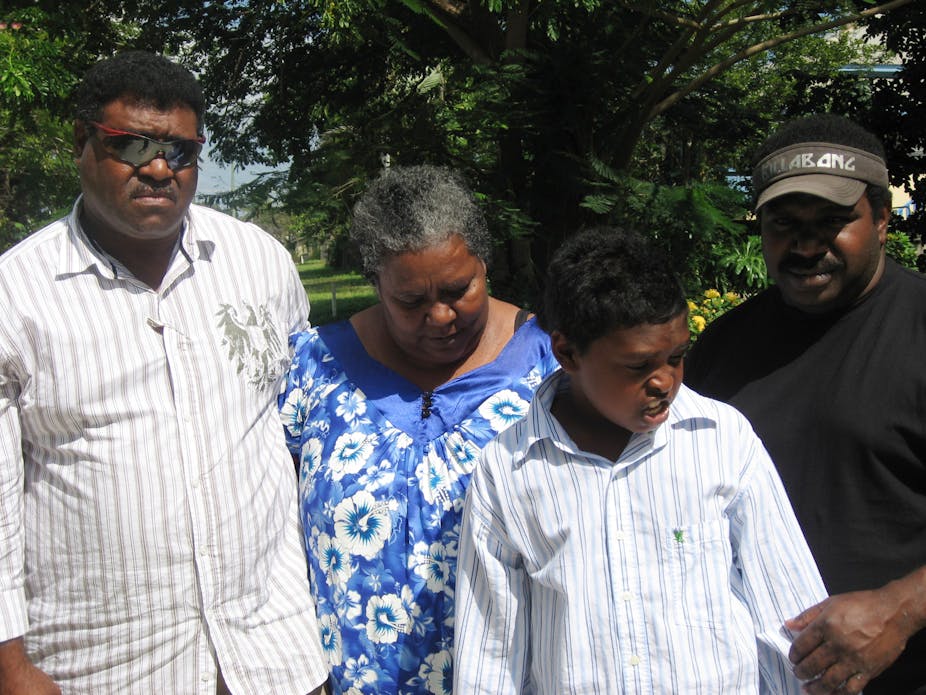
A couple of weeks ago, Justice Henry of the Queensland Supreme Court handed down judgement in favour of the families of five people killed in the tragic Lockhart River plane crash in 2005. The court awarded the maximum compensation of $500,000 to four families, and $388,255.20 to the fifth family.
The decision is obviously important for these families, who have been waiting to resolve compensation now for many years. However the case also dealt with a number of issues relevant more broadly to Aboriginal and Torres Strait Islander Australians and the law.
Traditional adoptions
The first issue addressed was whether children who were traditionally adopted could be considered to be “family members” and therefore entitled to compensation. The court noted that traditional adoptions still did not have legislative recognition.
This case was decided under specific Commonwealth legislation which did not, at the time of the plane crash, include traditional adoptions in the definition of “family”. For this reason, traditionally adopted children of the deceased were not entitled to compensation.
This highlights the need to resolve the status of traditional adoptions at law.
Calculating compensation
The court also looked at how to calculate compensation. In such cases, compensation often covers loss of services that are “commonly encountered in the setting of a suburban household, such as household maintenance and childcare”.
While the families in this case claimed this, they also claimed compensation for loss of traditional hunting and fishing that had been provided by the deceased. The defendant, however, argued for compensation only for the price of the food that the hunting and fishing provided.
The court found instead that the loss was a loss of food on the table provided by the services of the deceased as part of a way of life, pursuant to “an activity requiring special skill”. This could not be equated to the “purchase price of fresh seafood from a hypothetical (non-existent) local fishmonger”. On this basis the court awarded $25 per hour compensation for the loss of hunting and fishing. This rate is higher than that for “household maintenance and childcare”, valued at $20 per hour. Instead, it is commensurate with the wage of a qualified carpenter in recognition of the special skill involved.
This is important for the recognition of the role hunting and fishing played in the lives of the families of the deceased. It places a monetary value on aspects of culture of Indigenous Australians recognised also in terms of their skillfulness.
The court emphasised that this is qualitatively different from other types of fishing activities: “it bears no comparison to the occasional fishing trip to which some urban dwellers recreationally aspire”.

An additional compensation issue involved calculation of the projected income of the deceased. Usually the court uses national averages of life expectancy to estimate how much lost income should be compensated. The defendant wanted a significant discount of the deceased’s projected income because of the “lower life expectancies and higher incidence of health problems of indigenous persons”.
The court rejected this. Justice Henry said that:
Indigenous persons form part of the broader overall population base from which general statistics about health and longevity are drawn…[T]hose statistics ought not be disregarded merely because a case involves indigenous persons.
This was important for the families as it resulted in a greater award of compensation. It is important more broadly because it acknowledges, and rejects, the possibility of double discounting estimates of life expectancy - in this case, based on cultural background.
Credibility of Indigenous witnesses
Finally, the defendant challenged the witnesses’ credibility. It claimed that “most of the witnesses were unable or unprepared to respond to important questions asked in cross-examination”.
Issues for Indigenous witnesses in the courts are well known. In this case, the court found the Indigenous witnesses credible. Justice Henry acknowledged “traits well known by the court as common to many indigenous witnesses from remote communities”. Further, he said that while courteous, the “cross-examination … was not … likely to have obtained significant amounts of detailed information from such witnesses”.
We might wonder why the cross-examination was not carried out in a manner more appropriate to the witnesses’ cultural background. In any event, it is important that the court understood this issue and found accordingly.
The right outcome
Overall, this decision can be seen as an example of just some of the issues faced by Indigenous Australians in the court system. In this case, the defendant used health and longevity data specific to Indigenous Australians where it would minimise its liability, and then refused to acknowledge the cultural context of the families where it might afford them benefit.
In rejecting these arguments, the court has given expression to the families’ culture, while acknowledging their place within broader Australian society - and compensating them accordingly.