
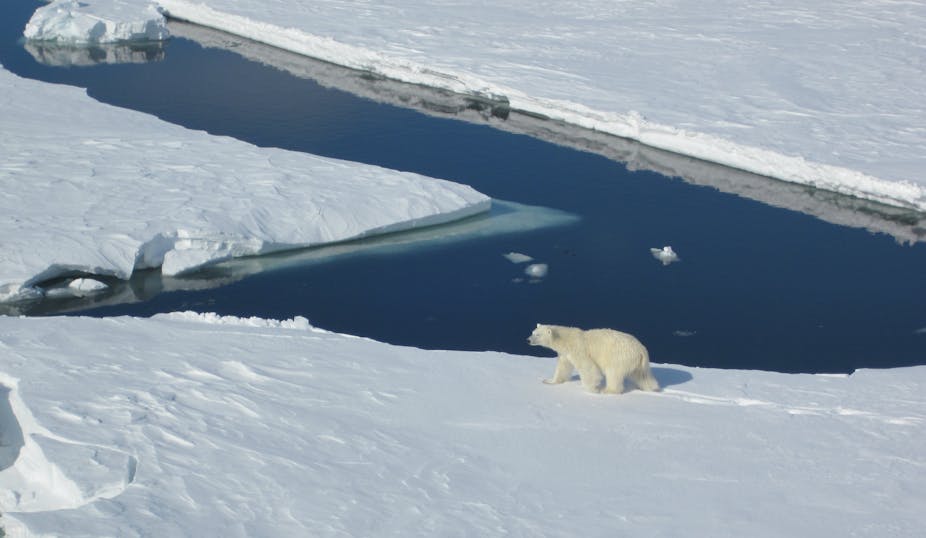
A few weeks ago, NASA announced that the area of Arctic ice is now almost as low as it was in 2007, its historic minimum.
The extent of ice has reduced to 4.33 million km² compared to the mean (1979 to 2000) of 7.04 million km². Simultaneously, three navigation routes have opened across the Arctic during the past boreal (northern) summer.
The 2011 event went relatively unnoticed, unlike that in 2007, which stirred significant international media attention. Media and political dialogues have focused society’s concerns on the Global Financial Crisis (GFC), diverting attention away from climate change.
Yet, the recent events in the Arctic are the closest manifestation of “dangerous” climate change yet realised on our planet.
Dangerous climate change is defined as change proceeding too fast for ecosystems to adapt naturally, threatening food production or preventing economic development proceeding in a sustainable manner.
Three major facts support this assertion:
1) The loss rate of Arctic sea ice in summer has accelerated, with the loss in area increasing by a factor of five since 1996¹, with ice thickness also falling at a rapid rate (43% from the 1970s to 1990s²).
2) Summer ice loss will trigger rapid changes in the Arctic. The Arctic marine ecosystems contain multiple elements that will shift in an abrupt manner when forced beyond their tipping point³. This will lead to changes in food webs and species loss⁴.
The reduced ice extent is expected, in turn, to set a number of additional physical, chemical and biological elements in motion, inducing rapid changes in the Arctic environment⁴.
These include:
- warming of seawater
- increased freshwater discharge
- loss of permafrost and ice sheets
- increased emissions of methane (a powerful greenhouse gas)
- a reduced capacity to sequester CO₂
- and changes in atmospheric circulation and chemistry, including the recent development of an ozone hole over the Arctic.
All of these environmental changes have potential global consequences for the earth system and humanity⁴.
3) Despite the immediacy of this scenario, we are ill-equipped to issue reliable forecasts. All models failed to forecast the 2007 event and have considerable difficulty in hindcasting it.
Models disagree greatly as to when the Arctic Ocean will become free of ice in late summer. There is a clear tendency for more recent forecasts to anticipate this event before 2050⁴.
Dangerous climate change is no longer a possible scenario for the future. It is a reality already in operation in the Arctic, arguably the most sensitive region of the world to climate change. It may be too late to avoid dangerous climate change there, but we can still avoid dangerous climate change elsewhere.
There is, therefore, an urgent need for society to re-start the conversation to avoid dangerous climate change.
Few economists may have predicted the GFC. But forecasts of forthcoming impacts from climate change have been well established for over two decades. This is despite a tendency of both society and the scientific community to indulge in semantic debates as an excuse to procrastinate.
We know what will happen under current patterns of emission of greenhouse gases, and increased depletion of critical resources (water, energy, food and a healthy environment), under current patterns of population growth and per capita resource use.
It is increased greenhouse gas emissions and not the financial meltdown that lead to the rapid, unambiguous changes in the Arctic.

Responsible members of the global society, including scientists and world leaders, must free themselves from the hypnosis of the GFC and take action to address other challenges humanity must face. We must avoid dangerous climate change, tackle environmental degradation and deal with reduced availability of critical resources.
Addressing the environmental basis of human well-being requires the concerted action of governments, scientists and industry. There must be a focus on delivering solutions rather than restating the problems.
There is huge potential for innovation. It will be capitalised by those societies able to deploy an entrepreneurial approach towards generating the needed outcomes.
Australia is strategically poised to take a leading role in developing this potential. The persistence and salience of the carbon tax debate has ensured climate change remains high in the nation’s political agenda. The concentration of global human population growth in the nations that we share our time zones with has made us aware of the stresses on resource supply.
Our industry is strong and healthy and has the entrepreneurial drive to dive, guided by the best possible scientific advice, into the challenges to provide a new basis for economic growth based on tangible, sustained benefits.
References
Carstensen, J., Weydmann, A. 2011. Tipping points in the Arctic: Eyeballing or statistical significance. In: The Arctic in the Earth System perspective: the role of tipping points (Wassmann, P., Lenton T.M. (eds), AMBIO (in press)
Wadhams, P. 2011. Arctic ice cover, ice thickness and tipping points. In: The Arctic in the Earth System perspective: the role of tipping points (Wassmann, P., Lenton T.M. (eds), AMBIO (in press)
Lenton, T. M. 2011b. Arctic climate tipping points. In: The Arctic in the Earth System perspective: the role of tipping points (Wassmann, P., Lenton T.M. (eds), AMBIO (in press)
Duarte, C., Agustí, S., Wassmann, P., Vaqué, D., Arrieta, J.M., Alcaraz, M., Holding, J. 2011. Tipping elements in the Arctic marine ecosystem. In: The Arctic in the Earth System perspective: the role of tipping points (Wassmann, P., Lenton T.M. (eds), AMBIO (in press)
Colin MacGillivray
Retired architect
"It may be too late to avoid dangerous climate change there, but we can still avoid dangerous climate change elsewhere."
With the population of China and India growing and aspiring to the life style of developed nations and the US ignoring climate change altogether, this seems to be a bit optimistic.
Are there any websites that have investigated the actual implications on, say, Australia of a 3 degree increase in average annual temperature and 600mm sea level rise?
What will shock people into actually doing something?
Byron Smith
PhD candidate in Christian Ethics at University of Edinburgh
Try here: http://www.fourdegrees2011.com.au/. This was a conference held recently to look at Australia in a four degree world. The talks can be downloaded.
It may be too late to avoid dangerous climate change everywhere, but possibly not too late to avoid truly catastrophic climate change everywhere.
James Szabadics
Technical Development and R&D Manager, Plantation Timber Industry
The main reason models fail on the 2007 event was because the wind patterns more so than atmospheric temperature change were responsible for ice loss that year. Similarly in 2011 the arctic summer was no warmer than average but wind patterns that forced the ice to compact in certain areas and transported other areas to lower lattitudes where they melted. This is why we had some recovery in ice area in 2008 and 2009 because the temperature in the summer melt season did not chnge but we saw different…
Read morePaul Richards
Paul Richards is a Friend of The Conversation.
James,
I hope you are right, but we can't base decisions on your belief.
We need to accept the other side presented by the consensus of scientific opinion. Consequences of doing nothing and probabilities playing out will be dire. Spending money on response to the data is not unlike what we do routinely on insurance for vehicles.
Making appropriate moves toward GCC, will mean we can respond effectively if the Arctic ice melts and the global sea currents literally turn curent climate patterns around.
What has been discussed here is really the heart of dramatic climate change, and really rarely mentioned in the wider media.
Probabilities of a reversal of the earth's thermohaline circulation are high and will have dramatic consequences. There is no question about that.
Can we risk not responding?
Jess Robertson
Postdoctoral Fellow at CSIRO
"The other factor in the sea ice melt is ocean heat content (OHC). This has levelled off since 2005 and if we see more frequent La-Nina events over the next 20 to 30 years I'd expect OHC to start to reduce and further arctic ice recovery to take place."
That's a ridiculous assertion. The only significant climatic trend in the figure you link to is the long term increasing heat content of the oceans over the last half-century. It's perfectly feasible to have periods of order a decade or so where…
Read moreByron Smith
PhD candidate in Christian Ethics at University of Edinburgh
Arctic sea ice volume tells its own story: http://neven1.typepad.com/.a/6a0133f03a1e37970b014e8b57bfcb970d-pi.
Doug Cotton
IT Manager
Kevin Trenberth plotted a curved trend based on the last 18 years or so of NASA sea surface data. His trend showed a maximum around 2006 and a subsequent cooling which I have confirmed from NASA figures has continued right through to now (Oct 2011) beyond the end of his plot. That plot features at the top of the home page at http://climate-change-theory.com
Trenberth never found his "missing energy" and Knox and Douglass rubbished the concept. The plain obvious facts are that ocean heat content…
Read moreJess Robertson
Postdoctoral Fellow at CSIRO
"His trend showed a maximum around 2006 and a subsequent cooling..."
Once again, I'll point out that decadal changes in heat content in the upper layer of the ocean is probably nothing more than noise. Most models predict these sorts of variations in SSTs within the context of an overall increase in ocean heat content.
"...ocean heat content in the long term has to correlate pretty well with sea surface temperatures because there is no sound reason for heat being permanently trapped in warmer waters…
Read moreJames Walker
logged in via Facebook
Thanks for article Paul, useful. In particular, thanks for *defining* what is meant by 'dangerous climate change' - that the speed of the change is as much of a problem as the amount of the change has never been explained to me before (and having had a vet I trust warn me to avoid rapid temperature shifts when moving pets, I know that you are making an important point - if it can kill a pet, it can slaughter wildlife).
Part of the problem you'll run into is those of us who remember being warned in the '70s that we were due for a new ice age: the thought of the planet being covered in ice is frankly a lot scarier than global warming, so 'erring on the side of caution' means risking the lesser evil. However, if your desired response is merely to *slow* global warming enough for the environment to adapt, you're dealing with both threats - so emphasising that should hopefully get you more support.
James Szabadics
Technical Development and R&D Manager, Plantation Timber Industry
Hi Jess,
I can assert that OHC 700 has levelled off over the last 6 years and support it with data and i have never asserted that the long term trend would change now but I do think that it might given the right set of circumstances. I have placed caveats on what might cause a change - vis a vis ENSO events.
I agree that the long term historical trend is rising OHC but the current divergence from long term trend is interesting and unexpected if humans are responsible. When we assert that…
Read moreJames Szabadics
Technical Development and R&D Manager, Plantation Timber Industry
Paul,
I'm not sure what you think my belief actually is when I used words like "if" and "might" I mean that I do not really know. I presented some food for thought & discussion and some links to the data. We live in interesting times and will learn a lot in our lifetimes.
Do you have a figure for "The probability of a reversal of the earths thermohaline circulation". When you say it "is high" I think you might just be making it up.
Paul Richards
Paul Richards is a Friend of The Conversation.
James,
this is a place for discussing Ideas, and a conduit for academia and the wider population to interact so if and "if" and "might" are appropriate. One of the reasons that site has been so successful. I sugest you get used to it.
As for the earth's thermohaline circulation the area the USA monitors, models run show there is a high probability of current reversal with as little as .3〫 - .2 〫change sea temperature in the Northern Atlantic.
This is science learned by K11- K12 if you need and depth it's mainstream science and readily available from reputable sources.
Doug Cotton
IT Manager
If you read all three pages at http://climate-change-theory.com you will see that I am suggestion the forcing mechanism is in fact the crust temperature beneath the ocean and land surfaces, far more than heat absorbed from solar insolation.
The sea surface temperatures are a better indicator of climate than any other measures because the heat in the oceans is close to 20 times that in the land surfaces and 30 times that in the atmosphere. Such temperatures are "transmitted" to the lowest few…
Read moreJames Szabadics
Technical Development and R&D Manager, Plantation Timber Industry
Paul,
You seemed to miss my question. What is the probability of THC reversal (with another 0.2 to 0.3 degrees af atlantic warming as per your outline)?
When you say "high probability" what do you mean by that >95%? if we only need another 0.3 degrees C of atlantic warming for the reversal to occur I think this seems at odds with other published literature. From the northern atlantic to the equatorial atlantic is a temperature gradient of 20+ degrees C. The ocean temperature anomaly maps…
Read moreKen Fabian
Mr
http://www.nodc.noaa.gov/OC5/3M_HEAT_CONTENT/
The ups and downs of OHC saw a rapid and steep rise 2002-3 which was not followed by a similar decline; calling this a levelling off or a decline is a big stretch. Only those willing to drop any semblance of academic integrity to reinterpret the alarming lack of 'down' after a big 'up' sound like warming of OHC has stopped.
el Nino at the start of the alleged post 2003 'decline' and La Nina at the end (which without underlying warming should've taken it back down to 2002 levels) ought to reinforce the impression that there is a strong warming trend that hasn't stopped.
Ken Fabian
Mr
Make that... 'can reinterpret the alarming lack of 'down' after a big 'up' to make it sound like warming of OHC has stopped.'
Doug Cotton
IT Manager
Well at least NASA also puts out some good news - sea levels dropped 6mm in 2010, so I'm not sure quite how that reconciles with less ice ... http://www.jpl.nasa.gov/news/news.cfm?release=2011-262
and 2011 is getting further below 2003 NASA sea surface temperature data ... http://climate-change-theory.com/2003-2011.jpg
Byron Smith
PhD candidate in Christian Ethics at University of Edinburgh
Mr Cotton, if you had troubled yourself to read beyond the headline, you would have found the answer in your first link. You are cherry-picking single data points.
Doug Cotton
IT Manager
Not an acceptable explanation I'm afraid when looked at in any detail. Multi-year Arctic ice has actually increased nearly 50% in the last three years. http://theconversation.homestead.com/arctic.gif and, in case you don't realise, that is a sharp reversal of the previous trend.
Byron Smith
PhD candidate in Christian Ethics at University of Edinburgh
You have just done precisely the same thing again. Three years is not a trend (notice how many other such "trends" could be constructed from the graph you linked to?) and by looking only at proportions, you hide the fact that the overall decline of Arctic sea ice is making the whole pie (of which those proportions are part) smaller. There is no recovery. Notice the PIOMASS graph of Arctic sea ice volume shows an even more depressing picture than the data for extent or area.
http://psc.apl.washington.edu/wordpress/research/projects/arctic-sea-ice-volume-anomaly/
Doug Cotton
IT Manager
Coupled with long-term (curved, roughly sinusoidal) trends which are evident in climate data, as well as superimposed shorter-term trends such as at the foot of my Home page http://climate-change-theory.com and, based on extensive study of the "papers" and application of sound physics to mechanisms in the atmosphere, it all adds up to this:
Yes, long-term warming of about another 0.4 deg.C peaking in about 2060 before long-term cooling for over 400 years. In the meantime, superimposed short term level or slightly declining trends can be expected until about 2028, followed by 30 years of warming. Further details are on my other site http://earth-climate.com
Doug Cotton
IT Manager
People need to remember that we should expect long-term net melting of ice simply because we are still coming out of the last ice age. Ice will melt at any temperature above zero after all. The last 60 years have seen an increase of 0.6 degrees, which extrapolates to another 0.9 deg.C by 2100. This is nothing like the IPCC projections. http://theconversation.homestead.com/60years.jpg
Furthermore, a closer look at the more accurate NASA satellite measurements in the lower troposphere reveal a curved trend which is now starting to look like a decline
http://theconversation.homestead.com/latest.jpg
The models used by the IPCC all depend on the lower troposhere warming at a rate of 1.4 times that of the sea surface. This is not happening, thus casting even more doubt on the validity of the models.
http://www.mdpi.com/2072-4292/2/9/2148/pdf
Ross James
Engineer
It went unnoticed because it briefly got close to 2007 level, then picked up to where it's been for the past few years. In other words, nothing much happened. Ever wonder about the predictions in 2007 that the Arctic would be ice free by 2013, and polar bears extinct? Well, it turns out that the polar bears are doing just fine since hunting restrictions were enforced. Arctic ice refused to listen to the predictions, and failed to decrease.
This was all emotive rubbish. The didn't mention that the Antarctic ice has been increasing for the past 30 years.
Arctic ice may be low, but is that unusual? The Northwest Passage has been open many times in the past.
Ross James
Engineer
Doug - "sea levels dropped 6mm in 2010, so I'm not sure quite how that reconciles with less ice" - it's important that people realise that floating Arctic ice has no significant effect on sea level. It doesn't matter whether it melts to water, or floats as above surface ice, sea level is unchanged (except for a very small effect from thermal expansion).
Sue Morrison
Environmental management student, UNE
Ross - I thought this site was a place for intelligent and INFORMED discussion. It would save a lot of wasted cyberspace if people would do a little research to answer their own questions before plunging into the discussion. You got it right regarding the effect of floating sea ice on sea level, but your brazen claim that "Antarctic ice has been increasing for the past 30 years" is simply ill-informed. See this link for a discussion about the important difference between sea ice and land ice, with…
Read moreDoug Cotton
IT Manager
If it's any comfort, a good sign is that multi-year Arctic ice has increased nearly 50% in the last three years. http://theconversation.homestead.com/arctic.gif
Douglas Cotton
logged in via Facebook
People may not realise that a significant portion of incoming solar radiation is in fact in the infra-red spectrum.
Carbon dioxide in the upper atmosphere will absorb much of this and re-emit at least half back to space, thus preventing it from getting through the atmosphere and adding its energy to the surface. This cooling effect has been calculated by Dr Charles Anderson (a physicist with 38 years experience) to be about seven (7) times any warming effect, although it may only happen during the day.
But that is good, because the melting of polar ice mostly only takes place during daylight in that hemisphere's summer because temperatures are below 0 deg.C at all other times. So the melting of polar ice is REDUCED by carbon dioxide.