
Mad or bad? Expert witnesses and the Anders Breivik trial

On July 22, 2011, Norwegian Anders Breivik killed 75 people, as a statement against Norway’s liberal immigration policies. He was a member of an extreme right wing group and a product of a dysfunctional childhood. But was he rational and deliberate, or just mad? That’s the question the court will have…

86v265kh-1334537044
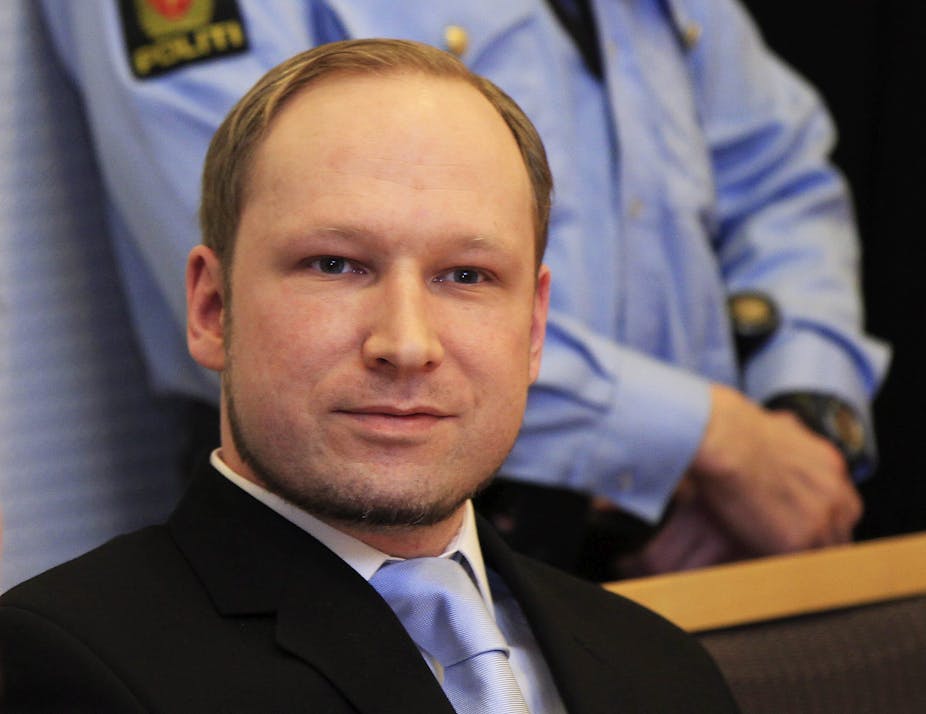
Two teams of psychiatric assessors have come to different conclusions about Breivik’s mental state. AAP

On July 22, 2011, Norwegian Anders Breivik killed 75 people, as a statement against Norway’s liberal immigration policies. He was a member of an extreme right wing group and a product of a dysfunctional childhood. But was he rational and deliberate, or just mad?

That’s the question the court will have to answer at the end of Breivik’s ten-week trial, which begins today.

Competing views

In January 2012, two court-appointed psychiatric experts conducted extensive assessments of Breivik’s mental state. After 36 hours of interviews they handed down a 234-page report that concluded Breivik suffered from a paranoid schizophrenic disorder and was acting on his delusional beliefs.

AAP

But following appeals from lawyers representing the interests of victims, the court sought the opinion of two further mental health experts. Contrary to the past assessment, the second set of experts determined that Breivik was not psychotic, or severely mentally handicapped at the time of assessment, nor at the time of the offending.

All the experts agreed that Breivik was an extremely high recidivism risk.

So how would a crime such as this be treated in Australia? And how does the role of the expert witness differ between Australia and Norway?

An expert witness is recognised by the court as a person who can give an opinion in a specific area of knowledge that is outside the understanding of an “average person”. Psychiatry and psychology expert witnesses must have relevant qualifications, training and experience to be recognised by the court as having such expertise.

Within Australia’s adversarial legal system, the defence and the prosecution will usually engage their own experts, even though the expert should not be an advocate for either party (defence or prosecution).

Usually, the expert will conduct an independent assessment and provide a report outlining the basis for his or her opinion. The report should state the facts or assumptions on which the opinion is based, and should not omit or fail to consider material facts which may contradict the opinion.

The expert should also make it clear when a particular question or issue falls outside his or her area of expertise. If the expert also considers there is insufficient data available, this must be stated to indicate that the opinion is no more than provisional.

In Norway, similar principles apply to being an expert witness, except that under their inquisitorial legal system, the court appoints the expert. (In an “inquisitorial” system, the court is actively involved in investigating the facts of the case, whereas in an “adversarial” system, the court acts an impartial umpire between the prosecution and the defence.)

In Australia, the most controversial area of “expert evidence” relates to opinions given in the context of the “insanity defence”. The law determines that a person with a mental impairment may be found “not guilty” of an offence if, at the time of the alleged offence, the person was suffering from a mental impairment, and, as a consequence either:

a) did not know the nature and quality of the conduct; or
b) did not know the conduct was wrong; or
c) were unable to control the conduct.

Although the person may be found “not guilty”, they won’t be released into the community. Instead they’ll be detained within a mental health institution (rather than a prison) for an indeterminate period of time, which cannot exceed the term of imprisonment had the defendant been found “guilty”.

The judicial system of Norway, however, has no provisions for an insanity defence. Instead, the court can sentence “mentally ill” defendants to involuntary commitment.

Involuntary or civil commitment is a legal process whereby an individual with symptoms of severe mental illness is court-ordered into treatment in a hospital or in the community as an outpatient. How long they remain in treatment depends on their response to treatment and their perceived risk to the community or themselves.

In Australia, similar state-based legislation applies to cases where the person is considered a danger to society or themselves because of their mental illness. These people can be detained for treatment and released when they’re no longer considered a risk.

Candles and flowers opposite Utoya Island, where Breivik killed 56 people. AAP

Penalties

Capital punishment was abolished in Australia in 1984 and hasn’t been used in Norway since 1905. The maximum penalty for murder or acts of terrorism in Australia is “life imprisonment”, whereas in Norway the maximum is 21 years of imprisonment.

The Norwegian correctional system places greater emphasis on the rehabilitation of offenders, and their re-conviction rate is around 20%.

In Australia, where comparatively less emphasis is placed on rehabilitation and more emphasis given to punishment, the re-conviction rate is around 40% .

The Norwegian court now has to determine how it will deal with its most notorious offender, Anders Breivik, in the light of the differing expert opinions it has received. If he is judged to be a mental-health patient, he will be treated and released when his mental health improves and he’s not considered a risk to himself or others. This would be an indeterminate sentence.

Alternatively, he will be convicted for “acts of terrorism” and given a mandatory 21 year sentence (to be released when he is aged 53). He would be offered access to rehabilitation aimed at reducing his risk of re-offending.

The victims' families legal challenge, which raised a different “expert” opinion, was likely motivated by a desire to see Breivik punished and convicted as “sane”, so that he will receive the mandatory 21-year sentence. A “mental illness” conclusion could see him released much sooner, if his treatment needs are met and he’s no longer considered a risk.

So, will Breivik be judged mad or bad? And how will that affect his sentence? The world will be watching closely over the next 10 weeks to see how the Norwegian legal system handles its most public criminal case.

Articles also by This Author

Sign in to Favourite

Want to follow The Conversation?

Sign up to our free newsletter to get the day's top stories in your inbox each morning, with a special wrap on Saturday.

Help evidence based journalism become the norm and donate

Join the conversation

38 Comments sorted by

  1. Peter Ormonde

    Peter Ormonde is a Friend of The Conversation.

    Farmer

    Can someone be so poisoned by hatred and anger that they are quite literally "maddened" by it? I suspect so. But does this mean they suffer from an "illness"?

    To be honest I doubt that any justice system can actually deal with the likes of a mass murderer like this bloke. Yes his ideas are mad but is he ill? How does one rehabilitate a man who makes his hate-filled political points by systematically murdering children?

    I don't have any answers to this... all I get are unanswerable questions…

    Read more
    1. Timothy Wong

      logged in via email @yahoo.com.au

      In reply to Peter Ormonde

      Peter Ormonde,

      Good questions. I'm not a psychiatrist but someone who is Tad Teitze who was involved in the editing of the following e-book:

      http://onutoya.com/

      I think that if we blithely dismiss all evil acts as "insane" then we risk both "de-politicizing" them and ignoring the nasty sides of human nature.

      Cf eg. Stephen Pinker's recent "The Better Angels of our Nature"

      Joanna Burke "An Intimate History of Killing"

      Babara Ehrenreich "Blood Rites: Origins and History of the Passions of War"

      report
    2. Timothy Wong

      logged in via email @yahoo.com.au

      In reply to Timothy Wong

      Oh and whilst we're on the subject see also Michael Mann's monumental "The Sources of Social Power"

      which Mann once summed up as "the forces of destruction as a equally important as the forces of production"

      report
  2. Comment removed by moderator.

    1. Peter Ormonde

      Peter Ormonde is a Friend of The Conversation.

      Farmer

      In reply to Gideon Polya

      Ah but Gideon, after all of that it is still a sheep.

      I think this mongrel was far more than just the string of adjectives you attach. He was essentially anti-everything ... anti anyone different at all at least in Norway... a "racial" purity enthusiast. His enthusiasm for Israel was that it provided a model for getting ethnic groups out of Europe... that is, and it is an important distinction, this fella supported Zionism because it was essentially a far away ghetto in which to dump an unwanted…

      Read more
    2. Timothy Wong

      logged in via email @yahoo.com.au

      In reply to Peter Ormonde

      Gideon Polya,

      Please don't be offended and obviously you can take it or leave it but, for what it's worth, I'm with Peter Ormonde on this one.

      You write like a bio-chemist ie. someone used to to describing molecules as they synthesize into compounds etc. Maybe you would be happier writing in German? A language where adding up words to form a brand new word is much more linguistically commonplace.

      It's not merely a question of "style" (understood as mere cosmetics) though your heavily repetitive…

      Read more
    3. Gideon Polya

      Sessional Lecturer in Biochemistry for Agricultural Science at La Trobe University

      In reply to Timothy Wong

      Timothy, I understand exactly what you and Peter are saying and as a lifetime lover of good literature I agree with both of you - but as you say I "write like a biochemist" and do so because I am one. After authoring or co-authoring over 100 scientific papers I am used to the succinct, efficient style demanded by scientific editors and indeed by busy scientific readers - a style far removed from James Joyce but it states the facts, albeit tersely.

      report
    4. Timothy Wong

      logged in via email @yahoo.com.au

      In reply to Gideon Polya

      Gideon, yep sure. As the saying goes, don't ever change mate.

      Apologies if I seemed to belaboring the point in my above post.

      Apart from anything else I can't help pushing Havelock's work onto people, both in real life and online

      report
    5. Sandra Kwa

      Grad Cert Ethics and Legal Studies, CSU

      In reply to Gideon Polya

      Laugh Out Loud! (My 10yo wants to know 'what's so funny, Mum?' Where do I begin?) Gideon, and Peter, I am enjoying both your styles today. Please don't stop!

      report
  3. Anthony Nolan

    Ruminant

    Pardon me for asking the obvious question, and perhaps psychiatric or psychological professionals might shed some light on this, but how is it possible for two different teams from the same discipline to arrive at diametrically opposed diagnoses of the same subject?

    report
    1. Jack White

      Forensic psychologist & Adjunct Associate Professor in Clinical Psychology at University of Canberra

      In reply to Anthony Nolan

      Good point. It comes down to interpretation of data.
      One expert may interpret responses to indicate a psychotic condition, while another may perceive it as being rational. As a psychologist involved in many of these types of assessments, there is much value in using a series of standardised test measures that provide better insight into a person's response pattern. Generally psychiatrists do not use psychometric tests, which may limit their information base.

      report
    2. Anthony Nolan

      Ruminant

      In reply to Jack White

      Yeah but, yeah but...happilly I've no professional axe to grind here. In the light of your response then I'll have to agree with the general tenency to declare that offering a psychological diagnosis for the accused is inadequate. He appears to me to be a man perectly capable of rationally pursuing mad ends which does not fit definitions of insanity. Or does it? Because, if it does, whole classes of expoiters and despoilers need to watch out.

      report
    3. Lu de Prís

      artist

      In reply to Jack White

      It is the problem of the ‘scientific’ community, transposed onto the legal system, that demands he must be either/or = bad or mad. Why can’t he be both?

      report
    4. Jack White

      Forensic psychologist & Adjunct Associate Professor in Clinical Psychology at University of Canberra

      In reply to Lu de Prís

      He can be both mad AND bad, but you might say 'Mad' trumps 'Bad' - treat the madness and the badness may go - or it may not.

      report
    5. Lu de Prís

      artist

      In reply to Jack White

      Interesting – so according to your experience which I’m sure is common, be the system adversarial or inquisitorial, the Norwegian must actually re offend in order to ultimately convince the ‘scientific’ and ‘legal’ communities that he is predominantly either mad or bad, given they currently do not have the criteria, in their respective fields, to effectively deal with his likes?

      report
    6. Jack White

      Forensic psychologist & Adjunct Associate Professor in Clinical Psychology at University of Canberra

      In reply to Lu de Prís

      Well that is what the next 10 weeks will decide in his trial! If the Court concludes he has a severe mental illness I.e. paranoid schizophrenia, he may be debtained indefinitely for “treatment" to an appropriate mental health institution. If they resolve he does not have a mental illness, he will be given a mandatory 21 year jail sentence.

      report
    7. Peter Ormonde

      Peter Ormonde is a Friend of The Conversation.

      Farmer

      In reply to Jack White

      See I think that's the problem Jack ... we run through a DSM scorecard and slap a label on it like "paranoid schizophrenia" and we can file it away.

      On that basis the Nuremberg trials would have consisted of a flock of blokes in white coats and clip boards and a bus. I don't think it is enough and I don't think it is an adequate explanation of what has occurred and why... perhaps no purely individual explanation is adequate.

      Our justice systems are predicated examining and judging individual…

      Read more
    8. Jack White

      Forensic psychologist & Adjunct Associate Professor in Clinical Psychology at University of Canberra

      In reply to Peter Ormonde

      I agree.
      I was iInvolved with Adelaide's infamous “Snowtown murders" where the offenders were driven by a perceived vigilante belief that they were removing from society those people who preyed on children. One of the prime offenders (Wagner) was found guilty of multiple murder, but had himself been a victim of childhood sexual abuse, and despite his attempts to tell those in authority (parents and police) was scorned and told he was "a liar". At the time of the Snowtown killings, politicians were openly stating that “paedophiles should be removed from society". This was reported in the press. Such crimes do have strong social elements to them, that are not addressed by a mental health assessment nor through the criminal justice system.

      report
    9. Lu de Prís

      artist

      In reply to Jack White

      Being aware that the next days shall determine, my point is that the two available boxes are inadequate in themselves, as is an either/or solution. In particular the psychiatric profession would appear to have fallen very short of getting a proper handle on this type of offender, despite being plenty in circulation, all be it on smaller scale operations. He is, in principle, no different from the man who kills his wife and justifies it by believing he must save mankind from sloppy housework. How…

      Read more
  4. Lu de Prís

    artist

    The notion that someone who is ill must be a victim, which can always be traced to some extent to the sins of the parents, and who has diminished responsibility, and is receptive to rehabilitation, is the premise for mental disease.
    Yet evil is also a choice – a whole series of choices.
    The crux of the difficulty is the psychiatric profession does not understand nor know how to treat evil; therefore throw it into a mixed bag along with other mental disorders.
    Breivik is both mad and bad.
    Surely if ever there was an argument for making evil a mental disease in its own right, he is it. This would afford the professions involved to make proper scientific scrutiny of it.

    report
  5. Comment removed by moderator.

    1. Joseph Bernard

      Director

      In reply to Terry Kelly

      @ Terry .. I Agree,

      Beveirik clear has emotions as he demonstrated in court when His "manifesto" was viewed.. And He has clear Logic He is applying to His actions.. abeit extreme.

      Beveirik clearly has issues with "Islamofacists" and as noted in an earlier post. “Some of the statistics He quotes are clearly valid”. And Beveirik is not the first to make these claims either.. Geert Widler a public figure has gained significant notoriety because of His claims regarding islam and…

      Read more
    2. Peter Ormonde

      Peter Ormonde is a Friend of The Conversation.

      Farmer

      In reply to Joseph Bernard

      Joseph

      Why do you Capitalise these Guy's pronouns?

      There is enough intolerant hateful stuff about to fuel any sort of receptive madness ... sufficient to get boys (and girls now) strapping on jackets full of C4, or to "justify" claims for the extermination of all Copts in Egypt, all Arabs in Israel, Christians in Sudan or schoolchildren in Norway... everywhere.

      Surely the question is what makes a mind receptive to this sort of anger and hate to the point of acts of psychopathic brutality.

      report
    3. Joseph Bernard

      Director

      In reply to Peter Ormonde

      @Peter,

      Sorry, but let us atleast try honour the 77 people that died by fully understaning what happened. I believe everything is connected and Breivik is part of an emerging theme. Do we ignore it? or Do we challenge it?

      What makes a person want to take justice into their own hands? I suggest possible causes include the lack of discussion to address the fears and violence usually occurs when there are no more words left!

      Is Bereivik the only person to have these fears? Better have an open discussion on this and make sure we have answers,

      report
    4. Peter Ormonde

      Peter Ormonde is a Friend of The Conversation.

      Farmer

      In reply to Joseph Bernard

      I'm really glad you added that last bit Joseph... phew.

      Yes fear is at the heart of it I think... that primitive animal flight or fight business ... prerational ... buried in the dark limbic system. Fear of anything and everything different... fear of change... perceptions of attack and insult.

      One of my concerns in writing and thinking about this issue has been the nature of the debate - or lack of debate - here about refugees and immigration. In my view it is an act of deep moral and political…

      Read more
    5. Joseph Bernard

      Director

      In reply to Peter Ormonde

      @Peter,

      yes Fear is the real enemy which fuels much of this behaviour.. The Fear is unfortunately milked as a control mechanism by shock jocks to drive their own ratings or agendas rather than explore a higher understanding.

      The good news is that most people on the planet just want a peaceful and happy life. The challenge is to find leaders or visionaries that are able to negotiate the minefield of different grievances’ and prejudices to reach a happy consensus.. While people are still talking we have hope

      my 5 cents worth

      report
  6. Bruce Tabor

    Research Scientist at CSIRO

    I'm no expert, but it strikes me that Breivik has Antisocial Personality Disorder, i.e. he's a psychopath; someone with no innate concern for the rights of others and totally lacking in empathy and remorse. As I understand it, personality disorders are not regarded as mental illnesses per se, but intrinsic aspects of someone's personality, with little to no prospect of changing. (I'm interested in your comments Jack.) On one level I find his reasoning remarkably rational, cool and calculating, yet utterly devoid of humanity.

    I do think that society must have recourse to forms of punishment (treatment?) that incarcerate individuals such as Breivik (or Martin Bryant) for the remainder of their lives. There is simply no possibility of rehabilitation. Many in Norway will be regretting that they only allow a maximum of 21 years of imprisonment.

    Menatlly ill? No. Mentally different? Yes.

    report
    1. Jack White

      Forensic psychologist & Adjunct Associate Professor in Clinical Psychology at University of Canberra

      In reply to Bruce Tabor

      You raise an issue that is intellectually interesting.
      I was involved in a trial several years ago R v Bini (2000) and R v Bini (2003) that provides more questions than answers.
      The defendant was diagnosed by myself and a psychiatric colleague (Chris Branson) with a Borderline Personality Disorder. In the first trial a mental incompetency (insanity) defense was successful. While waiting for the supervision programme to be agreed, he re-offended. Same offense type, no clinical change. A different Judge ruled him "competent" (or sane). So much for precedent!
      If Antisocial PD was considered a mental impairment - all prisons would all need to be renamed Mental Health Institutions ... maybe not a bad idea!!

      report
  7. john mills

    john mills is a Friend of The Conversation.

    artist

    How dodgy are psychiatrists then ,they give him an "excuse" diagnosis in their wisdom, and then renege on their diagnosis because the families are rightfully angry about it, all about their image now, interpret what you like, their a joke really,and a sad one at that.they should be seen as that, and be discredited, in fact not even be part of the proceedings, And isn't it funny how they do the exact opposite with their poor victims,tag and poison them, and back each other up, To me it shows how shallow they are, and how much they shouldn't ( cant really ) be trusted. They've got "excuse" as a means of exploitation and torture, whatever it needs to be, just quietly.

    report
    1. Jules Begg

      logged in via Facebook

      In reply to john mills

      I have not seen the details of his evidence. As a definition a delusion is a fixed false belief unamenable to explanation and not in keeping with society or cultural ideas. The latter part is the most difficult when assessing people with racial/religiose type ideas. Problem arises as to wether a delusion is part of illness or personality.
      Unfortunately some people dont fall neatly into a definition, perhaps this says more about inadequacy of the definition than the person.
      As Jack says the opinion of the expert is just that, an opinion. The Court is assumed to be the best at coming to a decision about what to accept as fact.
      Jacks point about telling the court the assumptions on what the report is based upon is important, this and presenting the history as obtained from the individual enables the courts to test the evidence.

      report
  8. john mills

    john mills is a Friend of The Conversation.

    artist

    The public wants Breivik to suffer at the hands of psychiatry until the end of time for his crimes, and not just do 21 years, hes mad like everyone else in society ,just hes mad and bad, hes sure that hes not mad though, and he talks confidently about the way he thinks, so that makes him saner and more secure in his madness,which is normal in the real world in spite of his bent way of thinking, hes deluded about hes bad,no doubt though.Then theirs the insecure in their thinking, they're mad like…

    Read more
  9. Eric Huttlestone

    Public

    Sorry guys, and with all due respect for the professional expertise but isn't this all a little arbitrary... I mean, it is beyond doubt Breivik murdered so many, and in cold blood... so, execute him!

    We lose the battle with violent crime daily. If anything our "civilised" culture affords the protection of violent people. Execution at least might make them consider the consequences of their action.

    And yes, I do understand... if I'm going to be executed I might as well make a bloody good job of what I'm about to do!
    To be honest, I don't think the risk of that mentality would make any difference to these particularly violent people.

    We probably can not predict such violent acts... so at least make certain the perpetrator will NEVER have the opportunity to repeat the vile act.

    Does this make me equally violent... I think I would prefer the label... soldier acting in defense of the victims... that's perfectly legal... isn't it!

    Bring back capital punishment.

    report