
McKeon review: we need to integrate research and health services

Last year the federal government asked my colleagues and I to investigate the state of health and medical research in Australia and make recommendations about the strategic direction of the sector. After months of consultations with researchers, clinicians, hospital managers and governments in every…

Kj582gdn-1348798424
Research should be routinely translated into clinical practice. Flickr/cstmweb

Last year the federal government asked my colleagues and I to investigate the state of health and medical research in Australia and make recommendations about the strategic direction of the sector.

After months of consultations with researchers, clinicians, hospital managers and governments in every state and territory, we are today releasing the Strategic Review of Health and Medical Research consultation paper.

Stronger connections

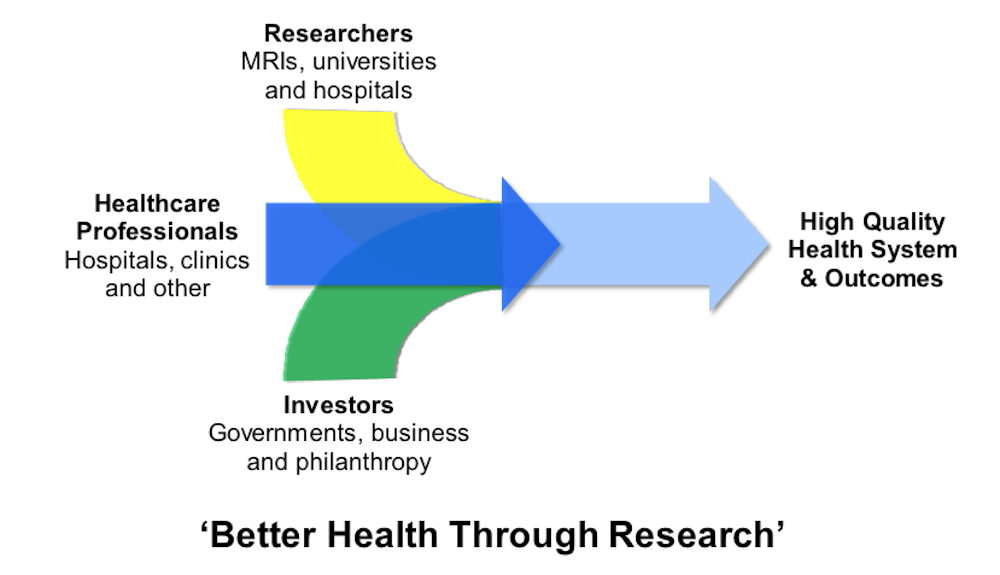
The overarching message from this paper is that Australia needs a stronger connection between health and medical research, and the delivery of health-care services. Embedding research into health care will ensure government investment in research benefits all Australians – through better health outcomes – and delivers the greatest economic value.

The National Health and Hospital Reform Commission noted the role of research in driving innovation in its final report in 2009:

“Valuing clinical leadership and embedding a culture which frees health professionals to invest time in quality improvement may be as important as structural change in achieving health reform … Providing health professionals with opportunities to combine teaching and research with their service responsibilities builds a culture of quality and is demonstrated to lead to better uptake of new knowledge and better outcomes.”

While we perform ground-breaking health and medical research within our research institutes, universities and companies, the growing pressure on health services has restricted research activity in the health system. This has also created barriers for research translation into evidence-based clinical and health interventions.
Rising health costs

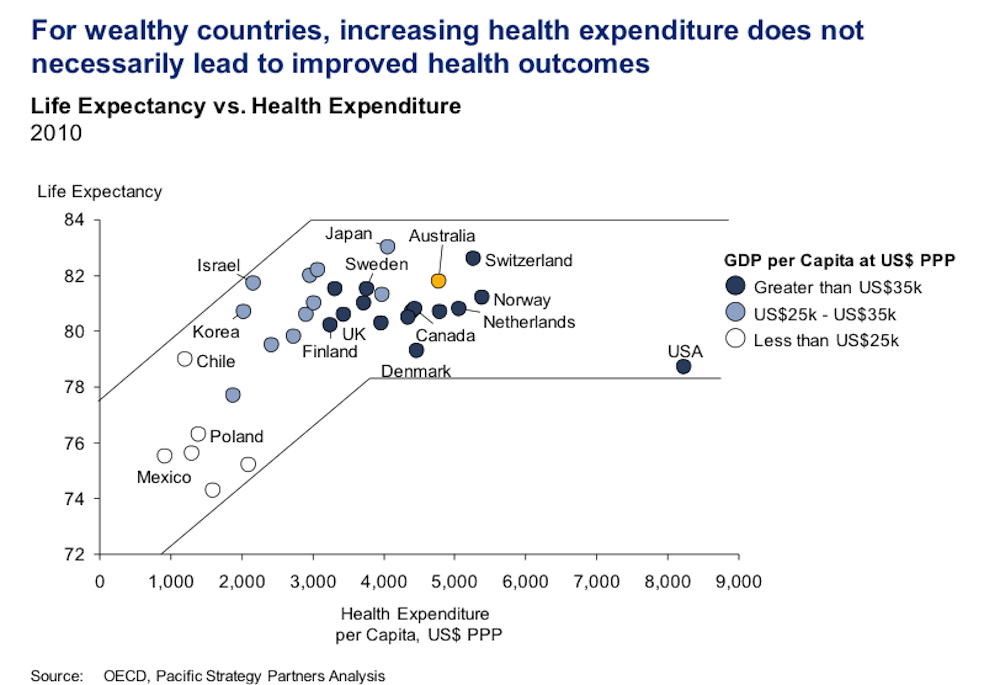
Our review found that while Australia’s health system compares well with other countries in terms of life expectancy, the cost of health care is escalating at an unsustainable rate. And there is a significant opportunity to reduce inefficiency and improve performance.

Australia’s national expenditure on health is estimated at over A$130bn in 2011-12. Of this, total government expenditure is currently over A$90bn and 7% of GDP, but will grow to over A$450bn and 13% of GDP by 2049-50, according to Treasury projections.

Simply increasing health-care expenditure does not necessarily lead to improved health outcomes. For developed countries, there is little correlation between total health system expenditure and health outcomes such as life expectancy. A more strategic investment approach is required to improve outcomes and control costs.
Health and medical research is the R&D function of Australia’s A$130bn health system. Investment in research has underpinned the improved quality of health care for Australians over the past 50 years, and has a fundamental role in improving the future effectiveness and efficiency of the health system. An additional dollar spent on research has a multiplier effect by driving efficiency and new practices, compared with an additional dollar spent on general health care.

One area of opportunity for improvement is the cost of inefficiency and adverse events in the health system. In the United States, this is estimated at between 20% and 30% of health expenditure. And while the equivalent Australian number is not known, it is likely to be significant. Health services research on the Australian health system must be a priority to identify and target more efficient ways to deliver health outcomes.

Steps to reform

Initially, the focus of health and medical research reform must be on realigning existing investment in two main areas: the National Health and Medical Research Council (NHMRC) and the health system.

The NHMRC’s current budget allocation should be optimised, including ring-fencing a portion of funding for priority-driven research. A set of eight to ten national health research priorities should be funded and an expert committee established for each priority area that determines and leverages spending.

We also must provide greater control, transparency and accountability of the approximately A$1.5bn annual research investment in the health system. This includes investment in preventing inefficiency and adverse events to deliver savings.

A well-designed program to address post-operative infections, for example, could provide significant savings that would more than fund the proposed increase in investment.

Once the appropriate controls and mechanisms are in place to track, monitor and ensure accountability of research, new investment programs over three to five years will deliver further health system improvement, support high quality research and stimulate new investment.

Investment of an additional A$2bn to A$3bn a year on research in the health system is required within eight to ten years to attain our recommended target of 3% of the health budget.

Retaining international lead

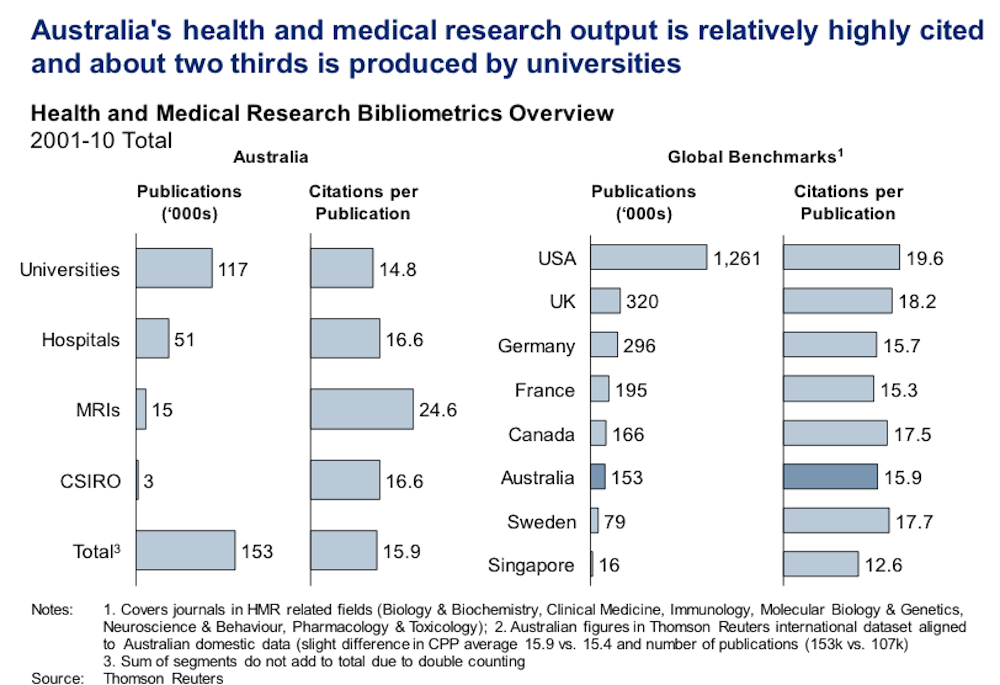
The Australian research sector is world class. If there were a Health and Medical Research Olympics, Australia would be sixth on the medal table of most prolific creators of research output.

This research has delivered a steady stream of clinical breakthroughs, from the purification and mass production of penicillin by Nobel Laureate Howard Florey in 1942, to the Gardasil vaccine for cervical cancer more recently.

Australians benefit strongly from this activity, with both local clinical breakthroughs and research on topics where we need particular focus such as Aboriginal health and skin cancer.

And when research is carried out in a hospital or by health-services providers, the standard of care increases regardless of the focus of the research itself.

It’s also important to note that commercialisation of research has underpinned a medicine and medical device industry that employs 40,000 people, exports A$3.8bn of goods, and will soon surpass the size of the automotive industry.
Summary of recommendations

The Panel has developed a draft ten-year strategy that has 21 recommendations, including:

  • Investing at least 3% of Australian and state and territory government health expenditure (an additional A$2bn to A$3bn per year by mid 2023) to drive research activity within the health system as an embedded component of the Australian government’s health reforms

  • Establishing “Integrated Health Research Centres” combining hospital networks, universities and medical research institutes to create globally relevant centres of excellence and drive translation of research into clinical practice

  • Creating up to 1,000 competitive practitioner fellowships for leading clinicians that protects 50% of their time to further embed research within patient care

  • Providing increased sector leadership by a rejuvenated NHMRC

  • Supporting focused research based on priorities of immediate clinical relevance to Australians, and in key areas such as Indigenous health, rural and remote health, and application of genomics to personalised medicine

  • Maintaining research excellence by making research a more attractive career path with improvements in people support, career flexibility and granting processes, and by strategic investment in infrastructure such as biobanks and data linkage networks

  • Advancing clinical trials, public health research and health services research

  • Providing clear pathways to translate research evidence into clinical practice, including a matching Translational Development Fund for early stage development and commercialisation

  • Incentivising high end philanthropy to invest in identified health priorities

A full set of draft recommendations can be found in the Strategic Review of Health and Medical Research consultation paper. Feedback on this paper is welcome until 31 October at www.mckeonreview.org.au.

Sign in to Favourite

Want to follow The Conversation?

Sign up to our free newsletter to get the day's top stories in your inbox each morning, with a special wrap on Saturday.

Become a friend of The Conversation and donate

Join the conversation

11 Comments sorted by

  1. Douglas Hilton

    Director, Walter and Eliza Hall Institute & Professor of Medical Biology at Walter and Eliza Hall Institute

    Simon - congratulations to you and your team on a wonderful draft document, which not only provides a vision for the health and medical research sector, but for the health of the Australian community. Ensuring all Australians benefit from the fruits of medical research without bankrupting the nation is truly one of our grand challenges. Your recommendations set out out a path to tackling this challenge that is both practical and economically responsible.

    report
  2. James Jenkin

    EFL Teacher Trainer

    Really interesting article. There's a big gap between research and practice in my area of language teaching, and no doubt in many fields.

    However, I just had two questions (as a complete non-expert):

    - Wouldn't we want to integrate worldwide, not just Australian, research into health services?
    - Are there any risks when research is driven by what authorities see as immediate needs - for example by prioritising projects that need less time, or by putting undue time pressure on research?

    report
  3. Dennis Alexander

    logged in via LinkedIn

    This is a good article, the consultation paper is well written and digestible and I'd love to buy the story. Increasing research (medical and other) is a public good in itself. What strikes me from the graph is a question: What are the differentiating factors between the different levels of "bang for buck"? Is it degree of integration of healthcare and medical research or is it, say, diet, smoking, lifestyle, hygiene in healthcare facilities, access to primary care, or some other collection of…

    Read more
  4. philip mckeon

    logged in via email @2mf.net

    Simon’s review is another in the genre of men stumbling about in the dark. What else could be expected from a majority of men on a panel. Health and medical research needs is to be administered equitably by women and men. Hospital boards with an equal number of women and men. Departments of medical research the same. Cabinet the same.

    report
  5. Debra Joan Smith

    Account Executive

    I work for a multinational who deal in infection prevention products. This is a vital discussion - thank you for it. Just to underscore the importance of this topic, i will share that I have been told that the 3rd leading cause of death in North America is an infection that one acquires while in a hospital. Just to be clear- that is not one you come in with but rather one that an already hospitalized sick person gets while in a hospital.

    I know of a case where a hotel chain wanted to benchmark…

    Read more
  6. Stephen Prowse

    CEO at Wound CRC

    While the review highlights complex problems of healthcare costs and integration of research and healthcare, the proposed solutions are really tinkering around the margins. As there is no chance that this Government or the next one will increased research funding, we need to be looking at innovative ways of supporting translational research that reduces health care costs. Pooling funds currently spent (somewhat ineffectively) on translational research into a Translational Research Council which is entirely focussed on impact oriented translational research would be a bold move. Such a council could have similar status to the ARC and NH&MRC and may make a real difference to innovation in Australia.

    report
  7. Rajan Venkataraman

    Citizen

    Thanks for the article Simon and I look forward to going on to read the consultation paper now. An observation I have - admittedly my career as a medical researcher ended about 15 years ago - is that there is a gulf between the medical profession and academia in Australia and there doesn't seem to be a culture of practitioners conducting resarch. There seems to be more of that cross-over in the U.S. and perhaps this cultural difference lies at the heart of your proposal for "integrated health research centres".

    Also, I underwent treatment for a condition about six years ago. The treatment at the time was quite new - it had only been introduced in Australia the year before. I was a bit surprised at the time that there didn't seem to be any attempt to capture and analyse data. I have been pleased, however, that six years later the hospital has got in touch with me again to do some follow-up analysis.

    report
    1. Debra Joan Smith

      Account Executive

      In reply to Rajan Venkataraman

      I think this is an excellent addition to this discussion which brings forth a really important point. With so many of us who are survivors of one condition or another, with so great a desire to advance research and the understanding of our condiitions, why are researchers not using our insights and experiences to greater effect? With computers and with the strong trend toward volunteerism, it would seem to be a natural and productive way forward.

      report
    2. Dennis Alexander

      logged in via LinkedIn

      In reply to Rajan Venkataraman

      Two points. Re: " There seems to be more of that cross-over in the U.S. and perhaps this cultural difference lies at the heart of your proposal for "integrated health research centres" The US spends much more for a lesser result as measured by life expectancy, so the question of integration being beneficial is open with the presenting answer, on the given information, in the negative.
      Second. Re: "there didn't seem to be any attempt to capture and analyse data." This is absolutely crucial but as a matter of course not just for new treatments but for all treatments and publicly available in de-identified format for access by medical researchers of all stripes.

      report
  8. Vlado Perkovic

    Executive Director, George Institute Australia

    Dear Simon,

    Congratulations on your thorough and perceptive analyses of an incredibly complex area. As you have ascertained, our main challenge is balancing 'knowledge for knowledge's sake' medical research against priority driven research. I am hopeful the discussion you have begun will lead to an improvement in this balance.

    I also hope that hospitals and health care facilities will ascribe greater value to the conduct of research, and reverse the pattern of recent years driven by budget related constraints

    report
  9. Nicholas Graves

    Professor of Health Economics at Queensland University of Technology

    This review is exciting and is full of good ideas.

    I am the academic director of the Australian Centre for Health Services Innovation (www.AusHSI.org.au) and we fund research that improves health services. To support a project we require partnership between a health services professional who knows the problems and a researcher who can help turn the issue and a solution into data for dissemination.

    I will comment on Simon McKeon’s call for translation of research data into good health policy…

    Read more