

In the US, as in Australia, debate about the merits of alternative gases has been heated. In the US the contentious gas is shale, rather than coal seam. But at least one source of conflict is the same: this gas may provide energy, but will it reduce greenhouse gas emissions?
Last April, I co-authored a paper with my colleagues, Bob Howarth and Tony Ingraffea, detailing the full-lifecycle methane emissions associated with shale gas development. We assessed the greenhouse gas impact of shale gas development over 100-year and 20-year time frames and in terms of energy (in MJ) and power (kWh) produced.
More methane than conventional gas
Based on the best publicly available – though very limited – data, we concluded that shale gas is not a viable “bridge” to a lower carbon future. Given the limited data, we urged further study and independent measurement.
In the ensuing months, several new studies addressing the relative climate impact of shale gas and a revised US emissions inventory have been released. Our most recent paper compares emission estimates from these sources to those of our earlier research.
Full-lifecycle emissions for conventional and shale gas, based on the revised national inventory data, fall within the ranges we initially reported. Nearly all studies confirm 40% to 60% higher methane emissions from shale gas than from conventional gas. However, methane’s importance in affecting the climate in the near-term remains grossly understated in many of the lifecycle studies; studies that base their final conclusions on 100-year global warming potentials (GWP) and dismiss the updated methane GWP factors.
Methane could make a difference now
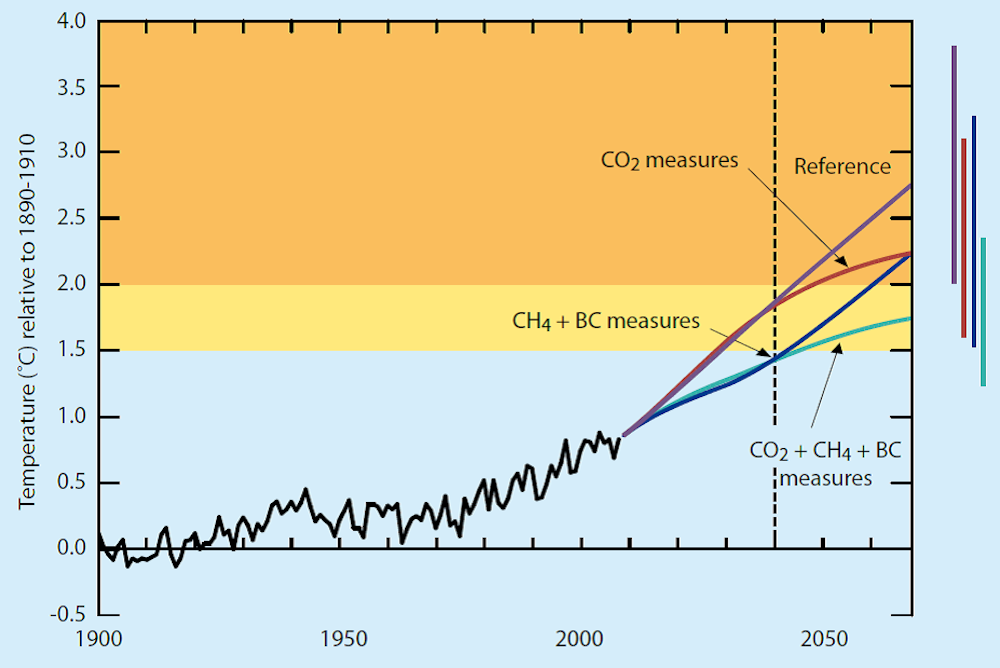
In 2007, Hansen and colleagues called for controls on both carbon dioxide and short-term climate forcers – such as methane – to avoid a 1.8°C rise in global mean temperature. If this rise happened, it would result in positive feedbacks in the climate system leading to rapid acceleration of warming and dramatic changes in climate.
Since then, the United Nations has set this critical threshold at a range of 1.5° to 2°C above pre-industrial levels. Recent reports from UNEP/WMO and Shindell et al have reiterated the need to control methane and other short-term climate forcers – though more urgently so.
Their findings indicate that critical thresholds will be hit within the next 15 to 35 years. Since carbon dioxide is a long-term climate forcer, controls – even if aggressive global carbon dioxide reductions are initiated now – will have little if any effect for 40 years or more. This may be too late.
On the other hand, control of short-term climate forcers such as methane has a more immediate impact, and is compatible with long-term climate mitigation when coupled with carbon dioxide reductions. While long-term climate stabilisation is important, the priority now is the very real near-term risk of dramatic and irreversible climate shifts. In this light, in studies and national inventories using the global warming potentials methodology, the 20-year timeframe is not only an appropriate tool, it’s a critical one.
Methane reduction is possible, but unlikely
The most recent US EPA emission estimates indicate that methane contributes 44% of the entire greenhouse gas inventory of the US. (This is when viewed through the lens of this 20-year period following emission and using Shindell’s values for global warming potential). The natural gas industry is by far the largest source of this methane from the US.
Technical solutions for reducing (not eliminating) methane emissions from shale gas do exist. The most obvious targets are the greatest emission sources: flowback (the waste water produced by the fracking process) and downstream fugitive emissions.
With gathering lines in place – and if the company has invested in proper separation equipment or contracted services – a portion of the methane produced during fluid flowback can be captured and sold to market. To date, there is no evidence this is common industry practice. At current prices, it may not even be in the interest of industry to capture this methane.
The US EPA proposed new regulations last summer mandating the capture of methane on all hydraulically fractured wells. But industry has successfully pushed the final ruling to spring of 2012. How the originally proposed regulations will hold up is still unclear.
Fix it, or find a better way?
Fugitive methane losses from downstream activity (such as gas storage, compression, transmission and distribution pipelines) make up an equally large portion of the estimated life-cycle methane emissions from the natural gas industry.
Fixing these leaks may be extremely costly. Half of the transmission pipelines in the US are more than 50 years old, and in many cities, the local distribution pipes are older yet. In cities such as Boston and Philadelphia, these local systems often pre-date the Great Depression of the 1930s, and are based on unwelded cast iron pipe placed end-to-end with sealant that probably gave out before World War II.
Does it really make sense to spend vast sums of capital to rebuild this crumbling natural gas system? Or is society better off investing that capital in technologies for the 21st century, such as renewable energy sources, greater energy efficiency and smart grids?