

Military intervention can be a cure worse than the disease

The new year is scarcely a month old. Yet we have seen enough to know that the fires raging in different parts of the Middle East and North Africa will not easily abate – and that the firefighting efforts of Western governments may prove no more successful than in the past. From Algeria to Afghanistan…

Ymb6mvk8-1360128095
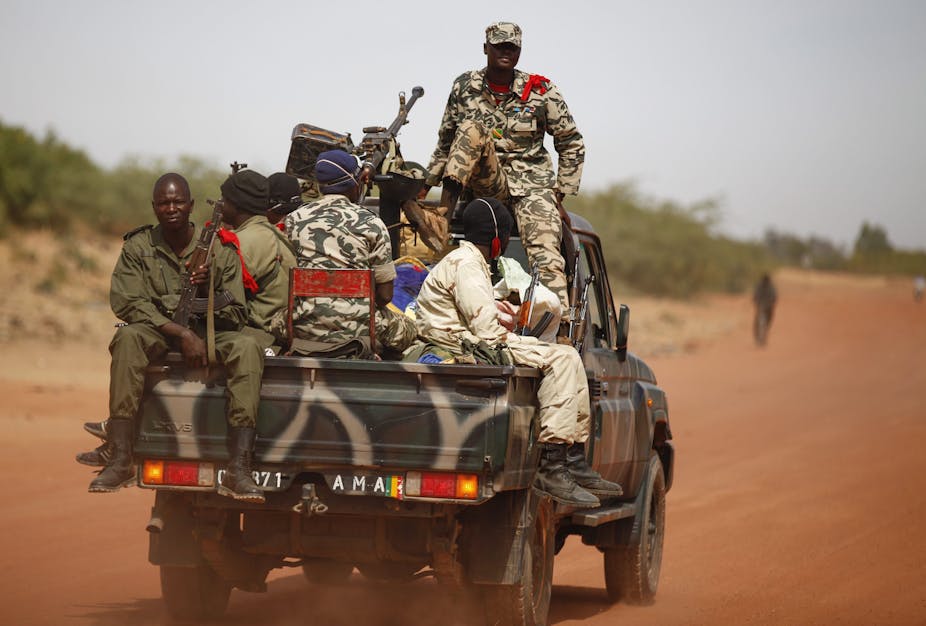
Malian troops patrol the town of Diabaly in the country’s north. AAP/Nic Bothma

The new year is scarcely a month old. Yet we have seen enough to know that the fires raging in different parts of the Middle East and North Africa will not easily abate – and that the firefighting efforts of Western governments may prove no more successful than in the past.

From Algeria to Afghanistan, we see governments whose survival depends on authoritarian rule or the continued support of external powers, or some mixture of the two. In a few places, in particular in Tunisia and Egypt, there has been talk of a transition to democratic institutions, but the path is strewn with obstacles. In many more places, Libya, Algeria, Syria, Iraq and Yemen to name a few, terrorist cells operating under different guises and names are fanning the flames, moving elusively from one flash point to another.

Attacks by Islamist insurgents on US outposts in Benghazi, Libya, at a gas plant in Algeria, and in Mali over the past 12 months may at first sight appear to be unconnected. A closer look suggests they are the interconnected symptoms of a deeper ailment.

In Algeria, on January 16, a group linked with al Qaeda took more than 800 people hostage at the Tigantourine gas facility near In Aménas. The raid mounted by the Algerian special forces managed to free nearly 700 Algerian workers and more than 100 foreigners, but at a high cost: 39 hostages were killed along with an Algerian security guard and 29 militants.

In Mali, the steady collapse of state control over the north of the country was followed by an inconclusive military coup in March 2012, which did little to stem the steady advance of the Saharan branch of al Qaeda. The insurgents were soon in control of the Tuareg north, effectively seceding from the rest of Mali and establishing a harsh form of Islamic law. This is the backdrop to French military intervention which has, for the time being, driven Islamists from the major cities they had occupied across northern Mali.

There is reason to think that in each case the terrorists received both weapons and training from militia camps in Libya.

During her testimony before the Senate Foreign Relations Committee on January 23, Hilary Clinton acknowledged as much. She said:

There is no doubt that the Algerian terrorists had weapons from Libya. There is no doubt that the Malian remnants of al Qaeda in the Islamic Maghreb have weapons from Libya.

Russian Foreign Minister Sergei Lavrov put it more forcefully, saying, “Those whom the French and Africans are fighting now in Mali are the (same) people who overthrew the Gaddafi regime, those that our Western partners armed.”

A French soldier rides an armoured vehicle through the Malian town Timbuktu. AAP/Arnaud Roine

He may well have added that the Taliban, which the United States has been fighting in Afghanistan for more than 11 years, is in part “the monster” the US helped to create when it decided to support and arm Islamist groups during the 1980s.

We are also seeing the revolving door of Islamist violence and Western intervention at work in Syria’s tragic devastation. In recent months, well armed Jihadist groups appear to be gaining the upper hand among the rebel groups fighting the Assad regime.

In this confused picture, one thing is becoming clearer by the day. US military interventions in Afghanistan in 2001 and Iraq in 2003 have turned out to be costly operations, greatly sapping the strength of the American state, and if anything widening the spread of terror. The Western intervention in Libya suggests more of the same.

Despite hundreds of US drone strikes, the death of Osama bin Laden and the fracturing of al Qaeda, the jihadist movement is organisationally more flexible and geographically more widespread than ever. With US and allied forces to end their combat mission in Afghanistan next year, the Taliban threat remains potent. Some 1100 members of the Afghan security forces have been killed in the past six months, while army personnel have been deserting in growing numbers. The number of al Qaeda fighters may have fallen in Afghanistan, but many have regrouped in Pakistan or shifted their focus to Syria, Libya, Iraq or Mali, Somalia and Yemen.

French President Francois Hollande shakes hands with a French soldier in Timbuktu, Mali. AAP/STR

France’s intervention in Mali may have temporarily disrupted the plans of Islamist groups, but for how long? François Hollande may have received a hero’s welcome in Timbuktu and Bamako, but French forces can’t remain forever. And, once they leave, will Malian forces, even with the support of neighbouring African states, succeed where they have failed in the past?

The political reality is that relations between the north and south of the country have been historically fraught. The Tuareg nomadic communities of the north have launched major rebellions over the years against what they see as exploitative southern rule. This perception is repeatedly reinforced by stories of massacres, the poisoning of wells and score-settling by pro-government militias against Tuareg civilians. Reports of mob lynchings and other reprisal killings of Tuaregs and Arabs by the Malian army as it retakes control of the north of the country can only fan the flames of grievance and mistrust.

The question, then, is not should international forces intervene to protect communities in need of protection? The “responsibility to protect” has rightly become a universally accepted principle.

Instead, the questions are: what form should protection take? Who should do the protecting? What can be done to prevent, rather than simply react to, mass atrocity crimes? What are appropriate strategies for dealing with rampant corruption and deep-seated ethnic, religious and economic divisions? And importantly, who may decide on these questions?

Military intervention conducted or orchestrated by the United States and its allies, however well intentioned, seems increasingly the wrong answer.

Articles also by This Author

Sign in to Favourite

Want to follow The Conversation?

Sign up to our free newsletter to get the day's top stories in your inbox each morning, with a special wrap on Saturday.

Spinner
Become a friend of The Conversation and donate

Join the conversation

9 Comments sorted by

  1. Mike Swinbourne

    logged in via Facebook

    What many people don't seem to realise - and unfortunately many politicians are among them - is that military intervention does not and never has solved these sorts of problems.

    Miliitary intervention can only create an environment in which the political processes can be conducted. And if those processes are not done properly, or if there is no real commitment to find a proper solution involving all the 'stakeholders' who are satisfied with the outcomes, then the whole ediface will come crashing down again.

    But then, this has been known for centuries. Maybe a few of our pollies should read Clausewitz or Sun Tzu.

    report
  2. Eddy Schmid

    Retired

    All I need to say is covered in the following articles;
    The Project for the New American Century.
    By William Rivers Pitt
    http://www.informationclearinghouse.info/article1665.htm
    02/25/03 -- -

    and this ;
    In Case You Missed it
    Blueprint of the PNAC Plan for U.S. Global Hegemony
    By Bette Stockbauer
    http://www.informationclearinghouse.info/article3249.htm

    Perusal of these documents will verify the agenda for anyone who wishes to avail themselves of what's coming down the track in our immediate future.
    I'm puzzeled that our academic bretheren have failed to familiarise themselves with these publications.

    report
  3. A Ahmed

    Student

    Totally agree

    "He who lives by the sword shall also die by it"

    But it is not guns that kill people! surely it is people that are willing to pull the trigger that are the real danger..

    So while some of us are all too happy to blame the war machine for all the issues, are we any closer to a solution?

    does anyone understand why the Islamists are out fighting everyone in their path?

    maybe history can teach us of a repeating pattern that started some 1400 years ago and…

    Read more
    1. Michael Shand

      Michael Shand is a Friend of The Conversation.

      Software Tester

      In reply to A Ahmed

      Lets not beat up on one religion too much, after all Israel just admitted to sterrilizing etheopian jews for decades because they were the wrong type of jew. Let us not forget what the christians are teaching in Uganda, that non heteronormal individuals deserve the death penalty, I fear you focus too narrowily and heavily on the islamic religions

      report
    2. Baz M

      Law graduate & politics/markets analyst

      In reply to John Phillip

      Name me one Islamic conflict that wasn't triggered by or where there was not some sort of involvement due to the hypocritical fascist ways of the west headed by the US? But hey nothing new right. Islams the new tag line. We have seen similar onslaughts and than pull backs by the West in Africa, Asia, Latin America. Nothing new really. Imperialists will be imperialists.

      report
    3. Baz M

      Law graduate & politics/markets analyst

      In reply to A Ahmed

      Michael don't even bother. This Ahmad character whom you can be sure of uses a fake name has the sole purpose of spreading his racist poison on here with every time I see a post by him. Got to love a true crusader behind a computer screen with a fake name.

      report
  4. Richard Koser

    Dude

    Say it ain't so Joe. Introducing guns escalates violence? Who would have thunk it? Don't tell the National Rifle Association; they might shoot you.

    You could have mentioned the US training of the Malian army - part of a $200m CIA anti-terror campaign across the region. Or the coupl in March last year, led by Amadou Sanogo, who had trained in the US including at the Marine officer school in Quantico. But the examples you give are pretty good. Unfortunately, "the enemy of my enemy is my friend" is a common belief, when we should probably take into account "the enemy of my enemy is probably some whacko with a score to settle". E.g the Afghan warlords.

    One query though: I thought the Tuareg were armed by Gaddafi, rather than the West. Not that I know any personally, but if I ever meet one I'll ask.

    report
  5. Michael Mihajlovic

    Retired

    I suggest we all read the articles in the links provided by Eddy Schmid and then reassess our arguments.
    It appears the USA has an ambition to dominate the world at any cost.
    The USA will stop at nothing to achieve this ambition.
    Every nation that was supposedly helped by the USA has been devastated.
    What right has the USA to dictate to every nation in the world?
    What right does the USA have to use any means to do this?
    What I would like to know is, as Eddy says, why our academics do not expose this.
    It would also be interesting to know why the leading western powers are supporting the USA in its path.

    report