


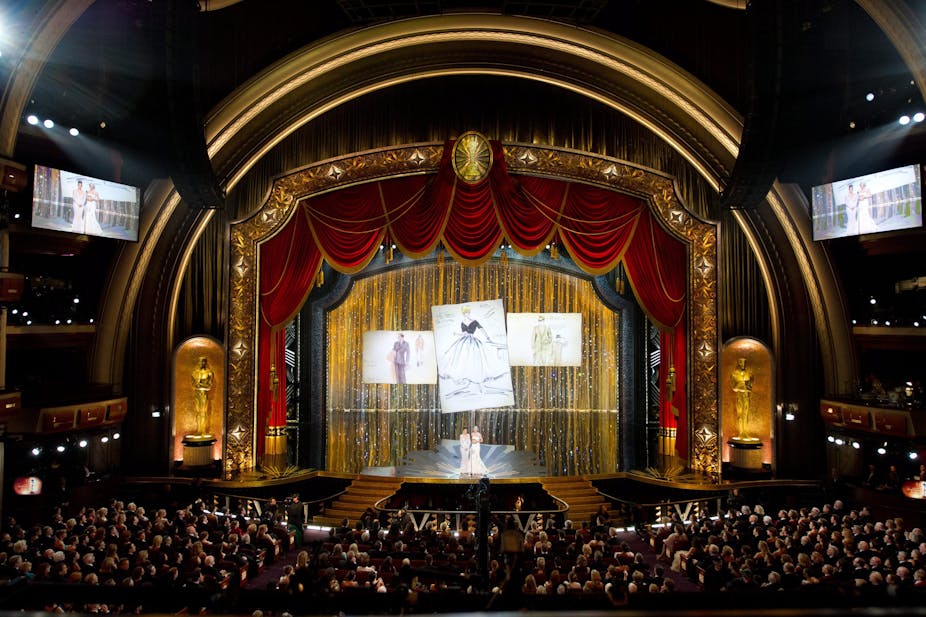
Like many students of film, I have a love/hate relationship with the Academy Awards. I eagerly read all of the predictions on various blogs, get into heated debates among friends over the nominees and love the pomp and ceremony. But there is a lot to hate about awards season, and there always seems to be a discrepancy between who should win and who does.
These gripes aren’t just limited to films geeks like me, who are disgruntled their favourite art house nominee won’t win.
There are three major ways the Oscars ruin cinema for all of us, even if we aren’t aware of it.
1) The Academy never votes for the best film
The Academy voters are a conservative group who are significantly less diverse than the movie going public. In 2012, The Los Angeles Times surveyed voters with results that many had long since suspected. Only 14% of voters are under the age of 50. They have a median age of 62, 94% are caucasian and 77% are male. It’s important to note here, the Academy does not reveal its membership list.
Many argued these statistics heavily influenced The King’s Speech beating The Social Network for best film in 2011 due to the older voters feeling alienated from a narrative about the internet.
The homogeneity amongst the voters is quite often reflected in the nominees. Minorities rarely getting a look-in. In 2011, the directing, acting and screenplay categories didn’t yield a single minority nomination.
But there is hope. An interesting development is the digital voting procedure introduced this year. Many voters found this electronic voting confusing, resulting in an extension of the voting deadline. There is the theory the change in voting procedure lifted edgier fare such as Beasts of the Southern Wild, which has given us the youngest-ever best actress nominee, Amour, which has provided the oldest, to the heights of standard Oscar bait such as Les Misérables and Lincoln.
While whatever constitutes as “the better film” is of course open to interpretation, films that are more appealing to an older, white, male audience are in with a better chance. How else did Extremely Loud and Incredibly Close (which received only one other nomination) score a best film nomination in 2012, while the likes of Midnight in Paris and The Girl with the Dragon Tattoo (which scored four and five respectively that year) were shut out of the category?
2) It’s all about the money
While a film can be nominated without one, it can’t win an Oscar without a significant campaign behind it. The money pushing Lincoln, Life of Pi and Les Misérables is quite significant and the buzz surrounding these films reflects this.
Following press screenings for his film, Steven Spielberg sat for a standard Q&A, which was screened in nine participating media events across the US. All media members received an accompanying coffee table book, Lincoln: A Cinematic and Historical Companion. Likewise, Warner Brothers are pushing Argo with great success.

Without the support of institutional heavyweights a film’s chances of collecting a statue are slim. Now a major player in Hollywood, Harvey Weinstein has guided many of his films to Oscar victory. In recent years he helped The Artist and The King’s Speech to Best Picture wins.
During his days at Miramax, he engineered victories for The English Patient, Chicago and Shakespeare in Love (which controversially upset Spielberg’s Saving Private Ryan). This year, Weinstein is betting on Silver Linings Playbook and Django Unchained.
Silver Linings Playbook is fast becoming a serious Oscar contender with nominations in every acting category. So while nominations for the likes of Emmanuelle Riva in Amour for Best Actress are a welcome surprise, the Weinsten factor will most likely help Jennifer Lawrence over the line.
3) Everyone’s a critic
I always find that film-goers see films differently during the awards season. The majority of contending films are released throughout the summer, so we’re often spoiled for choice. While I enjoy debating a film’s qualities following the screening, I often find audiences are less likely to just “sit back and relax” when a film is up for an Oscar. Instead they spend more time critically evaluating a particular performance or asking if the film really did deserve its screenplay nomination.
And we often go to films we otherwise wouldn’t be interested in seeing, just because they’re up for an award. Take Lincoln, for instance. The film’s trailer doesn’t interest me. If it wasn’t for all of the nominations it had received I wouldn’t see it. And now, instead of perhaps thinking about Lincoln’s efforts in abolishing slavery, I fear I will spend the entire time comparing Daniel Day Lewis’s performance to Hugh Jackman’s or Bradley Cooper’s. When in this mindset it’s quite difficult to enjoy a film.
The Academy Awards can provide an opportunity for excellent cinema, such as Amour, to receive a wider audience. But I dislike how the Oscars change the way we watch cinema. Ultimately, there are institutional hurdles in place that often prevent the best film winning, and change our perceptions of quality in cinema.
Read The Conversation’s take on the best picture nominees here: