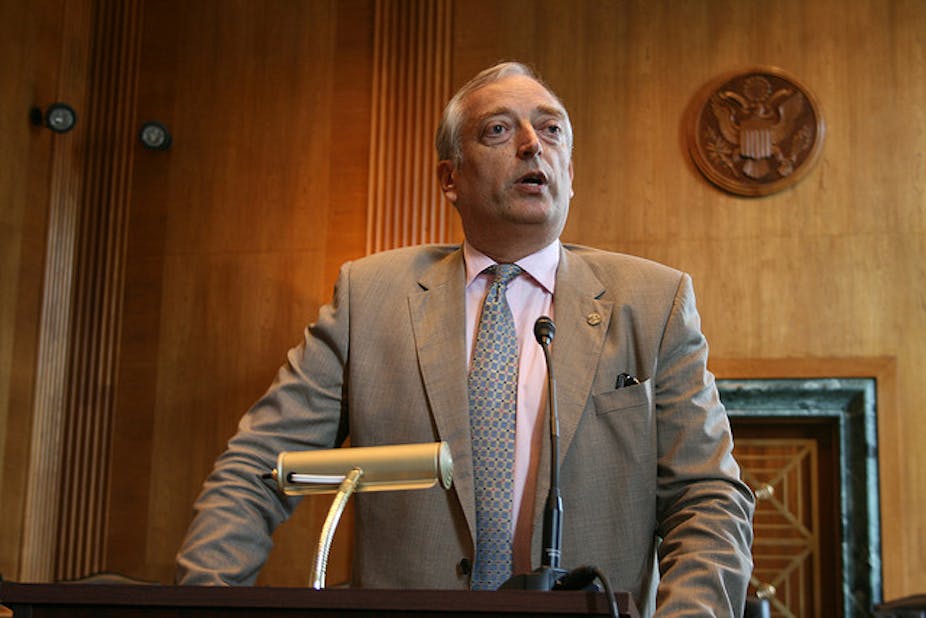
Christoper Monckton has returned to Australia where his unique brand of climate contrarianism is expected to get another good run in the media.
At The Conversation, we’re giving him a run too, but of a different nature. Every time he makes a climate change claim, we’ll test its validity with one of the many atmospheric and marine scientists, geologists, physicists, engineers and economists working in Australia.
What follows is a rolling blog, which we’ll update as Monckton’s Australian talkfest unfolds.
“In Europe we have already got a carbon trading scheme, which in the last two days has now collapsed for the third time in its history with prices heading right down to rock bottom so it makes no difference to anyone as to how much carbon dioxide they emit. If you look at the current economic state of Europe, that’s a pointer to what could happen to Australia if you adopt policies as extravagantly expensive and entirely pointless as far as the climate is concerned."
– 2UE, Thursday 30 June.
Judith McNeill: ‘Extravagantly expensive’ fiscal policies, whether they arise because banks are rescued or for any other reason, may indeed lead to debt levels that cannot be repaid without economic disruption. But such difficulties have very little do with climate policies.
Far from being pointless, raising the cost of carbon-intensive production will improve the competitiveness of less harmful economic processes. Appropriately designed and compensated, a price signal will work its way through markets, stimulating new ideas and business innovations that will gradually reduce the emissions intensity of the economy. There is also a strong ethical case for Australia not to free ride.
How much of an immediate economic impact will introducing a price on carbon have? Economic modelling suggests it will be manageable.
Judith McNeill is Research Programme Director at the Institute for Rural Futures, University of New England.
“One of the things I’ve costed is windmills. They are just about the least cost-effective ways of spending taxpayers’ money, except solar panels. They don’t actually solve anything. Solar will have a future as the panels become more efficient. The problem now is they degenerate very quickly in the sunlight."
– 6PR, Thursday 30 June.
Patrick Hearps: Wind power is the cheapest form of large-scale renewable energy, and as coal and gas prices increase, can be directly competitive with fossil power in Australia as it already is in some parts of the world. The global wind energy market has just reached 200 gigawatts of installed wind power capacity – if it “didn’t work” I doubt the electricity utilities would be buying the electricity the turbines produce. Companies like General Electric, Siemens and AREVA wouldn’t be rapidly expanding their wind power sectors, not to mention the booming Chinese wind industry.
Denmark and South Australia already produce more than 20% of their electricity from wind, Denmark has learned how to integrate it so effectively they have plans to reach 50% wind power by 2025. The Zero Carbon Australia Stationary Energy Plan showed with detailed modelling that wind power could supply at least 40% of the energy in a 100% renewable energy grid.
Standard silicon-based solar panels usually come with a lifetime guarantee of 20-30 years. The technology is dropping in price rapidly and is widely expected to hit grid parity within 3-5 years, after which point it will be cheaper to get electricity from the sun than from the fossil fuel grid.
Patrick Hearps is a Research Fellow for Energy & Transport Systems at the University of Melbourne.
“Scientists are weighing in because it is politically expedient, socially expedient and above all, financially profitable."
– 6PR, Thursday 30 June.
Stephan Lewandowsky: Mr Monckton’s pronouncements from the topsy-turvy zone are, as usual, the inverse of actual reality.
In the place called reality, there is a long and documented history of pressure being put to bear on scientists to downplay the truth about global warming. For example, NASA’s Inspector General has found that during the reign of George W. Bush, political appointees within the agency engaged in active censorship that “reduced, marginalized, or mischaracterized climate change science.” Likewise, Bush White House staffers replaced assessments of the National Academy of Sciences with a discredited paper by two individuals with no expertise in climatology, while hundreds of scientists within the U.S. Environmental Protection Agency have indicated that they were subject to pressure to downplay the risks from global warming. In Australia, similar events likely occurred under John Howard but have so far largely escaped the public’s attention.
In the place called reality, scientists do not make a profit from their research. Mr Monckton’s contention of “profitability” is perhaps the most laughable of his utterances from the twilight zone. Unlike share holders of fossil-fuel corporations, scientists and public granting agencies do not have a vested interest in the outcome of research.
Unlike a mining corporation whose profits are tied to the discovery and sale of coal, a scientist’s reputation, promotion, and further funding is tied to the discovery of something interesting that advances knowledge, whatever that may be.
Public funding is for research in the public’s interest.
If there were a scientific case against climate change and its human causes, the world’s granting agencies and climate scientists would fall all over themselves to make it – for humanity’s sake.
The global situation requires engagement by mature adults and Mr. Monckton’s vaudeville act is best left for the circus.
Stephan Lewandsowsky is a Professorial Fellow at the University of Western Australia.
“So-called renewable technologies actually emit more carbon dioxide than simply burning coal would do."
– 2UE, Monday 27 June.
Dylan McConnell: Monckton’s claim that renewable energy sources emit more carbon that fossil fuels is completely ludicrous and nonsensical. Even when considering a full life-cycle analysis, the emissions from renewable technologies are a skerrick of those generated from burning coal, gas and oil. How someone can honestly claim that the carbon intensity of renewables is higher than the direct burning of carbon fuels defies belief.
Dylan McConnell is a Zero Carbon Fellow at the University of Melbourne Energy Research Institute.
“Prediction of future climate states is not possible."
– 2UE, Monday 27 June.
Professor Steve Sherwood: I think I can predict than in six months It’s going to be much warmer than it is now in Australia! Seasonal and greenhouse warming are both predictable, for similar reasons. You have an added heat input and it causes the temperature to rise. In one case it’s the change in the tilting of the earth ‘s axis relative to the sun, in the other, its a strengthening of the atmospheric greenhouse effect. In both cases we can measure and compare the heat inputs, and compare the predicted and observed warming rates. It is really not rocket science.
Steve Sherwood is co-director of the Climate Change Research Centre, UNSW.
“Communists and socialist are profiting everywhere from action on climate change."
– 2UE, Monday 27 June.
Doctor Rick Kuhn: The real profiteers are the carbon-intensive corporations which are generating climate change. The skepticism of Monckton and like-minded Australian Liberals and Nationals serves their interests. He is also a beneficiary. His Australian tour in early 2010 ostensibly netted him $20,000.
Market oriented responses to climate change, like the one operating in Europe, can also generate massive corporate profits through speculative trading in carbon credits, without doing anything to promote the scale of investment in renewable energy that the planet and its inhabitants need. The logic behind the Labor/Greens carbon tax in Australia, also a market oriented non-solution, is similar.
Socialists deserve a hearing precisely because they identify the connection between climate change and capitalism, a system that puts profits before human needs, including our need for a healthy environment.
Rick Kuhn is a Reader in Politics at ANU.
“The planet is not warming at anything like the rate predicted."
– The Bolt Report, Sunday 26 June.
Professor Steve Sherwood: You have to look at time scales of at least 2-3 decades to make any meaningful test of climate predictions. If you look at those time scales it’s clear that warming has matched predictions. There has been a slight warming slowdown over the last 10 years, likely due to the unusual solar minimum or other temporary influences. This has not been enough to change the big picture.
Steve Sherwood is co-director of the Climate Change Research Centre, UNSW.
“It’s economically more sensible to let climate change happen and adapt to any consequences where and when they occur."
– The Bolt Report, Sunday 26 June.
Anna Skarbek: A recent report found that if we delay reducing our emissions until 2015, we will lose $1.5 billion of energy savings that are currently available, and the cost of meeting the bipartisan 5% reduction target would rise by $5.5 billion per year.
The Stern Review found that if we don’t act on climate change, the overall costs and risks of climate change will be equivalent to losing at least 5% of global GDP each year, now and forever.
If a wider range of risks and impacts is taken into account, the estimates of damage could rise to 20% of GDP or more. In contrast, the costs of action – reducing greenhouse gas emissions to avoid the worst impacts of climate change – can be limited to around 1% of global GDP each year.
Anna Skarbek is Executive Director at Climate Works Australia, Monash University.
Comments on this article are now closed.
M Hains
Phd
Noble sentiments indeed. But exactly 0 your series of 11 articles so far has fairly put the other side of the debate. But there is no shortage of name calling, high handed remarks and put downs. I will no longer waste my time reading this self styled "academic rigour." I am really surprised and disappointed at the overall poor standard of the articles on this site.
Declaration of interest: I want to see the theories, evidence and arguments of both sides of the debate. It seems I have come to the wrong place.
George Crisp
logged in via Facebook
Can you tell us what the "other side of the deabte is exactly" ? ( evidence rather than sentiment that is ).
Steve Sherwood
Director, Climate Change Research Centre at University of New South Wales
The reason the other "side" is not represented is that only those who actually work on the topic are invited to contribute here, and hardly anyone on the other "side" does so (with a tiny number of exceptions; see Garth Paltridge's contribution from last month). Now if you are one who believes experts are all corrupt and the only person you can trust is someone who does something else for a living, then you are right, this is not a site worth visiting, but there are plenty of blogs and newspapers you can read.
TREVOR RIDGWAY
MR ( I am retired now )
George , that is not how you spell DEBT but is is close !
The other way is CARBON TAX.
Regards.
Felix MacNeill
Environmental Manager
Thanks Steve - I admire your patience - I'm rapidly losing mine.
Mark Matthews
General Manager
M Hains. There are many sites on the internet dedicated to explaining the science - ie the "theories, evidence and arguments". With all due respect I think you believe that there is another side to this debate that is populated by numerous scientific experts in the appropriate fields, but that is not really the case. They are very thin on the ground and mostly discredited.
I'm with Steve Sherwood here. If you want to go and read material which better represents your world view, then there are any number of places you can visit.
I suggest the Bolt report.
Michael J. Biercuk
Senior Lecturer in the School of Physics at University of Sydney
You are correct M. Hains. The correct place for seeing the details of the scientific theories is in the peer-reviewed literature. Have a look.
Rockstar Philosopher
I'm a lefty ratbag, and I must agree that I'm finding the left bias to be a bit disconcerting. This site looks like it has a lot of potential, but I'm not interested in reading an echo chamber; we've already got Crikey for that.
Kevin Rennie
Citizen journalist
For some real science, try Four Degrees or More? at Melb Uni 12-14 July, a conference that includes Ross Garnaut. To help get the message out, please consider supporting my citizen journalism project <a href="http://bit.ly">Facing the Fourth Degree</a> that will report from and about this event. http://bit.ly/iHnths
Andrew Glikson
Earth and paleo-climate scientist at Australian National University
Debating scientific evidence requires that participants in the debate accept the scientific method, including:
1. Direct empirical observations.
2. Measurments of climate records (temperature, CO2, CH4, N2O, O2, O3, pH, Vapor content, ground water levels, ice thicknesses, ice migration rates, aerosols and so on).
3. Adherence to authenticated datasets.
4. Publication through the peer review literature.
3. The basic laws of nature.
With some exceptions, those of promote open-ended carbon emission…
Read moreAnthony Cox
logged in via email @optusnet.com.au
THE EVIDENCE SPEAKS FOR ITSELF; res ipsa loquitur eh, Dr Glikson? The prosecution rests; how ironic, as cases go I've thought the case for AGW has been moribund from day one.
For an alternative view of the CSIRO and BoM 'Snapshot" see the redoubtable Mr Bolt:
http://blogs.news.com.au/heraldsun/andrewbolt/index.php/heraldsun/comments/the_csiro_calls_this_proof/#commentsmore
Lest Drs Glikson or Sherwood accuse me of recanting from my declaration of using only expert sources you will see that Mr Bolt's alarming expose of the deficiencies of the 'Snapshot' are all sourced from the likes of Dr Quirk, Scafetta and my good friend, Dr Stockwell.
Mark Matthews
General Manager
Oh please, surely you are joking.
You cannot trust the likes of Andrew Bolt against the BOM and the CSIRO and the Royal Society and NASA and ...) ie - every reputable scientific agency in the world. This reminds me of the Dunning-Kruger effect.
Perhaps in legal circles there is no truth and no such thing as experts. Don't like what one scientist has to say... just bring in another that suits your purpose. Well that just doesn't work in this case. The theory of AGW is not a case of "Who has the most convincing argument on the day" This is a case of who has the most compelling scientific evidence.
Timothy Curtin
Economic adviser
Andrew Glikson said: Debating scientific evidence requires that participants in the debate accept the scientific method, including:
1. Direct empirical observations.
2. Measurements of climate records (temperature, CO2, CH4, N2O, O2, O3, pH, Vapor content, ground water levels, ice thicknesses, ice migration rates, aerosols and so on).
3. Adherence to authenticated datasets...
OK, here's an extract from my upcoming paper fulfilling all those criteria:
My paper's Fig. 4 shows the annual mean…
Read moreTimothy Curtin
Economic adviser
Andrew Glikson kindly provided a link here to the ineffable CSIRO/BoM report State of the Climate 2010. The abysmally low scientific and statistical standards of those organisations is evident at their first map, on page 1, which they say confirms their claim that “Some areas have experienced warming since 1960 of up to 0.4 °C per decade (see map) resulting in total warming over the five decades of 1.5 to 2 ºC”. But simple arithmetic implies that warming of up to 0.4 oC per decade over 5 decades…
Read moreTimothy Curtin
Economic adviser
Oops, my own arithmetic slipped, I was extrapolating 0.4 oC per decade over 10 decades, not five. Apologies.
Michael J. I. Brown
ARC Future Fellow and Senior Lecturer at Monash University
Tim Curtin is a prolific poster to The Conversation forums but has a modest knowledge of the relevant science. He prefers linear regression to using the relevant physics. The errors in his work have been pointed out many times but this has never damped his enthusiasm nor significantly changed his ideas.
A blog is dedicated to the errors in Tim Curtin's work (http://scienceblogs.com/deltoid/2010/04/tim_curtin_thread_now_a_live_s.php). As I've noted earlier, the quality of the posts to this site are wildly variable, but some do include relevant numbers and references.
Darren Jones
Biotechnology Manager
Oooh an "upcoming" paper. Very impressive I'm sure.
Before I and others waste our time reading lengthy tracts from this 'upcoming paper' how about you answer the following three questions:
1. What scientific qualifications and/or research & career experience do you have that makes you suitably knowledgable about climate science?
2. Which peer reviewed journal have you submitted your 'upcoming paper' to? Has it been accepted?
3. What other papers and publishing track record on climate change do you have in climate science? Peer-reviewed only please, sorry blogs don't count.
Timothy Curtin
Economic adviser
Michael Brown, fancy hearing from you, when you have yet to answer my questions to you concerning why both primary solar production of atmospheric water vapour and anthropogenic generation through the hydrocarbon combustion and power generation processes are absent from from the IPCC's most widely used models (e.g. BernCC, Bergen, MAGICC). You may do physics, but do you know any chemistry? Try writing out a formula for combustion of any hydrocarbon fuel. How does your physics manage to eliminate the H2O?
Linear regression is a tool that is widely applicable even in physics, and when it shows the far greater explanatory power of atmospheric water vapour than of CO2 as determinant of temperature change, you need to revise your physics. Start with John Tyndall (1861), available on Google. His experimental physics is completely confirmed by my regressions, yours is not.
Michael J. I. Brown
ARC Future Fellow and Senior Lecturer at Monash University
Anthony Cox may be the same Anthony Cox who is secretary of the "Climate Sceptics" political party (http://www.aec.gov.au/Parties_and_Representatives/Party_Registration/Registration_Decisions/3730.htm). He may thus have fixed views on the climate change debate.
I cannot comment on all the references mentioned, but the Scafetta model is extremely speculative, at best. It claims a correlation between climate and the position of the Sun relative to the centre of mass of the Solar System. No robust…
Read moreMichael J. I. Brown
ARC Future Fellow and Senior Lecturer at Monash University
Tim Curtin may be missing my point. Linear regression is a very useful tool for fitting data, but should not be a replacement for the underlying physics (or chemistry).
As a general comment, many of those countering the scientific consensus on climate change tend to use empirical models of data that don't have a robust basis in established theory (e.g., Scafetta). The risk of this approach is well known to many scientists. One can get misleading/spurious correlations and one can mask variables…
Read moreTimothy Curtin
Economic adviser
Michael Brown says: “(1) Linear regression is a very useful tool for fitting data, but should not be a replacement for the underlying physics (or chemistry).” So any old garbage will do even if refuted by observations evaluated by linear regression?
Read moreThen he adds: “As a general comment, many of those countering the scientific consensus on climate change tend to use empirical models of data that don't have a robust basis in established … One can get misleading/spurious correlations and one can mask…
Michael J. I. Brown
ARC Future Fellow and Senior Lecturer at Monash University
Readers may wish to read Section 2.5.6 "Tropospheric Water Vapour from Anthropogenic Sources" of IPCC AR4 WG1 (http://www.ipcc.ch/publications_and_data/publications_ipcc_fourth_assessment_report_wg1_report_the_physical_science_basis.htm). The section starts with "anthropogenic use of water is less than 1% of natural sources of water vapour". Readers can then follow the references if they wish more detail on the subject.
While the gigatons mentioned by Tim Curtin sound impressive, they are small relative to the total quantities of water involved in the water cycle (http://ga.water.usgs.gov/edu/watercycle.html). A cubic kilometre of water weighs in at a gigaton, so even 100 gigatons is a metaphorical drop in the world's oceans. Water is also precipitated out of the atmosphere relatively quickly, with a residence time of only days. This is orders of magnitude shorter than the residence time of carbon dioxide in the atmosphere.
Michael J. I. Brown
ARC Future Fellow and Senior Lecturer at Monash University
Tim Curtin may have misinterpreted my comments.
Science is advanced when robust observations and experiments challenge the prevailing theory. The emphasis is on the word robust. If one is to challenge the prevailing theory one should understand the theory, its predictions, margins of error and limitations. One must also understand the data being used to challenge the prevailing theory, including its uncertainties, systematic errors and limitations. One is then well placed to clearly show that theory…
Read moreTimothy Curtin
Economic adviser
Michael Brown: Thanks so much for the flattering comments about me! Your links were more useful, but perhaps because you are “only” an astronomer, you have misread the first and overlooked some of the facts in the second.
Read more(1) Here is footnote 23 in my paper, which already addresses your link to Forster & Ramaswamy et al. 2007: they state “The emission from water vapour from fossil fuel combustion is significantly lower than the emission from changes in land use (Boucher et al. 2004)” (2007:185…
Michael J. I. Brown
ARC Future Fellow and Senior Lecturer at Monash University
Tim Curtin is in error (again) and has omitted the most important numbers from the USGS site I referenced.
The water vapour content of the atmosphere is equivalent to 12,900 cubic kilometres of liquid water and the total volume of water on Earth is 1,385,000,000 cubic kilometres. The first number is consistent with the statement on the USGS site that "If all of the water in the atmosphere rained down at once, it would only cover the ground to a depth of 2.5 centimeters, about 1 inch". Annual precipitation…
Read moreTimothy Curtin
Economic adviser
Michael Brown: can you read? Here is what you just said about me: “Tim Curtin is in error (again) and has omitted the most important numbers from the USGS site I referenced”.
Really? Here are the numbers from the USGS site that you have totally misunderstood:
Read more“The National Oceanic and Atmospheric Administration (NOAA) provides some estimates of air and cloud density and weight. NOAA found that dry air has a density of about 1.007 kilograms/cubic meter (kg/m3) and the density of the actual cloud…
Michael J. I. Brown
ARC Future Fellow and Senior Lecturer at Monash University
I will keep this comment focused on the mass of water in the atmosphere and the water cycle.
The relevant paragraph from the USGS site (http://ga.water.usgs.gov/edu/watercycleatmosphere.html) is;
There is always water in the atmosphere. Clouds are, of course, the most visible manifestation of atmospheric water, but even clear air contains water—water in particles that are too small to be seen. One estimate of the volume of water in the atmosphere at any one time is about 3,100 cubic miles (mi3…
Read moreIan Enting
Honorary Senior Associate, Faculty of Science at University of Melbourne
"As everybody except CSIRO researchers know, [CO2] is a well mixed greenhouse gas which is at virtually the same level everywhere, whether at Barrow in Alaska, Mauna Loa in Hawaii, or Cape Grim in Tasmania. But CSIRO scientists believe that despite this uniformity, it is [CO2] that causes droughts in SW Australia – and of course extreme rains in Queensland! "
As Tim Curtin says, the CO2 concentration is almost the same everywhere. (BTW CSIRO have long been active in making the measrements that establish this.)
The CSIRO modelling that leads to the radiative effects and climate responses varying with latitude seems to me to be largely dependent on CSIRO using the contested assumption that the Earth is roughly spherical and CSIRO seeem to have largely failed to explore alternative views.
The long history of the alternative view has been described in Christine Garwood's book "Flat Earth".
Rockstar Philosopher
Why would I listen to Andrew Bolt, who no one can deny has a partisan agenda, over two governmental agencies with no motivation to lie? Can you see the source problem that so many people have here? You're essentially asking me to believe that there is a conspiracy with no apparent motive and that Andrew Bolt is primarily interested in the truth, rather than that the government agency is just doing their job and seeing where the evidence leads them and Andrew Bolt will say anything to sell ad space.
I just can't follow that line of reasoning, how do you?
Rockstar Philosopher
I stopped reading when you tried to tell me that 0.4 x 5 = 5.
James Szabadics
Technical Development and R&D Manager, Plantation Timber Industry
@ Steve Sherwood. Given the change over the last 10 years is in your words "likely due to the unusual solar minimum or other temporary influences" it appears as though you don't really understand what exactly it is that has caused the decelleration. This means that whatever it is that has counteracted the increased (and increasing) CO2 GHG effects changed could be significantly responsible for the warming of the period prior to the change could it not?
This highlights the healthy skepticism that our climate models to not encompass all climate forcings in the correct balance.
Anthony Cox
logged in via email @optusnet.com.au
My first questions are to Steve:
1 Why is 2-3 decades necessary to "make any meaningful test of climate predictions"?
2 Bearing in mind your 2-3 decades would you like to comment on this depiction of the 'success' of Hansen and the model predictions made in 1988?
http://c3headlines.typepad.com/.a/6a010536b58035970c01538f6ce0f7970b-pi
The graph was prepared by Ole Humlum, Professor of Physical Geography, Department of Physical Geography, Institute of Geosciences, University of Oslo, Norway.
I'll try to source all my comments with reference to expert sources, maybe Steve can do the same.
Stuart Allie
logged in via Facebook
Anthony,
The 2-3 decades is necessary for basic statistical reasons. The year-to-year variation in many climate indicators, such as global mean temperature anomaly, is such that 20-30 years of data is required to identify statistically significant trends. For some data sets (e.g. arctic sea ice extent,) the variation is less, so shorter time series can show statistically significant trends; but 20-30 years is a good rule of thumb for climate data.
By the way, that is one of the reasons that the claim by some that global warming has slowed or stopped, based on 10 years or less of data, is complete rubbish - the claim is statistically meaningless.
As for the link you provide: that graph is a fake. It does not accurately show the predictions from the IPCC assessment reports. Monkton has used a similar fake graph in his presentations.
See here: http://www.skepticalscience.com/ipcc-overestimate-global-warming.htm
and here: http://www.skepticalscience.com/Hansen-1988-prediction.htm
Anthony Cox
logged in via email @optusnet.com.au
How is it a fake? Here is the IPPC graph:
http://users.tpg.com.au/johnsay1/Stuff/temp20.jpg
And here is Hansen's original paper:
http://pubs.giss.nasa.gov/docs/1988/1988_Hansen_etal.pdf
Figure 3 I believe. Are you saying the HadCrut temperature data is a fake?
Stuart Allie
logged in via Facebook
As clearly explained at skepticalscience.com, the graph is a fake because it does not show the range of model outcomes, only their mean. See Figures 3, 5, and 6 in the first link I gave.
The intention of the graph you link to is to show that measured temps do not match the models, when in fact they do. The graph you link to misrepresents the facts and is therefore a fake. Or a lie if you prefer. EIther way, it does not show the truth.
Anthony Cox
logged in via email @optusnet.com.au
John Cook's site concludes this:
"In short, the main reason Hansen's 1988 warming projections were too high is that he used a climate model with a high climate sensitivity, and his results are actually evidence that the true climate sensitivity parameter is within the range accepted by the IPCC."
Unfortunately Hansen's calculations about climate sensitivity still appear too high:
http://www.abc.net.au/unleashed/1031292.html
Tony Fisk
logged in via Twitter
In the interests of accuracy, may I point out that the dates for the quotes you refer to appear to be a month out? (I think they should be June rather than July, or are you really good at predictions? ;-)
Timothy Curtin
Economic adviser
Darren Jones
Biotechnology Manager
said: 'Oooh an "upcoming" paper. Very impressive I'm sure.
'Before I and others waste our time reading lengthy tracts from this 'upcoming paper' how about you answer the following three questions:
1. What scientific qualifications and/or research & career experience do you have that makes you suitably knowledgeable about climate science?'
I have probably spent more time reading up and writing about it than you. But as I have just explained to Michael Brown…
Read moreDarren Jones
Biotechnology Manager
Tim,
Of course you are enitiled to 'inspect the IPCC models' - go for your life. And thank you for your list of publications. As I suspected, and as is common to every other climate change confusionist (to use Barry Jones' excellent descriptive term from a recent article here) I have encountered, it highlights nothing more than an interested amateur tinkering around the edges obsessively arguing semantics. Meanwhile, overwhelming real-world evidence of global climate change just keeps mounting…
Read moreNathan Stewart
Mr
It takes a strong dose of narcicissm and pseudoscientific behaviour to believe you have proved nasa, noaa, IPCC etc etc all wrong doesnt it?
Timothy Curtin
Economic adviser
Darren Jones said: “Meanwhile, overwhelming real-world evidence of global climate change just keeps mounting, proving your tenaciously held positions ever more untenable.”
Well Darren, here’s the “real world evidence” of Australia’s mean annual temperature trend since 1948:
y = 0.0048x + 13.598
R² = 0.1268
The linear fit is not good, but is statistically significant. However the annual increase of 0.0048 oC p.a. is not huge, the decadal is only 0.048 oC, and extrapolating to 2048 we reach an increase…
Read moreDarren Jones
Biotechnology Manager
"As for Munich Re, I am sure you can well imagine that their gloomy predictions of increasing severe weather events - for which there is no evidence here or anywhere..."
What a laughable statement. Munich Re hold the most comprehensive database on severe weather events in existence, and they employ a legion of mathematicians/actuaries/statisticians to interrogate that database. Yet rather than on balance trusting their analysis and capability, you suggest that instead we believe a retired economist who blogs incessantly on his own mis-applied and discredited take on regression analysis.
I don't think so!
Timothy Curtin
Economic adviser
Darren: so you really think Munich Re has NO interest in exaggerating future severe weather events as means of attracting premiums from dopes like you?
Over and out.
Justin H
logged in via Twitter
If only Mr Adam Spencer of ABC 702 had drawn on the resources of The Conversation during his debate with Monckton.
Monckton is an excellent spokesperson drawing on well resourced and rehearsed arguments from lobby groups all over the globe. Scientists continue to fail in this debate and need to take a more unified approach, please work to deliver the resources someone with public profile like Spencer needs to pull apart the likes of Monckton.
Recently there seems to be almost a vanity about the…
Read moreTimothy Curtin
Economic adviser
Michael Brown. Thanks
To begin at your ending, it is as I have said before largely an inventory problem. Sure the annual evaporation-precipitation cycle adds up to an enormous sum, but what is relevant for radiative forcing is the average volume of atmospheric water vapour over the year.
For example Kmart no doubt sells lots of pairs of shoes over the year, but its inventory of shoes on the shop floor on any day is a small percentage of the aggregate sales volume over the year.
That brings me…
Read moreMichael J. I. Brown
ARC Future Fellow and Senior Lecturer at Monash University
There is a factor of 1000 error in Tim Curtin's calculation.
This is flagged by the fact that global precipitation is on the order of a billion tons of water every minute, as discussed in the textbook "Essentials of Physical Geography".
The density of water is one ton per cubic metre. A cubic kilometre (1000 m by 1000 m by 1000 m) corresponds to 1,000,000,000 cubic metres. Thus a cubic kilometre of water weighs in at one billion tons or one gigaton.
Consequently, 12,900 cubic kilometres of water weighs in at 12,900 gigatons (not 12.9 gigatons). Assuming all the other calculations given by Tim Curtin are valid, 54.7% should be a negligible 0.05%.
Timothy Curtin
Economic adviser
Michael Brown: Not according to the link you gave me:
"The National Oceanic and Atmospheric Administration (NOAA) provides some estimates of air and cloud density and weight. NOAA found that dry air has a density of about 1.007 kilograms/cubic meter (kg/m3) and the density of the actual cloud droplets is about 1.003 kg/m3. In the final calculations, the 1 km3 cumulus cloud weighs a whopping 2.211 billion pounds (1.003 billion kilograms)! However, remember that air also has mass, so the cloud floats because the weight of the same volume of dry air is even more, about 2.220 billion pounds (1.007 billion kilograms). So, it is the lesser density of the cloud that allows it to float on the dryer and more-dense air."
So the factor for water vapour is 0.001003 tonnes per cubic km.
If NOAA is wrong, complain to them, not me.
Timothy Curtin
Economic adviser
Oops again, my last but one line should read 0.001003 billion tonnes per cubic km. Apologies.
Michael J. I. Brown
ARC Future Fellow and Senior Lecturer at Monash University
Tim Curtin has much in common with Lord Monckton.
A classic example is misusing numbers from reputable sources to attempt to gain credibility and divert attention from a spurious argument. In the case above, using the density of water vapour from NOAA when the density of liquid water should be used with the numbers provided.
Readers can calculate the mass of water contained in the atmosphere based on the following sentence from the USGS site;
"If all of the water in the atmosphere rained down…
Read moreTimothy Curtin
Economic adviser
Michale - toujours la politesse!
And this is really getting ever more surreal.
Here is the direct quote from USGS link that Michael kindly gave me:
"The National Oceanic and Atmospheric Administration (NOAA) provides some estimates of air and cloud density and weight. NOAA found that dry air has a density of about 1.007 kilograms/cubic meter (kg/m3) and the density of the actual cloud droplets is about 1.003 kg/m3. In the final calculations, the 1 km3 cumulus cloud weighs a whopping 2.211 billion…
Read moreMichael J. I. Brown
ARC Future Fellow and Senior Lecturer at Monash University
As I have noted earlier, the 12,900 cubic kilometres refers to equivalent liquid water rather than the water (vapour and liquid) contained within a cubic kilometre of cloud. Thus, while the NOAA numbers for the water within a cloud are correct, they are not the relevant numbers to determine the mass of 12,900 kilometres of liquid water. There are numerous ways of cross checking this, which I have discussed earlier.
If the 12,900 cubic kilometres did refer to the cubic kilometres of cloud in the Earth's atmosphere, then clouds would cover less than 1% of the Earth's surface area, even if they were a mere 5-m thick.
Given Tim does not know the amount of water in the atmosphere, he is not well placed to discuss the details of the role of water in climate, as he does in his Quadrant article.