Monday’s medical myth: cranberry juice prevents bladder infections

You might eat them in a sauce alongside your Christmas turkey or drink them juiced, perhaps with a shot of vodka. But the sweet, tart cranberry is also well known as a remedy for preventing urinary tract infections (UTIs). Cystitis – an infection and inflammation of the lining of the bladder – is the…

K4nc7hfx-1358384086
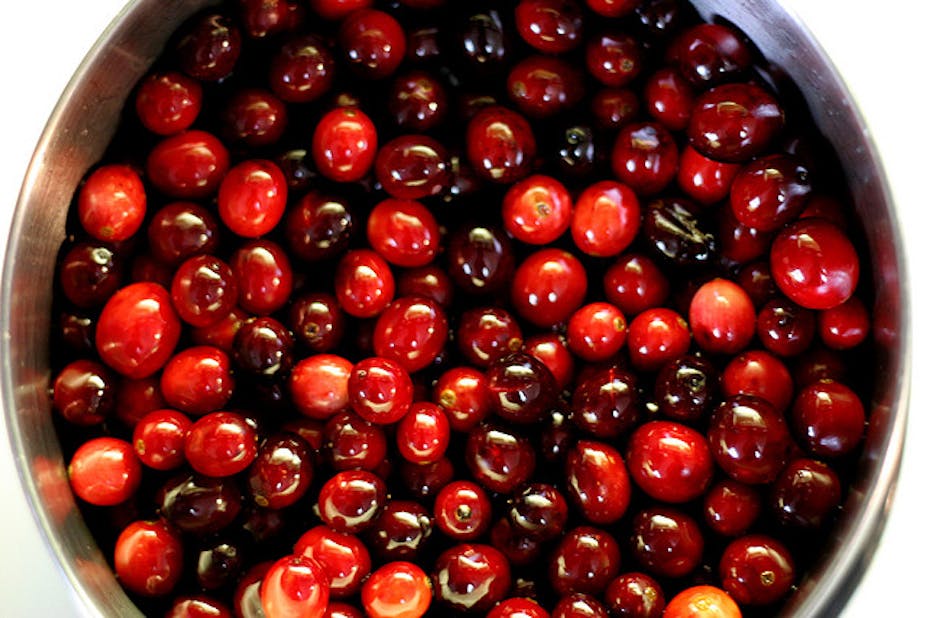
There are good reasons why cranberry products could work, but the weight of scientific evidence shows cranberry products are ineffective for preventing UTIs. Flickr/Half Chinese

You might eat them in a sauce alongside your Christmas turkey or drink them juiced, perhaps with a shot of vodka. But the sweet, tart cranberry is also well known as a remedy for preventing urinary tract infections (UTIs).

Cystitis – an infection and inflammation of the lining of the bladder – is the most common form of UTI, with symptoms including:

  • the frequent urge to pass urine
  • a stinging or burning sensation when passing urine
  • smelly urine
  • cloudy or blood urine
  • pain in the low abdomen or pelvis.

This condition occurs frequently in women, with one in three experiencing cystitis at least once in their life. As a general practitioner, it would be unusual for me to not see a case of cystitis most weeks. In most cases, cystitis is easily treated with a course of antibiotics.

As a folk remedy with a long history among Native Americans, cranberry juice was dismissed for years by the medical establishment. But this changed in the 1980s and 1990s when it was discovered that cranberry juice contained chemicals that seemed to stop E. coli (the most common bacteria causing UTIs) from sticking to the lining of the bladder.

Conceptually, if bacteria cannot attach to the bladder lining, then it would be flushed out with the urine and thus not cause an infection.

This thinking has been popularised in the last couple of decades. Cranberry juice and capsules have been widely recommended and promoted as a treatment for preventing bladder infections, particularly for women who suffer from recurrent infections. Health literature aimed at consumers, including high-quality sources, often advise that cranberry products can be used to reduce the frequency of UTI episodes.

Research into cranberry juice and UTIs is still underway. ArunKamaraj

In such a setting, it would be natural to believe that cranberry products were a proven therapy! Indeed, I was taught in medical school that cranberry was effective, and have personally prescribed it for my patients in the past.

Curiously, although there appears to be good scientific reasons why cranberry products could work in preventing UTIs, evidence that it does in real patients has been rather murky.

A 2009 Cochrane Library systematic review, which independently analysed all the available evidence, noted that there was some evidence that cranberry products might work, but it wasn’t clear what the “optimum dosage or method or administration” was.

The large number of dropouts from the available trials also suggested that it might not have been an acceptable treatment over a longer period of time.

This review was updated in October 2012 with the inclusion of newer and larger studies. Disappointingly, this revised appraisal of the empirical evidence seems to suggest that cranberry does not reduce the likelihood of a recurrence of UTIs in women.

I doubt that we have heard the last word on cranberry and there are studies in the pipeline.

But the weight of evidence, especially those from larger and better-designed trials, points towards the likelihood that cranberry products are ineffective for preventing UTIs.

Join the conversation

43 Comments sorted by

  1. Sue Ieraci

    Public hospital clinician

    Thanks for the succinct summary, Michael.

    This issue illustrates the difference between test-based outcomes and patient-based outcomes. Cranberry juice appeared to have some effect in the lab on microorganism adherence, but this has not translated into an improved clinical outcome for patients.

    We need to be wary about the translation of test-based outcomes (eg effects on microorganisms in the lab, effect on a blood test result or blood pressure reading) vs actual patient outcomes - such as less infections, less strokes etc.

    report
  2. Laurie Willberg

    Journalist

    More sophisticated health readers are already using d-mannose (the active ingredient in cranberry) to successfully CURE urinary tract infections. This article is too little too late, and I'd discount it based on the number of studies not included for whatever reason and that because of "high dropout rate" proper data couldn't even be collected.
    I note that the Cochrane study indicates that the effectiveness of antibiotics was just as poor.
    What's the take home message? Don't bother trying anything because nothing works?

    report
    1. Dave Hawkes

      Research Officer (Viral tools and Neuropeptides) at The Florey Institute of Neuroscience and Mental Health

      In reply to Laurie Willberg

      Hi again Laurie, Yet another broad statement with no cited evidence to back it up. Could you please demonstrate where in the 2009 Cochrane study the author's say that "the effectivessnes of antibiotics was just as poor" as cranberry products? The Cochrane Review included "All randomised controlled trials (RCTs) of cranberry juice (or derivatives) versus placebo, no treatment or any other treatment. Quasi-RCTs (e.g. those trials which randomised participants by date of birth, or case record number) were included, but the quality of the trials was taken into account during the analysis and discussion. Both parallel group and cross-over design were included." this seems like an appropriate group of studies to include and any studies not meeting these standards would most likely be severally compromised.

      report
    2. Laurie Willberg

      Journalist

      In reply to Dave Hawkes

      Just read the Cochrane study, Dave. It's right there in black and white.
      Just like any other research paper, there are assumptions about what to include and what not to. This isn't "exact" science.

      report
    3. Dave Hawkes

      Research Officer (Viral tools and Neuropeptides) at The Florey Institute of Neuroscience and Mental Health

      In reply to Laurie Willberg

      Again, I simply asked for you to cite where it says in the Cochrane study "the effectivessnes of antibiotics was just as poor" as cranberry products. Coming back with "it's right there in black and white" is not a citation or quote just a meaningless phrase. What part of my request is unclear. As I also said in my previous comment the authors state what they included and it is pretty obvious why (if studies were not placebo controlled the data would be almost impossible to analyze, ditto for randomized etc). Just because you don't like the results doesn't mean the study is flawed Laurie. Next time you reply try and actually address the question with facts not just you opinion.

      report
    4. Michael Tam

      Lecturer in Primary Care and General Practitioner at University of New South Wales

      In reply to Laurie Willberg

      D-mannose - there is no research of this substance in treating UTIs. Moreover, the "active ingredient" in cranberry is proanthocyanidin: http://en.wikipedia.org/wiki/A_type_proanthocyanidin

      Furthermore, the important part of the Cochrane review in comparing cranberry to antibiotics for the prevention of repeat symptomatic UTI in women is "Analysis 2.1.1" (search for that term here: http://onlinelibrary.wiley.com/doi/10.1002/14651858.CD001321.pub5/full";). A little bit disappointing with some…

      Read more
    5. Laurie Willberg

      Journalist

      In reply to Dave Hawkes

      You have to see the updated study. It says "Cranberry products (such as tablets or capsules) were also ineffective (although had the same effect as taking antibiotics), possibly due to lack of potency of the 'active ingredient'.
      You obviously didn't reference the update. Cranberry "had the same effect as taking antibiotics".
      Are we clear now?

      report
    6. Laurie Willberg

      Journalist

      In reply to Michael Tam

      Bar-Shavit Z, Goldman R, Ofek I, Sharon N, Mirelman D. Mannose-binding activity of Escherichia coli: a determinant of attachment and ingestion of the bacteria by macrophages. Infect Immun. 1980;29:417-424.

      Bouckaert J et. al. Receptor binding studies disclose a novel class of high-affinity inhibitors of the Escherichia coli FimH adhesin. Mol Microbiol 2005 Jan; 55(2):441-55.

      Ofek I, Beachey EH. Mannose binding and epithelial cell adherence of Escherichia coli. Infect Immun. 1978;22:247-254.

      Ofek I, Goldhar J, Eshdat Y, Sharon N. The importance of mannose specific adhesins (lectins) infections caused by Escherichia coli. Scand J Infect Dis Suppl. 1982;33:61-67.

      report
    7. Michael Tam

      Lecturer in Primary Care and General Practitioner at University of New South Wales

      In reply to Laurie Willberg

      These are not clinical studies Laurie.

      That was one of the points of my article. Anti-adhesion substances in cranberry (and other berries like blueberries) has been widely examined in the laboratory. There is no doubt that they seem to have an effect on E. coli adhesion. On this basis, what we now know to have been overly optimistic clinical recommendations were made.

      It is not enough for a treatment to have a theoretical basis to work. It needs to be demonstrated to work in real patients, in realistic settings. Cranberry as a whole substance, and proanthocyanidin as a measured substance has been tested clinically. It doesn't seem to work.

      D-mannose, as far as I can tell, has not actually been tested in a clinical trial.

      report
    8. Dave Hawkes

      Research Officer (Viral tools and Neuropeptides) at The Florey Institute of Neuroscience and Mental Health

      In reply to Laurie Willberg

      Thank you. As I said before all I wanted was for you to use a quote which you have done so again thank you. The point I was trying to make is that it has taken three comments to get you to post an actual reference to something you were saying. I note that you still have not addressed why you think the authors of the Cochrane review unfairly excluded some studies. I am also wondering why you feel the need to go on the attack when someone questions you.

      report
    9. Laurie Willberg

      Journalist

      In reply to Michael Tam

      Everyday reports from patients are positive, so common sense and a plausible mechanism of action supports the reports that it works. Patients aren't interested in someone pontificating about whether or not it's been tested in a formal clinical trial. They go to the health food store, buy some, and have complete respite within 48 hrs.
      You are likely not a primary health care provider and certainly not one who works with natural remedies. The fact that it HAS worked in many clinical studies to date isn't sufficient reason to dismiss it based on one analysis. Real world patients use products that have worked for others based on personal testimonials. They don't buy through "argument".
      I know people who experienced recurring UTIs. They took antibiotics and were back at the doctor's office a month later with the same problem. D-mannose finally got rid of the problem.
      So why don't you conduct a properly designed clinical trial and put it to the test yourself?

      report
    10. Michael Tam

      Lecturer in Primary Care and General Practitioner at University of New South Wales

      In reply to Dave Hawkes

      Actually, I am a primary health care provider. Furthermore, if we are going to play the game of one-upmanship, may I suggest that I have seen vastly more people with urinary tract infections that you have.

      Personal testimonials and anecdotes are a form of evidence. But we know that they are not reliable due to a whole host of cognitive biases. This is the whole point of scientific inquiry.

      report
    11. Laurie Willberg

      Journalist

      In reply to Michael Tam

      I doubt that someone who is experiencing the pain and suffering of a UTI is a candidate for "cognitive bias" when the symptoms subside! What is your experience of those with a UTI infection who spontaneously experienced a remission without intervention? What is your experience of those who have returned with recurring infections? How many patients have you cured and with what? Why would you have a problem with patients being cured without antibiotics? What else have you got when they don't work…

      Read more
    12. Michael Tam

      Lecturer in Primary Care and General Practitioner at University of New South Wales

      In reply to Laurie Willberg

      (1) Many people with lower urinary tract infection symptoms will in fact spontaneously experience remission. This happens "accidentally" in some cases - by the time the patient can come in for an appointment, their symptoms had already subsided. Some of these episodes are not in fact, bacterial cystitis. Some of these episodes may have been (women did get better from UTIs prior to the discovery of antibiotics).

      (2) As mentioned in the article, it will be a rare week that I don't see one or…

      Read more
    13. Laurie Willberg

      Journalist

      In reply to Michael Tam

      1. If you weren't able to take a culture to determine what these women actually had, how can you scientifically conclude they had a UTI?
      2. Simple UTIs at the time, how can you conclude these did not become recurrant?
      3. How do you deal with bacterial resistance? Why didn't the patient finish the treatment?
      4. Biofilms are the usual reason antibiotics didn't work. Next time try d-mannose.
      5. Cranberry is a suggestion for prevention, not cure, which is where we're at in the discussion right now…

      Read more
    14. Dave Hawkes

      Research Officer (Viral tools and Neuropeptides) at The Florey Institute of Neuroscience and Mental Health

      In reply to Laurie Willberg

      Laurie, Why do you post so many comments attacking other peoples positions with no evidence to support it. Michael Tam has had the patience to reply in detail to your comments and then you reply with more moving of the goalposts with a touch of the nirvana fallacy. You got snarky and said "You are likely not a primary health care provider" which if you looked up his profile on The Conversation you would know his qualifications and job. However your profile is lacking with detail, in fact what are your qualifications as a medical practitioner and how many people with UTI's have you treated? I don't expect these questions answered but I think they are relevant when you make statements such as "ou're left with the notion of prescribing antibiotics as a prevention for UTIs. That's nonsense"

      report
    15. Sue Ieraci

      Public hospital clinician

      In reply to Laurie Willberg

      "I know people who experienced recurring UTIs. They took antibiotics and were back at the doctor's office a month later with the same problem. D-mannose finally got rid of the problem. "

      Dr Willberg, can you please show your data, including the lab results for all those people, and the cure rate? What organisms did they have? Or did they have non-infective cystitis?

      report
    16. Sue Ieraci

      Public hospital clinician

      In reply to Laurie Willberg

      Laurie Willberg cites a list of references for "more sophisticated health readers." When shown that those references don't say what she thinks they say, she counters with "Everyday reports from patients are positive, so common sense and a plausible mechanism of action supports the reports that it works. Patients aren't interested in someone pontificating about whether or not it's been tested in a formal clinical trial. "

      WHich is it, Laurie Willberg, evidence or anecdote.

      More sophisticated health readers are more interested in evidence.

      report
    17. Mark Amey

      logged in via Facebook

      In reply to Laurie Willberg

      You do realise that the mannose we consume in our diet is rapidly converted to Glucose -6-phosphate, and fructose-6-phosphate then enters the glycolytic pathway. None is secreted/excreted into the urine.

      report
  3. Debra Joan Smith

    Account Executive

    Thank you. This is exactly what consumers like me need. I was influenced by this concept and drank cranberry juice at the first inkling of UTI. It turns out that while i am not much of a juice drinker, I like the stuff but i do not wish to promote myths.
    Thus, I will think more diligently about this and that is what i hope any good piece of writing or research does for me- make me think harder and I appreciate your information and efforts here.

    report
    1. Michael Tam

      Lecturer in Primary Care and General Practitioner at University of New South Wales

      In reply to Debra Joan Smith

      Thanks for the feedback Debra!

      For the most part, cranberry juice is safe (though it can interact with some medications such as warfarin). What I usually tell my patients who ask me about cranberry juice is that they should drink it if they like it, but it probably makes no meaningful difference to UTI recurrence.

      One of the interesting findings in Barbosa-Cesnik (2011) (http://cid.oxfordjournals.org/content/52/1/23) which I linked above is that that cranberry juice worked no better than a…

      Read more
    2. Debra Joan Smith

      Account Executive

      In reply to Michael Tam

      Thank you for the additional information and my experience is consistent with your thoughts. I think drinking more fluids does help to flush it out in my own case and in truth, while cranberry juice or drinking more fluids does seem to help my symptoms diminish- I have never in my 57 years of life defeated a bladder infection- which i fortunately get very seldomly- on my own.I have always needed a perscription to deal with it completely. In fact, I usually only resort to the cranberry measures when I get one which starts on a weekend - when my doctor's office is closed.

      report
  4. Michael Lardelli

    logged in via Facebook

    Of course, if you drink cranberry juice continuously then you will be selecting for bacteria that are able to withstand the inhibitory effects of the juice on binding of bacteria to the bladder lining. (Just like continously taking a low dose of antibiotic will select for antibiotic resistance.) So maybe cranberry juice is better used for acute cases of infection and not as a preventative?

    report
    1. Michael Tam

      Lecturer in Primary Care and General Practitioner at University of New South Wales

      In reply to Michael Lardelli

      That's a good thought there Michael. Unfortunately, we don't have any evidence on whether cranberry works effectively as an acute treatment for UTIs. The Cochrane Collaboration tried to conduct a systematic review on this very topic and there were NO studies that fulfilled their inclusion criteria (review up-to-date to July 2010). They did note that there were two studies underway. http://onlinelibrary.wiley.com/doi/10.1002/14651858.CD001322/abstract

      My prediction, however, is that it is unlikely that cranberry will be useful, EVEN IF it were effective. When appraising a new treatment, we shouldn't be just interested in whether it works at all (though clearly that's a given), but whether it is as good or better than an established treatment. Antibiotics work particularly well for urinary tract infections.

      report
    2. Laurie Willberg

      Journalist

      In reply to Michael Lardelli

      You are assuming that anyone who drinks cranberry juice will be likely inadvertently transferring E. coli where it shouldn't be...
      Let's first ask the question, how does E. coli get into the urinary tract in the first place? It's actually pretty simple to avoid UTI infections with proper hygiene.
      I suspect most people don't care for the taste of sour cranberry juice, which is why most people dropped out of various studies.

      report
    3. Michael Tam

      Lecturer in Primary Care and General Practitioner at University of New South Wales

      In reply to Laurie Willberg

      Some women seem to be more prone to developing UTIs than others. Yes, meticulous attention to genital hygiene is helpful but it is rather condescending to those who suffer from recurrent UTIs that "it is actually pretty simple to avoid... with proper hygiene".

      report
    4. Laurie Willberg

      Journalist

      In reply to Michael Tam

      UTI's don't just materialize out of nowhere, Michael. I am not being condescending at all. Medical practitioners need to educate their patients nonetheless.

      report
    5. Sue Ieraci

      Public hospital clinician

      In reply to Laurie Willberg

      Laurie Willberg must never have heard of wiping from the front backwards or urinating after vaginal sex. Or of "honeymoon cystitis".

      I guess they don't teach that stuff in journalism school...

      report
    6. Sue Ieraci

      Public hospital clinician

      In reply to Mark Amey

      Naturopathy at least has elements of scientific feasibility, Mark. Not so homeopathy, for which Laurie is an enthusiatic proponent.

      report
    7. Mark Amey

      logged in via Facebook

      In reply to Sue Ieraci

      Thanks, Sue, I stand corrected.

      This forum seems quite calm after the last one, doesn't it?

      report
    8. Chris Saunders

      retired

      In reply to Mark Amey

      Dear Michael,

      Definitely with you on the importance of the water ingredient, the more flushing the more comfortable one becomes ( a diluting effect) plus if swallowing cranberry juice besides being more interesting than plain water you are with the zeitgeist: it seems apparently absolutely everyone knows cranberry juice works, then you gain something of the placebo effect. I’ve fortunately only had one case of UTI, but it did not go after two courses of antibiotic with a couple of day’s abstinence…

      Read more
    9. Sue Ieraci

      Public hospital clinician

      In reply to Chris Saunders

      Hi, Chris

      Urinary tract infections are primary infections - they are not transmitted between people. They are more common in women because of the very anatomy that you describe. There would be very few women reaching older age without having had one.

      The other group that are prone to UTIs are elderly men, in whom a growing prostate causes blockage, and retention of urine in the bladder - leading to increased risk for infection. The most common organism is Eschericia Coli - a bowel organism.

      report
    10. Sue Ieraci

      Public hospital clinician

      In reply to Laurie Willberg

      Michael Tan, a practising generalist clinician who has probably helped thousands of people with UTIs, has presented a concise and clear review of the evidence on this topic.

      Laurie Willberg, a non-clinician who has never helped anyone with a UTI, let alone studied the clinical sciences, nor has even a basic understanding of infectious diseases or bacteriology, or urology, jumps in to criticise and argue.

      What is it that makes some people behave in this way? Is it some sort of resentment? Why keep pontificating in an area where you have no expertise? What does it achieve, other than displaying your lack of expertise in public?

      report
    11. Chris Saunders

      retired

      In reply to Sue Ieraci

      Thanks Sue,
      But it still raises a few questions. How does Eschericia Coli from the bowel get into the male urinary tract? And why can’t that explanation apply to females?
      And if in the male, UTIs are caused by urine retention, why is this then not the case in women especially when prolapse of the bladder is so common and is known to lead to urinary retention. Women with cystocele do complain of recurrent UTIs and the solution seems to be to conscientiously empty the bladder.

      report
    12. Mark Amey

      logged in via Facebook

      In reply to Chris Saunders

      'But it still raises a few questions. How does Eschericia Coli from the bowel get into the male urinary tract? And why can’t that explanation apply to females?'

      I think it may well be poor hygiene. I can't quote any studies ( just woke up from nightshift, and still in a blur), but hand hygiene is often poor, with hand washing rates as low as 30% after using the toilet. Sounds exist, but women do tend to have better hand hygiene than men, but, yes it is plausible that this is the cause f infection in women.

      Bear in mind that in some public toilets the taps/basin appear as dirty as the urinal!

      report
    13. Chris Saunders

      retired

      In reply to Mark Amey

      Ok, so let’s pretend I am a man, I have visited the toilet and have the Escheria Coli on my hands? How does it then get into my urinary tract?

      report
    14. Sue Ieraci

      Public hospital clinician

      In reply to Chris Saunders

      Hi, Chris,

      Urinary retention is much less common in women than in men. By far the most common cause of urinary obstruction is an enlarged prostate in elderly men. This is much more common than cystocele in women: almost all elderly men have some benign prostate enlargement.

      The source of the E Coli is the bowel, with entry via the urethra. In men, the entry to the bladder is more difficult due to the length of the urethra. Small amounts of organisms entering the urinary system would normally be flushed by the flow or urine. IN the setting of obstruction and a bladder full of stagnant urine, the organisms can multiply.

      report
    15. Sue Ieraci

      Public hospital clinician

      In reply to Chris Saunders

      Chris - the E Coli are in small numbers on the perineum (area between urethra and anus). If they enter the bladder and there is stagnant urine, they multiply.

      report
    16. Chris Saunders

      retired

      In reply to Sue Ieraci

      Dear Sue, I most appreciate your replies, but wonder about the effects of pelvic organ prolapse on the Australian female population. With 30,000 hysterectomies a year, I don’t think the number of cystoceles would be small.
      Have I got it right yet? If you have a UTI, it is probably due to the fact of incomplete urination which means the usual constant flushing of the always present E Coli does no longer prevent its multiplying in the urethra and the pooled non shifting urine in the bladder provides ideal conditions.
      With the female anatomy, the process of the march of E Coli appears a short simple journey, but in the male anatomy, it does not seem simple at all. And in the case of old men with prostate enlargement would not a dribble do the job?
      What protects babies in nappies?

      report
    17. Sue Ieraci

      Public hospital clinician

      In reply to Chris Saunders

      Chris, the problem in women is the short distance from the outside into the bladder, due to a short urethra (as you described)."The infection occurs when the organisms move from the perineum, through the urethra and into the bladder. It is the flushing/emptying of the bladder that helps dilute the organisms - not flushing the urethra.

      For men, UTIs are much less common UNTIL prostatic obstruction causes pooling/stagnation of urine in the bladder, which allows the organisms to multiply. UTIs in…

      Read more